.png)
ALCOA is an acronym FDA guidance uses to describe what makes a record trustworthy: Attributable, Legible, Contemporaneous, Original, and Accurate. The extended version, ALCOA+, adds four more expectations — Complete, Consistent, Enduring, and Available — for a nine-principle framework. It didn't originate in food safety: FDA's Data Integrity and Compliance With Drug CGMP guidance defines and anchors data integrity to ALCOA for pharmaceutical manufacturing records. Food safety and quality teams have picked it up as a practical checklist as more HACCP, FSMA, and traceability recordkeeping moves off paper and into software.
The nine ALCOA+ principles
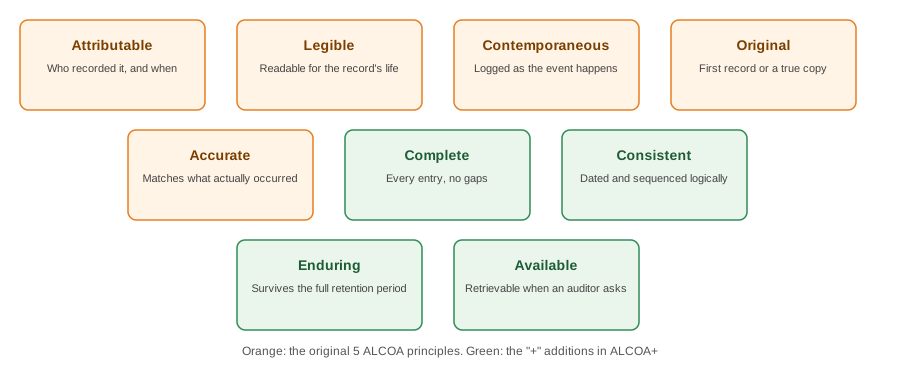
- Attributable — the record shows who created or changed it, and when.
- Legible — readable for as long as the record needs to be kept, not just at the moment it's written.
- Contemporaneous — logged at the time the event actually happened, not reconstructed afterward.
- Original — the first recording of the data, or a verified true copy.
- Accurate — the record actually reflects what occurred, free of transcription or calculation errors.
- Complete — every entry and any reprocessing or repeat testing is captured, not just the passing result.
- Consistent — entries are dated and sequenced in the order events actually occurred.
- Enduring — the record survives intact for its full required retention period.
- Available — retrievable for review or audit whenever it's needed, not archived somewhere no one can reach.
Why this matters for FSMA and HACCP records specifically
None of FDA's food safety regulations use the word "ALCOA" directly. But the underlying expectation — that FSMA recordkeeping be attributable, accurate, and retrievable within 24 hours — is functionally the same standard ALCOA describes, and FSMA 204's move toward electronic traceability records raises the same questions pharma manufacturers have dealt with for longer: who touched this record, when, and can you prove it wasn't altered after the fact. A monitoring log that's edited after a shift, a corrective action that isn't dated until days later, or a shared login where three people enter data under one name would all fail ALCOA's attributable and contemporaneous tests — and would likely draw the same nonconformance from a food safety auditor reviewing the same record.
Where ALCOA compliance actually breaks down on paper
In practice, the gaps aren't dramatic. They're the small habits that build up: a blank cell filled in from memory at the end of a shift instead of in real time, corrections made with whiteout instead of a single line-through and initials, a corrective action recorded on a sticky note and never linked back to the batch it affected, or records kept in a binder that's hard to produce quickly when an auditor asks. Electronic systems don't automatically fix this — a system that lets anyone backdate an entry or edit a submitted record without a trace has the same integrity problem as a paper log, just with a cleaner font.
Where IONI fits
Timestamped entries, locked submissions, and a visible audit trail on every monitoring log and corrective action are what turn a record from "looks fine" into something that actually holds up under ALCOA's attributable and contemporaneous tests. See how IONI keeps food safety records audit-ready and traceable back to who entered them and when.
Frequently asked questions
Is ALCOA a food safety regulation?
No. ALCOA comes from FDA's pharmaceutical data integrity guidance for drug CGMP records. It isn't cited by name in FSMA or HACCP regulations, but the same underlying expectations — accurate, attributable, retrievable records — apply to food safety recordkeeping.
What's the difference between ALCOA and ALCOA+?
ALCOA covers five original principles: Attributable, Legible, Contemporaneous, Original, Accurate. ALCOA+ adds four more: Complete, Consistent, Enduring, and Available.
Do food manufacturers need to follow ALCOA?
It isn't a legal requirement for food manufacturers the way it is for pharmaceutical CGMP records, but it's a useful, increasingly-referenced framework for evaluating whether HACCP and FSMA records would hold up under audit scrutiny.
Can electronic records automatically satisfy ALCOA?
Not automatically. An electronic system only satisfies ALCOA if it actually enforces the principles — timestamped, attributable entries, a real audit trail, and no ability to silently backdate or overwrite a submitted record.