.png)
Last updated: October 2026 · By Alex Uspenskyi
BRCGS certification is proof that a food site meets the BRCGS Global Standard for Food Safety, a GFSI-benchmarked standard retailers use to approve suppliers. A certification body audits the site against the standard, currently Issue 9, and awards a grade from AA to D (with a "+" when the audit was unannounced). BRCGS is developing Issue 10 but, as of October 2026, has not published a release date.
If your buyer just required BRCGS certification and you only started researching it this week, you are not behind. Many small and mid-sized food manufacturers reach this point because a retailer, distributor, private-label customer, or food service account makes certification a condition for doing business.
Choosing the wrong standard for your customer base, or preparing without knowing the minimum grade your buyer expects, can cost months. This guide covers what BRCGS stands for, how grading works, what certification costs, how it compares to SQF, and what to build first.
What Does BRCGS Mean?
BRCGS is the name of the certification scheme and the organisation that owns it; it is the trading name of BRC Trading Ltd, part of LGC ASSURE. The "BRC" reflects the scheme's British retail heritage: it began as a common supplier standard for UK retailers, developed through the British Retail Consortium, and has since grown into a global standard that BRCGS says is adopted by tens of thousands of sites in more than 130 countries. BRCGS uses the line "Brand Reputation through Compliance" as its brand signature, and some certification bodies spell the acronym out as "Brand Reputation through Compliance Global Standards".
In short, BRCGS certification means a site passed an audit against the BRCGS Global Standard for Food Safety. BRCGS is benchmarked by GFSI, which maintains the list of recognised certification programme owners; GFSI itself does not certify anyone.
What BRCGS Is and Why Retailers Require It
When a retailer or brand owner requires BRCGS certification, they are asking for independent third-party confirmation that your food safety management system meets a recognized global standard. It is not a self-assessment or supplier questionnaire. It is a formal audit by an accredited certification body against Issue 9, which was published in August 2022, with certification audits against it starting on 1 February 2023.
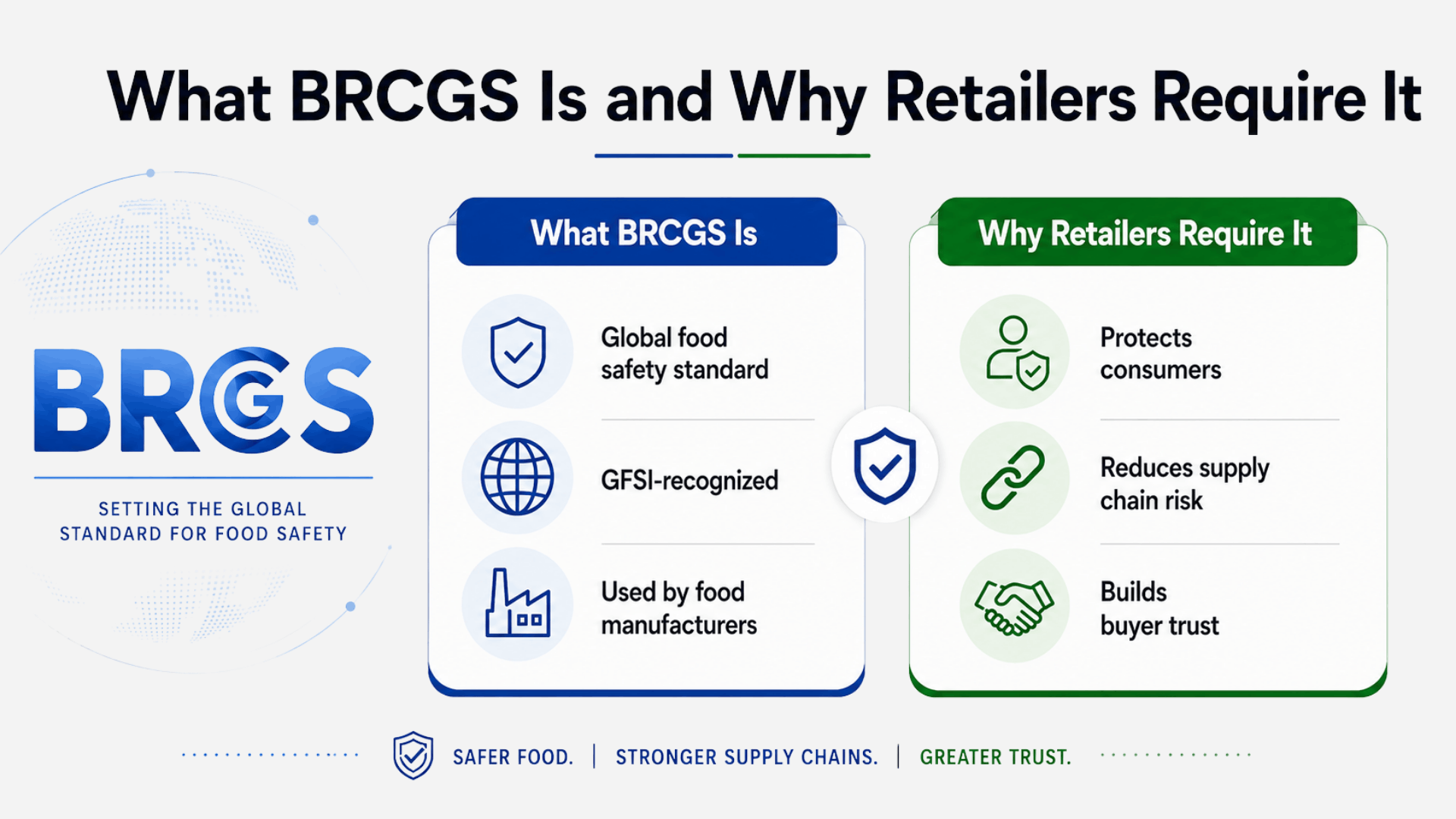
BRCGS is especially common in UK, European, and international private-label supply chains. In North America, it is often required by businesses that export, serve global customers, or supply brands with international retailer relationships. For manufacturers already working on culture documentation, the evidence overlaps with IONI's guide to food safety culture under SQF Edition 10.
BRCGS vs SQF: Which One Do You Actually Need?
Both are GFSI-benchmarked, and a buyer who asks for "GFSI certification" usually accepts a recognized scheme such as BRCGS, SQF, FSSC 22000, or IFS. They overlap on HACCP, management commitment, supplier approval, document control, corrective actions, traceability, internal audits, and training, but differ in how the audit is scored.
| BRCGS Food Safety (Issue 9) | SQF Food Manufacturing (Edition 10) | |
|---|---|---|
| Scheme owner | BRCGS (BRC Trading Ltd, part of LGC ASSURE) | Safe Quality Food Institute (SQFI) |
| GFSI benchmarked | Yes (GFSI recognition of Issue 9) | Yes (see the GFSI list) |
| Common in | UK and EU retail, international private label | North American retail and distribution (buyer-dependent) |
| Grading | Letter grades AA to D, or not certificated (BRCGS Issue 9, Table 2) | Numeric score, 100 minus point deductions (SQFI) |
| Audit frequency | Every 12 months for grades AA, A and B; every 6 months for C and D | Annual recertification; a surveillance audit at six months for lower ratings |
| Unannounced option | "+" added to the grade when the audit was unannounced | Certification body must run an unannounced audit at least once every three years; annual unannounced option available |
| Typical buyers | Retailers and brand owners that name BRCGS | Retailers and brand owners that name SQF |
The first step is simple: check what your buyer actually requires. Some buyers specify BRCGS, some specify SQF, and some accept either but require a minimum grade. If your customers are mainly in US retail and distribution, SQF may be the better fit. If you export to the UK or Europe, support global private-label programs, or your customer named BRCGS, prepare for BRCGS. For the HACCP foundation both rely on, see IONI's article on HACCP vs SQF.
How to Get BRCGS Certified: 7 Steps
- Choose your scope. Confirm product categories, processes, high-care or high-risk zones, traded products, and customer-specific requirements.
- Buy the standard. Get Issue 9 (and the interpretation guideline if you want one) from BRCGS.
- Run a gap analysis. Compare your HACCP plan and procedures to every requirement that applies.
- Build and close the gaps. Start with HACCP, the 12 fundamental clauses, and document control, then start collecting records.
- Pick an accredited certification body. See the next section; the BRCGS Directory lists certificated sites.
- Sit the audit. A document review and a site audit, including a traceability exercise.
- Close non-conformities and receive your certificate. Corrective action evidence is due within 28 calendar days for the grades that require it, and the grade decides your next audit date.
The detail for each step is in the sections below.
Who Can Certify You: BRCGS Certification Bodies in the US
You cannot self-certify. Certification bodies (CBs) audit you against the standard. These accredited bodies publish BRCGS Food Safety services; confirm US availability and a quote for your site before you choose:
- NSF: certifies to the BRCGS Global Standard for Food Safety.
- LRQA: lists accredited BRCGS Food Safety certification on its US site.
- SCS Global Services: audits to BRCGS Food (US availability to be confirmed with SCS).
- DNV: approved and accredited for the BRCGS Global Standard Food Safety.
- DQS: offers conformity assessment for BRCGS Food (confirm for your US site).
- FSNS Certification & Audit: publishes BRCGS audit pricing (see the cost table).
Use the BRCGS Directory to check how sites are listed once certified.
How the BRCGS Audit Works
The audit has two connected parts: a document review of your food safety management system, and a site audit that checks the system works in production through observation, interviews, and records. It also includes a traceability exercise: the auditor picks a lot and expects you to trace it back to raw materials and forward to customer dispatch, with COAs, production records, rework, and shipping data connecting under time pressure. Sites can choose an unannounced audit, which adds a "+" to the grade. For the full walkthrough of audit day, read what happens in a BRCGS audit.
BRCGS Audit Grades: What They Mean and What They Cost You
The grade depends on the number and severity of non-conformities (NCs) found. The table follows Table 2 of the BRCGS Issue 9 standard. A "+" (AA+, A+, and so on) means the audit was unannounced.
| Grade (announced / unannounced) | Critical NCs | Major NCs | Minor NCs | Re-audit frequency | Note |
|---|---|---|---|---|---|
| AA / AA+ | 0 | 0 | 5 or fewer | 12 months | Evidence for NCs due within 28 calendar days |
| A / A+ | 0 | 0 | 6 to 10 | 12 months | |
| B / B+ | 0 | 0 | 11 to 16 | 12 months | |
| B / B+ | 0 | 1 | 10 or fewer | 12 months | |
| C / C+ | 0 | 0 | 17 to 24 | 6 months | Evidence for NCs due within 28 calendar days |
| C / C+ | 0 | 1 | 11 to 16 | 6 months | |
| C / C+ | 0 | 2 | 10 or fewer | 6 months | Revisit required within 28 calendar days |
| D / D+ | 0 | 0 | 25 to 30 | 6 months | |
| D / D+ | 0 | 1 | 17 to 24 | 6 months | |
| D / D+ | 0 | 2 | 11 to 16 | 6 months | |
| Not certificated | Any critical NC | A major NC against a fundamental clause, or counts above the limits in Table 2 (for example, 31 or more minors) | No certificate; re-audit required | Re-audit no earlier than 28 calendar days after the audit date |
Grades affect commercial access directly. A buyer may accept Grade B for supplier approval but require A or AA for private-label work, and many programs ask for a minimum grade or an unannounced audit. Confirm the requirement before you set the audit date; the exact minimum depends on the buyer, product category, and supply agreement.
The most important point is the 12 fundamental clauses. A major non-conformity against the statement of intent of a fundamental clause means no certificate, regardless of performance elsewhere.
What BRCGS Issue 9 Actually Requires
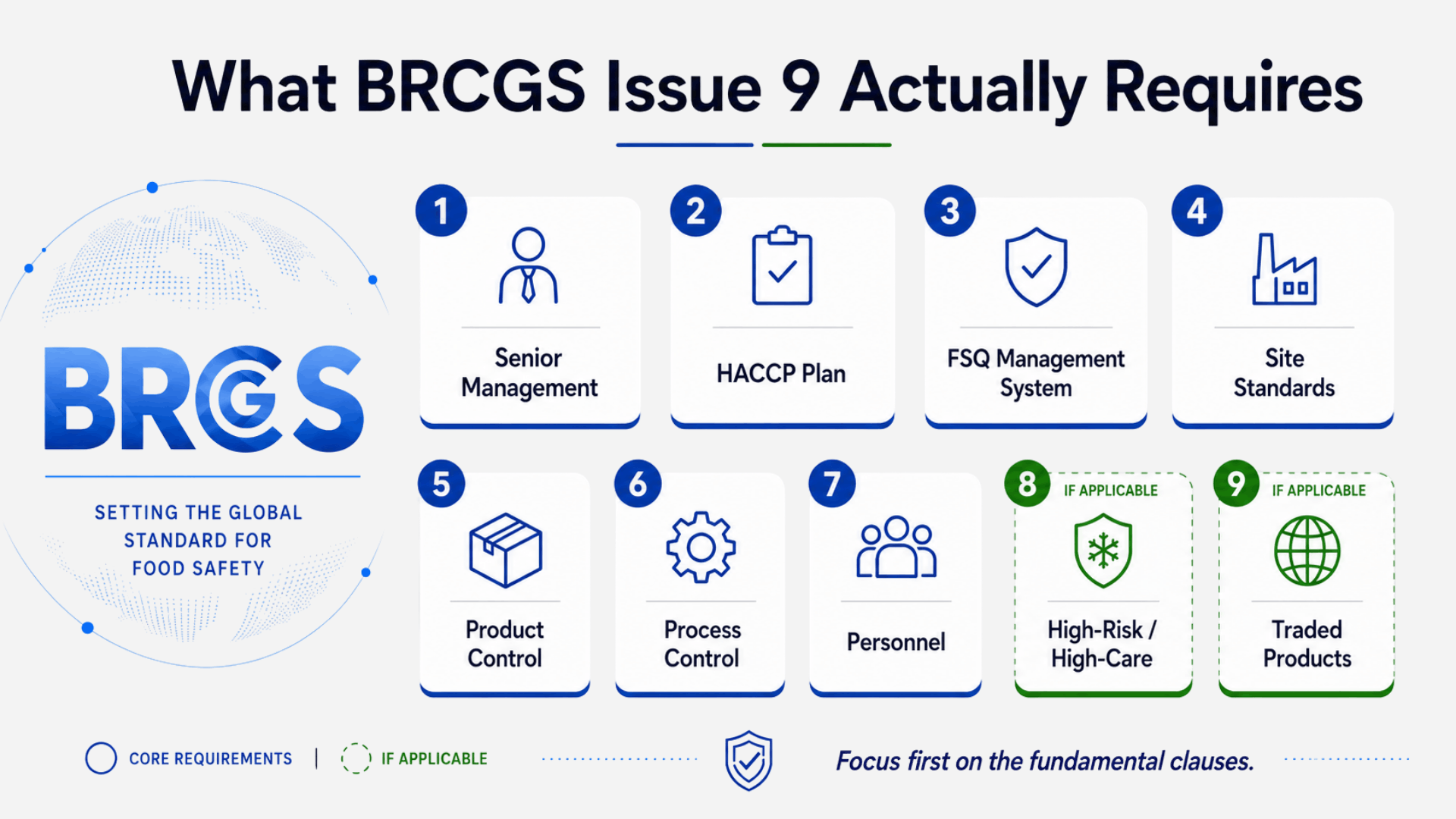
Issue 9 has nine sections: senior management commitment; the food safety plan (HACCP); the food safety and quality management system; site standards; product control; process control; personnel; production risk zones (high risk, high care, and ambient high care); and traded products. Sections 8 and 9 apply only to some sites, so confirm your scope before excluding them. For first-time certification, the fundamental clauses should drive your preparation sequence.
The 12 fundamental clauses
| Clause | Title | What auditors ask for |
|---|---|---|
| 1.1 | Senior management commitment and continual improvement | Food safety policy, objectives, management review with real data, resources, and culture evidence |
| 2 | The food safety plan, HACCP | A current plan covering products, process flow, hazards, CCPs, limits, monitoring, verification, and validation |
| 3.4 | Internal audits | A scheduled programme, trained auditors, findings closed through corrective action |
| 3.5.1 | Management of suppliers of raw materials and packaging | Supplier approval, risk assessment, and monitoring beyond a supplier list |
| 3.7 | Corrective and preventive actions | Root cause, action, owner, due date, and verification of effectiveness |
| 3.9 | Traceability | A tested system that traces backward and forward and reconciles quantities |
| 4.3 | Layout, product flow and segregation | Zoning and flow that prevent cross-contamination |
| 4.11 | Housekeeping and hygiene | Cleaning schedules with verification, not just procedures |
| 5.3 | Management of allergens | Risk assessment, segregation, validated cleaning, and label controls |
| 6.1 | Control of operations | Defined process parameters, monitoring, and corrective action when limits are missed |
| 6.2 | Labelling and pack control | Controls that stop the wrong label or pack reaching the wrong product |
| 7.1 | Training | Evidence of competence for everyone working independently, including temporary and contract staff |
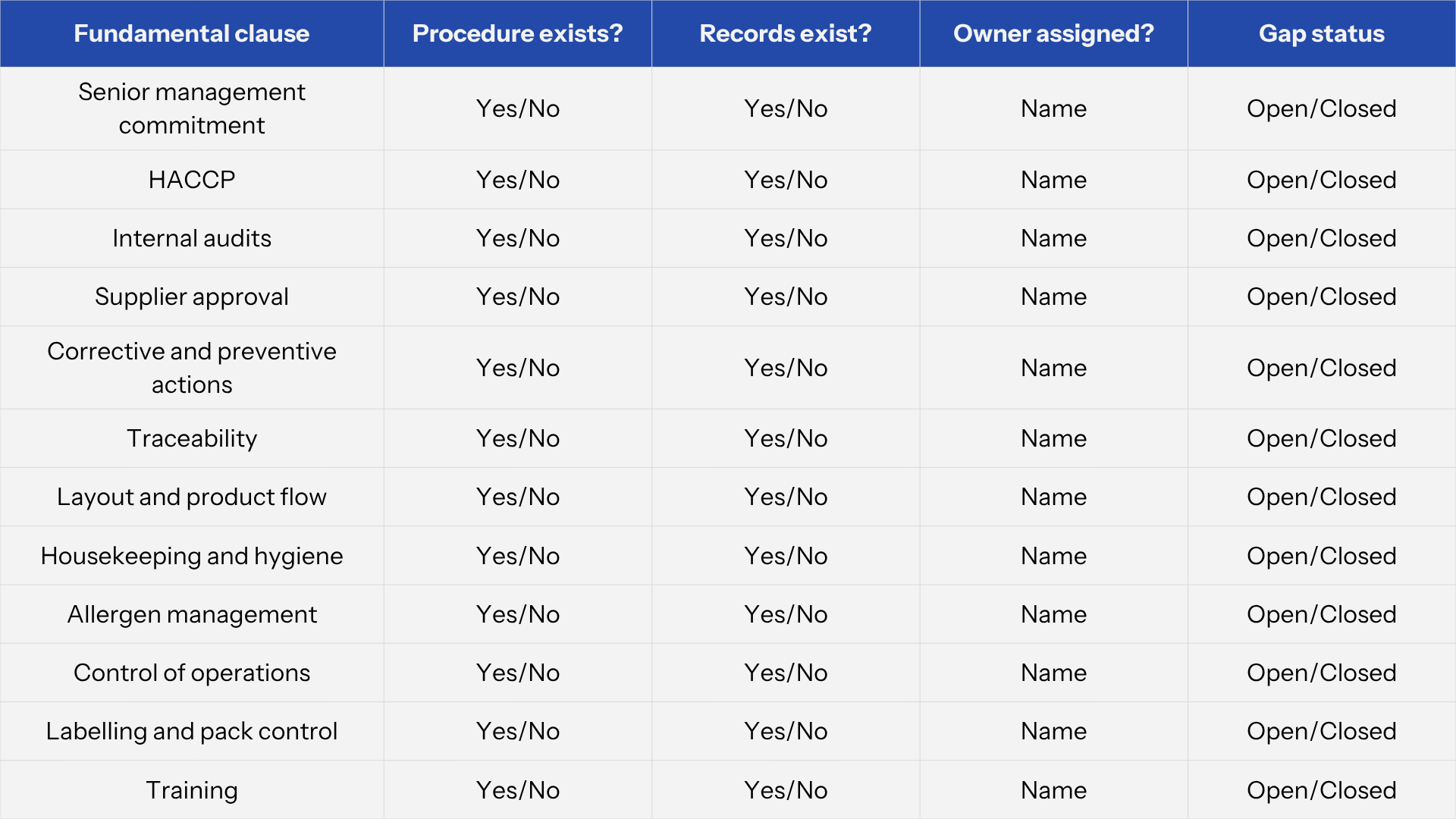
Clause titles follow the Issue 9 structure; check the numbers against your own copy of the standard. Treat each fundamental clause like its own mini-audit: list the procedure, owner, required records, review frequency, and open gaps. For clause 3.9, auditors test traceability on live lots, so make sure supplier, production, and dispatch records connect.
Section 1: Senior Management Commitment
Covers food safety policy, measurable objectives, management review, resources, and food safety culture. Management review should cover performance data, complaints, audit results, non-conformities, incidents, and supplier performance, not just a generic annual meeting.
Section 2: Food Safety Plan, HACCP
BRCGS requires a documented HACCP plan aligned with recognized HACCP principles; the Codex General Principles of Food Hygiene is a key reference. The biggest risk is usually not a missing plan but an outdated one: if products, ingredients, suppliers, equipment, packaging, or intended use changed, the plan must be reviewed.
Section 3: Food Safety and Quality Management System
The backbone: document control, specifications, supplier approval, internal audits, corrective actions, non-conforming product, traceability, complaints, incidents, and recall. Supplier approval is a major audit focus; see IONI's guide to supplier approval minimum requirements, where many of the same evidence principles apply.
Section 4: Site Standards
Facility design, maintenance, cleaning, pest control, waste, calibration, environmental monitoring, and zoning. A common issue is a cleaning procedure with no evidence that it works.
Section 5: Product Control
Allergens, product authenticity, food fraud prevention, product development, packaging, inspection, testing, and release. Allergen management is a fundamental clause, so you need more than a matrix: risk assessment, verified cleaning, label controls, storage and rework controls, and training.
Section 6: Process Control
Operational control, quantity and weight control, and calibration. Auditors look for defined parameters, monitoring records, corrective actions when limits are missed, and calibrated equipment.
Section 7: Personnel
Training applies to permanent, temporary, seasonal, and contractor staff. A signed sheet is not always enough: the record should show what was trained, when, by whom, how competence was checked, and when refresher training is due.
Sections 8 and 9: High-Risk and Traded Products
Section 8 applies to high-risk, high-care, and ambient high-care production environments. Section 9 applies to traded products. Confirm your scope against product categories, process type, and customer expectations.
How Much Does BRCGS Certification Cost?
Costs vary by site size, scope, and certification body, so treat these as reference points and get quotes. The figures below are published by one certification body, FSNS (2026); audit fees are set by each certification body. Total spend also depends on the corrective work your gap analysis uncovers.
| Cost item | Typical US range | Source / note |
|---|---|---|
| Buying the standard (Issue 9) | About $177 | FSNS, 2026 |
| Interpretation guideline (optional) | About $237 | FSNS, 2026 |
| Pre-assessment or pre-audit (optional) | About $6,000 | FSNS, 2026 |
| Certification audit | About $7,000 | FSNS, 2026; scales with site size, scope, and audit days |
| Auditor travel | Billed on top of the audit fee | FSNS, 2026 |
| Consultant (optional) | – | No published benchmark; varies widely |
| Software (optional) | – | Varies by vendor |
| Rough all-in total | Around $13,000+ | FSNS, 2026 estimate for the standard, pre-audit, and audit |
BRCGS Certification Timeline: How Long Does It Take?
The fixed constraint is operational records, not document writing. You can write procedures quickly, but you cannot create credible historical evidence overnight. The ranges below are practical estimates, not BRCGS requirements.
| Starting condition | Realistic time to first certificate |
|---|---|
| Existing HACCP plan, SOPs, and active records | 3 to 5 months |
| Existing HACCP plan, incomplete SOPs | 5 to 8 months |
| No formal food safety management system | 9 to 12 months |
| Already SQF certified | 2 to 4 months |
A 90-day record window is a practical rule of thumb for many first-time projects, covering CCP monitoring, sanitation verification, receiving checks, COA reviews, calibration, corrective actions, complaints, internal audits, and traceability tests. Teams usually lose time in three places: HACCP and documentation take longer than expected, records start too late, and the internal audit and CAPA happen too close to the certification audit. A pre-certification internal audit 6 to 8 weeks before the site audit leaves time to fix issues and show closure. IONI's SQF audit checklist applies the same evidence logic.
What BRCGS Auditors Look For and Where Small Manufacturers Fail
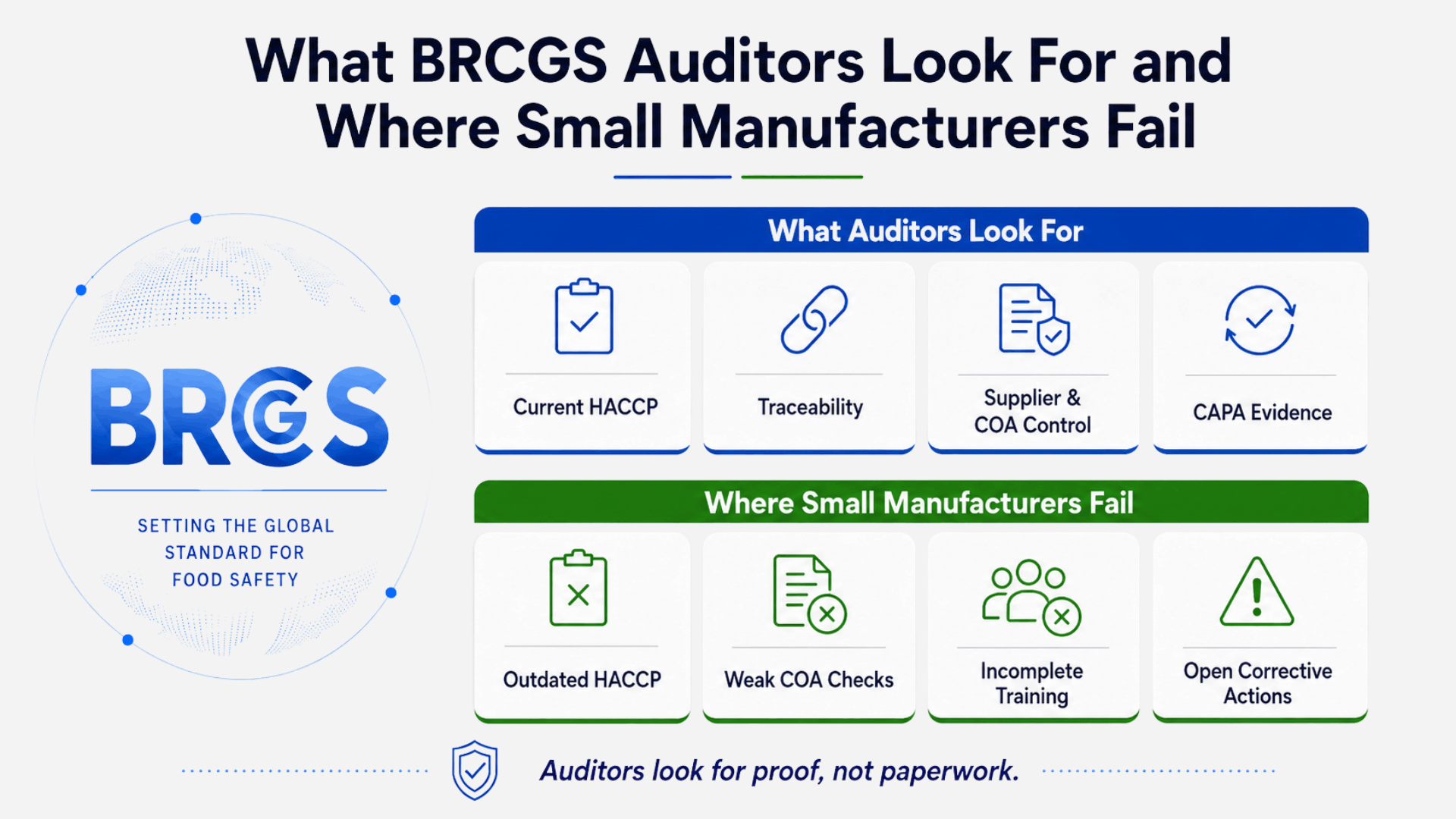
HACCP Plan Not Current
The plan exists but does not reflect current ingredients, suppliers, flow, equipment, packaging, or allergens. Tie HACCP review to change management so a new supplier or line triggers a review before production.
Major NC Against a Fundamental Clause
Sites prepare across all nine sections but build weak evidence for the fundamental clauses. Build a separate evidence map for the 12 clauses with procedure, owner, records, review frequency, and open gaps.
Traceability Exercise Fails Under Pressure
Traceability is a live test of whether daily records connect. Auditors may pick an older lot, a partial lot, or a product with rework. If records are split across binders, spreadsheets, and email, the exercise drags. In the US, the FDA's FSMA Food Traceability Rule also requires additional traceability records for certain foods; see IONI's guide to FSMA 204.
Allergen Cleaning Is Not Verified
A procedure is not proof. The auditor expects evidence the cleaning works, such as visual inspection, swabbing, ATP, or allergen-specific testing, and label control that stops the wrong label reaching the wrong product.
Training Records Do Not Cover All Staff
Records often cover permanent staff but miss temporary, agency, or contract personnel working independently. Every person needs training before independent work, with topic, date, trainer, assessment, and refresher requirement.
COA Filed but Not Checked
A COA in a folder is not enough. Auditors look for evidence it was reviewed against the approved specification: supplier lot, internal lot, parameters, limits, actual results, pass or hold decision, reviewer, and date.
What to Build First: A Practical Sequence
This is the detail behind steps 3 and 4 above. The fastest way to fail a BRCGS audit is not a missing binder or a formatting issue; it is a major non-conformity against one of the 12 fundamental clauses, so prepare each as if it were its own audit.
Confirm Scope and Applicable Clauses
Confirm product categories, process types, storage conditions, traded products, high-care or high-risk status, and customer requirements. Do not build documents for requirements that do not apply, and do not miss ones that do.
Gap Your HACCP Plan Against Issue 9
Review the plan against current products, ingredients, allergens, flow, equipment, suppliers, packaging, and intended use. An AI-assisted gap analysis against BRCGS Issue 9 can speed up this comparison.
Map the 12 Fundamental Clauses
Create a matrix per clause: procedure, owner, required records, review frequency, open gaps.
Establish Document Control
Every controlled document needs a version, approval date, owner, revision history, and status, with obsolete versions removed from production areas. Auditors use document control to judge whether the system is controlled.
Build COA Receiving Verification
Connect supplier lot, internal lot, COA, specification, parameters checked, results, decision, and reviewer. This prevents a common supplier approval finding: COAs received but never compared to the spec.
Start Records Before the Audit Date Is Close
Collect CCP and process monitoring, sanitation inspections, allergen changeover verification, receiving checks and COA reviews, calibration, training, corrective actions with closure, internal audit findings, and traceability tests. IONI's Food Safety Compliance Readiness Report shows where many manufacturers struggle.
Run the Internal Audit Early
Run it at least 6 to 8 weeks before the certification audit and put every finding into CAPA with root cause, action, owner, due date, and verification of effectiveness.
Where Software Helps BRCGS Preparation
BRCGS certification does not require software, and software is not itself certified or approved by BRCGS. It does require evidence that is controlled, current, and easy to retrieve. IONI is a food safety and operations platform for the production floor and the compliance team. For BRCGS preparation it can:
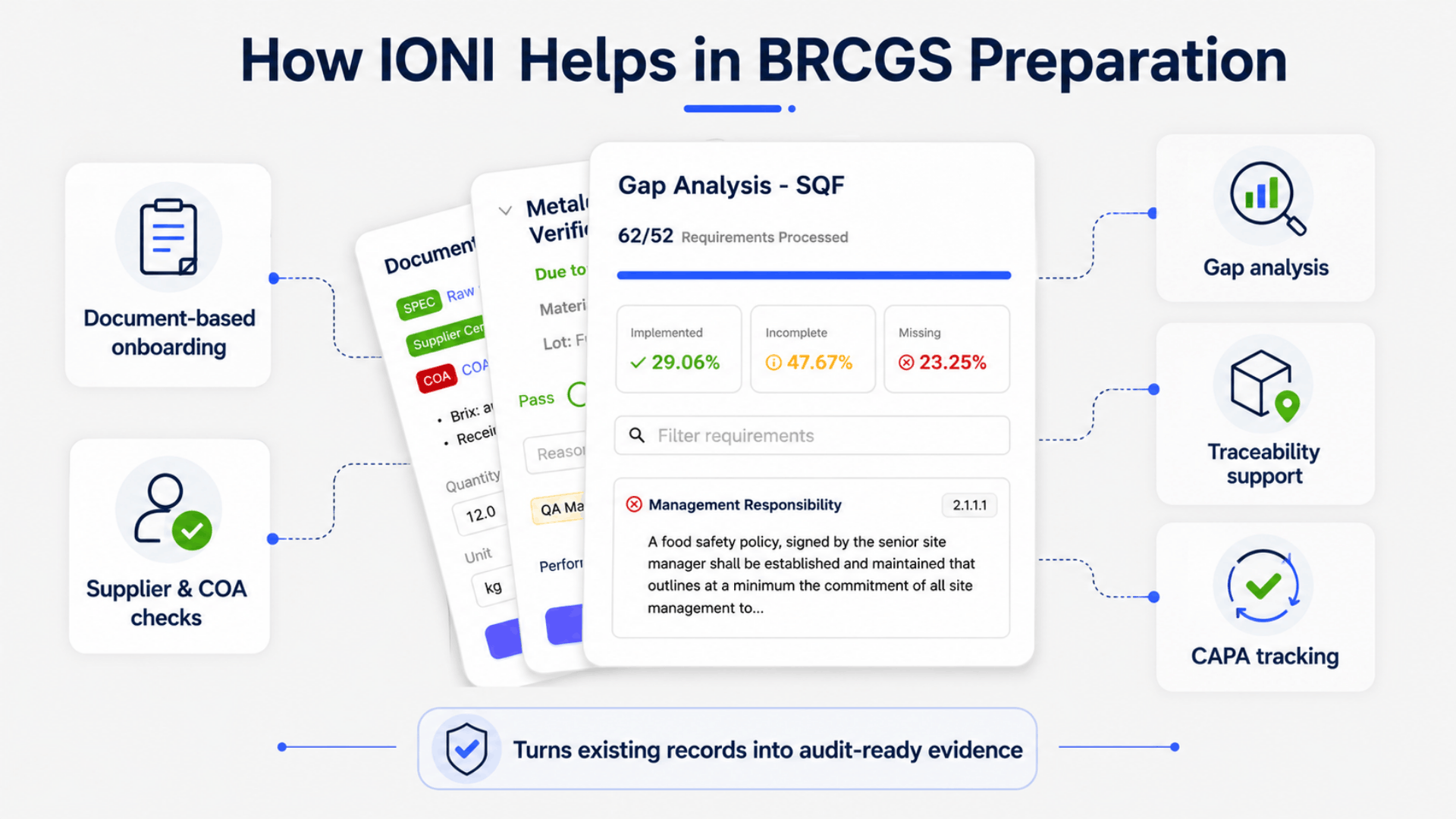
- Run a gap analysis against BRCGS Issue 9: compares your documents to the requirements, gives a coverage score, and recommends documents to create or update.
- Check COAs at receiving: attach a certificate of analysis to a received lot and compare it to the supplier specification, which addresses the "COA filed but not checked" failure above.
- Support the traceability exercise: a batch audit view shows backward ingredient trace and forward shipments, and exports a traceability PDF.
- Keep operational evidence together: operational checks and logs with reviewer sign-off, plus deviations and CAPA.
When the auditor runs the traceability exercise, the question is simple: can you trace a lot from supplier receipt through production to customer dispatch using records that already exist? For teams preparing for BRCGS, SQF, or FSMA, IONI's compliance platform page covers standards, requirements, and daily tasks. Our guide to Ingredients Intelligence covers supplier documents, specs, and COAs.
Book a demo to see how IONI supports BRCGS preparation with your own documents.
FAQ
What is BRCGS certification?
BRCGS certification is third-party certification to the BRCGS Global Standard for Food Safety, awarded after an accredited certification body audits a site. Retailers and brand owners require it because it gives independent evidence that a supplier's food safety management system meets a recognized, GFSI-benchmarked standard. It is widely used in UK, European, and global supply chains.
What does BRCGS stand for?
BRCGS is the name of the scheme, the trading name of BRC Trading Ltd. The "BRC" reflects its origin as a British retail standard. BRCGS uses "Brand Reputation through Compliance" as its brand signature, and some certification bodies expand the acronym as Brand Reputation through Compliance Global Standards.
What is the current version of the BRCGS food safety standard?
The current version is Issue 9, published in August 2022, with certification audits against it starting on 1 February 2023 (BRCGS). BRCGS is developing Issue 10 but had not published a release date as of October 2026 (BRCGS update).
How does BRCGS grading work?
Grades run from AA to D, with "Not certificated" for sites that fail. The grade depends on the number of critical, major, and minor non-conformities, and a "+" marks an unannounced audit. Grades AA, A, and B are re-audited every 12 months; C and D every 6 months. See the grades table above for the exact thresholds.
What are the BRCGS fundamental clauses?
There are 12: senior management commitment, the HACCP food safety plan, internal audits, management of suppliers of raw materials and packaging, corrective and preventive actions, traceability, layout and product flow, housekeeping and hygiene, management of allergens, control of operations, labelling and pack control, and training. A major non-conformity against the statement of intent of a fundamental clause means no certificate.
How much does BRCGS certification cost?
Published figures from one certification body put the standard at about $177, an optional pre-audit at about $6,000, and the certification audit at about $7,000 plus auditor travel, or around $13,000 in total (FSNS, 2026). Your quote will depend on site size, scope, and certification body.
How long does BRCGS certification take?
With an existing HACCP plan, SOPs, and active records, plan for roughly 3 to 5 months. With incomplete SOPs, 5 to 8 months is more realistic, and starting from scratch often takes 9 to 12 months. The constraint is building enough operational records to prove the system works, not writing documents.
Can I get BRCGS certified if I am already SQF certified?
Yes. The move from SQF is usually more manageable than starting from scratch because both rely on HACCP, supplier approval, internal audits, corrective actions, training, traceability, and management commitment. The main work is restructuring documents, learning BRCGS grading, mapping the 12 fundamental clauses, and closing Issue 9-specific gaps. The SQF Food Safety Code: Food Manufacturing, Edition 10 is useful to review alongside BRCGS.