.png)
A pest control program in the food industry is the written system a plant uses to keep pests out, check for them on a schedule, and prove it. FDA's cGMP rule, 21 CFR 117.35(c), says pests must not be allowed in any area of a food plant and effective measures must be taken to exclude them. In practice that means exclusion, routine inspections and monitoring, controlled treatment, and records.
What FDA's GMP rule actually requires
21 CFR 117.35 didn't introduce new pest-control regulations when FSMA's preventive controls rule was finalized — it reaffirmed existing Current Good Manufacturing Practices and elevated them from guidance to enforceable requirement. In practice, that means a facility must: exclude pests from the facility through physical barriers (sealed doors, screens, pest-proof construction), eliminate pest harborage in and around the facility, control pest activity through monitoring (traps, bait stations, scheduled inspections) with documented results, and restrict pesticide use in food-production areas to what's permitted under applicable regulations, in a way that doesn't contaminate food.
The 4 pillars of an effective pest control program
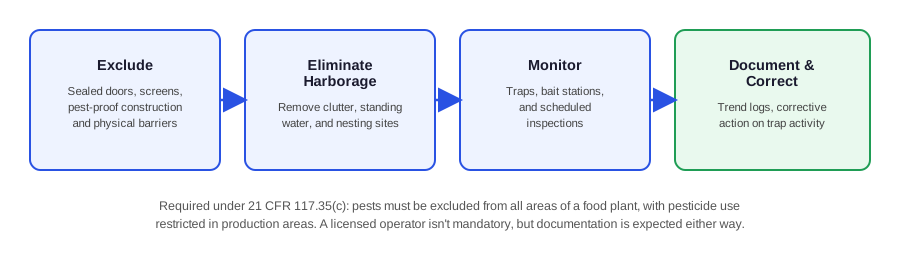
- Exclude — physical barriers that keep pests from entering: door sweeps, air curtains, sealed conduit penetrations, screened vents.
- Eliminate harborage — remove the conditions pests need to nest: clutter, standing water, overgrown vegetation near the building, gaps in storage practices.
- Monitor — traps, bait stations, and scheduled inspections that generate a record, not just a visual walk-through.
- Document and correct — trend the monitoring data over time and take corrective action when activity increases, rather than only reacting to a live infestation.
In-house program vs. licensed pest control operator
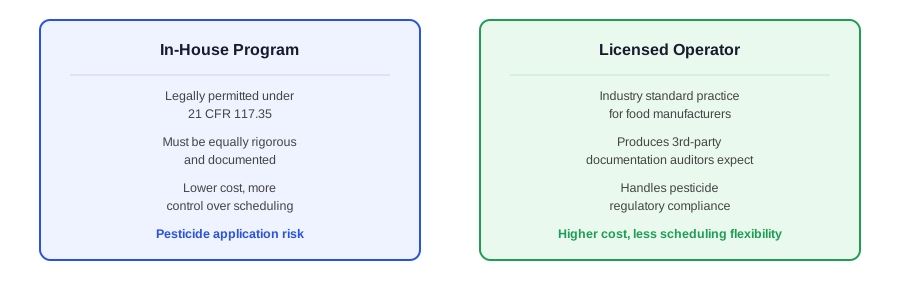
21 CFR 117.35 does not require a licensed pest control operator — an internal program is legally permissible. In practice, most food manufacturers still contract a professional pest control service, largely because it produces the third-party documentation auditors and GFSI schemes expect to see, and because pesticide application in and around a food plant is easy to get wrong from a regulatory standpoint. An internal program is workable, but it needs to be equally rigorous and equally well documented — FDA and third-party auditors evaluate the program's effectiveness and records, not who happens to be holding the sprayer.
How pest control connects to your HACCP plan and audits
Pest control is typically treated as a prerequisite program supporting your food safety plan, alongside GMP and sanitation programs, rather than a standalone CCP — unless your hazard analysis identifies a specific point where pest contamination is a food safety hazard requiring a Critical Control Point. GFSI-benchmarked schemes like SQF and BRCGS both expect a documented pest control program with trend analysis as part of prerequisite program review, and pest activity trending upward without a documented corrective action is a common audit finding.
See how IONI keeps pest control monitoring records connected to your broader food safety documentation: Food Safety Software.
Frequently asked questions
Does FDA require a licensed pest control operator?
No. 21 CFR 117.35 doesn't mandate a licensed operator — internal pest control programs are permitted — but the program must be documented and effective regardless of who runs it.
Can pesticides be used in food production areas?
Pesticide use is restricted in food-production areas and must comply with applicable regulations in a way that prevents contamination of food. Most facilities limit pesticide application to non-production zones and use physical traps or bait stations in production areas.
Is pest control a Critical Control Point?
Usually not — it's typically managed as a prerequisite program rather than a CCP. It can become a CCP if a facility's specific hazard analysis identifies a process step where pest-related contamination can't be controlled any other way.
How often should pest monitoring stations be checked?
There's no single FDA-mandated frequency; the right interval depends on your facility's risk profile and is typically set by your pest control program and verified during internal and third-party audits. What matters to auditors is that checks happen on a documented, consistent schedule.