A daily production report is a one-page summary of what a food plant planned to make, what it actually made, and what got in the way during one day or shift: output, yield, downtime in minutes, labor hours, batches and lots, QA holds, and deviations. Use the free template below and review it every morning.
Free download: Daily production report template (PDF, 1 page) and editable Excel version (XLSX). No sign-up or email needed. The template is vendor-neutral; fill it in on paper or in a spreadsheet.
What Goes in a Daily Production Report
Keep it to one page that a supervisor can complete in ten minutes at the end of the shift. Each field below earns its place by answering a question someone will ask the next morning.

| Field | Why it matters | Where the number comes from |
|---|---|---|
| Line / product | Output means little unless you know which product and line made it. | Production schedule or plan for the day |
| Planned quantity | The baseline for every comparison. | Production plan or work order |
| Actual quantity | What was really packed and counted as good output. | Line count, scale or end-of-run count |
| Yield % | Shows loss against plan. Use one definition and write it on the sheet. | Actual output ÷ planned output × 100, or finished weight ÷ raw input weight |
| Batches / lots made | Links the day's numbers to the batch records and lot codes behind them. | Batch records |
| Downtime (minutes) | A plain number that shows how much of the shift the line was not running. | Supervisor's log of stops |
| Labor hours | Lets you compare output per labor hour across days and lines. | Timekeeping or shift roster |
| QA holds | Product that cannot ship until QA decides what to do with it. | Hold tags and the QA hold log |
| Deviations | Anything that went off plan or off limit that day, with a reference to the full record. | Deviation or corrective action records |
| Sign-off | Shows who completed the report and who reviewed it. | Supervisor and QA or plant manager |
Sample Filled-In Daily Production Report
Here is an example for a small snack plant. The numbers are invented to show how the fields work together.
| Line / product | Planned | Actual | Yield % | Batches / lots | Downtime (min) | Labor hours | QA holds | Deviations |
|---|---|---|---|---|---|---|---|---|
| Granola bars, line 1 | 4,800 | 4,560 | 95.0 | 2 (L-1028A, L-1028B) | 35 | 42 | 1 | 0 |
| Granola bars, line 2 | 3,600 | 3,420 | 95.0 | 2 (L-1029A, L-1029B) | 20 | 30 | 0 | 1 |
| Trail mix 12 oz | 2,000 | 1,880 | 94.0 | 1 (L-1030A) | 0 | 18 | 0 | 0 |
| Day total | 10,400 | 9,860 | 94.8 | 5 | 55 | 90 | 1 | 1 |
In the morning meeting, this one page tells the team three things in under a minute: yield was just under 95%, line 1 lost 35 minutes (the notes explain a seed lot switch), and one deviation on line 2 needs a closed record.
Daily Production Report vs. Batch Record vs. Shift Handover
These three documents overlap, which is why plants often skip one. Each answers a different question, so keep them separate and link them by lot code.
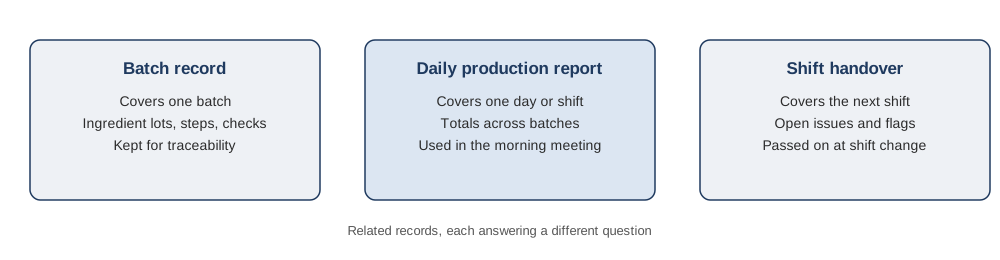
| Batch record | Daily production report | Shift handover | |
|---|---|---|---|
| Covers | One batch | One day or shift, all batches | What the next shift needs to know |
| Typical content | Ingredient lots, steps, checks, finished lot | Planned vs actual, yield, downtime, labor, holds, deviations | Open issues, flags, equipment status |
| Main use | Traceability and food safety evidence | Daily operations review | Continuity between shifts |
| Who completes it | Operators and QA during the run | Supervisor at end of shift | Outgoing supervisor |
The daily report summarizes records; it does not replace them. Records required under your food safety plan, such as CCP monitoring, sanitation and corrective actions, still need to be created at the time of the activity with actual values, the date, and who did the work, as 21 CFR 117.305 describes for preventive controls records. For how a tracked run becomes a batch record, see our guide to production tracking software for food manufacturers.
How to Use the Report in the Morning Meeting
- Read the totals first. Compare actual with planned and yield with your target. Note anything outside the range you agreed.
- Ask about each miss. For every line below plan, read the downtime minutes and the notes. Was it a changeover, a breakdown, a late ingredient or a QA hold?
- Check the QA holds. Decide who releases, reworks or discards each held lot and by when.
- Confirm every deviation has a record. The report should reference it. If it does not exist yet, assign someone to open it today.
- Write down actions with an owner and a date. Carry open items onto today’s sheet so they are not lost.
Paper, Spreadsheet or Software?
A one-page paper sheet or a shared spreadsheet is enough to start. The weak point is the data behind it: counts keyed in after the shift, lot codes copied by hand, and holds recorded somewhere else. When the report is built from records made at the line, supervisors spend less time totalling and more time acting.
IONI’s food manufacturing software records the underlying records on the floor: batches with ingredient assembly and lot records, operator checks through a touch-friendly operator app (with who filled each check in and who reviewed it), deviations with corrective actions, and a batch traceability PDF export. It runs on top of the accounting system you already use. These are the records a daily production report summarizes. For what to look for in floor-level software, see our guide to shop floor management software for food plants. To see it working on your own process, book a demo from that page.
FAQ
What is a daily production report?
A daily production report is a one-page summary of one day or shift in a plant. It compares planned and actual output and records yield, downtime, labor hours, batches and lots made, QA holds, deviations and a sign-off.
What should a daily production report include?
At a minimum: line and product, planned and actual quantity, yield, batches or lots made, downtime in minutes, labor hours, QA holds, deviations, notes, and the names of the person who completed it and the person who reviewed it.
Who fills in the daily production report?
The shift supervisor or line lead usually completes it at the end of the shift, using counts and records from the line. A plant manager or QA lead reviews and signs it, ideally the next morning.
How is a production report different from a batch record?
A batch record documents one batch in detail: ingredient lots, steps, checks and the finished lot. A production report summarizes the whole day across batches and points to the batch records behind it.
Does a daily production report replace food safety records?
No. CCP monitoring, sanitation, corrective action and other records required by your food safety plan must still be made on their own, at the time of the activity. The daily report only summarizes them and references them.
Can I edit the template?
Yes. Download the Excel version and add or remove columns to fit your lines, or change the yield definition. Adapt it to your own plan and any requirements from your certification body or customers.
Template by IONI (ioni.ai). Last updated: October 28, 2026.