
No. 21 CFR Part 11 does not apply to the records food manufacturers keep under 21 CFR Part 117, so a plant may keep those records electronically without meeting Part 11. Going digital is a choice, not a mandate. One exception: a record that another law also requires stays subject to Part 11.
Last updated: November 24, 2026. Every rule below is quoted or paraphrased from the Electronic Code of Federal Regulations and FDA pages, checked on that date. This is general information, not legal advice. Confirm your own case with your regulatory counsel or certification body.
What 21 CFR Part 11 Is, and Why Food Vendors Mention It
Part 11 sets the criteria under which FDA treats electronic records and electronic signatures as trustworthy and generally equivalent to paper (21 CFR 11.1). It was written for any FDA-regulated record, and it grew up around drugs and devices. FDA's own scope guidance says the agency intends to interpret the scope of part 11 narrowly.
You still hear that it applies to food. Software sold into several regulated industries often carries Part 11 language such as audit trails and electronic signatures, and some sales material repeats it as if every food plant needed it. For Part 117 records, the regulation says otherwise.
Does 21 CFR Part 11 Apply to Part 117 and FSMA 204 Records?
Two sentences in the food rules settle most of the question. In 21 CFR 117.305(g), records established or maintained to satisfy Part 117 that meet the definition of electronic records are exempt from Part 11. The same section says that records that satisfy Part 117 but are also required under other applicable statutes or regulations remain subject to Part 11. Section 11.1(i) repeats the exemption from the Part 11 side. For the Food Traceability Rule, 21 CFR 1.1455(e) uses the same wording.
| Record | Part 11 applies? | Source |
|---|---|---|
| Records required by Part 117 (monitoring, corrective actions, verification, training) | No | 21 CFR 117.305(g) and 11.1(i) |
| FSMA 204 traceability records (21 CFR Part 1, Subpart S) | No | 21 CFR 1.1455(e) |
| Food defense (intentional adulteration) records under Part 121 | No | 21 CFR 11.1(o) |
| A Part 117 record that another law or regulation also requires | Yes, it stays subject | 21 CFR 117.305(g), second sentence |
| Records no FDA rule requires, kept for your own use | Not Part 11 records | FDA Part 11 scope guidance |

Part 117 itself already allows electronic records. Section 117.305(a) lets you keep original records, true copies such as scans, or electronic records. So the answer to "can HACCP records be electronic?" is yes, as long as they meet the same content rules as paper.
What Part 117 Still Requires of Any Record, Paper or Electronic
The exemption removes the Part 11 layer. It does not remove the Part 117 rules, which apply the same way to a binder, a spreadsheet or software. Under 117.305, records must contain the actual values and observations from monitoring, be accurate, indelible and legible, be created at the time of the activity, and carry the plant identity, the date and time, the signature or initials of the person who did the work, and the product and lot code where appropriate. Monitoring and corrective action records must be reviewed within 7 working days, or a reasonable time with a written justification (21 CFR 117.165(a)(4)), and records are kept at the plant for at least 2 years (21 CFR 117.315).
What Auditors Still Expect (Good Practice, Not Law)
Your certification body and your customers set their own expectations on top of the regulation. Check the exact wording in your scheme's current documents, because it changes between editions. In practice, the questions are the same ones the table above implies: who recorded it, when, what the real value was, whether it was reviewed, and whether you can find it fast. Our guide to ALCOA+ data integrity for food safety records turns those questions into a habit.
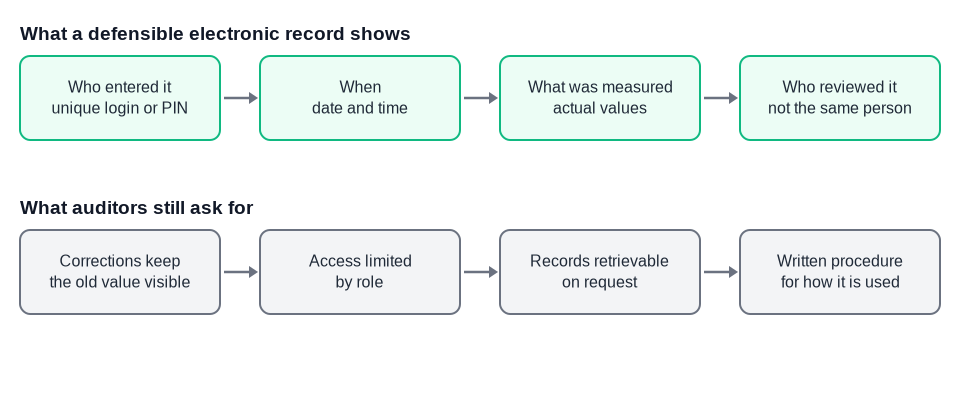
A Defensibility Checklist for Electronic Food Safety Records
Use this to test any system, spreadsheet or software, before you rely on it. The Basis column separates what Part 117 says from what is good practice.
| Check | What it should show | Basis |
|---|---|---|
| Who did it | The name or initials of the person who did the work, tied to a unique login or PIN, not a shared one | 21 CFR 117.305(f)(3); unique logins are good practice |
| When | Date and time, recorded at the time of the activity | 21 CFR 117.305(d) and (f)(2) |
| What was measured | The actual reading or observation, not just a tick or OK | 21 CFR 117.305(b) |
| Which plant and lot | Plant identity, and product and lot code where appropriate | 21 CFR 117.305(f)(1) and (f)(4) |
| Corrections | Legible and indelible entries, with the original value still visible after a correction | 21 CFR 117.305(c); keeping the old value visible is good practice |
| Review | A second person reviews monitoring and corrective action records within 7 working days, or a justified reasonable time | 21 CFR 117.165(a)(4) |
| Retention and retrieval | Records kept at the plant for at least 2 years and found quickly on request | 21 CFR 117.315(a)(1) |
| Access | Only authorized people can create or change records, and roles are written down | Good practice |
FSMA 204 and the Sortable Spreadsheet
The Food Traceability Rule asks covered firms to give FDA an electronic sortable spreadsheet of required traceability information within 24 hours of a request in an outbreak or recall, with exceptions for small operations such as a non-farm, non-retail business with $1 million or less in annual food sales (21 CFR 1.1455(c)). FDA's rule page, current as of November 4, 2026, says FDA proposed to extend the compliance date to July 20, 2028 and that Congress directed FDA not to enforce the rule before that date. Check FDA's page for the current status. For what the rule means in a plant, read our FSMA 204 guide for food manufacturers.
What This Means If You Are Going Digital
You do not need to meet Part 11 to move Part 117 records off paper, but you do need records that meet the table above. If you are choosing how to move, our step-by-step guide to switching from paper or spreadsheets to digital food safety shows what to move first. For background on the rules, see 21 CFR Part 117 explained and food safety documentation and recordkeeping.
IONI is our product, so weigh this accordingly. In IONI, each log keeps who filled it in and who reviewed it, operators cannot confirm logs, nobody can confirm their own log, and the operator kiosk uses a PIN that locks after repeated wrong tries. That is the kind of record trail the checklist describes. It sits inside food safety compliance software for manufacturers. No software makes a plant compliant on its own. Book a demo and bring one of your own check logs.
FAQ
Does 21 CFR Part 11 apply to food manufacturers?
Not to records required by Part 117 or the FSMA 204 traceability rule. Sections 117.305(g) and 1.1455(e) exempt them. A record that is also required by another statute or regulation that is not exempt stays subject to Part 11, so check the rule that requires it.
Is Part 11 compliance mandatory for food plants?
No, not for Part 117 records. A plant can keep them on paper or electronically. If you choose electronic records, they still have to meet the Part 117 record rules, such as actual values, the time of the activity, the person who did the work, and review.
Can HACCP records be electronic?
Yes. Section 117.305(a) allows original records, true copies and electronic records. Monitoring, corrective action and verification records can all be electronic if they carry the required content.
Do I need electronic signatures for food safety records?
Part 117 asks for the signature or initials of the person performing the activity. A unique login or PIN that identifies that person is a common way to meet that in an electronic system. Ask your certification body how it wants this shown.
When would Part 11 apply to a food company?
When a record is required under a statute or regulation that is not exempt from Part 11, even if the same record also satisfies Part 117. Section 11.1 lists the exemptions, so read it against the rule that requires your record.
Does FSMA 204 change any of this?
No. Section 1.1455(e) exempts traceability records from Part 11 in the same way. FDA's page gives July 20, 2028 as the date before which it will not enforce the rule, so check that page for updates.
About the author: Alex Uspenskyi writes about food safety compliance and plant operations at IONI.