.png)
The three types of hazards that make food unsafe are biological, chemical, and physical. These food safety hazards can enter a product through ingredients, employees, equipment, processing conditions, packaging, or the wider supply chain. FSMA hazard analysis also requires manufacturers to consider radiological hazards, while allergens are usually managed as a separate operational category because they require dedicated controls.
Every food safety system starts with the same question: what could make this product unsafe, and where can that hazard be prevented, eliminated, or reduced to an acceptable level? HACCP plans, FSMA food safety plans, SQF programs, BRCGS certification, and FSSC 22000 all depend on a hazard analysis that reflects the actual product, process, facility, and supply chain. A generic list of hazards is not enough. The analysis must connect each credible hazard to a clear control and supporting evidence.
Quick answer: The three core types of food safety hazards are biological, chemical, and physical. Food manufacturers also commonly manage allergens as a separate category, and FSMA includes radiological hazards within chemical hazards. Biological hazards are usually controlled through validated process conditions and sanitation. Chemical hazards often depend on supplier, formulation, and storage controls. Physical hazards require prevention, inspection, and detection. Allergen hazards require segregation, cleaning validation, label control, and accurate supplier data.
What Is a Food Safety Hazard?
A food safety hazard is a biological, chemical, or physical agent that could cause illness or injury. Under 21 CFR §117.130, a covered facility must identify and evaluate known or reasonably foreseeable hazards for each type of food it manufactures, processes, packs, or holds. The written analysis must determine whether any of those hazards require preventive controls. For the full requirements of FDA's HARPC framework beyond the hazard analysis itself — preventive controls, monitoring, corrective actions, and verification — see our guide to what HARPC is.
That wording matters. A hazard does not become significant simply because it is theoretically possible. The team must consider whether the hazard has a credible route into the product, how severe the outcome could be, how likely it is under the facility's conditions, and whether existing controls are sufficient.
For example, Salmonella may be a significant ingredient hazard in a low-moisture product even when the product does not support growth. The organism can survive for long periods and remain dangerous when the product is consumed or rehydrated. By contrast, a hazard with no credible source, pathway, or history in the product may be documented as not requiring a preventive control, provided the reasoning is technically sound.
A strong hazard analysis therefore considers the food, ingredients, intended use, vulnerable consumers, process steps, equipment, facility environment, packaging, storage, transport, supplier performance, and regulatory history. It also distinguishes between controls managed through a CCP, preventive controls, supplier programs, sanitation procedures, allergen programs, or prerequisite programs.
Biological Hazards
In food safety, biological hazards include pathogenic bacteria, viruses, parasites, and microbial toxins. They receive the most attention in many HACCP plans because a small failure in cooking, cooling, sanitation, or temperature control can allow a product to cause widespread illness.
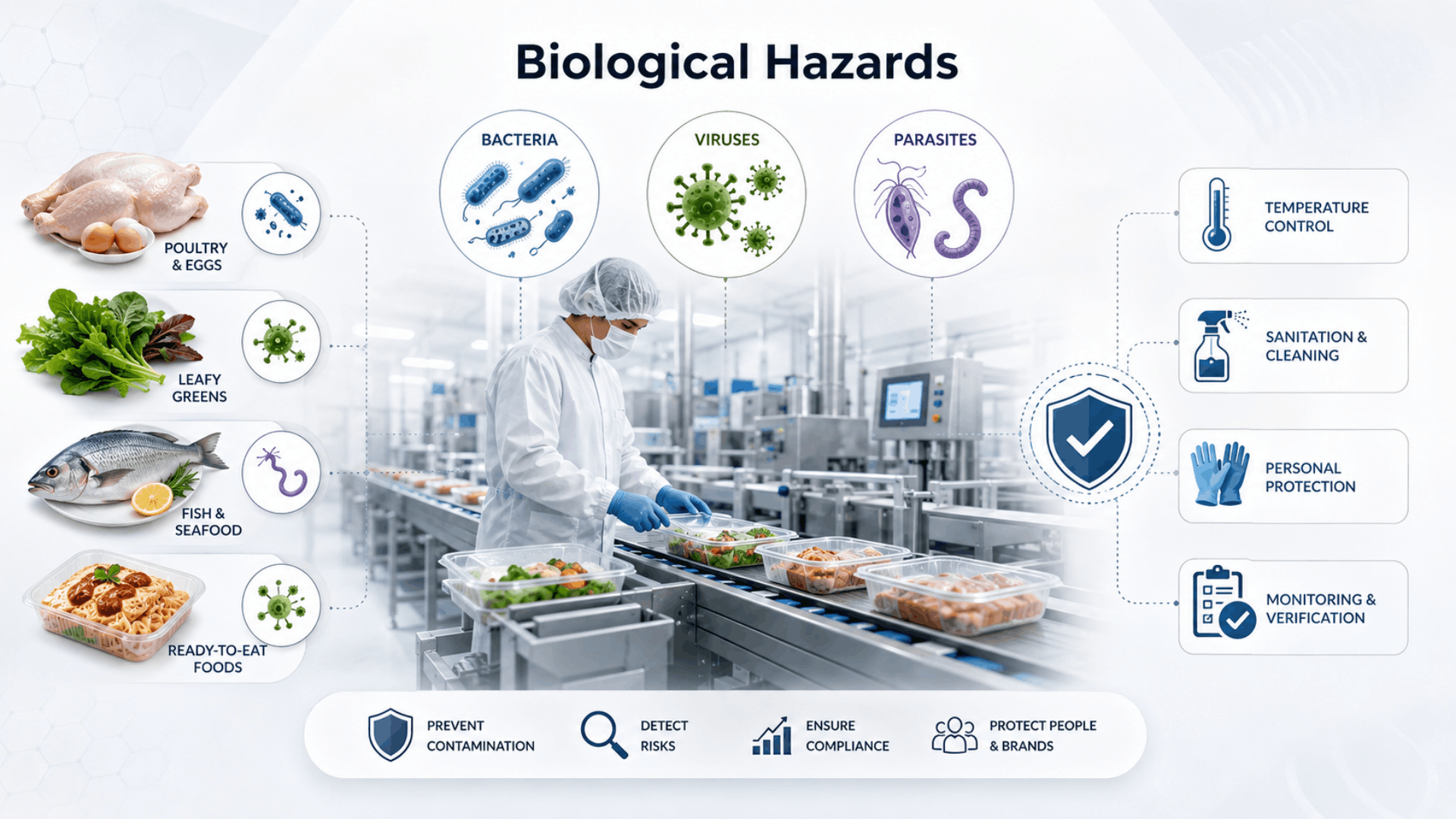
The relevant organism depends on the food and process. A ready-to-eat meat plant may focus heavily on Listeria monocytogenes. A nut processor may prioritize Salmonella. A refrigerated reduced-oxygen product may require controls for Clostridium botulinum. A cooked rice operation may need to address Bacillus cereus and time-temperature abuse.
Bacteria
Bacterial hazards cause illness through infection, toxin production, or both. Some grow rapidly under favorable conditions. Others survive processing environments or produce toxins that remain after the cells are destroyed.
Salmonella is associated with poultry, eggs, raw produce, nuts, spices, flour, chocolate, and other low-moisture foods. It can persist in dry environments without growing, which makes moisture control, hygienic zoning, dry sanitation, supplier approval, and validated lethality processes important. The CDC estimates that Salmonella causes about 1.35 million infections in the United States each year.
Listeria monocytogenes is a central concern in ready-to-eat production because it can survive and grow under refrigeration. It can establish itself in drains, floors, hollow rollers, damaged seals, and other difficult-to-clean niches. Refrigeration alone is therefore not an adequate control. RTE facilities need hygienic equipment design, controlled traffic patterns, effective sanitation, and environmental monitoring that is tied to investigation and corrective action.
Escherichia coli O157 and other Shiga toxin-producing E. coli, or STEC, are associated with ground beef, raw milk, unpasteurized juice, flour, sprouts, and leafy greens. These organisms can cause severe illness at a low infectious dose. Controls may include validated cooking, agricultural water controls, supplier verification, testing, and prevention of cross-contamination after a kill step.
Clostridium botulinum is an anaerobic spore-forming bacterium associated with low-acid canned foods, vacuum-packed products, reduced-oxygen packaging, and some oil-based products. Its spores can survive ordinary cooking. Manufacturers therefore control germination and toxin formation through validated combinations of thermal processing, pH, water activity, salt, preservatives, refrigeration, and package design.
Clostridium perfringens is commonly linked to cooked foods that cool too slowly. Spores may survive cooking, germinate during cooling, and multiply while the product remains in a favorable temperature range. Batch size, container depth, airflow, cooling equipment, and cooling records all affect the real level of control.
Staphylococcus aureus is frequently introduced by people. It can be carried on skin, in nasal passages, and in infected cuts. If contaminated food remains at an unsafe temperature, the organism can produce heat-stable enterotoxins that are not reliably removed by later cooking. Hand hygiene, wound controls, employee illness policies, and time-temperature management are therefore essential GMP controls, not administrative details.
Bacillus cereus is associated with rice, pasta, spices, dairy products, sauces, and other foods. Some strains produce a heat-stable emetic toxin, while others cause diarrheal illness after growth in the intestine. Rapid cooling, controlled holding, ingredient risk assessment, and hygienic handling after cooking reduce the risk.
Viruses
Viruses do not multiply in food, but they can survive long enough to infect consumers. Very small amounts may be sufficient to cause illness, so prevention depends heavily on employee hygiene, illness exclusion, water quality, and supplier controls.
Norovirus is a frequent cause of foodborne outbreaks and is usually introduced by infected people, contaminated water, or contaminated shellfish. In a manufacturing facility, the most important controls are handwashing, prevention of bare-hand contact with ready-to-eat food, effective cleaning and disinfection, and strict exclusion of symptomatic employees. Shellfish operations also depend on approved harvest areas and reliable supplier documentation.
Hepatitis A spreads through the fecal-oral route and has been linked to shellfish, frozen berries, produce, and ready-to-eat foods handled after processing. Vaccination can prevent infection, but facilities still need effective hygiene, illness reporting, sanitation, and supplier controls because vaccination does not replace process discipline.
Parasites
Parasites are less common in highly processed foods, but they can be significant in meat, fish, produce, and water-related supply chains.
Trichinella species are associated with undercooked pork and wild game. Controls include validated cooking or freezing procedures where freezing is recognized as effective for the relevant species and product.
Toxoplasma gondii and Cryptosporidium can reach food through contaminated animals, soil, irrigation water, or processing water. Produce manufacturers should account for water source, treatment, agricultural practices, and supplier controls when evaluating these hazards.
Anisakis species occur in fish intended for raw or undercooked consumption. The FDA Fish and Fishery Products Hazards and Controls Guidance provides control guidance for parasite destruction, histamine formation, pathogens, environmental contaminants, and other seafood hazards.
How Biological Hazards Are Controlled
Biological hazards are controlled through validated lethality treatments, refrigeration, freezing, rapid cooling, water activity reduction, pH control, preservatives, hygienic design, sanitation, environmental monitoring, and supply-chain controls. The correct combination depends on the target organism and the product conditions before, during, and after processing.
In a HACCP system, a cooking, pasteurization, retort, chilling, or formulation step may become a Critical Control Point when failure would leave the product unsafe and no later step would reliably correct the problem. Critical limits must be measurable and supported by scientific or technical evidence. Monitoring must show what happened to the actual batch, not simply that an operator completed a form.
FSMA uses a broader preventive controls model. A biological hazard may be managed through a process control, sanitation control, supply-chain control, or another risk-based measure. The facility must also define monitoring, corrective action, verification, validation where applicable, and records that demonstrate the control was implemented as intended.
Turn your hazard analysis into a working control system. See how IONI helps food manufacturers manage HACCP, FSMA, SQF, and BRCGS requirements in one connected workflow.
Chemical Hazards
In food safety, chemical hazards are naturally occurring or introduced substances that can cause harm when present at unsafe levels. They may originate in raw materials, agriculture, processing, sanitation, maintenance, packaging, or the environment.

Unlike many biological hazards, chemical contamination often cannot be removed after it enters the product. Prevention and upstream verification are therefore central to control.
Naturally Occurring Chemical Hazards
Mycotoxins are toxic compounds produced by certain molds, including Aspergillus, Penicillium, and Fusarium species. Aflatoxins are associated with corn, peanuts, cottonseed, tree nuts, and some spices. Other concerns include ochratoxin A, deoxynivalenol, fumonisins, patulin, and zearalenone. The relevant hazard depends on the commodity, geography, weather, storage conditions, and supplier history.
Testing alone is not a complete mycotoxin control program. A useful program combines approved suppliers, commodity specifications, representative sampling, validated test methods, moisture control, storage inspection, pest management, and clear disposition rules for nonconforming lots.
Histamine, also called scombrotoxin, can form in certain fish when temperature abuse allows bacteria to convert naturally occurring histidine into histamine. Once formed, histamine is not reliably removed by cooking, freezing, or washing. The practical control is uninterrupted temperature management from harvest through receiving, processing, storage, and distribution.
Marine biotoxins include saxitoxins, domoic acid, and brevetoxins. They are produced by algae and can accumulate in shellfish. Manufacturers generally cannot control their formation inside the facility, so controls depend on approved harvest areas, government monitoring programs, supplier approval, and receiving documentation.
Naturally occurring plant toxins include glycoalkaloids in green or sprouted potatoes, cyanogenic glycosides in cassava and some kernels, and lectins in inadequately cooked kidney beans. Product formulation, raw material selection, preparation instructions, and validated processing conditions may all be relevant.
Agricultural And Veterinary Chemical Residues
Pesticide residues may remain on raw agricultural commodities when products are misapplied, used too close to harvest, or subject to different maximum residue limits across markets. Food manufacturers should define market-specific specifications and obtain evidence that suppliers comply with applicable tolerances.
Veterinary drug residues can occur in meat, milk, eggs, honey, and aquaculture products when withdrawal periods are not followed or unapproved substances are used. Supplier qualification, declarations, testing plans, and verification of regulatory status are the main controls.
Heavy metals such as lead, cadmium, mercury, and arsenic may enter ingredients through soil, water, feed, industrial contamination, or natural geology. Risk varies by ingredient and source. Cocoa, rice, spices, seafood, root crops, and foods for infants may require more focused specifications, supplier data, or testing.
Process-Induced Chemical Hazards
Cleaning and sanitizing chemical residues can contaminate food when chemicals are mixed incorrectly, used outside their intended application, stored poorly, or not adequately removed from food-contact surfaces. Control requires approved chemicals, clear concentrations and contact times, controlled dispensing, employee training, pre-operational inspection, and rinse or residue verification where required.
Lubricants, hydraulic fluids, coolants, paints, and maintenance chemicals can become hazards when they leak, drip, or are used near exposed food. Food-grade status alone does not justify uncontrolled contact. Preventive maintenance, line clearance, leak response, chemical inventories, and protection of exposed product are still necessary.
Acrylamide can form in carbohydrate-rich foods during high-temperature processing, particularly frying, baking, and roasting. Risk reduction may involve raw material selection, recipe adjustment, control of reducing sugars and asparagine, temperature and time optimization, and finished-product monitoring.
Nitrosamines may form in some cured foods when nitrites react with amines under favorable conditions. Manufacturers control the risk through legal formulation limits, validated processing, ingredient controls, and management of time and temperature.
Packaging-Related Chemical Hazards
Packaging materials can transfer substances into food when they are unsuitable for the product or used outside their approved conditions. Migration may depend on food composition, contact time, temperature, package structure, recycled content, inks, adhesives, and barriers.
A packaging specification should therefore confirm the material, intended food type, temperature range, contact conditions, regulatory status, and supplier change-notification requirements. A general statement that packaging is "food grade" is usually not enough to demonstrate suitability for a specific product and process.
How Chemical Hazards Are Controlled
Chemical hazards are controlled through supplier approval, ingredient and packaging specifications, certificates of analysis, risk-based testing, formulation controls, receiving inspection, approved chemical programs, maintenance controls, and storage conditions. The facility should define which documents are required, how often evidence is verified, what triggers additional testing, and who has authority to place material on hold.
Supplier documents also need to be connected to the ingredient and product where they matter. A current COA in a shared folder is not useful if the team cannot confirm which specification it supports, whether the test method is appropriate, or whether a failed result affected released product.
Strengthen ingredient and supplier controls before hazards reach production. Explore IONI Ingredients Intelligence for food companies to connect specifications, supplier evidence, hazard data, and compliance checks.
Physical Hazards
In food safety, physical hazards are foreign objects that can injure a consumer. Common examples include metal, glass, hard plastic, bone, stones, wood, rubber, and pieces of equipment or packaging. These hazards are easy to describe but difficult to control when the facility relies only on a final detector and ignores how the material entered the product.
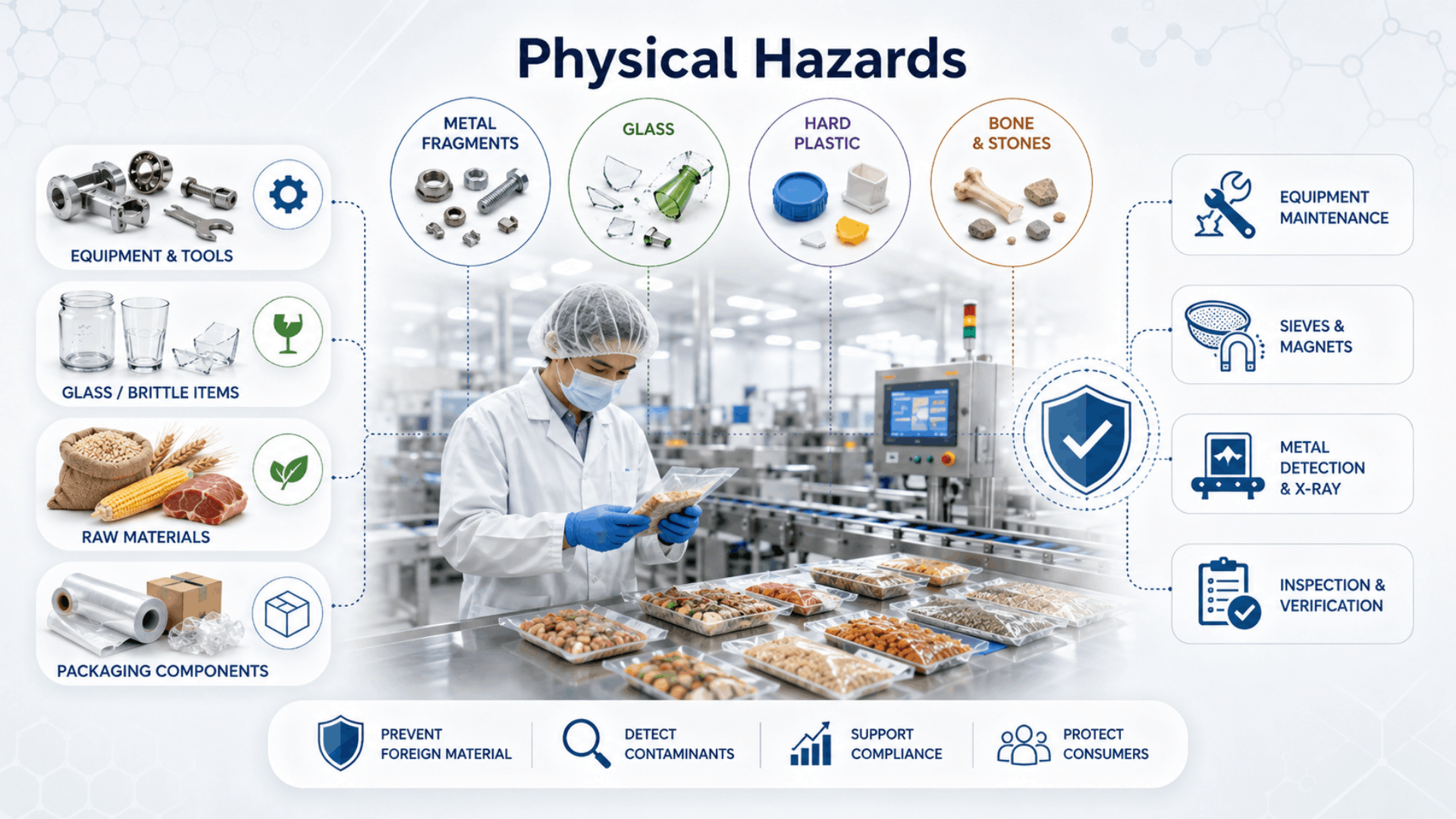
A strong physical hazard program combines prevention, inspection, detection, equipment control, maintenance discipline, foreign-material investigation, and supplier management. Detection is the final barrier, not the entire system.
Common Sources Of Physical Contamination
Metal fragments may come from broken blades, worn screens, wire brushes, fasteners, bearings, cutting equipment, tools, or maintenance work. Controls include preventive maintenance, tool accountability, equipment inspection, magnets, sieves, metal detection, and documented checks after repairs.
Glass may come from lighting, gauges, windows, containers, or laboratory items. Facilities should maintain a glass and brittle-plastic register, protect or remove vulnerable materials, define breakage procedures, isolate affected product, and document cleanup and line release.
Hard plastic can enter food from guards, scrapers, conveyor parts, bins, packaging, or damaged utensils. Color contrast can make fragments easier to find, but color coding does not prevent breakage. Condition inspection and replacement criteria are still required.
Bone fragments are a known concern in meat, poultry, and fish products. Deboning controls, supplier specifications, trimming, equipment setup, visual inspection, and X-ray systems may all be relevant depending on the product and customer requirements.
Wood, rubber, and string may come from pallets, packaging, seals, gaskets, gloves, and ingredient sacks. Pallet rules, controlled unpacking, packaging inspection, and routine checks of flexible components reduce the risk.
Stones, soil, and field debris can arrive with grains, legumes, root vegetables, and other agricultural materials. Supplier controls, receiving inspection, washing, screening, aspiration, magnets, and destoning equipment may be needed before processing.
Physical Hazard Detection Methods
Metal detection and X-ray inspection are the most common in-line technologies for physical hazard detection. Their performance depends on the contaminant, product, package, line speed, orientation, aperture size, temperature, salt content, moisture, and equipment setup.
Metal detectors are typically challenged with certified ferrous, non-ferrous, and stainless-steel test pieces. Sensitivity must be established for the actual product and package. Wet, salty, or conductive products can create product effect and reduce performance. A facility should document validation, routine challenge frequency, reject verification, failed-check response, and control of product produced since the last acceptable test.
X-ray systems can detect many dense contaminants, including metal, glass, stone, mineralized bone, and some dense plastics. They may also identify missing items, underfill, breakage, or package defects. X-ray performance still has limits, particularly for low-density materials or contaminants positioned in difficult orientations.
A detector rejection is not the end of the investigation. The facility should identify the contaminant, determine its source, assess other potentially affected product, correct the equipment or process failure, and evaluate whether the event indicates a wider loss of control.
Allergens As A Food Safety Hazard
Allergens are often discussed separately from biological, chemical, and physical hazards because the operational controls are distinct. Under FSMA, food allergen controls are a specific category of preventive controls. BRCGS Food Safety Issue 9 treats allergen management under clause 5.3 as a Fundamental requirement.
An allergen hazard exists when a major allergen is present but not accurately declared, or when cross-contact introduces an allergen into a product that should not contain it. The consequence can range from a mild reaction to life-threatening anaphylaxis in a sensitized consumer.
In the United States, the nine major food allergens are milk, eggs, fish, crustacean shellfish, tree nuts, peanuts, wheat, soybeans, and sesame. The FASTER Act made sesame the ninth major food allergen effective January 1, 2023. In Canada, manufacturers must account for the country's priority allergens, gluten sources, and added sulphites.
Heat does not make an undeclared allergen safe. Allergen control depends on accurate ingredient data, segregation, scheduling, controlled rework, validated cleaning, label approval, line clearance, label verification, employee practices, and supplier change notifications.
Label control deserves the same level of attention as production controls. A correctly manufactured product in the wrong package is still unsafe. Facilities should verify the product, label, allergen declaration, version, and package at startup, changeover, and defined intervals during the run.
Radiological Hazards
FSMA includes radiological hazards within the chemical hazard category. Potential sources include naturally occurring radioactive materials, contaminated soil or water, nuclear incidents, and certain raw materials sourced from affected regions.
Most food facilities will conclude that radiological hazards do not require preventive controls because there is no credible source or pathway. That conclusion should still be documented. A facility sourcing from a region with known contamination, using ingredients that concentrate radionuclides, or responding to a new regulatory alert may need targeted supplier evidence, testing, or temporary sourcing restrictions.
This is also where static hazard analysis can fail. A hazard that was not relevant last year may become relevant after a contamination event, new import restriction, supplier change, or updated government guidance. AI regulatory intelligence can help compliance teams monitor changes and connect them to affected products, ingredients, suppliers, and markets.
How Hazard Analysis Works In Practice
Identifying potential food hazards is only the first step. A useful hazard analysis explains where each hazard could occur, why it matters, how likely it is, how severe the outcome could be, and which control manages it. It should be specific enough that another qualified person can follow the reasoning without relying on unwritten knowledge.
At each ingredient and process step, the team should:
- Identify biological, chemical, physical, allergen, and radiological hazards that are known or reasonably foreseeable.
- Evaluate severity and probability using product history, scientific evidence, regulatory data, supplier performance, intended use, and facility conditions.
- Decide whether the hazard requires a preventive control or is adequately managed through prerequisite programs and other controls.
- Identify the control type, responsible role, monitoring method, limits or acceptance criteria, corrective action, verification, and required records.
- Document the justification, including the reasoning for hazards that do not require additional control.
The Codex General Principles of Food Hygiene provides the internationally recognized foundation for Good Hygiene Practices and HACCP. In practice, however, the quality of a HACCP hazard analysis depends on how well the general principles are applied to the actual operation.
A statement such as "Salmonella may be present" is incomplete. The analysis should identify the ingredient or process step, explain the source and likelihood, define whether the product supports growth, identify the control, and state the evidence supporting the decision. The same level of specificity should apply to allergens, chemical residues, packaging migration, and physical contaminants.
The analysis must also be reviewed when conditions change. New ingredients, suppliers, equipment, packaging, processing parameters, rework practices, target markets, customer requirements, complaints, recalls, or regulatory updates may alter the hazard profile. A scheduled annual review is useful, but it does not replace event-driven reassessment.
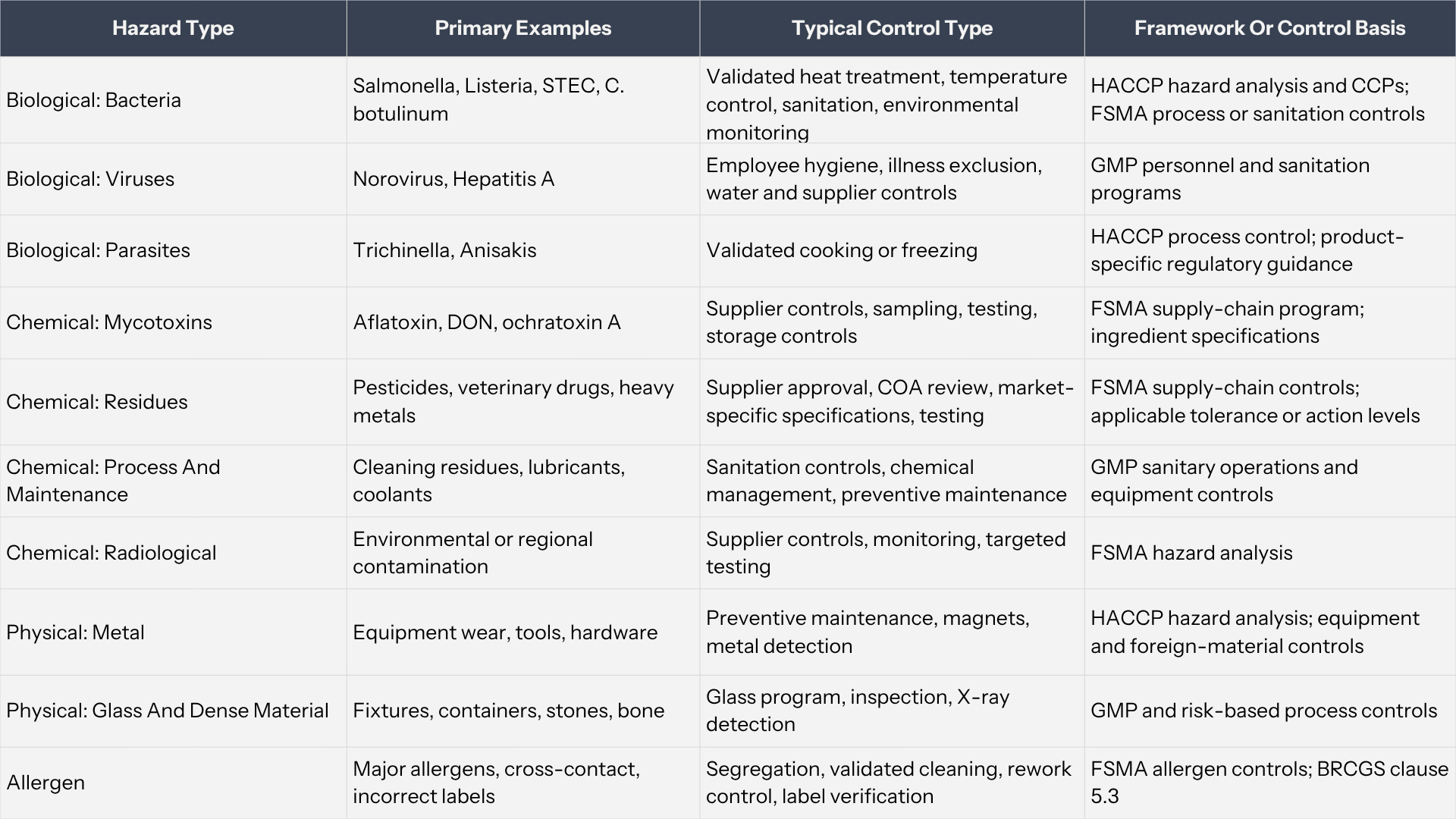
A well-written table does not replace the underlying analysis. Auditors and regulators will still expect product-specific reasoning, control evidence, and records that show the system operates consistently.
FAQ
What Are The Three Types Of Food Safety Hazards?
The three types of hazards that make food unsafe are biological, chemical, and physical. Biological hazards include bacteria, viruses, parasites, and microbial toxins. Chemical hazards include natural toxins, residues, cleaning chemicals, process contaminants, packaging migration, and radiological hazards. Physical hazards include foreign objects such as metal, glass, bone, stones, and hard plastic. Food manufacturers also manage allergens as a separate operational category because allergen cross-contact and incorrect labeling require dedicated controls.
What Are Examples Of Biological Hazards In Food?
Examples include Salmonella in poultry, nuts, flour, and spices; Listeria monocytogenes in ready-to-eat foods; STEC in ground beef and leafy greens; Clostridium botulinum in low-acid or reduced-oxygen products; Clostridium perfringens in slowly cooled cooked foods; Norovirus from infected handlers or contaminated water; and Anisakis in fish intended for raw consumption. The correct control depends on the organism, food, process, and point at which contamination can occur.
What Are Examples Of Chemical Hazards In Food?
Chemical hazards include aflatoxins and other mycotoxins, histamine in susceptible fish, pesticide residues, veterinary drug residues, heavy metals, cleaning chemical residues, non-food-grade maintenance chemicals, acrylamide, nitrosamines, and substances migrating from packaging. Many chemical hazards cannot be removed after contamination, so supplier, specification, formulation, and storage controls are especially important.
What Are Examples Of Physical Hazards In Food?
Physical hazards include metal fragments from equipment, glass from fixtures or containers, hard plastic from tools or machine parts, bone in meat and fish, stones in agricultural commodities, and wood, rubber, or string from packaging and facility materials. Controls include preventive maintenance, foreign-material inspections, sieves, magnets, metal detectors, X-ray systems, glass registers, and supplier requirements.
What Is Hazard Analysis In Food Safety?
Hazard analysis is the systematic process of identifying known or reasonably foreseeable hazards and evaluating whether they require preventive controls. It is the first principle of HACCP and a core requirement of FSMA food safety plans. The analysis links each significant hazard to a control, monitoring method, corrective action, verification activity, and supporting record.
How Are Food Safety Hazards Controlled In Food Manufacturing?
Biological hazards are controlled through validated processing, sanitation, temperature, pH, water activity, and environmental monitoring. Chemical hazards are controlled through supplier approval, specifications, testing, formulation, chemical management, and packaging controls. Physical hazards are controlled through maintenance, inspection, sieving, magnets, metal detection, and X-ray systems. Allergens are controlled through accurate ingredient data, segregation, validated cleaning, label verification, and rework management.
What Is The Difference Between A Food Safety Hazard And A Food Safety Risk?
A hazard is something with the potential to cause harm, such as Salmonella in a raw ingredient. Risk considers the probability and severity of harm under specific conditions. The same hazard may present a different risk depending on contamination level, process controls, product characteristics, intended use, storage, and consumer population. Hazard analysis identifies and evaluates the hazard so the facility can decide whether a preventive control is needed.
Understanding Hazards Is How Food Safety Systems Start
Every CCP, preventive control, supplier requirement, sanitation procedure, monitoring record, and corrective action should trace back to a hazard identified in the analysis. When that connection is missing, the food safety plan becomes a collection of documents rather than a functioning control system.
Facilities should revisit the analysis when products, ingredients, suppliers, equipment, packaging, processes, target markets, or regulatory requirements change. The review should also use evidence from complaints, deviations, environmental results, foreign-material findings, audit observations, and recalls. These signals show whether the original assumptions still match operating reality.
A strong system keeps the analysis connected to current specifications, monitoring tasks, records, and corrective actions. It also makes regulatory changes actionable instead of leaving them in a newsletter or spreadsheet.
Build an audit-ready food safety system around your real products and documents.
See IONI food safety software, connect regulatory changes through IONI Regulatory Intelligence, and use custom integrations to fit the workflow around your existing systems.