.png)
In Canada, most food businesses don't apply for a standalone "HACCP certificate." HACCP (Hazard Analysis and Critical Control Point) principles are built directly into the Preventive Control Plan (PCP) that the Safe Food for Canadians Regulations (SFCR) require for a Safe Food for Canadians (SFC) licence, issued by the Canadian Food Inspection Agency (CFIA). Separately, voluntary third-party HACCP system certification — offered by bodies such as the Bureau de normalisation du Québec (BNQ) — exists for businesses whose retailers or buyers specifically request it. For more on CFIA itself — its mandate and how it compares to FDA — see our guide to what the CFIA is.
Do You Need HACCP Certification to Sell Food in Canada?
If your business manufactures, processes, treats, packages, imports, or exports food for interprovincial or international trade, the SFCR generally requires you to hold an SFC licence and maintain a Preventive Control Plan built on HACCP principles, along with prerequisite programs covering sanitation, pest control, allergen management, and traceability. This is a regulatory requirement administered through CFIA's My CFIA licensing portal — not a certificate issued by a third-party auditor.
A separate, voluntary layer exists on top of that: third-party HACCP system certification. This is not required by CFIA to hold an SFC licence, but some retailers, foodservice buyers, or export markets ask for it as proof of a verified food safety system.
How HACCP Fits Into the SFCR
The SFCR doesn't reference "HACCP certification" as a licensing category. What it requires is a Preventive Control Plan (PCP) that reflects HACCP's core elements — hazard analysis, identification of critical control points, critical limits, monitoring procedures, corrective actions, verification, and recordkeeping — plus the prerequisite programs that support them. CFIA's own Food Safety Enhancement Program (FSEP) describes this HACCP-based approach as the foundation federally registered establishments have used for years, now folded into the PCP requirement under the SFCR.
The Regulatory Path: PCP + SFC Licence
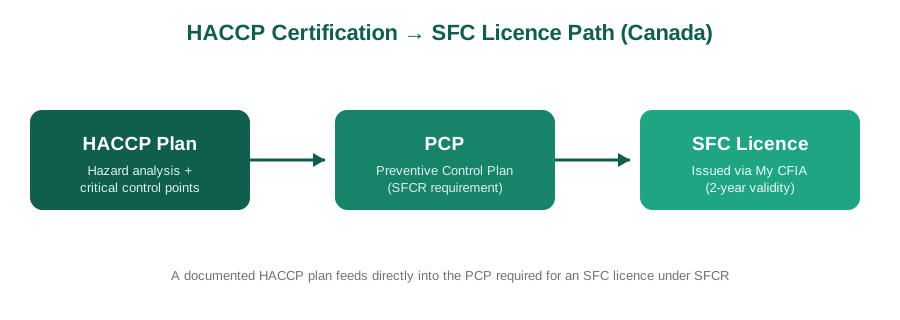
For most manufacturers, this is the only path that's actually mandatory:
- Build a Preventive Control Plan covering hazard analysis, CCPs, monitoring, and corrective actions — the same discipline as a HACCP plan.
- Apply for an SFC licence through My CFIA, including the Food Safety Supplemental Information (FSSI) questionnaire for each establishment.
- Maintain the licence, which is valid for two years and renewable through the same portal starting 120 days before expiry.
- Be subject to CFIA verification and inspection against your PCP, not a separate HACCP audit.
For manufacturers who also sell into the US, our guide to what SFCR requires covers how this compares to FSMA's preventive controls rule. For the mechanics of the licence application itself, see our step-by-step SFC licence walkthrough.
The Voluntary Path: Third-Party HACCP Certification
Third-party HACCP system certification is a separate, optional step where an accredited body audits your HACCP system against a recognized standard — for example, BNQ's program evaluates compliance against FSEP requirements. Businesses typically pursue this when a specific buyer, retailer, or export market asks for documented third-party verification beyond what an SFC licence alone demonstrates. It doesn't replace the SFC licence requirement, and it isn't necessary for most domestic manufacturers unless a customer specifically asks for it.
How to Get Started
Practically, most Canadian food manufacturers should:
- Confirm whether the SFCR applies to your specific activities and food types.
- Build (or review) a Preventive Control Plan using HACCP's hazard-analysis discipline.
- Apply for an SFC licence via My CFIA if you don't already hold one.
- Only pursue third-party HACCP certification if a buyer or export market specifically requires it.
Keeping the hazard analysis, monitoring records, and corrective-action documentation connected — rather than scattered across binders and spreadsheets — is what makes both CFIA verification and any buyer-requested certification audit faster. See IONI Food Safety Software for how manufacturers keep this documentation audit-ready.
FAQ
Is HACCP certification legally required to sell food in Canada?
Not as a standalone certificate. What's legally required under the SFCR is a Preventive Control Plan built on HACCP principles and, for most manufacturers involved in interprovincial or international trade, an SFC licence from CFIA. Third-party HACCP certification is voluntary.
What's the difference between an SFC licence and HACCP certification?
An SFC licence is the mandatory CFIA authorization to carry out specific food activities, backed by your Preventive Control Plan. Third-party HACCP certification is a separate, optional audit against a HACCP-based standard, typically requested by specific buyers rather than by CFIA.
How long does an SFC licence last?
An SFC licence is valid for two years from the date it was issued or renewed, unless cancelled, deactivated, or surrendered earlier.
Who certifies HACCP systems in Canada?
CFIA verifies Preventive Control Plans as part of SFC licensing. For voluntary third-party HACCP certification, bodies such as BNQ audit food safety systems against HACCP-based standards like FSEP.
Does a HACCP certificate replace an SFC licence?
No. They serve different purposes — the SFC licence is the mandatory regulatory authorization; third-party HACCP certification is an optional, additional layer some buyers request.