.png)
The Canadian Food Inspection Agency (CFIA) is the federal, science-based regulatory body responsible for safeguarding Canada's food supply and the plant and animal resources it depends on. It administers and enforces the Safe Food for Canadians Regulations (SFCR), licenses and inspects food establishments, and verifies that domestic and imported food products meet Canadian requirements.
What the CFIA actually does
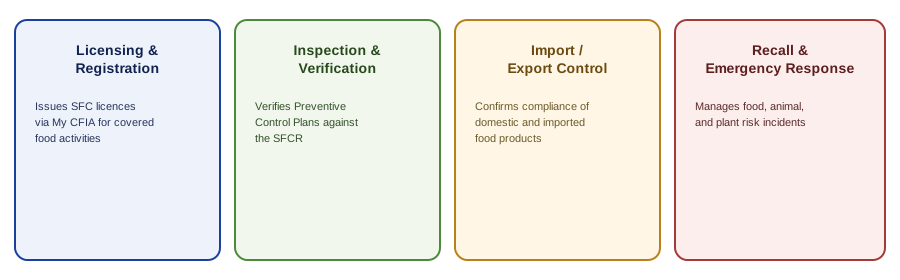
Per the CFIA's own mandate, mitigating risks to food safety is its highest priority, working in partnership with industry, consumers, and provincial and municipal organizations. In practice, that mandate breaks down into a few concrete functions: issuing Safe Food for Canadians (SFC) licences through the My CFIA portal, verifying that a licence holder's Preventive Control Plan actually meets SFCR requirements, confirming the compliance of both domestic and imported food products — including label content — and managing food, animal, and plant risk incidents and emergencies, including recalls. See our guide to what CFIA requires on a food label for the labelling side of that verification work specifically.
CFIA and the Safe Food for Canadians Regulations
For most food manufacturers, the CFIA relationship starts with the SFCR. Our guide to what SFCR requires covers who needs an SFC licence and what a Preventive Control Plan has to include; our step-by-step guide to getting an SFC licence walks through the actual My CFIA application process, current fees, and renewal timing. HACCP principles are built directly into that Preventive Control Plan requirement rather than existing as a separate CFIA certification — see our guide to HACCP certification in Canada for how that distinction actually works in practice.
CFIA vs. FDA: a quick comparison
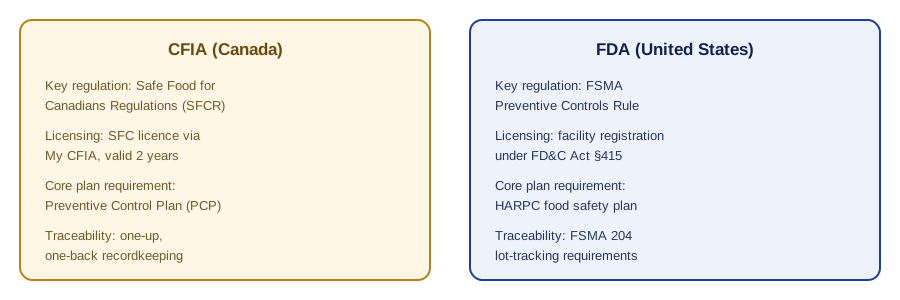
Manufacturers selling into both markets often need to satisfy the CFIA and FDA at the same time, and the two systems are structurally similar without being interchangeable. The CFIA's SFC licence and Preventive Control Plan roughly parallel FDA's facility registration and HARPC food safety plan requirement, and both regulators require lot-level traceability recordkeeping, though the specific data elements, formats, and legal basis differ. Meeting one regulator's requirements does not automatically satisfy the other.
Where IONI fits
Manufacturers selling into the US, Canada, or both need their Preventive Control Plan and supporting documentation to satisfy CFIA verification, FDA inspection, or both at once — without maintaining two disconnected systems. See how IONI helps food manufacturers keep compliance documentation audit-ready across FSMA, BRCGS, and SQF requirements.
Frequently asked questions
What does CFIA stand for?
CFIA stands for the Canadian Food Inspection Agency, the federal body responsible for enforcing Canada's food safety regulations, including the Safe Food for Canadians Regulations.
Is the CFIA the same as the FDA?
No. The CFIA is Canada's food safety regulator; the FDA is the equivalent US regulator. They enforce separate national regulations, and compliance with one does not automatically satisfy the other.
Do I need to deal directly with CFIA if I sell food in Canada?
Most businesses that manufacture, process, import, export, treat, or package food for the Canadian market need an SFC licence issued by CFIA and are subject to CFIA verification of their Preventive Control Plan.
Does CFIA certify HACCP plans?
Not as a standalone certificate. CFIA verifies that a licensee's Preventive Control Plan, which is built on HACCP principles, meets SFCR requirements. Separate, voluntary third-party HACCP certification exists but isn't required by CFIA itself.