A training matrix for food manufacturing is a grid that lists every role in the plant against the trainings that role needs, how often each is repeated, and when each person last completed it. It is the quickest way to show an auditor who is trained on what, and to spot who is overdue.
This guide gives a sample training matrix, explains what FDA expects, lists refresher triggers and covers the records behind the grid. It builds on our guide to GMP training for food plant employees.
What a Training Matrix Is
The matrix answers three questions at a glance: what training does each role require, who has completed it, and when does it expire. It does not replace the training itself or the signed record; it is the index that makes both findable.
Training Matrix Template for a Food Plant
The example below is a starting point. Adjust roles and frequencies to your products, your hazard analysis and your customers' requirements.
| Training | Production operator | Sanitation | Maintenance | QA / supervisor | Frequency (example) |
|---|---|---|---|---|---|
| GMPs and personal hygiene | Required | Required | Required | Required | At hire, then annually |
| Allergen awareness and cross-contact | Required | Required | Required | Required | At hire, then annually |
| Sanitation procedures and chemical handling | As needed | Required | As needed | Required | At hire, on procedure change |
| Metal detector, scale and equipment checks | Required | Required | Required | At hire, on equipment change | |
| Corrective action and deviation reporting | Required | Required | Required | Required | At hire, then annually |
| Food defense awareness | Required | Required | Required | Required | At hire, then annually |
| HACCP and food safety plan review | Required | On plan reassessment | |||
| Internal audit | Assigned auditors | At assignment, then as needed |
What FDA Expects
Under 21 CFR 117.4, each individual engaged in manufacturing, processing, packing or holding food, including temporary and seasonal staff, must receive training in the principles of food hygiene and food safety, including the importance of employee health and personal hygiene, as appropriate to the food, the facility and the individual's assigned duties. Supervisors must be assigned responsibility for compliance and have the education, training or experience to oversee production of clean and safe food. Records that document the required training must be established and maintained.
Specialist roles have their own requirement. For the preventive controls qualified individual, 21 CFR 117.180 requires training at least equivalent to an FDA-recognized standardized curriculum, or equivalent job experience, and requires that applicable training be documented with the date, type of training and people trained.
What SQF and BRCGS Audits Look For
Certification schemes expect documented training and demonstrated competence for roles that affect food safety. Check the current edition of your scheme for exact clause wording. Our guides to the SQF audit checklist and to food safety culture under SQF Edition 10 show how training evidence fits into the wider audit.
How to Build the Matrix, Step by Step
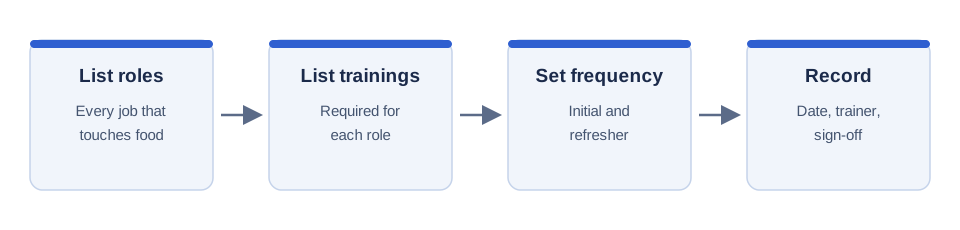
- List every role that touches food, packaging or food-contact equipment, including temporary staff.
- List the trainings each role needs, starting from GMPs, allergens, sanitation and the controls in your food safety plan.
- Set an initial deadline (before unsupervised work) and a refresher frequency for each.
- Record each completion with the date, trainer, content and a sign-off by the employee.
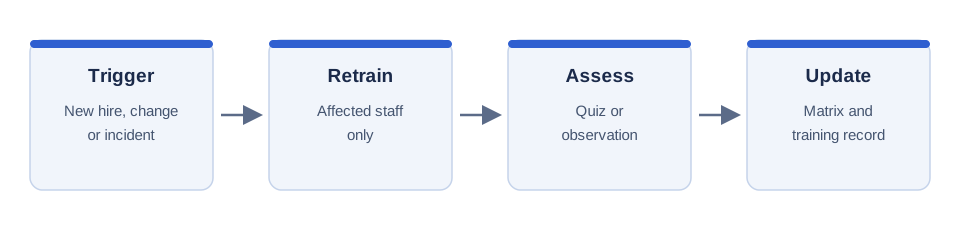
- Add an assessment where competence matters, such as an observed task or a short quiz.
- Review the matrix at least annually and whenever the process, equipment or plan changes.
Refresher Triggers
- A new hire or a transfer to a different area.
- A new or changed procedure, recipe, allergen or piece of equipment.
- A deviation, audit finding, customer complaint or recall that points to a training gap.
- A change in regulation or in the standard you are certified to.
Audit Records Behind the Matrix
| Record | What it shows |
|---|---|
| Sign-in or completion record | Who attended, the date and the trainer |
| Training content or SOP reference | What was covered, and which document version |
| Assessment result | That the person understood, not only attended |
| Retraining record | What was done after an incident or change |
| Role description | Why that person needed that training |
Where IONI Fits
IONI is the production and traceability layer that runs on top of the QuickBooks you already have. Its training records track employee training on documents and SOPs, so a procedure change can be tied to who has been trained on it. The matrix design, frequencies and the training content itself remain your decisions.
FAQ
What is a training matrix?
A grid of roles against required trainings, showing frequency and completion dates, so you can see who is trained and who is overdue.
Does FDA require food employees to be trained?
Yes. 21 CFR 117.4 requires training in food hygiene and food safety appropriate to the food, the facility and the person's duties, and requires records of that training.
How often should food plant employees be retrained?
The regulation does not set a fixed interval. Many plants retrain annually and whenever a procedure, product or incident requires it.
Is a training matrix required for SQF or BRCGS?
Both schemes expect documented training and competence. Check the current wording of your scheme on format; a matrix is a common way to show it.
What should a training record include?
The date, trainer, topic or document trained on, the person trained and a sign-off, plus any assessment result.
Last updated: October 21, 2026
Keep the production record where the work happens. Explore IONI's production and traceability software for food manufacturers.