.png)
Halal certification is a third-party verification that a food manufacturer's ingredients, processes and facility meet a certifier's halal standard. In the US it is issued by private certifying bodies such as IFANCA and Islamic Services of America (ISA) after an application, document review, facility audit and committee decision. It is separate from food safety certification.
Last updated: October 7, 2026
This guide describes what US certifiers publish about their own processes. It does not give religious rulings: halal requirements are set by each certifier and by the rules of the market you sell into, so always confirm specifics with the certifier you choose.
What Halal Certification Covers
A halal certifier reviews what goes into a product and how it is made. IFANCA, for example, lists food, beverages, cosmetics and personal care, nutritional and dietary supplements, and pharmaceuticals among the categories it certifies (IFANCA). ISA's published process starts by confirming the source of origin of every ingredient and, for meat and poultry, how the animal was slaughtered (ISA).
What halal certification does not cover is food safety. A halal certificate says nothing about whether your hazard controls, sanitation or recall plan would pass an audit. Those questions belong to your food safety system and, if a customer requires it, to a GFSI-benchmarked scheme.
Halal Certification Bodies in the US
There is no single national halal authority in the US. Private organizations certify, and their standards, fees and recognition abroad differ. Two long-established certifiers publish their processes online:
| Certifier | What it publishes about scope | Process as published | Fees as published |
|---|---|---|---|
| IFANCA (Islamic Food and Nutrition Council of America) | Food, beverages, cosmetics and personal care, supplements, pharmaceuticals | Application, agreement and price quote, technical review, on-site audit, final review and certification | No amounts; a fee quote or invoice comes with the contract |
| Islamic Services of America (ISA) | Product lines including meat, poultry and flavors; facility and per-product certification | Inquiry, application, service agreement, product review, facility audit, committee review, certificate | Fee categories listed (audit, travel, facility, product review, per-product); no amounts |
Sources: IFANCA certification process, ISA certification basics. Other certifiers exist, and some export markets keep their own lists of recognized bodies, so check recognition before you choose.
The Halal Certification Process, Step by Step
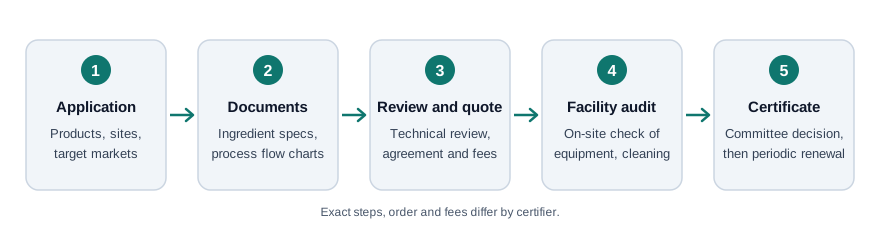
Certifiers word the steps differently, but the published processes share the same backbone:
- Inquiry and application. You describe your products, facility locations and target markets. ISA's application covers facility locations, contacts, product categories, product counts and, for private label, who owns the formula.
- Ingredient and process documentation. ISA's quality assurance team requests product lists, ingredient specifications and statements, and process flow charts. IFANCA's application likewise asks for ingredient and process detail.
- Agreement and quote. IFANCA sends a contract with a fee quote or invoice at this stage. ISA executes a service agreement before the audit is scheduled.
- Technical review. The certifier checks the submitted documents, and may ask you to replace ingredients that do not meet its guidelines.
- Facility audit. An auditor inspects the plant on site. ISA sends a pre-audit checklist and sets the date once questions are resolved.
- Committee review and certificate. ISA's halal committee reviews the audit report and approves or denies; IFANCA lists a final review and decision. After that, the certificate is issued.
- Renewal. ISA states that facility and product certifications are good through the end of the current calendar year. IFANCA's process page does not describe renewal, so ask about renewal terms and re-audit frequency in your quote.
Timelines depend on how many products you certify and how quickly you can supply documents, and the certifiers do not publish a standard duration.
Ingredient and Supplier Documentation You Will Need
Most delays come from incomplete ingredient records, not from the audit itself. Expect the certifier to ask for:
- Complete ingredient and raw material listings for every product, with manufacturer identification when requested. ISA states all ingredients must be halal, although it may approve halal-sensitive materials from internationally recognized sources at its discretion (ISA).
- Animal-derived ingredients. ISA's example is gelatin in yogurt, which can be pork-derived, and it says animal enzymes must be plant-based or halal certified (ISA). Capture the animal source and the supplier's certificate for each such ingredient.
- Flavors and alcohol. For flavors, ISA assesses critical ingredients such as alcohol and colors. Ask flavor suppliers for the carrier and solvent in writing.
- Processing aids and release agents. ISA asks about factors such as release agents, so list them even though they never appear on the label.
- Shared lines and cross-contact. ISA asks whether other products on the processing line are halal. An IFANCA article, dated 2011, says its facility inspection covers equipment, cleaning, sanitation and cross-contamination risk (IFANCA); confirm current practice with the certifier. Cleaning records and line sequencing become evidence here, much as they do for allergen control (see our guide to allergen management).
- Supplier certificates. Halal certificates from ingredient suppliers, kept current. Our ingredient compliance checklist shows how to structure the specification and document set, and the same discipline helps with food fraud and VACCP, because an unverified ingredient source is exactly where substitution risk hides.
Halal Certification Cost
None of the certifiers above publishes a price list. IFANCA states that a fee quote or invoice accompanies the contract, and ISA lists the categories it invoices: an audit inspection fee, travel expenses and auditor per diem, facility certification, a one-time product review charge and per-product certification. Cost is therefore quote-based and typically varies with the number of products, facility size and complexity, the audit's travel requirements and the markets you sell into. Request quotes from more than one certifier and ask what is included in renewal.
Export Markets: Destination Rules Matter
A halal certificate that works in one market may not be accepted in another. Indonesia is a current example. According to Australia's Department of Foreign Affairs and Trade, Indonesia's Halal Law requires food and beverage products, including raw ingredients and additives, to be halal certified from 17 October 2026, and the regulator BPJPH took over functions previously handled by the Indonesian Ulema Council. The same source says exporters can certify directly with BPJPH or through a foreign certification body approved by BPJPH for the product scope, and that the Indonesian importer registers the certificate on BPJPH's portal (DFAT). IFANCA publishes a separate certification-process page for Indonesia (IFANCA). Rules change, so check the destination regulator and your certifier before you ship.
Halal vs. Kosher vs. GFSI-Benchmarked Schemes

| Halal certification | Kosher certification | GFSI-benchmarked scheme (SQF, BRCGS, FSSC 22000) | |
|---|---|---|---|
| What it is | Third-party verification against a halal standard | Third-party verification against kosher requirements | Audited certification of a food safety management system |
| Who sets or recognizes it | Each certifier, plus destination-market regulators | The kosher certification agency | Scheme owner sets it; GFSI recognizes programs that meet its benchmarking requirements |
| What it covers | Ingredient sources, processes, equipment and cross-contact | Ingredients, equipment and production | Hazard control, GMP, supplier approval, traceability, food safety culture |
| Relationship to food safety | Separate; not a food safety audit | Separate; not a food safety audit | Food safety is the purpose |
Kosher follows a similar pattern to halal: the OU, for instance, describes an application with ingredient and plant details, a plant inspection by a rabbinic field representative and a contract before a letter of certification is issued (OU Kosher). GFSI says it does not certify anything itself; it recognizes certification programs that meet its benchmarking requirements, and its stated vision is "Safe food for people everywhere" (GFSI). Halal status is a different question answered by a different body, so a SQF, BRCGS or FSSC 22000 certificate does not by itself tell a customer your product is halal. Our guide to GFSI schemes and how to choose the right one covers the food safety side, and many manufacturers hold both.
Keeping the Evidence in One Place
Halal certification is document-heavy: ingredient specifications, supplier certificates, process flow charts, cleaning and changeover records, and the audit trail that proves it. IONI's public food safety software page says it reads uploaded documents such as SOPs, recipes, ingredient specs and supplier certificates, keeps COAs and supplier certifications in one place with expiry alerts, and records checks and logs automatically. The page does not describe a halal-specific module, so treat it as a place to organize the evidence a certifier will ask for, not as a halal certifier or a substitute for one.
Frequently Asked Questions
What is halal certification for food manufacturers?
It is third-party verification that your ingredients, processes and facility meet a certifier's halal standard. The certifier reviews documents, audits the plant and, after committee review, issues a certificate you can use on approved products.
Who provides halal certification in the US?
Private certifying bodies, including IFANCA and Islamic Services of America. There is no single national authority, and standards and market recognition differ by certifier, so confirm which body your customers and destination markets accept.
How much does halal certification cost?
The certifiers reviewed here do not publish prices. IFANCA provides a fee quote with its contract, and ISA invoices audit, travel, facility and product fees. Cost is quote-based and varies with products, facility and markets.
Is halal certification the same as food safety certification?
No. Halal certification verifies halal status. Food safety certification, such as a GFSI-benchmarked scheme like SQF, BRCGS or FSSC 22000, verifies a food safety management system. Neither replaces the other.
Does halal certification need to be renewed?
Generally yes, certification is time-limited. ISA states facility and product certifications are good through the end of the current calendar year. Ask your certifier for its renewal terms and re-audit frequency in writing.
What documents do I need to apply?
Expect product lists, ingredient specifications and statements, process flow charts, details on animal-derived ingredients, alcohol in flavors, processing aids and release agents, and information on shared production lines.