.png)
Outsourcing manufacturing is no longer a transitional model for emerging brands. It is a structural strategy used by multinational food companies and scaling challenger brands alike. Yet while production is outsourced, regulatory responsibility is not. The brand name on the label remains accountable for safety, legality, and transparency in every market where the product is sold. That reality places Ingredient Compliance at the center of outsourced operations.
In 2025, recall data reinforced what many of us in food safety have observed for years. Undeclared allergens remained the leading cause of recalls across major markets, and overall recall volumes increased significantly in the third quarter of 2025 according to reporting summarizing FDA and FSIS data (Food Safety News, December 2025).
A separate 2025 report analyzing U.S. recall trends highlighted that undeclared allergens accounted for the highest percentage of recall events, while concerns about recall timeliness and transparency persisted (Food Safety Magazine, 2025 report coverage).
Those figures are not abstract. In outsourced models, allergen mismanagement, outdated specifications, undocumented substitutions, and incomplete traceability typically sit at the root of these events. The pattern is clear: when Ingredient Compliance is treated as a document exchange exercise rather than a controlled system, drift accumulates until it becomes visible in the form of a recall.
This is why an operational Ingredient Compliance Checklist must exist not only on paper, but as an enforceable, auditable framework embedded across brand and co packer workflows.
What Ingredient Compliance Means When You Don't Own a Factory
When a brand does not own the production facility, Ingredient Compliance becomes an exercise in structured governance rather than physical control. The co packer purchases ingredients, receives deliveries, manages storage, and executes manufacturing steps.
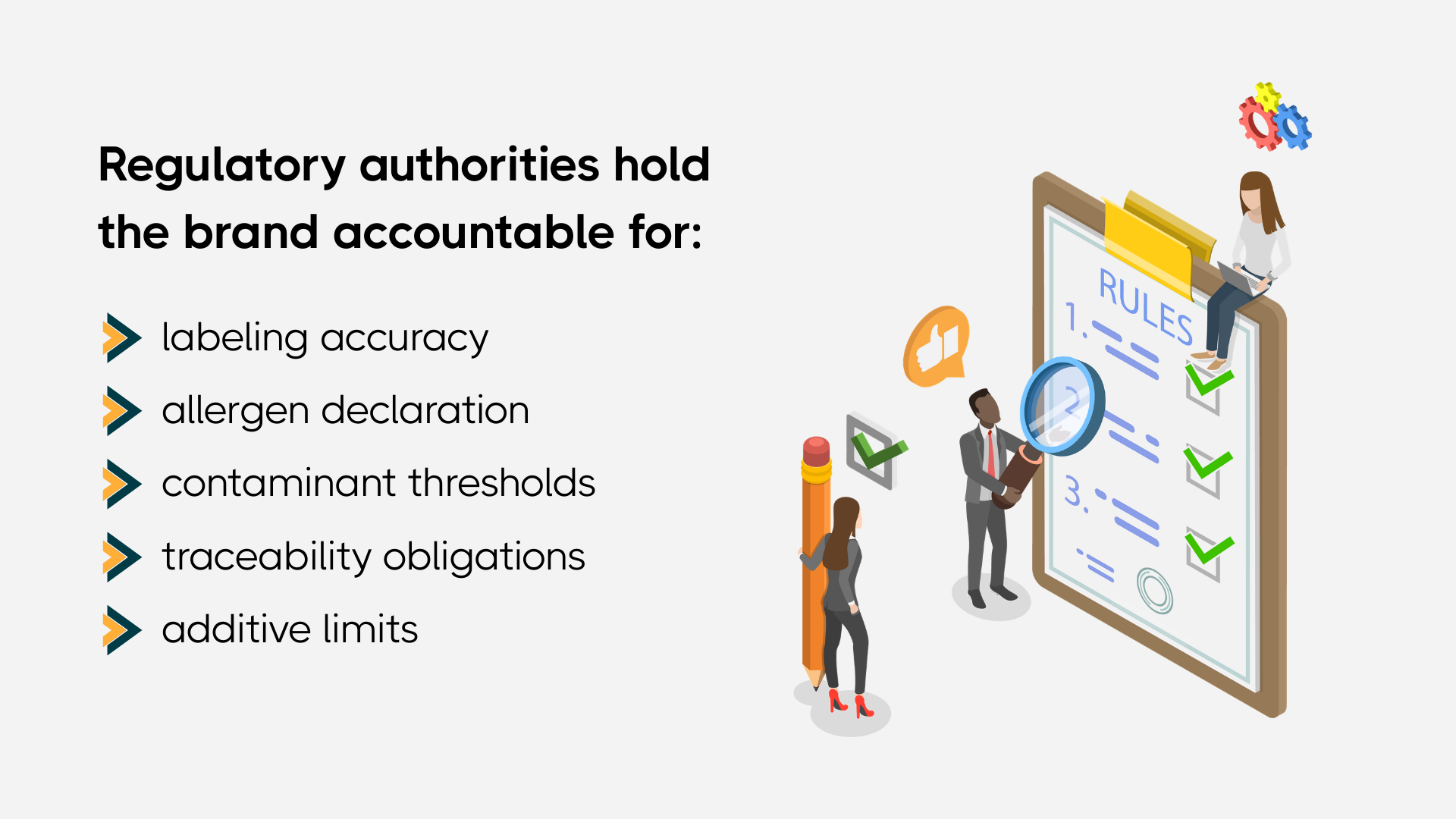
However, regulatory authorities will still hold the brand accountable for labeling accuracy, allergen declaration, additive limits, contaminant thresholds, and traceability obligations.
In practical terms, Ingredient Compliance means that the brand must retain authoritative oversight of ingredient approval, supplier qualification, specification control, and change management, even if operational execution occurs elsewhere.
Many brands mistakenly assume that a signed co packing agreement is sufficient. In reality, regulatory enforcement in 2025 continues to reinforce that oversight cannot be contractually delegated away. Where documentation gaps exist between brand records and co packer practice, authorities view this as systemic control failure.
The modern Ingredient Compliance Checklist must therefore function as a shared but brand governed system. It must define which ingredients are approved for which SKUs and markets, which suppliers are authorized, what evidence is required per lot, how substitutions are handled, and how traceability data flows upstream and downstream.
This is where digital governance platforms such as IONI become critical. Rather than relying on spreadsheet approvals and email chains, IONI structures Ingredient Compliance into controlled workflows that link ingredient data, specifications, supplier documentation, and SKU level mapping into one governed environment.
The operational transformation described in one of our previous articles demonstrates how AI driven validation prevents silent approval drift between documents and actual use.
In outsourced manufacturing, your Ingredient Compliance Checklist becomes your control tower.
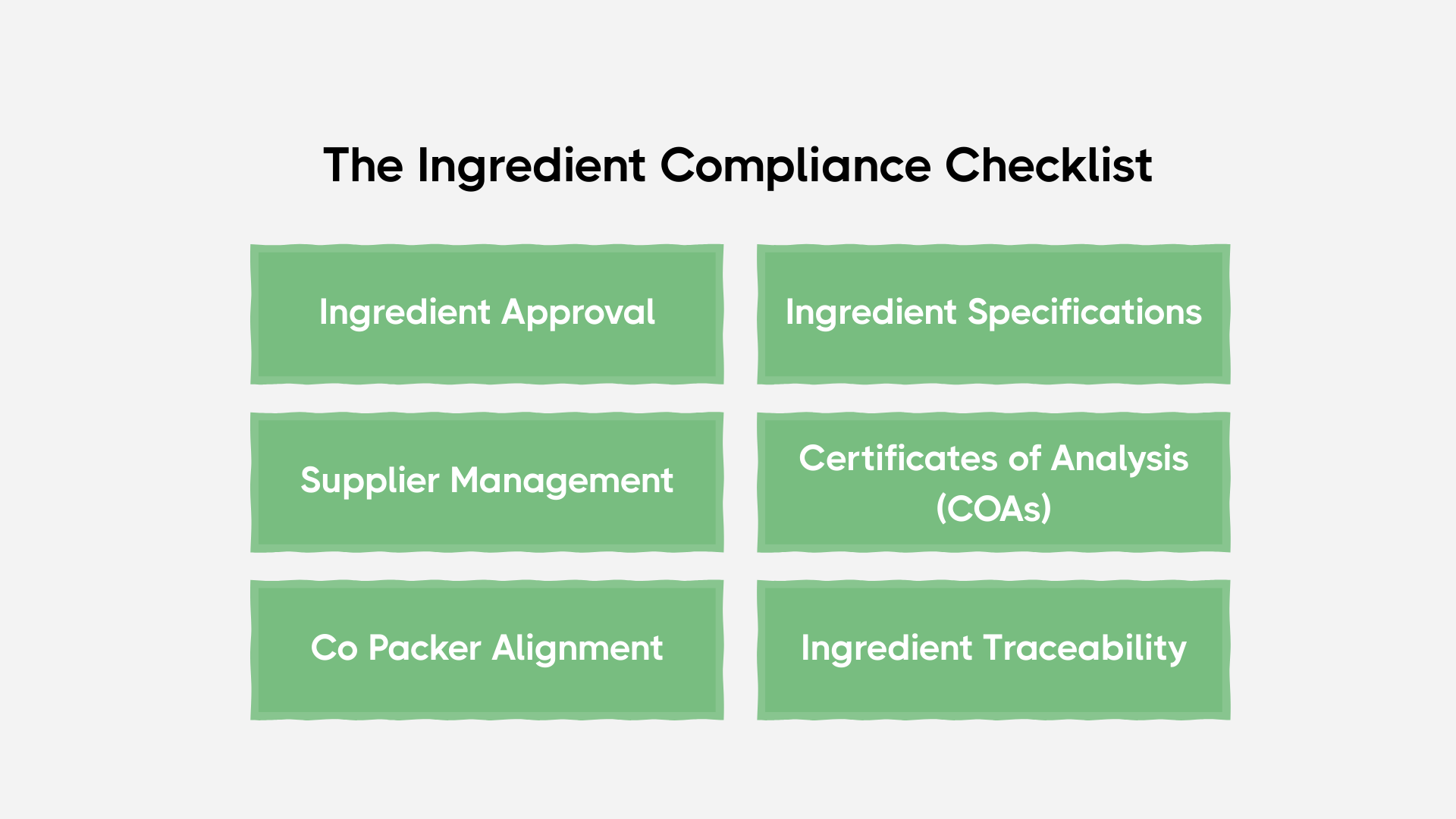
The Ingredient Compliance Checklist
The Ingredient Compliance Checklist is not a static document. It is a layered control system. Each layer reinforces the others. Weakness in one layer undermines the whole structure.
Ingredient Approval
- Defined use
- Allergen status
- Regulatory fit
Ingredient approval begins with defined use. Every ingredient must be explicitly linked to specific SKUs, formulations, and target markets. Without this linkage, an ingredient can migrate informally into unintended products or jurisdictions.
Allergen status requires more than collecting a supplier statement. It demands verification against finished product labeling and cross contact risk assessment. Given that undeclared allergens continue to dominate recall statistics in 2025, brands cannot afford ambiguity.
Regulatory fit extends beyond allergen considerations. It includes additive permissions, maximum residue levels, fortification limits, and claims compliance. An ingredient acceptable in one jurisdiction may trigger reformulation or relabeling in another. For ingredients sourced from foreign suppliers, that same fit review is where FSVP verification obligations get flagged, and for ingredients on USDA's bioengineered foods list, it's where a BE disclosure requirement gets caught before it becomes a labeling gap.
IONI embeds ingredient approval into structured review workflows. Regulatory, quality, and product development stakeholders review defined use, allergen classification, and market alignment before approval is activated. This ensures Ingredient Compliance decisions are recorded, version controlled, and auditable.
Ingredient Specifications
- Current spec version
- Critical limits
- Storage & handling
Specifications form the technical foundation of Ingredient Compliance. They define microbiological criteria, chemical thresholds, physical characteristics, and sensory attributes.
Increased regulatory scrutiny in 2025 has focused on contaminant management and pathogen control in ready to eat categories. Where specification versions are not synchronized across all production sites, enforcement exposure increases.
The Checklist must confirm that every co packer operates using the current approved specification version. Critical limits must align with the brand's hazard analysis. Storage and handling requirements must be clearly documented and implemented.
IONI app centralizes specification governance, automatically triggering review when new versions are uploaded and mapping changes to affected SKUs and facilities. This prevents the common failure mode where specification updates are communicated but not operationalized.
Supplier Management
- Approved suppliers
- Risk level assigned
- Re approval process
Supplier management in outsourced manufacturing is often diluted because co packers maintain their own approval lists. However, Ingredient Compliance requires brand visibility and control over supplier authorization.
Risk level assignment must reflect ingredient hazard profile, geographic sourcing risk, historical performance, and regulatory sensitivity. Re approval processes must include periodic review of audit status, performance data, and documentation completeness.
IONI integrates supplier risk assessment with ingredient approval and SKU mapping, creating a dynamic governance model. Instead of static supplier lists, risk scoring and documentation status are continuously visible, reducing blind spots that frequently surface during audits.
Qualification and re-approval works best when it is treated as a repeatable workflow rather than a one-time review, with risk level, documentation status, and audit history tracked continuously for every approved supplier.
The broader evolution of AI supported audit readiness described in our article shows how continuous control monitoring replaces episodic audit preparation.
Certificates of Analysis (COAs)
- Lot level COAs
- Spec alignment
- Expiry tracking
COAs are often treated as administrative paperwork. In reality, they are one of the most direct evidentiary links between ingredient safety and finished product compliance.
Each lot must be accompanied by a COA aligned to the approved specification. Results must be verified against critical limits. Expiry and retest periods must be monitored.
In recall investigations, lack of lot level evidence frequently complicates traceability and root cause analysis. A structured Ingredient Compliance Checklist requires clear rules for COA collection, verification, and storage.
IONI digitizes COA validation, cross referencing lot data against approved specifications and flagging deviations in real time. This reduces manual review burden while strengthening defensibility.
For the practical version of this same check — what a receiver should confirm on every incoming shipment, and what dedicated software should do with that data — see our guides to a receiving inspection checklist for food manufacturers and quality inspection software for food manufacturers.
Ready to try? Feel free to book a demo with us and see how IONI may help you.
Co Packer Alignment
- Approved ingredient lists
- No substitutions without approval
- Format & requirement alignment
Misalignment between brand approved ingredient lists and co packer purchasing practices remains one of the most common compliance breakdowns in outsourced models.
Substitutions during shortages must follow a defined approval pathway. Format alignment ensures that ingredient codes, naming conventions, and documentation structures match across systems.
Ingredient Compliance requires continuous synchronization between brand data and co-packer operations. IONI supports structured integration by mapping approved ingredient lists to SKU level data and enforcing substitution review workflows.
The operational resilience benefits of structured compliance automation are further explored in our recent blog post, where automation reduces the lag between regulatory requirement and procedural alignment.
Ingredient Traceability
- Supplier to SKU mapping
- Lot traceability
- Recall readiness
Traceability must link supplier, ingredient lot, production batch, and finished SKU. Without clear mapping, recall containment becomes slow and expensive.
The 2025 discussions around recall transparency and timeliness highlighted ongoing industry challenges in executing rapid traceability during incidents (Food Safety Magazine).
IONI integrates ingredient traceability directly into SKU and production mapping, enabling faster isolation of affected lots. The system approach to digital traceability is described in one of our food safety blog posts, where structured data replaces manual reconstruction during crisis.
Effective Ingredient Compliance is inseparable from traceability maturity. If you are evaluating tools for this layer, our food traceability software buyer's guide has a feature checklist and a table of the FSMA 204 critical tracking events.
Change Management
- Spec changes reviewed
- Impact assessed across co packers
Change management represents the final safeguard. Ingredient specification revisions, supplier changes, allergen updates, or process adjustments must trigger impact assessments across all affected SKUs and facilities.
In outsourced environments, change often occurs incrementally and informally. That is precisely how compliance gaps develop.
IONI embeds structured change control into Ingredient Compliance workflows, ensuring that any modification to ingredient data automatically prompts review of labeling, hazard analysis, and co-packer alignment.
The recall prevention value of structured change management aligns with broader risk reduction principles outlined in A Guide to Food Safety Risk Management Software: How Manufacturers Prevent Recalls.
Turning the Checklist Into a Repeatable System
A Checklist that exists only in policy documents will eventually fail under operational pressure. To transform an Ingredient Compliance Checklist into a repeatable system, brands must integrate governance, data control, and accountability mechanisms.
First, approval authority must be clearly defined and digitally enforced. Second, documentation must be version controlled and centrally visible. Third, risk assessment must be dynamic rather than static. Fourth, traceability mapping must be continuously validated.
The financial implications of structured Ingredient Compliance are often underestimated. Recall costs extend beyond product withdrawal. They include logistics, brand damage, retailer penalties, and lost sales.
The financial return on structured compliance governance is discussed in Why ROI Matters in Food Manufacturing (and How IONI Is Finally Delivering It), where automation reduces both direct and indirect risk exposure.
IONI operationalizes the Ingredient Compliance Checklist by turning what is traditionally a fragmented set of documents into a structured, living governance system. In many outsourced manufacturing environments, ingredient data sits in one spreadsheet, supplier approvals in another folder, audit evidence in shared drives, and traceability records inside the co packer's ERP. Each piece may exist, but they rarely speak to each other. That separation is precisely where risk accumulates.
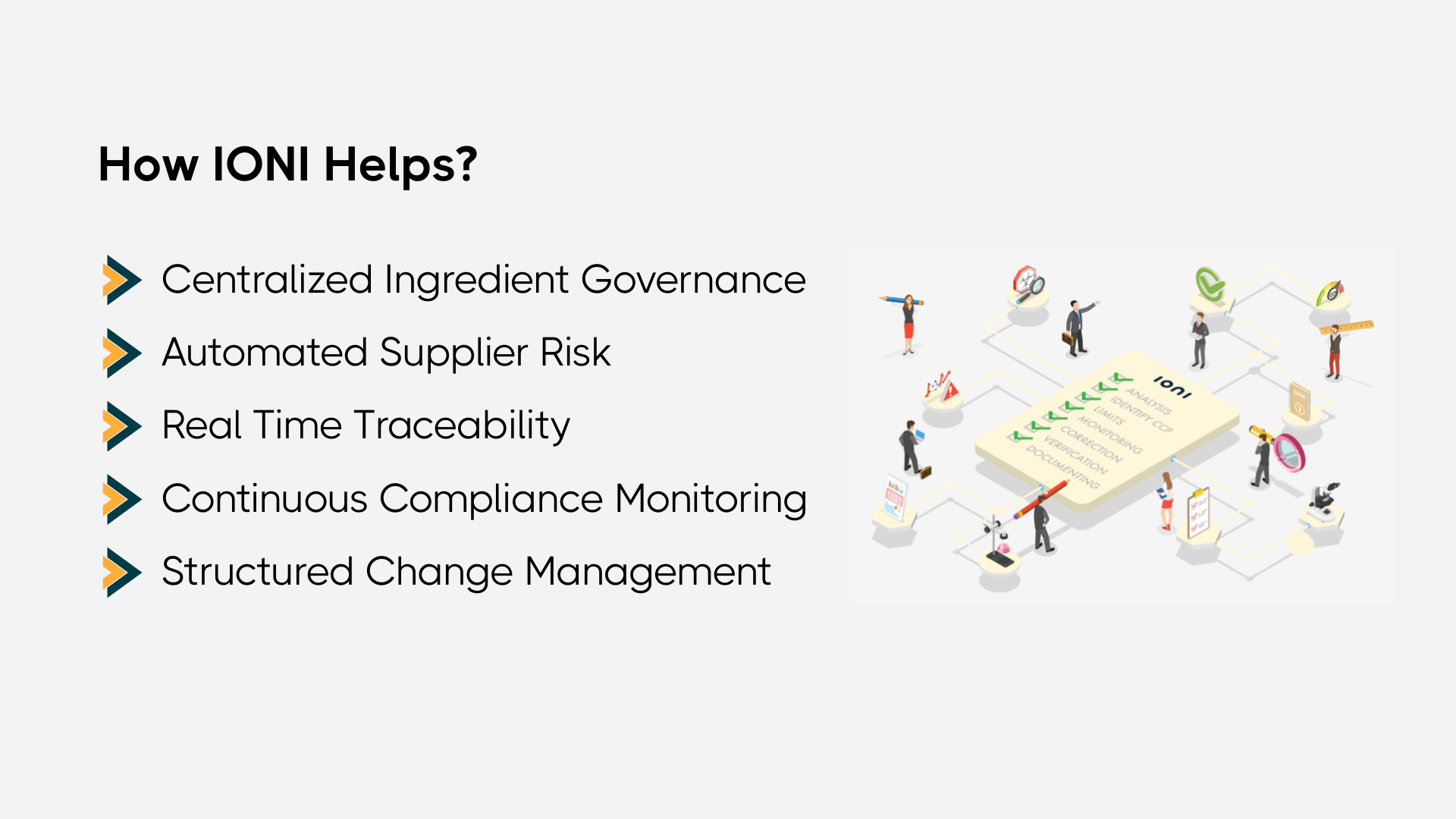
By connecting ingredient data, supplier governance, audit readiness, and traceability into one unified environment, IONI eliminates the silent gaps that typically develop between approval and execution. An ingredient is not simply "approved." It is approved for defined SKUs, defined markets, and defined suppliers, with specifications linked, allergen status mapped, and change control rules embedded.
Supplier documentation is not stored as passive evidence. It is tied to risk level, review cadence, and performance indicators. COAs are not archived as PDFs. They are cross checked against current critical limits. Traceability is not reconstructed during a crisis. It is structured in advance.
This shift fundamentally changes the role of compliance within a brand organization. Instead of quality teams preparing intensively for periodic audits, the system continuously validates alignment between what was approved and what is being used. Instead of discovering during an audit that a co packer is operating with an outdated specification version, discrepancies are surfaced in real time. Instead of reacting to a recall notification from a supplier and scrambling to determine affected SKUs, lot mapping is already structured and accessible.
In an outsourced model, this level of control is not about micromanaging the co packer. It is about maintaining regulatory accountability in a distributed production environment. Regulators increasingly expect brands to demonstrate active oversight, not just contractual language. In 2025, recall reporting and enforcement actions continue to emphasize documentation integrity, allergen governance, and traceability responsiveness. Oversight must be demonstrable, not implied.
A systematic Ingredient Compliance framework allows brands to move from reactive defense to proactive governance. It reduces operational friction because expectations are clearly defined. It strengthens audit outcomes because evidence is structured and retrievable. It protects commercial relationships because deviations are identified early rather than during retailer escalations. Most importantly, it aligns executive visibility with operational reality. Leadership can see risk exposure trends, supplier performance shifts, and compliance health indicators in one place instead of relying on fragmented updates.
IONI makes the Ingredient Compliance Checklist executable. It transforms a conceptual control model into a daily operational discipline. In a world where recall volumes have increased and regulators expect structured oversight, Ingredient Compliance must function as a monitored system with traceable accountability. When compliance becomes systematic, it stops being a cost center and becomes a stabilizing asset for growth.
Ready to try? Feel free to book a demo with us and see how IONI may help you.
Conclusion
Outsourced manufacturing does not reduce regulatory accountability. It increases structural complexity. Ingredient Compliance therefore becomes the backbone of brand protection.
The Ingredient Compliance Checklist described here is not theoretical. It reflects the control layers that regulators expect to see and that recall data in 2025 confirms are necessary.
When ingredient approval is clearly defined, specifications are synchronized, suppliers are risk assessed, COAs are validated, co packers are aligned, traceability is mapped, and changes are governed, risk exposure decreases significantly.
IONI enables this transformation by converting fragmented documentation into structured governance. In outsourced environments, that structure is not optional. It is the difference between controlled growth and uncontrolled exposure.
Ingredient Compliance, when operationalized as a living Checklist embedded in daily workflows, becomes not just a defensive requirement but a strategic advantage.