.png)
Undeclared allergens are still one of the most preventable reasons food products get recalled. The FDA has previously identified undeclared allergens as the leading cause of Class I food recalls for at least a three-year period, which shows how often the failure point is not the absence of a food safety system, but a breakdown inside one specific control.
Production scheduling is one of the simplest allergen controls; our food plant production schedule template shows how to sequence runs around allergens.
That matters because most allergen incidents do not come from a missing binder. They come from a program that exists on paper but fails at one practical point: cross-contact during production, a cleaning step that was never properly validated, a supplier change that did not trigger review, or a label that no longer matches the formulation.
This guide explains what food allergen management actually requires, what an allergen control plan needs to include, how to validate and verify cleaning, and what SQF, BRCGS, and FSSC auditors are likely to check first.
What an Allergen Management Plan Actually Needs to Cover
An allergen management plan, sometimes called an allergen control plan, is the documented system that identifies allergen risks across your facility, controls cross-contact, and verifies that those controls are working.
Allergen control sits inside the broader food safety system as a prerequisite program, but it carries more audit weight than many other PRPs because the consequence of failure can be immediate and serious. If a consumer with an allergy is exposed to an undeclared allergen, the issue can become a recall, a customer complaint, a retailer escalation, or a certification finding very quickly.
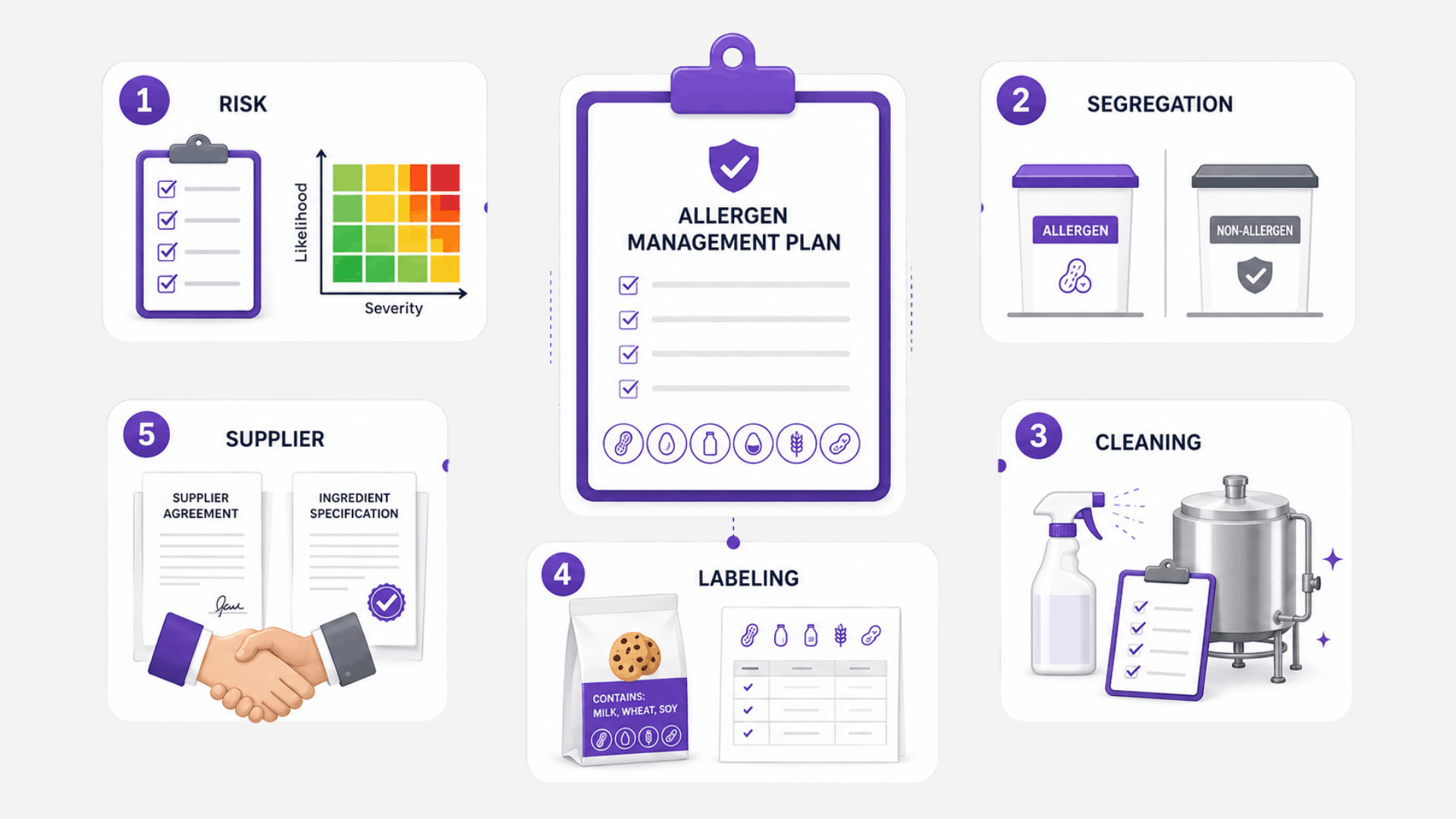
A complete allergen control plan should cover five areas:
- A documented allergen risk assessment covering every raw material, processing aid, and rework stream, not only finished product formulas. The assessment needs to show where allergens enter the facility, where they are stored, which lines and tools touch them, and where cross-contact could occur between receiving and shipping.
- Segregation and cross-contact controls, including physical separation, dedicated utensils or equipment where practical, storage controls, line clearance, and production sequencing that reduces unnecessary allergen changeovers.
- Validated cleaning procedures for allergen changeovers, with evidence that the procedure actually removes allergen residue. A signed sanitation record proves the task was completed. It does not prove the cleaning method works.
- Label and formulation controls that connect recipe changes, ingredient changes, supplier changes, and packaging approval. This is where many real recalls begin: the product changes, but the label does not.
- Supplier coordination, including current allergen declarations for every ingredient and processing aid, plus a defined requirement for suppliers to notify you when allergen status changes. For SQF sites, this should connect directly to the broader supplier approval program, not sit as a separate annual document review.
The plan should be reviewed at least annually and immediately after any change to products, ingredients, suppliers, labels, production lines, or cleaning methods. A plan that was correct last year may no longer reflect the risk in the facility today.
Building the Risk Assessment: Where Most Plans Are Incomplete
The risk assessment is the foundation of allergen management. It is also where many programs look complete but still miss the real exposure points.
Start with a complete allergen inventory. List every allergen present anywhere on site: finished products, raw materials, processing aids, rework, trial ingredients, samples, and anything brought near production by contractors or visitors. In the US, the major allergens under FDA food allergen labeling requirements are milk, eggs, fish, crustacean shellfish, tree nuts, peanuts, wheat, soybeans, and sesame.
Canada is similar, but not identical. Health Canada’s priority allergen list includes eggs, milk, mustard, peanuts, crustaceans and molluscs, fish, sesame seeds, soy, sulphites, tree nuts, and wheat or triticale. That means a US allergen list should not simply be copied into a Canadian-market product review.
Build an allergen risk matrix. For each allergen, assess the likelihood of cross-contact and the severity of the consequence. Likelihood depends heavily on the form of the allergen. A powdered allergen handled in open equipment creates a different exposure profile than a sealed, solid ingredient. Severity depends on the exposed population, the allergen, and the intended market.
Map physical pathways, not only ingredient lists. Walk the actual production flow and ask - practical questions:
- Where does the allergen enter the building?
- Where is it stored?
- Which utensils, bins, scales, conveyors, fillers, mixers, or packaging areas touch it?
- What is downstream of that equipment?
- What happens to rework?
- Could dust, oil, residue, or damaged packaging move the allergen into another product stream?
This is the part a paper-only assessment often misses. Shared rework, shared utensils, shared scales, and airborne particulate from powders are common weak points because they do not always appear in the finished product formula.
Revisit the assessment whenever something changes. A new supplier, ingredient, claim, packaging format, cleaning chemical, rework practice, or piece of shared equipment can change the allergen profile. The trigger should be built into change control, not left for the next annual review.
Teams that struggle to track these changes manually often benefit from a more structured regulatory intelligence process, especially when products move across US, Canadian, or retailer-specific requirements.
Allergen Cleaning Validation: How to Actually Prove It Works
This is the part of allergen management that is most often documented incorrectly.
A cleaning procedure that is followed consistently is not the same as a cleaning procedure that has been proven to remove allergen residue. Auditors distinguish between those two things, and your records should too.
Validation answers: does this method work?
Verification answers: is the validated method still being followed and still effective during normal operations?
Validation is a scientific exercise. It proves that a specific cleaning method removes a specific allergen from specific equipment under defined conditions. Verification is the ongoing operational check that confirms the procedure is being applied correctly after changeovers.
The SQFI allergen management tip sheet points to documented validation and verification of cleaning procedures and other allergen safety procedures used by the site. In practice, that means the validation record is not optional evidence. It is the proof behind the sanitation program.
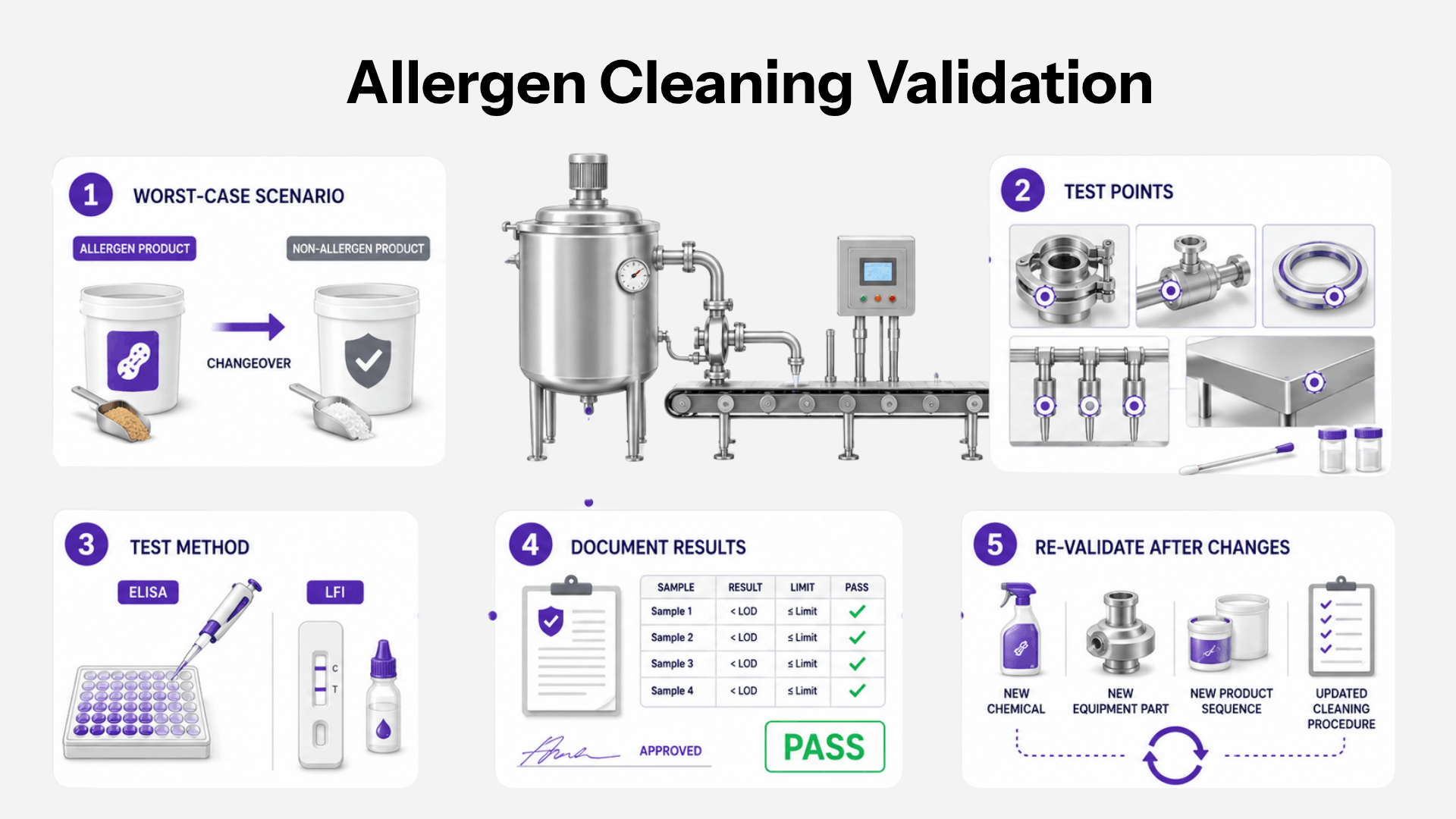
How to run a practical validation study:
- Identify the worst-case scenario.
Choose the product and allergen combination most likely to challenge the cleaning process. This is usually the highest-allergen-content product followed by a non-allergen or different-allergen product on the same line. Do not validate only the easiest changeover and assume the result covers every other scenario.
- Define test points before the study.
Common points include hard-to-clean food-contact surfaces after sanitation, product-contact tools, transfer points, and product samples from the first units after startup. For higher-risk lines, include samples from early, middle, and later production to confirm the cleaning outcome holds through the run.
- Choose the right test method.
ELISA testing is commonly used for validation because it can provide quantitative results for a specific allergen. Lateral Flow Immunoassay testing is faster and often more practical for routine verification because it usually gives a qualitative result. ATP can be useful as a hygiene indicator, but it is not allergen-specific. It should not be treated as proof that a specific allergen has been removed unless your validation work supports that use.
- Document the full record.
A useful validation record should show the allergen tested, product run, equipment, cleaning procedure, sampling locations, method used, results, pass/fail criteria, corrective actions, and approval. This is the evidence auditors ask for. The sanitation SOP alone is not enough.
- Re-validate when conditions change.
A new allergen, new equipment, new cleaning chemical, new production sequence, new tool design, or major line modification can invalidate an old study. A three-year-old validation study on different equipment is not current evidence.
Routine verification should then be built into the production schedule. For example, after allergen changeovers, the site may use LFI testing, visual inspection, pre-operational checks, and documented release criteria before the next product starts. The method should match the risk and the validation evidence.
Label and Formulation Controls: Where Allergen Recalls Actually Happen
Cross-contact gets much of the attention, but many allergen recalls start with labeling. The failure is usually simple: a formulation changed, an ingredient supplier changed, the wrong label roll was loaded, or an old label version stayed in use after a recipe update.
The FDA’s food allergen guidance documents explain how allergen labeling requirements apply to FDA-regulated foods. For manufacturers, the practical takeaway is simple: the label must match the current formula, ingredient declarations, and allergen status before the product reaches production.
Advisory statements need their own discipline. “May contain” statements are not a substitute for controls. FDA guidance on major food allergen labeling and cross-contact explains that advisory statements such as “may contain” or “produced in a facility that also uses” are separate from mandatory allergen declarations. They should not replace current good manufacturing practices, preventive controls, segregation, cleaning, or scheduling.
The review should confirm:
- The label matches the current formula.
- All major allergens are declared correctly.
- Ingredient subcomponents are reviewed.
- Supplier allergen declarations are current.
- Rework allergen status is accounted for.
- The correct packaging version is approved.
- Obsolete labels are removed from use.
- Line clearance includes label and packaging verification.
Advisory statements need their own discipline. “May contain” statements are not a substitute for controls. FDA guidance states that advisory statements should not replace current good manufacturing practices or food allergen preventive controls, and they must be truthful and not misleading.
That means “may contain” should not be used as a blanket liability shield. It should be the result of a documented risk assessment showing that residual cross-contact risk remains even after reasonable segregation, scheduling, cleaning, and handling controls are in place.
“Free from” claims carry even more responsibility. If a product says “peanut-free,” “dairy-free,” or “gluten-free,” the site needs evidence to support the claim. The claim should be tied to supplier controls, formulation review, cleaning validation, and verification testing where appropriate. Under BRCGS Issue 9, unsupported absence claims can become an audit finding because the site is making a product safety and legality claim without adequate evidence.
Catch allergen label gaps before production with IONI Food Safety Software, which connects formulas, supplier declarations, allergen risks, and label review records.
What SQF, BRCGS, and FSSC Auditors Actually Check
SQF, BRCGS, and FSSC 22000 all treat allergen management as a high-risk part of the food safety system. The framing is different, but the practical evidence auditors ask for is similar.
For manufacturers preparing for multiple schemes, it helps to manage allergen control as one connected evidence chain rather than three separate binders. IONI’s FSMA, BRC, and SQF compliance support is built around that kind of linked evidence model, where risk assessments, tasks, records, suppliers, and corrective actions are connected instead of scattered across spreadsheets and folders.
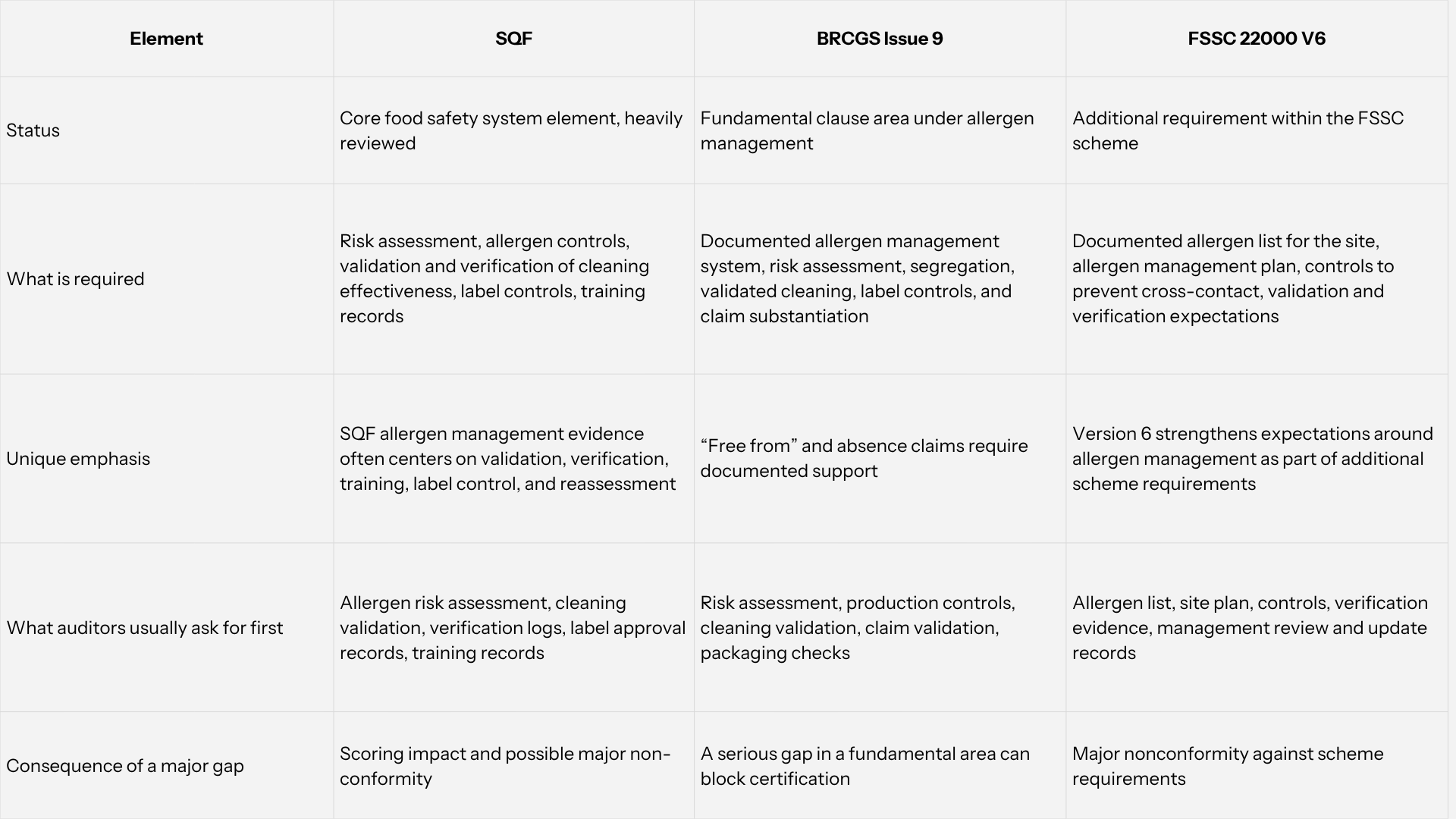
Across all three schemes, auditors usually start with the same evidence:
- The allergen risk assessment.
- The allergen inventory.
- The cleaning validation study.
- Routine verification records.
- Production sequencing records.
- Label review and approval records.
- Supplier allergen declarations.
- Training records for relevant personnel.
- Corrective actions from failed checks.
- Proof that the plan was updated after changes.
For SQF sites, an internal check should not only ask whether an allergen procedure exists. It should ask whether the records prove the procedure is working. The same logic applies to the broader SQF audit checklist: auditors look for evidence linkage, not only policy language.
For BRCGS sites, allergen controls are tested against real operating conditions. Auditors may ask what changed most recently and then trace whether the allergen assessment, supplier documents, formulation, label, and production controls were updated.
For FSSC 22000, the official FSSC 22000 Version 6 documents and FSSC additional requirements should be reviewed directly because allergen management expectations sit within the scheme’s additional requirements. A site that runs several allergen profiles in the same area should be prepared to show how verification confirms the controls are still effective during normal operations.
Prepare for SQF, BRCGS, FSSC, and retailer audits with IONI’s connected audit evidence workflows for allergen risks, cleaning validation, verification logs, and supplier records.
Common Allergen Control Failures and How to Close Them
The risk assessment only covers finished products.
This is one of the most common gaps. Processing aids, rework, supplier-introduced allergens, trial ingredients, and shared tools are left out. Walk the facility and map the physical process, not only the recipe.
Cleaning procedures exist, but no validation supports them.
“We clean the line” is not evidence. A documented validation study should prove that the procedure removes the target allergen under worst-case conditions.
Verification stops after the first validation.
Validation is not a permanent certificate. If the equipment, chemical, product, allergen, sequence, or procedure changes, the validation may no longer apply. Build routine verification into the schedule.
Label review is not connected to change control.
The recipe changes, but the label workflow does not catch up. Make label approval a required gate before production release. For manufacturers managing multiple formulas and supplier inputs, ingredients intelligence can help keep ingredient, allergen, supplier, and specification data connected.
Advisory statements are used without a documented basis.
“May contain” should be backed by risk assessment. If the statement is used broadly without analysis, it can look like weak control rather than caution.
Training does not reach everyone who affects allergen control.
Allergen training should cover production, sanitation, maintenance, warehouse staff, temporary workers, contractors, and anyone who can introduce or fail to control allergen risk. This is not only a training issue. It is part of the facility’s broader food safety culture, because people need to understand why the control matters, not only where to sign.
Supplier allergen status is not actively monitored.
A supplier can change a formula, shared line, processing aid, or facility practice. If your approval program does not require notification of allergen changes, your own allergen assessment can become outdated without anyone realizing it.
Regulatory and customer requirements are checked too late.
Turn scattered allergen records into audit-ready workflows with IONI Food Safety Software, using your existing SOPs, specs, supplier files, and cleaning records.
Building the Allergen Control Plan: A Practical Sequence
Step 1: Complete the allergen inventory and risk matrix.
Identify every allergen on site. Include raw materials, processing aids, rework, trial materials, packaging-related risks, and contractor or visitor risks where relevant. Score each allergen for cross-contact likelihood and severity.
Step 2: Map physical cross-contact pathways.
Walk the flow from receiving to storage, staging, production, rework, sanitation, packaging, and shipping. Identify shared equipment, shared utensils, airborne dust, residue traps, damaged packaging risks, and rework loops.
Step 3: Build and validate cleaning procedures for every relevant changeover.
Use worst-case scenarios. Define sample points. Use allergen-specific testing where appropriate. Document pass/fail criteria and corrective actions. Then define routine verification checks for live operations.
Step 4: Connect label review to formulation change control.
No new or revised label should reach production without documented review against the current formula, supplier declarations, allergen inventory, and destination-market requirements.
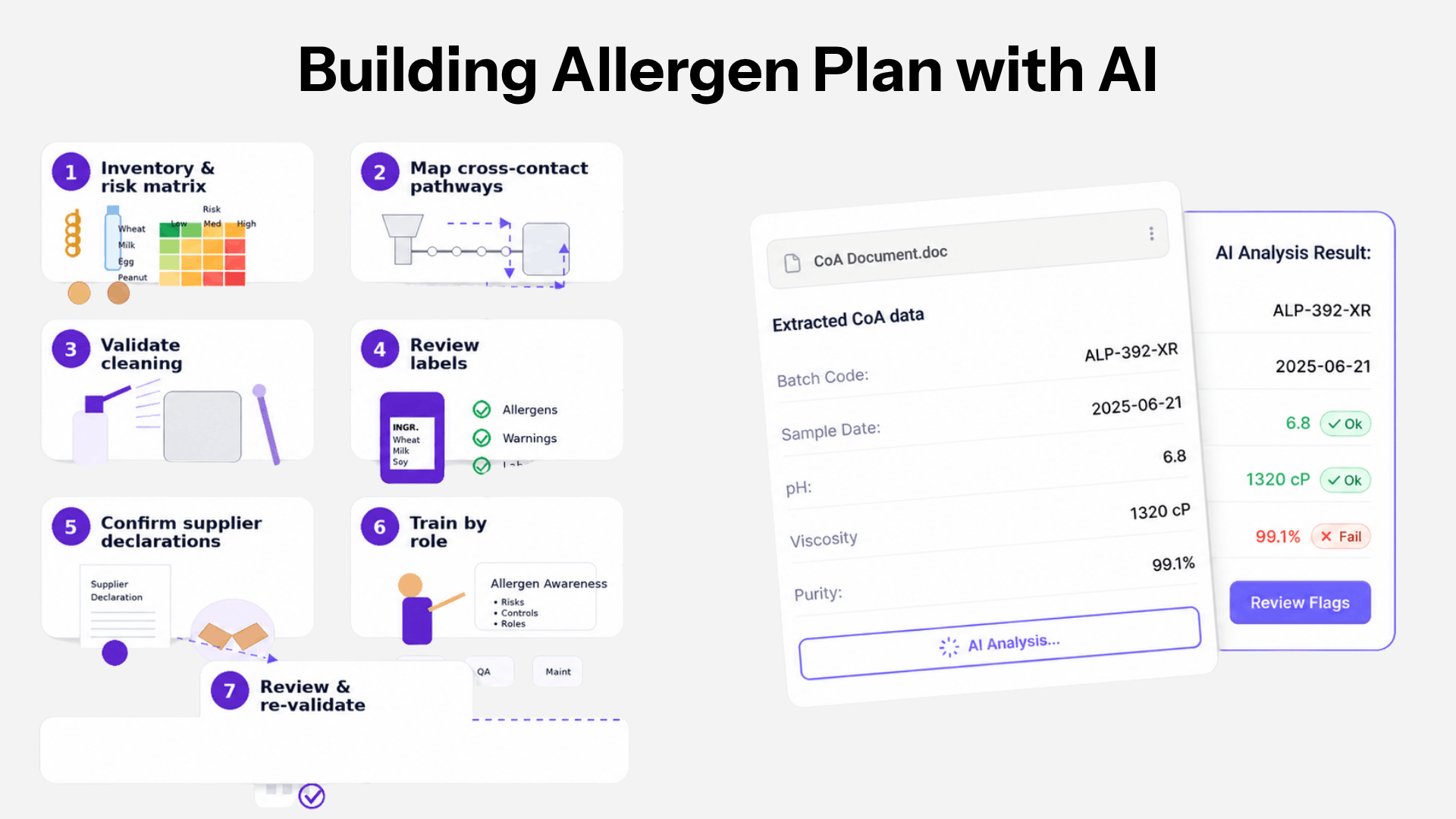
Step 5: Formalize supplier allergen communication.
Require current allergen declarations for every ingredient and processing aid. Add a supplier notification requirement for any allergen-related change. Review allergen status during supplier approval and reassessment.
Step 6: Train by role, not by department.
Production, sanitation, maintenance, warehouse, temporary labor, and contractors do not need identical training. They need training that matches the ways their work can create or control allergen risk.
Step 7: Review and re-validate on a defined schedule.
Review the allergen management plan at least annually. Reassess immediately after changes to products, ingredients, suppliers, labels, equipment, cleaning methods, claims, or production sequence.
The records this program generates are the exact evidence chain an auditor traces: validation studies, verification logs, label review sign-offs, supplier declarations, training records, corrective actions, and change-control approvals. Manufacturers managing these records across binders, spreadsheets, email threads, shared drives, and ERP exports often struggle to produce the full chain quickly.
IONI connects allergen risk assessments, cleaning verification tasks, label review records, supplier documentation, and corrective actions inside one food safety software system. If your allergen evidence lives in ERP, supplier portals, spreadsheets, or QA tools, custom integrations can help connect those records instead of forcing the team to rebuild everything manually.
Watch How It Works:
FAQ
What is an allergen management plan?
An allergen management plan is a documented system that identifies allergen risks throughout a food facility, controls cross-contact between allergen-containing and allergen-free products, and verifies that those controls work. It covers risk assessment, segregation, cleaning validation, label and formulation control, supplier coordination, training, and review. It functions as a prerequisite program within the broader food safety management system and is expected under SQF, BRCGS, FSSC 22000, and FDA Preventive Controls.
What is the difference between allergen validation and verification?
Validation proves that a cleaning procedure or control method works. It is usually a planned study using allergen-specific testing under defined conditions, often worst-case conditions. Verification confirms that the validated procedure is still being followed correctly during routine operations. Validation answers whether the method can work. Verification answers whether it is working today, on this line, after this changeover.
What are the major food allergens that must be controlled?
In the United States, FDA-regulated major allergens are milk, eggs, fish, crustacean shellfish, tree nuts, peanuts, wheat, soybeans, and sesame. Sesame became the ninth major food allergen on January 1, 2023. In Canada, Health Canada’s priority allergen list includes eggs, milk, mustard, peanuts, crustaceans and molluscs, fish, sesame seeds, soy, sulphites, tree nuts, and wheat or triticale. A manufacturer selling in both markets should account for both lists.
How does BRCGS treat allergen management differently from other requirements?
BRCGS Issue 9 treats allergen management as a high-priority product safety area. Sites need a documented allergen management system, a risk assessment, controls for segregation and cross-contact, validated cleaning, packaging controls, and evidence supporting any allergen absence or “free from” claim. A serious gap can affect certification because allergen management is closely tied to product safety, legality, and consumer protection.
Is “may contain” labeling a substitute for allergen controls?
No. Advisory statements such as “may contain” are not a substitute for allergen controls, good manufacturing practices, or food allergen preventive controls. They should be used only when supported by a documented risk assessment showing that residual cross-contact risk remains despite reasonable controls. Overuse without evidence can create audit, customer, and retailer problems.
What is the most common cause of allergen-related food recalls?
Many allergen recalls are linked to undeclared allergens, often caused by label or packaging failures. Typical root causes include formulation changes that were not reflected on the label, incorrect packaging loaded during changeover, obsolete labels left in circulation, or supplier ingredient changes that were not reviewed. Strong label approval and formulation change control are essential allergen controls.
How often should an allergen risk assessment be reviewed?
At minimum, the allergen risk assessment should be reviewed annually. It should also be reviewed immediately after any change that could affect allergen risk, including a new ingredient, new supplier, formulation change, new production line, new equipment, new cleaning procedure, new claim, or change in intended market. Waiting until the annual review can leave the facility operating with an outdated risk profile.
Start With the Risk Assessment, Not the Paperwork
The allergen programs that hold up under audit are not always the ones with the thickest binders. They are the ones where the risk assessment reflects the real facility, the cleaning validation has real test data behind it, and label review is a gate in the change process rather than an afterthought.
Build the assessment first. Everything else, including cleaning validation, label control, training, supplier coordination, and verification, should exist to control the specific risks the assessment identifies.
This also makes allergen management easier to prove during audits. A connected evidence chain helps the team show not only that a procedure exists, but that the facility understands the risk, controls it, checks it, and updates the system when something changes. That is the difference between an allergen program that looks complete and one that actually passes scrutiny.