.png)
Introduction: Why AI Is Transforming the Food Industry
Food manufacturers in 2026 operate in conditions that manual food safety systems were not designed to handle. Supply chains span multiple countries. Certification requirements continue to tighten under frameworks such as SQF and BRCGS. Supplier documentation arrives in inconsistent formats. At the same time, the volume of regulatory updates across CFIA, FDA, and EU regulatory systems continues to grow.
The result is predictable. QA teams spend a disproportionate amount of time on administrative work instead of actual food safety control. AI is shifting that balance. It does not replace food safety expertise. It reduces the manual workload tied to documentation, regulatory monitoring, and supplier management, allowing teams to focus on risk and decision making.
According to Mordor Intelligence, the AI in food and beverages market is valued at $18.34 billion in 2026, up from $13.39 billion in 2025, and is forecast to reach $88 billion by 2031 at a compound annual growth rate of nearly 37%. As of 2025, more than 60 percent of AI adoption in food manufacturing is concentrated in real time quality inspection and contamination detection.
For Canadian manufacturers, the regulatory environment is moving in the same direction. The CFIA's 2024-2025 Departmental Results Report shows that 48.8% of higher-risk recall incidents in Canadian-produced food were detected through CFIA sampling activities, an increase from 34.9% the year prior. The agency is actively rolling out AI-driven detection tools and has committed in its 2025-2026 Departmental Plan to "user-centric digital tools that aim to improve data accessibility and information-sharing." Manufacturers under SFCR oversight face the same trajectory: tighter detection, faster enforcement, more digital expectations.
This is how food industry AI is not only valuable - it has become a necessity. Manufacturers that regarded AI as an investment in the future are now watching competitors deploy computer vision on inspection lines, use machine learning for predictive maintenance, and automate HACCP documentation with platforms that never miss an update. The question has changed from "should we adopt AI?" to “how quickly can we put it into place and where do we begin?” A guide to those who are food safety professionals, QA directors, plant managers, and operations leaders, looking for a clear, practical primer on how artificial intelligence in food production operates today, what it can realistically do to deliver on promises, and how to prevent the most common implementation errors.

Key Benefits of Using AI in the Food Industry
The benefits of AI in food manufacturing are not theoretical. They are showing up in measurable outcomes across facilities of every size, from large multinational processors to small and mid-size manufacturers running 10 to 50 person operations. Here is what is actually changing on the ground.
Real-Time Contaminant Detection
Traditional contamination detection relies on manual inspections and laboratory testing: both periodic, both prone to missing issues between checks. AI-powered vision systems monitor production continuously and flag deviations the moment they occur.
The difference in response time matters. A contamination event caught by a sensor mid-shift means a line stop and a corrective action. The same event caught by a lab test two days later means a potential recall.
Reduced Downtime Through Predictive Maintenance
Unplanned downtime in food manufacturing can exceed $50,000 per hour depending on the facility and product line. AI driven predictive maintenance analyzes sensor data, vibration patterns, temperature fluctuations, and motor performance to flag equipment issues weeks before they result in breakdowns. Augury's 2025 State of Production Health report, which surveyed more than 150 food and beverage manufacturers, found that machine health monitoring and predictive maintenance are among the top AI use cases in the industry. Facilities using these tools report 8 to 12% improvements in overall equipment effectiveness.
Audit Readiness That Does Not Depend on Heroics
One of the less visible but deeply practical benefits of the use of ai in food industry is in compliance management. GFSI certification schemes, FSMA preventive controls, and customer specific audit requirements generate enormous documentation loads. When a facility manages HACCP plans, SOPs, training records, corrective action logs, and monitoring data across multiple product lines, the risk of something slipping through the cracks is constant.
This is an area where platforms like IONI make a tangible difference. Rather than relying on a QA manager to manually track every document version, every overdue corrective action, and every training expiration, IONI's AI reads your existing documentation, identifies gaps, and maintains continuous audit readiness. One mid size bakery reported that their QA manager's time spent on document control dropped from 15 hours per week to under 3 after implementing IONI's system. That is not a marketing claim. That is time redirected from paperwork to actual food safety work.
If you are not familiar with how a solid HACCP foundation works alongside these tools, the fundamentals still matter. AI amplifies a well designed system. It does not replace the need for one.
Smarter Supply Chain and Traceability
The FDA's Food Traceability Rule, with its compliance deadline now extended to July 2028, is pushing every manufacturer to think harder about end to end traceability. AI makes this manageable by connecting ingredient lots, production runs, and distribution records into a searchable, auditable chain. When a supplier reports a potential contamination event, AI powered traceability can identify every affected finished product in minutes rather than days.
Lower Waste, Lower Costs
AI driven demand forecasting and process optimization are reducing ingredient waste by up to 20% at facilities that have adopted these tools. For food manufacturers dealing with razor thin margins, rising input costs, and tariff pressures, that kind of waste reduction translates directly into margin improvement. Unilever, for example, improved forecast accuracy by 10% in its frozen food operations using AI systems, reducing both waste and out of stock situations.
Want to see how this works on a real production floor? Book a 20-minute walkthrough and we'll show you a live IONI dashboard for facilities like yours.
Technologies Behind AI in the Food Industry
Understanding what artificial intelligence in food processing actually means in practice requires looking at the specific technologies being deployed. AI is not a single tool. It is a family of technologies, each suited to different problems in the manufacturing environment.
Machine Learning and Predictive Analytics
Machine learning models analyze historical production data to identify patterns that humans cannot see. These models applied in the food industries are applied in demand forecasting (predicting how much product to make and when), predictive maintenance (anticipating equipment failures before they happen), and process optimization (adjusting parameters like temperature, speed, and ingredient ratios to minimize waste and maximize yield).
The machine learning and predictive analytics segment held approximately 38% of the AI in food manufacturing market in 2024, making it the single largest technology category. This is not surprising. Every food plant produces enormous volumes of sensor data, production logs, and quality records. Machine learning transforms that data from a storage burden into an operational advantage.
Computer Vision and Image Recognition
Computer vision is the technology behind AI powered quality inspection. Cameras mounted on production lines capture images of every product, and trained models evaluate those images in real time against quality standards. These systems detect bruises on fruit, discoloration on meat, foreign objects in packaged foods, seal integrity issues on packaging, and dimensional defects on baked goods.
The accuracy of modern computer vision in food applications now exceeds 98% in controlled environments. Nestle, for instance, uses AI driven cameras across its production lines to continuously monitor for deviations from quality norms. For smaller manufacturers who cannot afford dedicated QA inspectors on every line, computer vision offers coverage that was previously impossible.
Natural Language Processing (NLP)
NLP is the technology that enables AI systems to read, understand, and generate human language documents. In food manufacturing, this means AI can parse regulatory text, extract requirements from audit standards, analyze supplier certificates, and even draft corrective action reports.
This is where platforms like IONI apply NLP in a way that directly reduces the compliance burden. When a new GFSI benchmarking update drops or a regulatory change affects your certification scope, IONI's regulatory intelligence engine can parse that change and map it against your existing food safety system, flagging exactly where your documentation needs updating. That kind of automated regulatory monitoring used to require a dedicated compliance analyst. Now it runs in the background.
Internet of Things (IoT) Integration
AI in food processing works best when it has access to real time data from the production environment. IoT sensors provide that data: temperatures in cold storage, humidity in packaging areas, vibration readings from motors, flow rates in liquid processing, and dozens of other parameters. When AI models ingest this sensor data, they can detect anomalies in real time, predict equipment failures, and verify that critical control points are being maintained.
The combination of IoT sensors and AI analytics is particularly powerful for environmental monitoring programs, which are becoming increasingly important under SQF Edition 10 and the 2024 GFSI Benchmarking Requirements update.
Robotics and Automation
AI-powered robotics in food manufacturing perform tasks ranging from pick and place operations in packaging to autonomous guided vehicles in warehousing. These systems use computer vision and machine learning to adapt to variable products, making them suitable for food manufacturing environments where product shapes, sizes, and packaging change frequently.
The integration of robotics with AI is accelerating in 2026, driven by persistent labor shortages in the food manufacturing sector. Rather than replacing workers, most manufacturers report that AI robotics are filling roles that have been consistently difficult to staff, particularly repetitive inspection and packaging tasks.
Common Use Cases of AI in Food Manufacturing
The real measure of any technology is not what it can do in theory, but what it is actually doing in production environments today. Here are the use cases where ai in food manufacturing is delivering measurable results in 2026.
AI Powered Quality Inspection
This is arguably the most mature and widely deployed use case. Computer vision systems on production lines inspect products in real time, catching defects, contaminants, and packaging errors at speeds that manual inspection cannot match. In Q3 2025, prepared foods led all FDA food categories in recalls with 29 events, including a recall of 10.59 million ice cream bars due to Listeria concerns. Many of these recalls could have been prevented or contained earlier with AI powered inspection and environmental monitoring.
Manufacturers using AI vision systems report 35% fewer quality defects on average. For a facility producing thousands of units per hour, that translates into fewer customer complaints, fewer retailer chargebacks, and significantly lower recall risk.
Predictive Maintenance for Production Equipment
Every food manufacturer knows the pain of an unplanned equipment shutdown during a production run. Spoiled batches, missed delivery windows, overtime costs for emergency repairs. AI driven predictive maintenance turns this from a reactive scramble into a planned activity.
Cargill, one of the world's largest agribusiness companies, has described AI as "transformative technology" used in everyday workflows across its facilities in more than 70 countries. Their approach focuses on using machine learning to analyze equipment sensor data and predict failures before they occur. This is not experimental. It is standard operating procedure at scale.
For smaller manufacturers, the same principle applies at a more accessible level. IONI's platform, for example, can track monitoring schedules, flag overdue equipment checks, and link maintenance records to your HACCP verification activities, ensuring that your preventive maintenance program stays audit ready without adding administrative overhead.
Automated HACCP and Compliance Documentation
Here is a scenario that every QA manager knows: it is two weeks before an SQF audit, and you discover that three SOPs are out of date, a training record is missing for a new employee, and the CAPA from your last internal audit was never formally closed. You spend the next 80 hours in panic mode pulling evidence together.
Artificial intelligence in food manufacturing is changing this dynamic. AI powered platforms can continuously monitor your document control status, flag overdue actions, auto generate corrective action drafts, and compile audit evidence packs on demand. This is not about replacing human judgment. It is about making sure the system catches what humans inevitably miss when they are managing dozens of requirements across multiple product lines.
IONI specifically addresses this by reading your existing SOPs and food safety documents, building your HACCP framework with AI assistance, and then continuously validating your system against FSMA, SQF, BRCGS, or CFIA requirements. The result is what we call "continuous audit readiness," where your facility is not scrambling before audits because the system never falls out of compliance in the first place.
Curious whether continuous audit readiness fits your operation? Schedule a quick demo and bring your toughest audit scenario to test.
AI Driven Traceability and Recall Management
With traditional systems, that could take hours or days for you to get at once. Your team combs through production logs, cross-references supplier records, pulls shipping documentation, calls distributors. Each hour that passes, more at-risk products enter the hands of the consumer. AI driven traceability is revolutionizing the timeline. If those ingredient lots, production batches, sanitation records, environmental monitoring results and distribution data are already interconnected in one system, a full trace forward and backward takes minutes. You track every completed product that had the affected ingredient, every facility that handled it and every end patron who had it in front of her. The recall becomes focused and rational, not sweeping and panicked. This capability is also becoming a baseline expectation for co-packers and private label manufacturers that produce for more than one brand, rather than a nice-to-have at the moment.
Retailers are eager to view digital traceability readiness as part of their supplier qualification process, long before the FDA’s Food Traceability Rule compliance deadline in July 2028. Canadian manufacturers operating under SFCR Part 5 face parallel expectations: every batch needs a unique lot ID, records must be retained for two years, and CFIA can request a complete forward-and-backward trace at any time. Whether you produce for Canadian retail, US export, or both, AI-powered traceability is what makes that level of responsiveness operationally feasible. The manufacturers who can demonstrate that capability today are the ones winning new contracts.

Demand Forecasting and Production Planning
Food manufacturers have always struggled with the balance between overproduction (which creates waste) and underproduction (which creates stockouts and lost revenue). AI changes the calculus by analyzing historical sales data, seasonal patterns, weather data, promotional calendars, and even social media trends to generate more accurate demand forecasts.
PepsiCo, which manages a global portfolio including Lay's, Doritos, and Cheetos, uses AI to optimize production and distribution across its manufacturing network. The complexity of managing billions of snack packages across multiple facilities, warehouses, and retailers is exactly the kind of problem where machine learning excels because it can process more variables simultaneously than any human planning team.
Environmental Monitoring and Pathogen Detection
Environmental monitoring programs are receiving heightened attention under SQF Edition 10 and the 2024 GFSI Benchmarking Requirements update. AI systems can analyze environmental swab results, track trends over time, correlate findings with production events, and flag emerging pathogen risks before they become contamination events.
This is particularly relevant for ready to eat food manufacturers, dairy processors, and any facility where Listeria and Salmonella are ongoing environmental concerns. Manual tracking of environmental monitoring data in spreadsheets makes trend analysis nearly impossible. AI makes it automatic.
Recipe Optimization and New Product Development
AI is reshaping how new products get developed and how existing formulations adapt to market pressure. NotCo, the Chilean AI company behind the Giuseppe platform, has been working with Barry Callebaut since 2022 on AI-assisted formulation, and that partnership became operationally critical in 2024 and 2025 as the global cocoa crisis pushed prices to historic highs and forced manufacturers to rethink chocolate recipes at speed. Where reformulation used to take 12 to 18 months of lab work, AI tools can now generate viable candidates in weeks. The Institute of Food Technologists launched its CoDeveloper AI platform in 2024, giving food scientists structured access to 85 years of research data through an AI interface. These are not small experiments. They represent a fundamental shift in how the food industry approaches product development.
Modern AI driven formulation tools can simulate ingredient interactions, predict consumer acceptance, and optimize for cost, nutrition, and regulatory compliance simultaneously. Mondelez reported that AI reduced their product development timelines by 4 to 5 times, contributing to a 5.4% sales lift. For mid-size manufacturers, similar capabilities are starting to appear in compliance-focused platforms. Built-in formulation logic that flags allergen mismatches, regulatory thresholds, and ingredient compatibility issues before a recipe even reaches the lab is becoming standard, not premium.
How IONI Helps Food Manufacturers Use AI More Effectively
Before going into specific features, here is a concrete example of what AI-powered food safety actually changes on the ground.
A real example: a bakery that cut its compliance overhead by 80%
A mid-size specialty bakery in Ontario, producing roughly 40 SKUs across allergen-sensitive product lines, came to IONI in late 2024 with the same problem we hear from dozens of Canadian and US operators. Their QA manager was spending 15 hours per week on document control alone: chasing supplier COAs, updating SOPs, reconciling allergen declarations, tracking training completions, preparing for the next audit. That left her roughly 20 hours per week for actual food safety work: supplier visits, process improvements, allergen control reviews, training the floor team.
They were not failing audits. But the system was fragile. One missed supplier change, one outdated SOP, one CCP measurement that was not properly logged, and an audit finding could appear out of nowhere.
Six months after implementing IONI, that QA manager spends under 3 hours per week on document control. The platform parses incoming COAs automatically, flags supplier specs that drift outside limits, alerts on overdue training and CAPAs, and compiles audit evidence on demand. Her recovered 12 hours per week now go into supplier audits, food safety culture training, and a complete redesign of their allergen control program. They passed their last SQF audit with zero major nonconformities.
This is what AI in food manufacturing looks like when it works: not a moonshot, just a systematic shift in how a QA team spends its time.
Where IONI fits Among the Available Options
The AI-for-food-safety market in 2026 is not what it was two years ago. Manufacturers comparing options usually look at three categories.
Enterprise platforms (C3 AI, Microsoft Cloud for Manufacturing, Google Cloud's industry solutions) deliver depth and customization, but require dedicated IT teams, custom integration projects, and budgets that start in the hundreds of thousands. They make sense for global processors with multi-site operations and existing cloud infrastructure.
General-purpose food safety software (Safefood 360, FoodLogiQ, TraceGains, SafetyChain) covers documentation, traceability, and supplier management well, but most of these were built before the current generation of AI capabilities. They store and organize data but do not interpret it the way modern AI platforms can. Adding AI features to a system architected for static document management is a slower path than building AI-native from the start.
AI-native compliance platforms (where IONI sits) are designed from the ground up around AI parsing, gap detection, and continuous validation. The trade-off is that the category is newer, and individual platforms vary widely in depth.
What IONI specifically focuses on:
- Built for SME food manufacturers (10 to 200 employees), not adapted from enterprise tools
- Works with existing documentation (paper, PDFs, spreadsheets), no clean digital infrastructure required as a prerequisite
- Continuous SFCR, FSMA, SQF, BRCGS, FSSC 22000 mapping in real time, not periodic compliance reviews
- Source-linked AI outputs so every recommendation is auditable and defensible to a CFIA or third-party inspector
- Pricing accessible to small operators: $99/month for single-facility, $199/month for multi-site
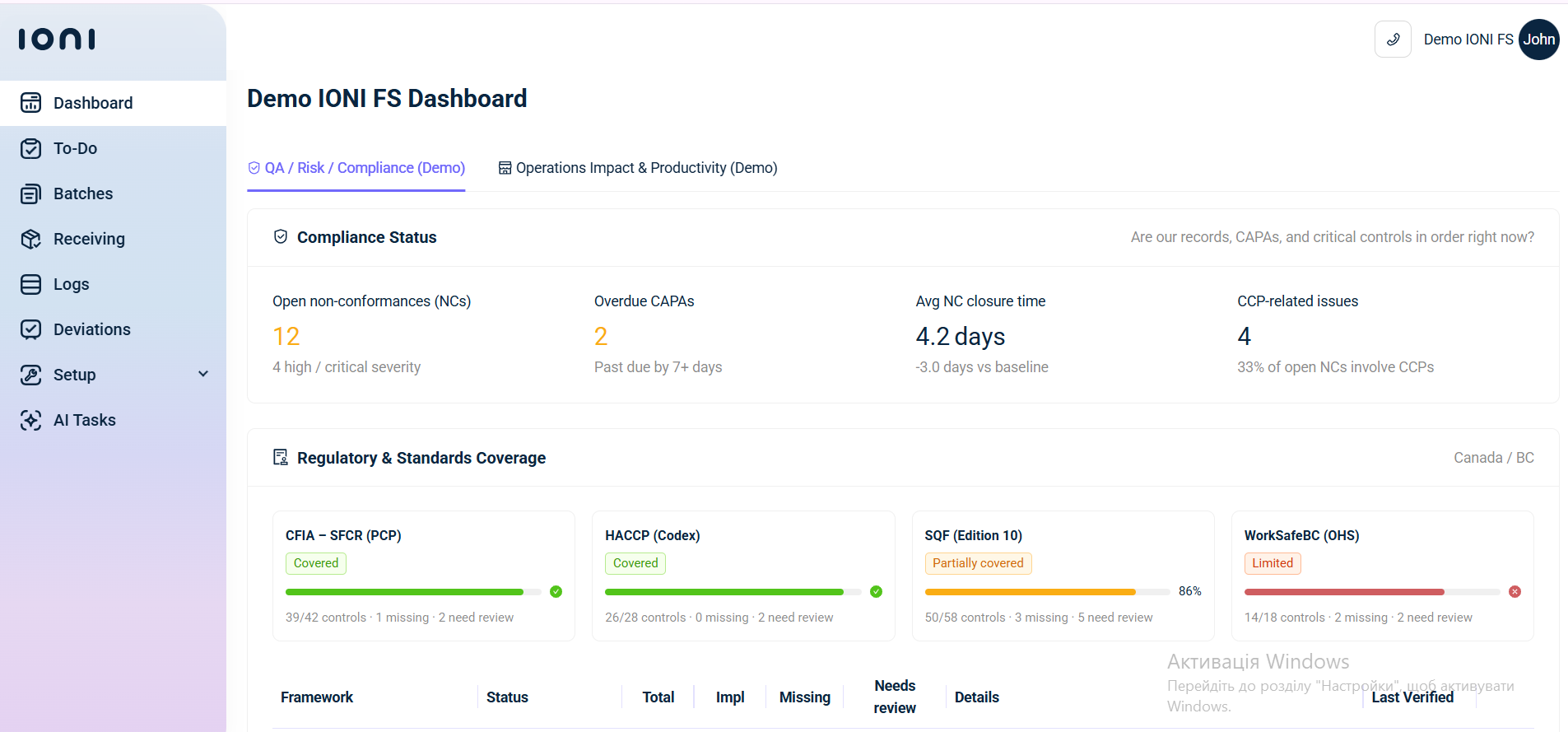
From Paper to Digital in Days, Not Months
Most food manufacturers we work with start in the same place: a mix of paper logs, Excel spreadsheets, shared drives full of SOPs, and a QA manager who carries half the system in their head. IONI changes this by ingesting your existing documents, automatically extracting products, ingredients, hazards, CCPs, and monitoring points, and building a digital food safety management system from your actual operations.
The AI does not ask you to start from scratch. It reads what you already have. Upload your current SOPs, ingredient lists, process flows, team info, and food safety documents, and IONI parses the structure, identifies the key elements, and creates your digital foundation. Most facilities are operational within days, not the weeks or months that traditional FSMS implementations require.
Document Intelligence Powered by AI
Documentation is the operational heart of any food safety system, and this is where most systems fail. IONI utilizes computer vision and natural language processing to continually read, interpret, and validate your documents.
Upon receipt of a new supplier specification, IONI breaks it down to analyte level parameters. Upon receipt of a Certificate of Analysis, the platform retrieves measurement values, normalizes them (converting automatically between ppm, mg/kg, percentages, and other formats), and compares results directly against limits defined by the system. If a supplier’s heavy metal values are rising across shipments - and even while technically compliant - IONI flags the risk buildup before it becomes a compliance failure.
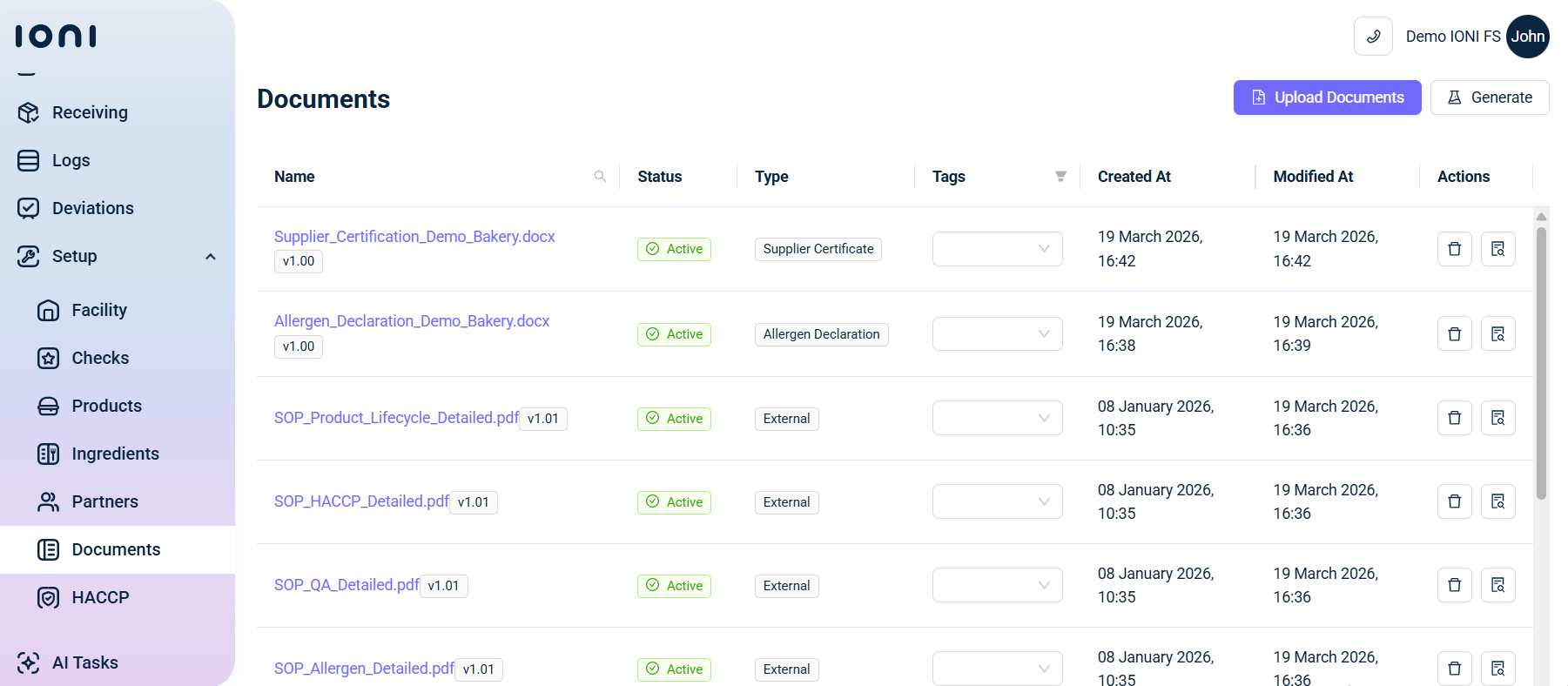
This capability is critical at scale. Take a manufacturer holding 800 ingredients across 400 SKUs with multiple co packers. Supplier versions of each ingredient may contain a number of regional regulatory declarations, allergen certifications, and contaminant test reports. This results in thousands of active documents under management at any time. A manual review cannot reliably detect drift across that volume. IONI can.
If your team is spending more time chasing documents than running quality programs, let's talk. We'll walk you through a quick session and you can decide if IONI fits.
Continuous Gap Analysis Against Your Certification Scheme
Whether you are certified under SQF, BRCGS, FSSC 22000, or need to comply with FSMA and CFIA requirements, IONI continuously checks your records, logs, and CAPAs against the applicable standard. When something is out of date, overdue, or missing, you get an alert before it becomes an audit finding.
The system does not just check boxes. It interprets requirements. When EFSA revises acceptable daily intake thresholds, when the FDA updates contaminant action levels under the Closer to Zero program, or when a GFSI benchmarking update cascades new requirements into your certification scheme, IONI evaluates which ingredients, which SKUs, and which documentation elements are affected. Your compliance team gets a specific, actionable list rather than a vague notification that "something changed."
This is particularly valuable as GFSI certification schemes evolve. The December 2024 GFSI Benchmarking Requirements update and SQF Edition 10 (released March 2026) both introduced new requirements around food safety culture, change management, and environmental monitoring. IONI tracks these changes and maps them to your system so you are not caught off guard during your next recertification audit.
HACCP Plan Generation and Maintenance
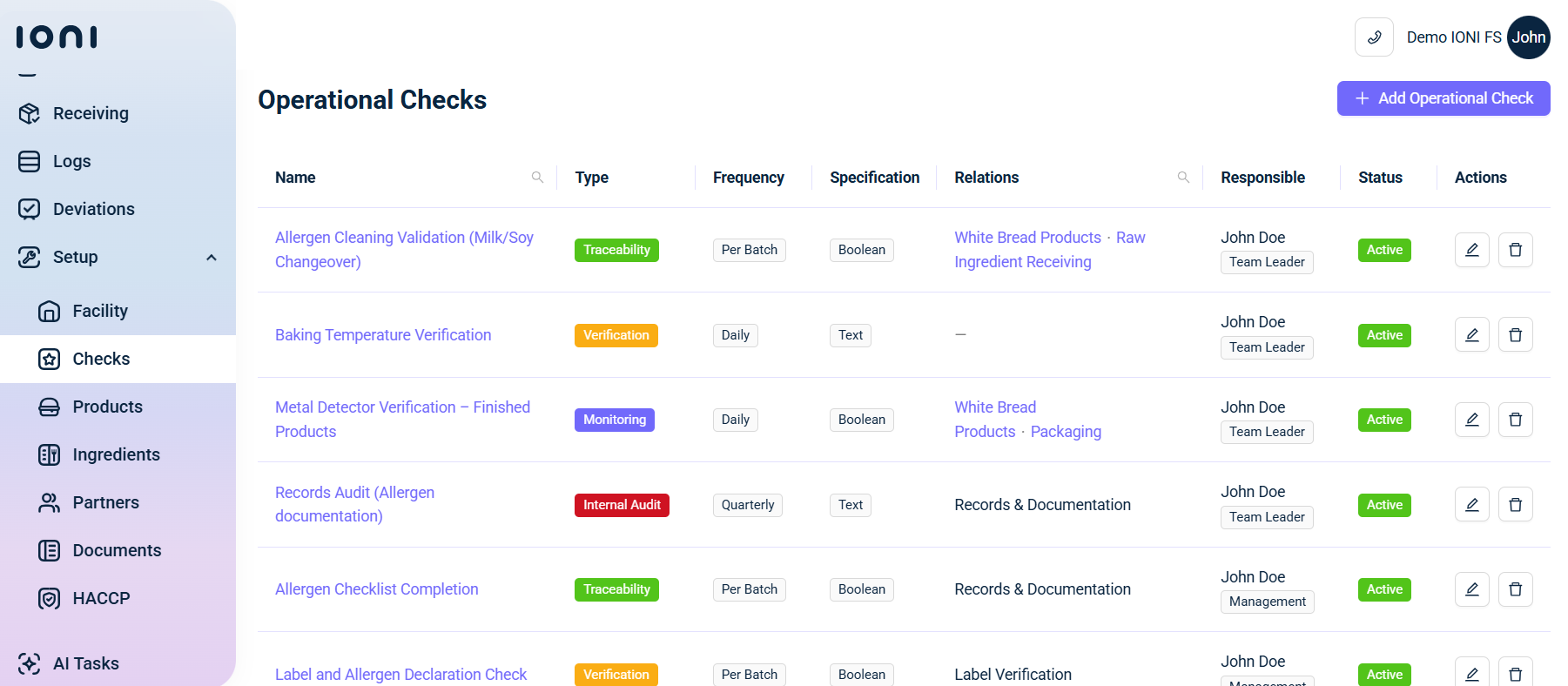
IONI's AI powered HACCP builder can generate a complete HACCP plan in under an hour, including hazard analysis, CCP identification, monitoring procedures, corrective action protocols, flow charts, and SOPs.
It complies with Codex, EU, FDA and GFSI guidelines locally and globally (the plan is in full compliance with global). But the easy part is making a plan to execute. Keeping it is where the bulk of food safety systems break down. When you change suppliers, add a new product line, change a process step or reformulate products, it can be easy to overlook the relevant HACCP elements in order not to take the risk of missing out. IONI automatically flags those connections and keeps going.
Now, when you add a new allergen containing ingredient, the system then determines each of the CCPs, all monitoring procedures and all the labels that will need to be reviewed. When you cite a supplier specification that changed in your HACCP plan, you will recognize the mismatch as soon as possible and not find it in an audit. For facilities where the same person handles HACCP, supplier programs, document control, training, and audit prep, this automated maintenance is what sets a system up into the modern state, or leaves them quietly under the cloud.
Audit Evidence Pack in Minutes
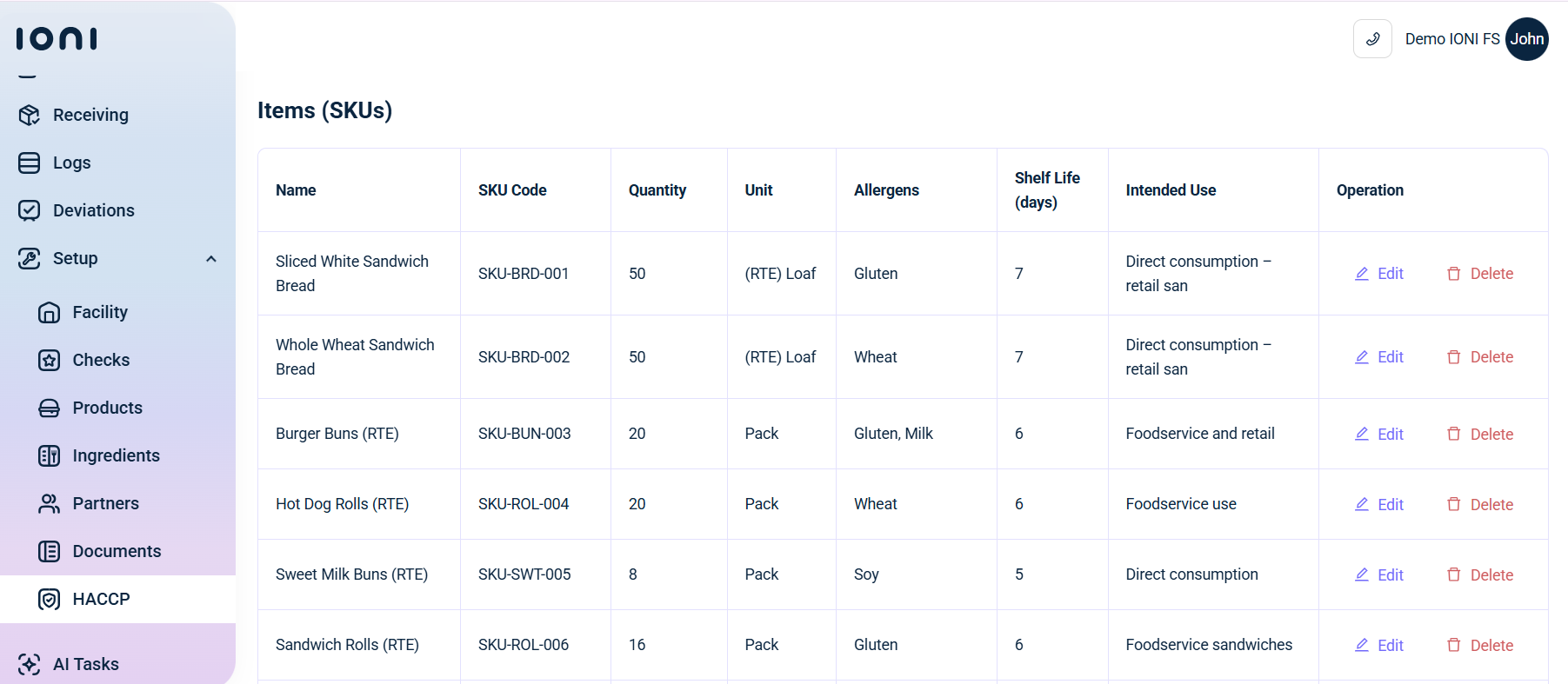
As the time towards your certification audit gets closer, IONI can compile a full evidence pack by drawing together your monitoring records - CAPA logs, training documentation, document version histories, verification activities, and management review records. What it typically takes your team days of manual assembly happens in minutes.
The system includes a daily “readiness score” based on how your records stack up against your certification scheme’s requirements. No more pre-audit scrambles. You know where you stand at all times, and you can fill in the gaps as they appear rather than waiting until two weeks before the auditor arrives.
IONI allows different multi-site manufacturers and co-packers to put all evidence together in the same format and against the same requirements. This removes the inconsistency issue that is one of the most frequent results obtained through multi-site audits.
Real Time Regulatory Intelligence
Regulatory landscapes shift constantly. FSMA updates, CFIA policy changes, EU regulation amendments, GFSI benchmarking revisions, EFSA threshold adjustments. IONI's regulatory intelligence module monitors these changes across schemes and jurisdictions in real time, alerting your compliance team when something affects your certification scope, your ingredient portfolio, or your labeling requirements.
In early 2026, EFSA issued recommendations regarding toxin limits following infant formula recalls. A contaminant threshold update like this can affect ingredient specifications, supplier qualifications, and product formulations simultaneously. IONI evaluates these cascading impacts across your portfolio automatically, so your team can act immediately rather than discovering the exposure weeks later during a manual review.
No more discovering during an audit that a requirement changed six months ago and your system did not keep up.
Ready to try? Feel free to book a demo with us and see how IONI may help you.
Challenges of Implementing AI in Food Manufacturing
For all its promise, AI adoption in food manufacturing is not without friction. Being realistic about the challenges is important because it leads to better implementation decisions. The manufacturers who succeed with AI are not the ones who ignore these obstacles. They are the ones who choose tools and approaches that address them directly.
Data Quality and Integration
AI models are only as good as the data they ingest. Many food manufacturers have data scattered across paper logs, disconnected spreadsheets, legacy ERP systems, and manual monitoring records. Before AI can deliver value, this data needs to be digitized, structured, and integrated. For some facilities, this is a weeks long project. For others with decades of paper based systems, it can take months.
This is one of the reasons IONI was designed to start from existing documentation rather than requiring a clean digital infrastructure as a prerequisite.
When you upload SOPs, ingredient specs, or Certificates of Analysis (PDF, Word, Excel, and even scanned documents) in whichever format you have them, IONI’s AI takes everything, reads it, parses the content, extracts the relevant data points and structures it as a working digital system. You don’t need to manually re-enter years of records or build a database from scratch before getting value from the platform. That said, the principle remains: the cleaner your data, the faster you get results. Facilities that have some digital record keeping at the very least, even rudimentary spreadsheets, onboard faster than those operating from nothing but paper. But neither scenario is a dealbreaker. IONI has evolved for the messiness of reality of how food manufacturers really work, not the sanitized version.
Cost and ROI Uncertainty
The cost of AI implementation varies enormously depending on the scope. An enterprise wide deployment with custom machine learning models, new sensor infrastructure, and dedicated data science teams can run into the hundreds of thousands of dollars. That makes sense for a global processor with dozens of facilities and dedicated IT departments. It does not make sense for a 30 person bakery or a mid size co-packer running three product lines.
This is where purpose built platforms change the equation. IONI's pricing starts at $99 per month for a single facility HACCP plan, with a premium tier at $199 per month for multi-site operations with full AI powered compliance management. Enterprise pricing is available for larger organizations with custom requirements. Compared to hiring an additional QA specialist ($50,000 to $70,000 per year) or engaging food safety consultants ($2,500 to $12,000 per project), the platform delivers continuous value at a fraction of the cost of adding headcount.
The key is to start with a specific problem that has a measurable cost. If you know that your QA manager spends 15 hours per week on document control, or that audit preparation consumes your team for two full weeks every year, or that unplanned downtime costs your facility $50,000 per event, you have a clear baseline against which to measure ROI. IONI customers typically see that baseline shift within the first month of implementation: document control time drops by 70 to 80 percent, CAPA closure accelerates by three times, and audit evidence assembly goes from days to minutes.
Workforce Skills and Change Management
In the food manufacturing environment, AI will not take away jobs. What it does is alter the skills which must be learned. QA professionals who spent most of their time on documentation now must be familiar with AI generated insights, validate AI recommendations, and manage exception workflows. Plant managers must also understand what predictive maintenance outputs mean and how to act upon them. This is a legitimate concern, notably for smaller manufacturers where team members may lack familiarity with digital compliance tools. IONI solves this through guided onboarding and a food safety professional, not data scientist interface.
The platform presents information in familiar terms: HACCP plans look like HACCP plans. Corrective actions look like corrective actions. Monitoring schedules look like monitoring schedules. The AI has the work done behind the scenes, to automate monotonous functions, but the user experience remains rooted in the language and workflows that QA teams already comprehend. Gartner Group forecasts that 33% of enterprise software apps will feature agentic AI by 2028, up from just 1% of apps in 2024. This suggests that in no time at all, dealing with AI will become routine for virtually all food manufacturer roles.
Companies that can get their teams started on AI tools this early on will find it easier than those that wait for adoption to turn into a mandatory practice. The free trial option offered by IONI allows teams to do so without making a full bet on implementation, which is a lower risk avenue of establishing familiarity.
Algorithmic Transparency and Trust
One of the persistent concerns with AI in food processing is the "black box" problem: AI makes a recommendation, but no one can explain why. In food safety, where decisions need to be defensible and auditable, this matters. An auditor will not accept "the AI told us to" as justification for a critical limit or a hazard classification. Facilities need AI tools that provide clear reasoning for their outputs, not just answers.
This is a core design principle at IONI, not an afterthought. When the platform flags a compliance gap, it shows exactly which requirement triggered the alert, which section of the applicable standard (SQF, BRCGS, FSSC 22000, FSMA, CFIA) is referenced, and which specific evidence is missing, out of date, or inconsistent. When IONI generates a HACCP recommendation, you can see the logic: which hazard was identified, which data points informed the risk assessment, and which regulatory basis supports the control measure. Every output includes source linked citations, so your team and your auditors can verify the reasoning independently.
This level of transparency is not just good practice. It is what makes AI usable in a regulated environment. If you cannot explain a compliance decision, it is not a defensible decision. IONI ensures that every recommendation, every alert, and every generated document carries the audit trail needed to stand up to scrutiny.
Regulatory Ambiguity
Questions remain over how AI-generated HACCP plans, AI-assisted hazard analyses, and automated compliance monitoring will be examined by auditors or regulatory inspectors. The industry itself looks on track to become a reality but the progress differs according to its location and certification scheme.
The FDA’s Human Foods Program, which was reorganized in May 2025, has begun employing AI ever more internally. Its Elsa platform uses machine learning to predict risk based inspection scheduling which indicates support from the policy levels of AI implementation in food safety ecosystems. In Canada, CFIA is considering digital transformation of its inspection systems. For EFSA in Europe, it employs advanced analytical tools for contaminant risk modeling. Even regulators are using AI, which is a natural step toward acceptance of AI-powered compliance tools embraced by manufacturers.
For individual manufacturers, the safest way forward in 2026 is with AI being a tool that helps human decision makers, not a proxy for professional food safety judgment. This is what IONI is built to do. The platform makes recommendations, writes documents, and highlights risks, but every decision is reviewed, approved, and signed off through a human food safety professional. It's the AI that takes care of the volume, the pattern recognition, the cross referencing that cannot be done by humans at scale. It is the judgment, the context, and the human accountability that no AI should be trusted with alone.
The Future of AI in the Food Industry
The trajectory of ai in food manufacturing through 2026 and beyond points toward several developments that food manufacturers should plan for.
Agentic AI Enters Manufacturing
Agentic AI, which can autonomously reason, plan, and take action rather than just responding to prompts, is projected to appear in 33% of enterprise software by 2028. In food manufacturing, this means AI systems that do not just flag a problem but initiate the corrective action workflow, notify the responsible team member, and verify completion. It is the difference between a system that generates a report and a system that manages a process.
Digital Twins for Food Processing
Digital twin technology creates a virtual replica of a physical production line, allowing manufacturers to simulate changes before implementing them. In food processing, this means testing new formulations, adjusting process parameters, or evaluating the impact of an equipment change without disrupting actual production. Early adopters are reporting energy savings of 20 to 40% from AI optimized process parameters in operations like extrusion, spray drying, and fermentation.
Autonomous Quality Systems
The convergence of computer vision, IoT sensors, and machine learning is moving toward fully autonomous quality systems that inspect, decide, and adjust without human intervention for routine operations. Human expertise is redirected to exception management, system design, and continuous improvement rather than repetitive monitoring tasks.
Expanded Traceability Requirements
The FDA's Food Traceability Rule compliance deadline (July 2028) and ongoing GFSI emphasis on recall readiness will push every manufacturer toward digitized, AI enabled traceability. Companies that invest now will have systems mature and proven by the time compliance deadlines arrive. Companies that wait will face a compressed and stressful implementation timeline.
Food Safety Culture as Measurable Data
SQF Edition 10 and the 2024 GFSI Benchmarking Requirements both make food safety culture a structured, auditable requirement. AI can support culture measurement by analyzing incident trends, training completion patterns, near miss reports, and employee engagement data to provide an objective picture of how food safety is actually practiced on the floor, not just how it is documented on paper.
Sustainability Through Optimization
AI driven process optimization is emerging as a key sustainability tool. By reducing waste, cutting energy consumption, and optimizing water use, artificial intelligence in food manufacturing aligns business efficiency with environmental responsibility. For manufacturers facing both margin pressure and sustainability reporting requirements, AI offers a way to address both simultaneously.
Conclusion: Why Food Manufacturers Should Invest in AI Today
The case for artificial intelligence in food processing is no longer speculative. The technology is proven, the use cases are well documented, and the competitive gap between AI adopters and non adopters is widening every quarter.
In 2026, food manufacturers using AI report 35% fewer quality defects, 25% less unplanned downtime, and up to 20% reduction in ingredient waste. Meanwhile, the facilities that have not adopted these tools are dealing with the same challenges that have always plagued the industry: documentation overload, inconsistent quality, reactive maintenance, and audit preparation that feels like an emergency every single time.
The barriers to entry have dropped significantly. You do not need a data science team or an enterprise IT budget to start using AI in food manufacturing. Platforms like IONI are designed specifically for food manufacturers who need practical AI capabilities, from HACCP automation and compliance monitoring to audit evidence assembly and regulatory intelligence, without the complexity of building custom solutions.
Start with a specific problem. Whether it is document control that consumes your QA manager's time, HACCP plans that are chronically out of date, or audit preparation that puts your team under unnecessary stress, there is an AI solution that addresses it directly and delivers measurable ROI within months.
The food manufacturers who will lead in the next decade are the ones investing in these capabilities today. Not because AI is trendy, but because the operational demands of modern food manufacturing, from regulatory complexity to supply chain risk to consumer expectations for safety and transparency, simply require tools that exceed what manual systems can deliver.

Discover how IONI can help your facility implement AI for food safety and compliance.
FAQ
What is AI in food manufacturing?
AI in food manufacturing refers to the application of technologies like machine learning, computer vision, natural language processing, and predictive analytics to optimize production, quality control, food safety compliance, supply chain management, and traceability in food processing operations.
How is AI used in food processing quality control?
AI in food processing uses computer vision systems to inspect products in real time, detecting defects, contaminants, foreign objects, and packaging errors at speeds and accuracy levels that manual inspection cannot match. Modern systems achieve accuracy rates above 95% and can reduce defect rates by more than 25%.
How much does it cost to implement AI in food manufacturing?
Costs vary widely. Enterprise deployments with custom models and new sensor infrastructure can reach hundreds of thousands of dollars. Purpose built platforms like IONI that focus on compliance, HACCP, and audit readiness are significantly more accessible and can deliver ROI within months through reduced manual work and fewer compliance gaps.
Is AI replacing food safety professionals?
No. AI in food manufacturing augments human expertise rather than replacing it. AI handles repetitive tasks like document monitoring, data analysis, and routine inspection, freeing food safety professionals to focus on judgment intensive work like hazard analysis, system design, and incident response.
What are the biggest challenges of implementing AI in food manufacturing?
The most common challenges are data quality and integration (getting data out of paper and spreadsheets into a usable format), cost justification (starting with measurable problems), workforce skills (training teams to work alongside AI tools), and regulatory acceptance (ensuring AI outputs are auditable and defensible).
How does artificial intelligence in food manufacturing improve traceability?
AI connects ingredient lots, production records, and distribution data into a searchable digital chain. When a safety issue arises, AI powered traceability can identify every affected product in minutes rather than the hours or days required by manual systems.
What is the market size for AI in food manufacturing?
According to Mordor Intelligence, the AI in food and beverages market is valued at $18.34 billion in 2026, up from $13.39 billion in 2025, and is forecast to reach $88 billion by 2031 at a compound annual growth rate of nearly 37%.
How does IONI specifically help food manufacturers with AI?
Is my data secure with IONI? All data is encrypted in transit and at rest. Customer documents are never used to train AI models. IONI is built to meet enterprise security expectations, with full data control retained by the customer. Detailed security documentation is available on request, including for compliance with retailer supplier-data requirements.
Is my data secure with IONI?
All data is encrypted in transit and at rest. Customer documents are never used to train AI models. IONI is built to meet enterprise security expectations, with full data control retained by the customer. Detailed security documentation is available on request, including for compliance with retailer supplier-data requirements.
Ready to see what AI-powered food safety looks like in practice? Book a demo and we'll tailor the session to your facility's exact compliance scope.