.png)
Last updated: October 2026
Regulatory intelligence software monitors regulators and standards bodies such as the FDA, USDA, CFIA and GFSI schemes, filters each change for relevance, and shows which of your products, SOPs and plans it affects. The best platforms for food manufacturers add AI applicability checks, a decision record for each change, and gap analysis against your own documents.
TL;DR
- Best for food plants that want monitoring tied to their quality system: IONI.
- Best for watching specific web pages: Visualping.
- Best for multi-market pharma and food regulatory affairs teams: Freyr RegIntel or RegASK.
Below we compare five regulatory intelligence tools relevant to food manufacturers, based on how well each connects an external regulatory change to internal compliance work. Vendor details and prices were checked on each vendor's website on October 15, 2026.
What Is Regulatory Intelligence Software?
Regulatory intelligence software is a platform that watches regulators and standards bodies, flags the updates that apply to your products and sites, and links each change to the SOPs, HACCP plans and supplier records it affects. AI-powered regulatory intelligence adds automatic relevance filtering, per-product applicability checks and short impact summaries, so a small QA team does not have to read every Federal Register notice.
Regulatory Intelligence vs. Regulatory Change Management vs. GRC
These three terms are often used as if they meant the same thing. They do not.
- Regulatory intelligence (RI) is finding and interpreting changes: what changed, and does it apply to us?
- Regulatory change management is assigning and closing the work that follows: who updates which document, by when, and what evidence proves it was done.
- GRC (governance, risk and compliance) is the enterprise layer: risk registers, internal controls and policy governance across the whole company.
| Regulatory intelligence | Regulatory change management | GRC | |
|---|---|---|---|
| Purpose | Detect and interpret external changes | Assign, track and close the resulting work | Govern enterprise risk, controls and policy |
| Typical user | Regulatory affairs, QA manager | QA, operations, document owners | Risk, legal, internal audit |
| Output | Relevant alerts, applicability opinion, summary | Tasks, revised documents, sign-off record | Risk register, control framework, reports |
| Food example | FDA changes a labeling rule; software flags it as relevant to your packaged SKUs | Label SOPs for those SKUs are updated, reviewed and signed off | Labeling compliance appears as a risk with an owner and a control |
For a food plant, the first two have to be joined. An alert that never turns into an updated SOP creates work without closing the loop, and a task system with no view of what changed outside has nothing to act on.
Why Regulatory Monitoring Is a Full-Time Problem
Food manufacturers who track FDA and CFIA changes manually run into the same problem: the update arrives after the decision has already been made. Recent examples show how many separate dates a lean QA team has to keep track of.
On the FDA Food Traceability Rule (FSMA 204), FDA states that it proposed to extend the compliance date from January 20, 2026, to July 20, 2028, and that Congress directed FDA not to enforce the rule before that date. Companies still have to decide how to plan for supplier lot tracking, traceability records and documentation in the meantime.
In Canada, the CFIA states there is no enforcement discretion after January 1, 2026 for front-of-package nutrition labelling, and its action plan commits to risk-based inspections of over 2,400 manufactured food establishments, with completion by fall 2026.
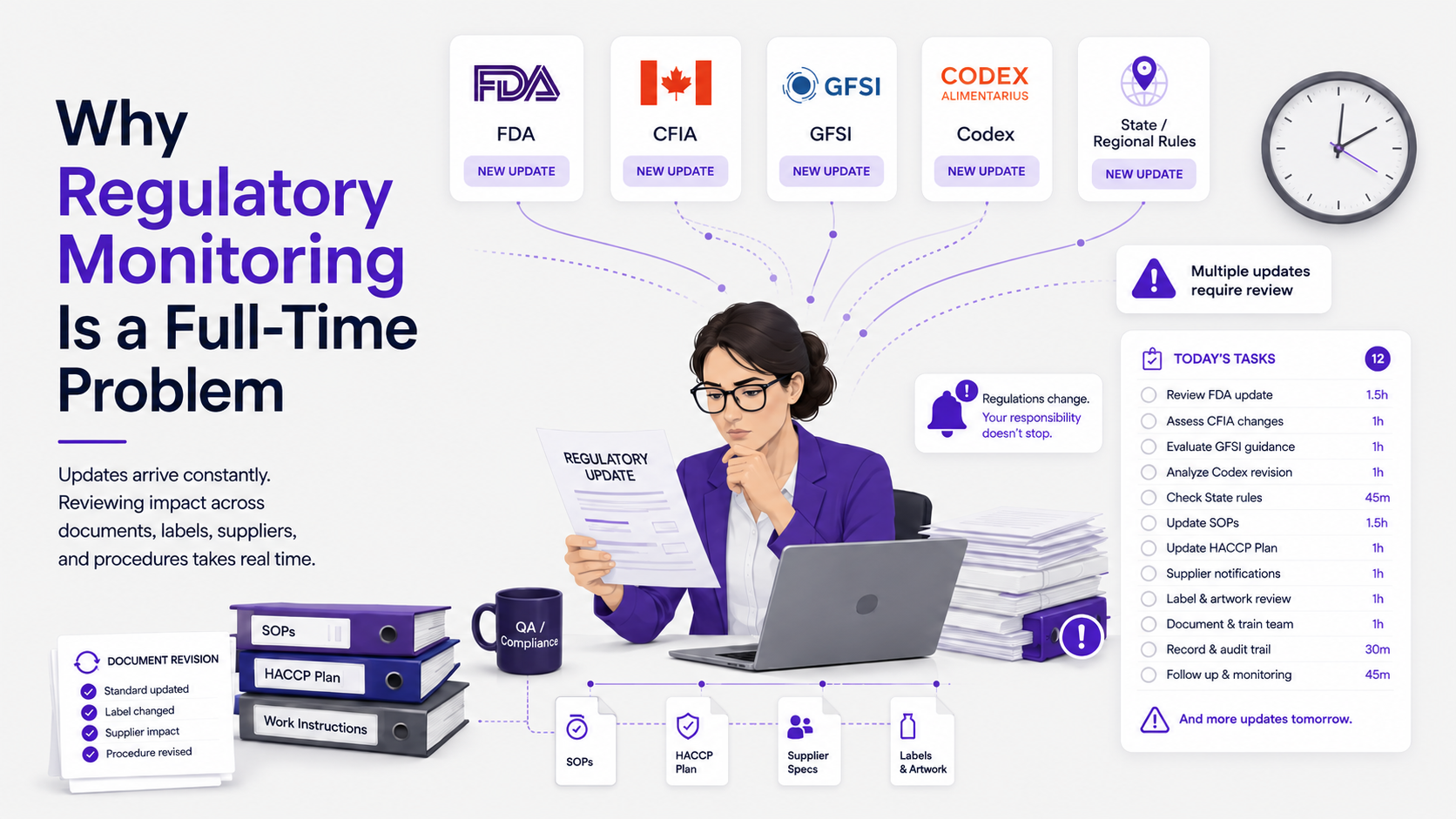
Manual monitoring (bookmarking regulatory portals, scanning newsletters, relying on consultant updates) misses things, and the gap between a change and the moment it reaches your team can be weeks.
How Regulatory Intelligence Software Works: 5 Steps
- Sources. The platform watches regulatory feeds and publications, for example eCFR, the Federal Register, FDA, USDA FSIS, CFIA and EUR-Lex, plus any custom pages you add.
- Change detection. A scheduled scan finds new or amended text and ingests it.
- AI relevance filter. The change is scored against your company profile, your products and your markets, so unrelated updates drop out.
- Per-product assessment. For each affected product the system gives an applicability opinion with its reasoning, so a reviewer can check it.
- Decision record and document updates. A person signs off (not applicable, no action, or action required), the decision is stored, and the affected SOPs or plans are updated.
Quick Comparison
Not every regulatory intelligence tool is built for the same job. Some are best for simple web page monitoring. Others focus on global regulatory tracking, supplier compliance or expert advisory support.
| Tool | Best for | What it monitors | Maps changes to your products/SOPs? | AI features | Pricing model |
|---|---|---|---|---|---|
| IONI | Food plants that want regulatory monitoring tied to their quality system | Sources you configure, such as eCFR and EUR-Lex | Yes: per-product assessments, and gap analysis against your own documents | 3-stage relevance and applicability pipeline, cited Q&A, gap analysis | Quote |
| Visualping | Watching specific regulatory web pages | Any web page you choose | No | AI summaries of page changes | Free plan; paid plans from $10/month billed annually |
| Freyr RegIntel | Multi-market regulatory affairs teams (incl. food) | 125,000+ regulations across 200+ markets | Impact assessment is on the Corporate plan | AI regulatory assistant, document chat, dashboards, alerts | $100/user/month (Plus); Corporate: quote |
| TraceGains | Food brands tying regulation to suppliers and ingredients | Supplier and ingredient network; global alerts mapped to ingredients | Ingredients and suppliers; SOP mapping not stated | – | Quote |
| RegASK | Teams that want AI monitoring plus expert validation | Monitoring and curated content across 160+ markets, incl. food and beverage | Impact assessment module listed | Conversational assistant, expert validation | Quote |
For food manufacturers, the key question is whether the tool only alerts the team to external changes or helps connect those changes to internal SOPs, HACCP plans and audit evidence. Pricing shown as of October 15, 2026, from each vendor's site; confirm current terms with the vendor.
#1 IONI: Regulatory Intelligence Tied to Your Quality System
Most regulatory tools stop at alerts. IONI is built to answer the harder question: which of our products and documents does this change affect, and what did we decide? It is an operations and food safety compliance platform, and its regulatory intelligence module works from the same document library as the rest of the quality system.

What it does:
- Sources and monitoring: watch feeds such as eCFR and EUR-Lex. New or changed text goes through a 3-stage AI pipeline: a relevance pre-check, a product filter, then applicability checks in batches of SKUs.
- Feed: an inbox of regulatory changes with action-required cards and a per-product AI assessment you can review.
- Products catalog: SKUs with markets, HS codes and specs, each with a compliance status (OK, At risk, Non-compliant, Awaiting action or Pending).
- Decision Records: formal sign-off (not applicable, no action, action required) that updates the product's compliance status.
- Researcher, compare and impact assessment: chat over the regulations you enable with citations, compare a requirement across jurisdictions, and check whether a requirement applies to your company.
- Gap analysis: compare a regulation or standard against your own documents and get a coverage score with recommendations.
- Documents: a QMS library with Google Drive and OneDrive sync and bulk upload of up to 100 files.
IONI is for food manufacturers that want the regulatory side connected to the daily compliance and operations work, not a separate dashboard. Pricing: quoted separately for regulatory intelligence.
Watch how IONI works:
Book a demo to see how IONI maps a regulatory change to your products and documents.
#2 Visualping: Page Monitoring for Specific Regulatory Sources
Visualping is not a regulatory intelligence platform. It is a page monitoring tool that compliance teams use to track specific websites such as FDA dockets or CFIA guidance sections. It detects that a page changed and highlights the difference. It does not interpret whether the change applies to your products or connect to your documents, so analysis stays with your team.
For manufacturers that need to watch a defined set of sources, it works well, setup takes minutes, and it costs far less than a compliance platform. Use it alongside a dedicated food safety system, not instead of one.
Key features:
- Monitors web pages you choose
- AI summaries of what changed on all plans
- Check frequency from every 60 minutes on the free plan to every 2 minutes on higher plans
- Slack, Microsoft Teams and Google Sheets integrations on Business plans
Pricing (vendor page, October 15, 2026): Free plan (5 pages, 150 checks a month). Personal from $10/month billed annually ($14 billed monthly). Business from $100/month billed annually ($140 billed monthly).
#3 Freyr RegIntel: Multi-Market Regulatory Tracking
Freyr RegIntel covers medicinal products, medical devices, cosmetics, food and dietary supplements, and biocides and household chemicals, with 125,000+ regulations across 200+ markets. Its AI assistant, freya, answers regulatory questions, and the platform also offers document chat, dashboards and alerts.
It suits teams that monitor several product categories and geographies at once. For a food manufacturer focused on domestic compliance it is likely more coverage than needed; the strength is breadth, the tradeoff is complexity.
Who it's for: multi-market regulatory affairs teams in food, pharma or consumer goods.
Pricing (vendor page, October 15, 2026): 14-day trial for up to 5 users. Plus plan listed at $100 per user per month (the page also shows "starting from $125" without explanation). Corporate is custom-priced with a 20-user minimum and adds workflows, impact assessment and document management.
#4 TraceGains: Supplier Intelligence with Ingredient-Linked Alerts
TraceGains is built for food and beverage brands that need supplier compliance alongside regulatory monitoring. Where IONI connects regulatory changes to internal documentation, TraceGains connects them to the ingredient and supplier side: its site describes a networked intelligence layer that maps global alerts to the ingredients you care about, plus supplier management, supplier compliance and audit management.
It is a reasonable fit for mid-size to large brands with complex supply chains. Ask the vendor how its regulatory content is sourced and which ERP or PLM systems it integrates with, as its public pages do not detail either.
Who it's for: food and beverage brands that need regulation tied to ingredient sourcing.
Pricing: Quote (demo request on the vendor site).
#5 RegASK: AI Monitoring Plus Expert Validation
RegASK combines AI-driven monitoring and a conversational assistant with expert validation. Its site cites about 1,800 subject matter experts and 160+ markets, and lists food and beverages alongside life sciences, dietary supplements and personal care. Modules include monitoring, impact assessment, workflows and insights.
Expert access is a real differentiator when an AI answer is not enough, such as market access in a new geography. For a US or Canadian manufacturer focused on domestic compliance, it is likely more infrastructure than needed.
Who it's for: companies in food, pharma or personal care dealing with emerging markets or regulations that need expert interpretation.
Pricing: Quote (none published on the vendor site).
How to Choose: 6 Questions to Ask a Vendor
- Sources: which sources does it cover for the US and Canada, and can you add your own?
- Product mapping: does it map each change to your SKUs, or only send alerts?
- Your documents: can it compare a rule or standard to your own SOPs and plans?
- Audit trail: is there a record of who assessed each change, when, and what was decided?
- PDFs and Drive: how does it handle PDFs and documents in Google Drive or OneDrive?
- Pricing model: per user, per market, or by quote, and what is included?
Can ChatGPT Do Regulatory Intelligence?
Not on its own. A general chatbot does not watch sources on a schedule, does not keep a record of what applied and what you decided, and cannot cite against your document versions. It is useful for drafting and explaining text you give it, but not for monitoring.
Which Platform Fits Your Situation
You are a food manufacturer and want regulatory monitoring connected to your products, documents and quality system: IONI.
You need to watch a small set of specific regulatory pages and can handle analysis internally: Visualping, alongside your existing food safety system.
You operate across multiple markets or product categories: Freyr RegIntel.
Regulatory monitoring needs to connect to ingredient sourcing and supplier decisions: TraceGains.
You are entering a new market or need human expert interpretation: RegASK.
FAQ
What is regulatory intelligence software?
Regulatory intelligence software monitors regulators and standards bodies such as the FDA, USDA, CFIA and GFSI schemes, filters each change for relevance, and shows which of your products, SOPs and plans it affects. The best platforms for food manufacturers add AI applicability checks, a decision record for each change, and gap analysis against your own documents.
What is the difference between a regulatory intelligence platform and a regulatory intelligence tool?
A platform covers the whole loop: monitoring, assessment against your products, and records of what was decided. A tool does a single job, such as monitoring a web page for changes. Tools are cheaper and quicker to set up but leave interpretation and document updates to your team.
What does AI-powered regulatory intelligence add?
AI adds relevance filtering, so unrelated updates drop out, per-product applicability checks, short summaries of what changed, and cited answers to questions about the text. Every AI opinion should still be reviewed and signed off by a person.
Is regulatory intelligence software worth it for small food manufacturers?
Usually, when the QA team is lean. Smaller manufacturers often rely on one person for compliance, suppliers, production issues and audit preparation, so a missed update is costly. The value is not replacing expertise but saving time and turning a regulatory change into action. If you only need to watch a few pages, a low-cost page monitor may be enough.
What is the difference between regulatory intelligence and compliance management?
Regulatory intelligence focuses on the outside world: which rules, guidance and standards are changing and whether they apply to you. Compliance management focuses on internal execution: HACCP plans, corrective actions, supplier approvals, document control and audit evidence. The gap appears when a change is found but the team still has to work out what to change internally, which is why the two should be connected. See the comparison table above for how regulatory change management and GRC fit in.
Can regulatory intelligence software replace a consultant?
No. A consultant brings judgment and practical experience that software cannot replace. Software handles the repetitive monitoring and cross-referencing, so consultants and QA leaders can spend their time on decisions, risk assessment and audit readiness.
Related Reading
- Best HACCP Software for Food Manufacturers in 2026
- How to Create a HACCP Plan: Step-by-Step Guide for Food Manufacturers
- SQF Audit Checklist for Small Food Manufacturers
- What Are GFSI Schemes and How to Choose the Right One?
- Manual vs. AI-Generated HACCP Plans: What Actually Saves Time and Passes Audits