A master production schedule (MPS) is the plan that states which finished products you will make, in what quantity and in which time period. Food manufacturers use it to turn orders and demand into a feasible build plan, then test it with rough-cut capacity planning before committing ingredients, labor and line time.
This guide explains the MPS, shows a simple sample, walks through rough-cut capacity planning and adds the food-specific limits that generic guides skip. For the daily layer below the MPS, see our production schedule template for food plants and our overview of production planning software.
What a Master Production Schedule Is
According to the ASCM CPIM learning system, the output of master scheduling is a master production schedule for each product, stating what will be produced in each period of the planning horizon, and rough-cut capacity planning is a check on whether bottleneck work centers and other key resources have enough capacity (ASCM). In a food plant, the "product" is usually a SKU or a product family, and the period is usually a week.
| Plan | Question it answers | Typical horizon | Level of detail |
|---|---|---|---|
| Master production schedule | How many of each product do we make, and in which week? | Weeks to months | SKU or family per week |
| Rough-cut capacity plan | Can our key resources actually do that? | Same as MPS | Hours on bottleneck equipment and labor |
| Detailed production schedule | Which line runs what, in which order, today? | Days | Batch, line and sequence |

A Sample MPS for a Food Manufacturer
The numbers below are illustrative. They show one SKU over four weeks: demand from confirmed orders, the quantity planned for production and the projected stock on hand.
| Week | Confirmed orders (cases) | Planned production (cases) | Projected on hand (cases) |
|---|---|---|---|
| Opening stock | 200 | ||
| 1 | 600 | 800 | 400 |
| 2 | 900 | 800 | 300 |
| 3 | 700 | 800 | 400 |
| 4 | 1,000 | 1,000 | 400 |
Projected on hand is the previous balance plus planned production minus orders. If it falls below zero or below a safety level, the plan needs more production or a different timing.
Rough-Cut Capacity Planning, Step by Step
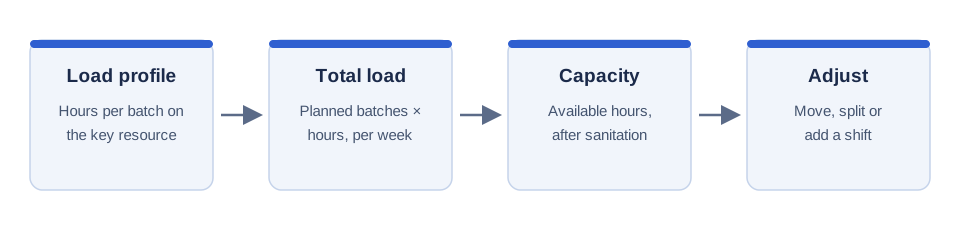
Rough-cut capacity planning converts the master schedule into capacity requirements on key resources and tests whether the schedule is feasible before it is run through detailed planning. The key resources are the ones that actually limit output.
- Identify the bottleneck resources, such as the cooker, the filler or the packaging line, and any scarce labor skill.
- Build a load profile: how many hours each batch of each product needs on each key resource.
- Multiply planned batches by hours to get the total load per week.
- Compare with available hours, after subtracting sanitation, changeovers, maintenance and breaks.
- If load exceeds capacity, move production earlier or later, split the batch, add a shift or change the plan with sales.
Food-Specific Limits That Change the Answer
- Allergen sequencing and changeovers: running an allergen product earlier in the week, or grouping allergen runs, can cut cleanup time. See our line changeover and line clearance checklist.
- Sanitation time: a wet clean-down is capacity you do not have for production.
- Shelf life: making too far ahead eats the shelf life your customer expects.
- Ingredient availability: a feasible machine plan can still fail if an ingredient is not in stock.
- Yield: if yield is 92 percent, plan the input for the output you need.
Where IONI Fits
IONI is the production and traceability layer that runs on top of the QuickBooks you already have; it is not an ERP. Its Batches view can plan from orders, showing coverage against demand and ingredient stock, and then carries the batch through assembly and lot capture. It does not do finite capacity scheduling or demand forecasting, so rough-cut capacity checks stay in your own planning method.
FAQ
What is a master production schedule?
It is the plan that states which finished products will be made, how many, and in which period. It sits above the detailed daily production schedule.
What is rough-cut capacity planning?
It is a check that converts the master schedule into hours on key resources, such as bottleneck equipment, to see if the schedule is feasible.
How is an MPS different from a production schedule?
The MPS works at product and weekly level. The production schedule assigns specific batches to lines and times each day.
How often should a food manufacturer update its MPS?
Review it on a regular rhythm, such as weekly, and whenever large orders, ingredient shortages or equipment issues change what is feasible.
Do small food manufacturers need an MPS?
A simple version helps once you run several products on shared equipment. A spreadsheet is enough to start.
Last updated: October 21, 2026
Keep the production record where the work happens. Explore IONI's production and traceability software for food manufacturers.