.png)
Quality inspection software for food manufacturers checks incoming raw materials and ingredients against a supplier's certificate of analysis (COA) and your own specification before they're accepted into inventory, then keeps that inspection result attached to the specific lot for traceability. Generic inspection or QC software built for other industries can track pass/fail results, but it usually can't validate allergen declarations, tie an inspection to a specific lot code for a recall, or map to the supplier verification activities FSMA already requires — which is why food manufacturers evaluating this category need to look past the generic "quality inspection software" listicles built for manufacturing broadly.
What incoming inspection software actually needs to check
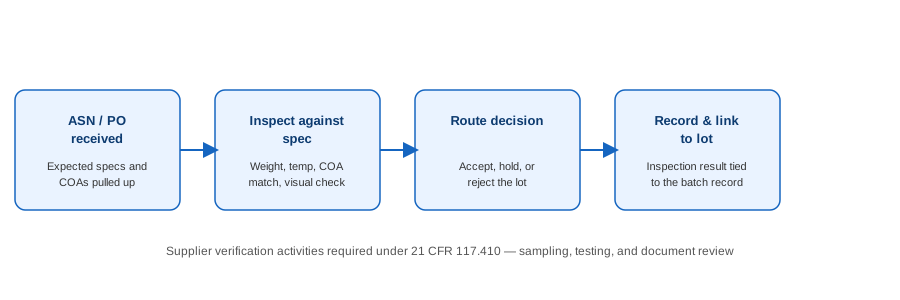
At minimum, useful incoming inspection software should: pull up the expected specification and any COA tied to a purchase order automatically; let a receiver log weight, temperature, visual condition, and COA match against that spec in one place; route the lot to accept, hold, or reject based on the result; and permanently link that inspection record to the lot or batch number so it surfaces later if that ingredient is ever involved in a recall investigation.
Why generic inspection software often falls short here
Most inspection and QC software on the market is built for discrete manufacturing — checking a machined part's dimensions against a CAD tolerance, for example — and doesn't natively handle food-specific requirements like allergen cross-checks, COA field validation against a supplier specification, or lot genealogy that follows an ingredient from receiving through to finished product. Bolting food-specific fields onto general QC software is possible but usually means custom configuration work a smaller manufacturer doesn't have the internal resources to maintain.
What FSMA already requires you to document at receiving
This isn't purely a software-buying decision — FSMA's supply-chain program rule already sets requirements here. Under 21 CFR Part 117, Subpart G, a receiving facility must use approved suppliers, determine appropriate supplier verification activities (onsite audits, sampling and testing, or document review), and document those verification activities in records — including the raw material or ingredient identified, the date, and the conclusion. Software that automatically links an inspection result to the supplier verification record makes that documentation requirement close to automatic instead of a separate paperwork exercise.
Where this fits with supplier quality more broadly
Incoming inspection is one checkpoint inside a larger supplier quality program. See our guide to supplier quality management software for FSQA teams for the broader supplier-approval and COA-tracking picture, and our ingredient compliance checklist for brands that outsource manufacturing and still need visibility into what's arriving at their co-manufacturer's dock.
Where IONI fits
IONI's Ingredients Intelligence validates supplier COAs against your specifications automatically and keeps every incoming inspection linked to the lot it belongs to — so a receiving decision and an FSMA supply-chain record are the same action, not two. See how IONI's Ingredients Intelligence handles incoming COA and spec validation.
Frequently asked questions
Is quality inspection software the same as a QMS?
No. Incoming inspection software specifically covers checking raw materials and ingredients against specs at receiving. A quality management system (QMS) is the broader documented set of processes a company uses to meet quality requirements across the whole operation.
Does FSMA require software for supplier verification?
No, FSMA doesn't mandate software specifically — 21 CFR Part 117 Subpart G requires the verification activities and documentation regardless of format. Software just makes meeting that documentation requirement faster and less error-prone.
What should food manufacturers look for beyond generic inspection software features?
Allergen cross-checks, COA field validation against your own specification, and the ability to permanently link an inspection result to a specific lot or batch number for traceability.