.png)
Introduction
Compliance under the Safe Food for Canadians Regulations is no longer a back-office function. In 2026, it is one of the most direct factors shaping which Canadian food businesses grow, which lose customer contracts, and which face public licence suspensions. The regulatory environment has tightened, CFIA enforcement has sharpened, and retailers are moving faster than ever to drop suppliers who cannot demonstrate continuous compliance.
This article is a practical guide for Canadian food manufacturers, processors, importers, and co-packers who need to understand what SFCR compliance actually requires in 2026, where traditional compliance methods are breaking down, and how AI-powered tools are changing what is operationally possible, especially for small and mid-size operators. We will walk through the core compliance pillars (PCPs, traceability, licensing, risk management, CFIA inspections), examine the unique challenges SMEs face, and look at where the industry is heading next.
What is SFCR and why it matters for Canadian food businesses
In December 2025, the CFIA suspended a food manufacturer’s licence for 36 days after six recalls connected to their facility. The suspension was published publicly. Contracts were lost. Reputation took years to rebuild. This is what SFCR compliance looks like when it fails in 2026.
For a plain-language breakdown of what SFCR actually requires — licensing, preventive control plans, and traceability — see our guide to what SFCR is.
The Safe Food for Canadians Regulations consolidated 14 separate federal food rules into a single framework when they came into force. For the first time, Canadian food manufacturers, importers, processors, exporters, and many retailers operated under one set of expectations covering licensing, preventive controls, traceability, packaging, and labelling. The goal was simple on paper and complex in practice: make Canada's food supply safer and more transparent, without creating an impossible administrative burden for the businesses that feed the country.
SFCR compliance is not optional. If your business manufactures, processes, treats, preserves, grades, packages, labels, or stores food for interprovincial trade or export, the Safe Food for Canadians Regulations apply to you. If you import food into Canada, they apply to you. If you grow or harvest fresh fruits or vegetables that cross provincial borders, they apply to you. The scope is broad by design, and the consequences of getting it wrong have become more serious over the past two years.
For Canadian food businesses, SFCR is not just a regulatory checkbox. It determines whether you can hold a CFIA licence, whether retailers will stock your product, whether you can access export markets, and how you respond when something goes wrong, the speed and scope of your recall response defines the difference. Getting SFCR compliance right is the foundation for everything else.
The growing complexity of food safety compliance in Canada
SFCR compliance under the standards was never easy, but it has become measurably more challenging. According to the CFIA's 2024 to 2025 Departmental Results Report, 48.8% of higher-risk recall incidents involving Canadian-produced foods were detected through CFIA sampling activities, an increase from 34.9% the year prior. That jump was credited to more sophisticated detection processes including whole genome sequencing, expanded surveillance programs, and improved outbreak investigation tools. Translation: regulators are uncovering more problems faster, and using better science to do it.
Enforcement is sharpening across the board. The CFIA's licence suspension and cancellation register is publicly searchable, with new entries added throughout 2025 and into 2026. Once a suspension is published, it stays accessible to anyone running a supplier check, including major retailers and export market regulators. The reputational consequences often outlast the regulatory ones. The agency also issued 94 food recall warnings in 2025, with 98% issued within 24 hours of confirming the need for a recall, signaling that response times are tightening on the regulator's side as well. Even with these efforts, only 79.5% of food establishments addressed their compliance issues upon CFIA follow-up in 2024, well below the agency's 85% target.
The regulatory environment is advancing on multiple fronts simultaneously. Front-of-pack nutrition labelling requirements entered into full force January 1, 2026. As of October 2025, food businesses applying for or maintaining an SFC licence must submit complete establishment information as a mandatory condition, replacing what used to be a voluntary questionnaire. The CFIA also launched a new inspection quality assurance program in meat establishments in April 2025, with plans to expand it across all food commodities over time. In its 2025 to 2026 Departmental Plan, the agency commits to leveraging "user-centric digital tools that aim to improve data accessibility and information-sharing" and is actively developing its own AI tools, including a system to predict microbial hazards in imported shrimp. In other words, regulators are upgrading their tools and reassessing the entire framework. Food businesses that depend on the same systems they were using five years ago are being left behind, often in a way they did not even realize.
Why traditional compliance methods are no longer enough
SFCR compliance has typically been handled similarly for most small and mid-size Canadian food businesses for years on paper binders, in Excel spreadsheets, in hand-written production logs, with a QA lead who knows where everything is. It worked when the requirements were simpler, when product portfolios were smaller and CFIA inspectors spent most of their time on site rather than reviewing digital records.
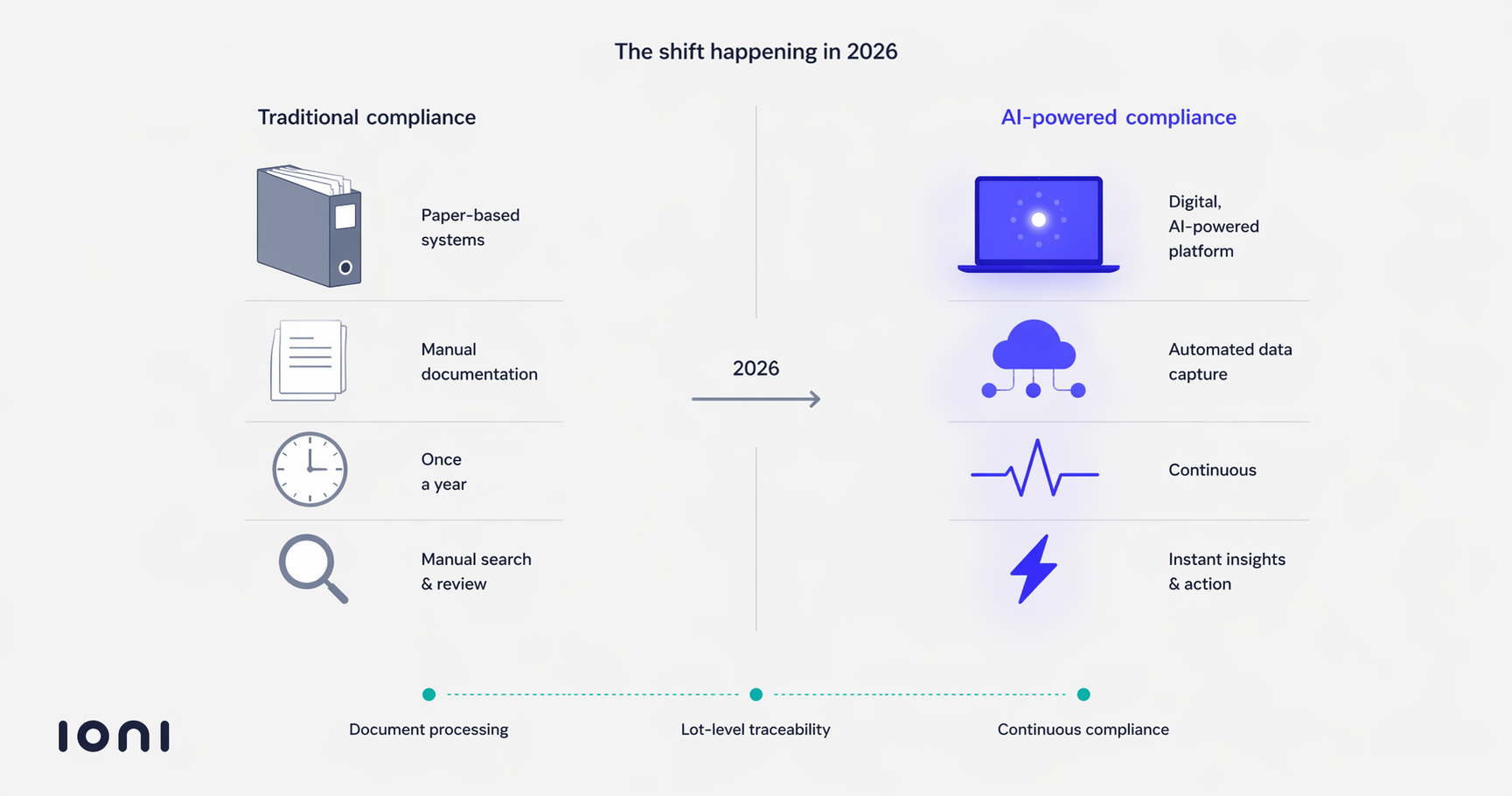
It does not work anymore. Paper logs get misplaced. Spreadsheets drift out of date. Handwritten records become illegible. Traceability reconstructions that should take minutes end up taking hours. And when something goes awry, the gap between what your system says happened versus what actually happened is a real problem. Companies making progress on SFCR food safety in 2026 are those closing this gap with AI.
Platforms specifically for Canadian food operators, such as IONI, are enabling this transition for small and mid-size businesses that wouldn’t otherwise be able to pay for dedicated compliance infrastructure. Not replacing human judgment, but providing the capabilities to process the amount of documentation, the velocity of trace requests, the pattern matching among hundreds of supplier records, and the regulatory monitoring that no manual approach would have the bandwidth to maintain at scale.
The Compliance Burden Under SFCR
Before we consider how AI fits in, it is reasonable to be clear about what SFCR compliance really demands of us. SFCR is not a single requirement that you tick off once and forget. It is a layered system that touches almost every part of a food business, from the moment ingredients arrive at your facility to the moment finished products leave for distribution. Each layer carries its own documentation expectations, and each one needs to remain current and defensible at any time CFIA or a customer auditor walks through the door. To understand the operational weight of SFCR, it helps to look at what compliance actually looks like on the ground for a typical Canadian food business.
For a mid-size food processor in Canada, an average week consists of keeping a written Preventive Control Plan that addresses biological, chemical, and physical hazards across all product lines. It consists of measuring Critical Control Points at specified times and recording each measurement. It involves tracking incoming ingredient lots against supplier documentation, updating traceability records one step back and one step forward for every batch, managing sanitation schedules, environmental monitoring programs, keeping training records current for all food safety personnel, and documenting every corrective action taken from identification through verification of effectiveness.
That is the baseline. On top of that, you have SFCR Part 6 commodity-specific requirements if you are dealing with dairy, meat, fish, eggs, or processed produce. You have bilingual labelling obligations under Parts 10 and 11. You have import verification requirements if you purchase from foreign suppliers. You have export documentation requirements if you ship internationally. And all of it should be available to CFIA in English or French within 24 hours of a request. For large operators with dedicated compliance teams, that is within reach.
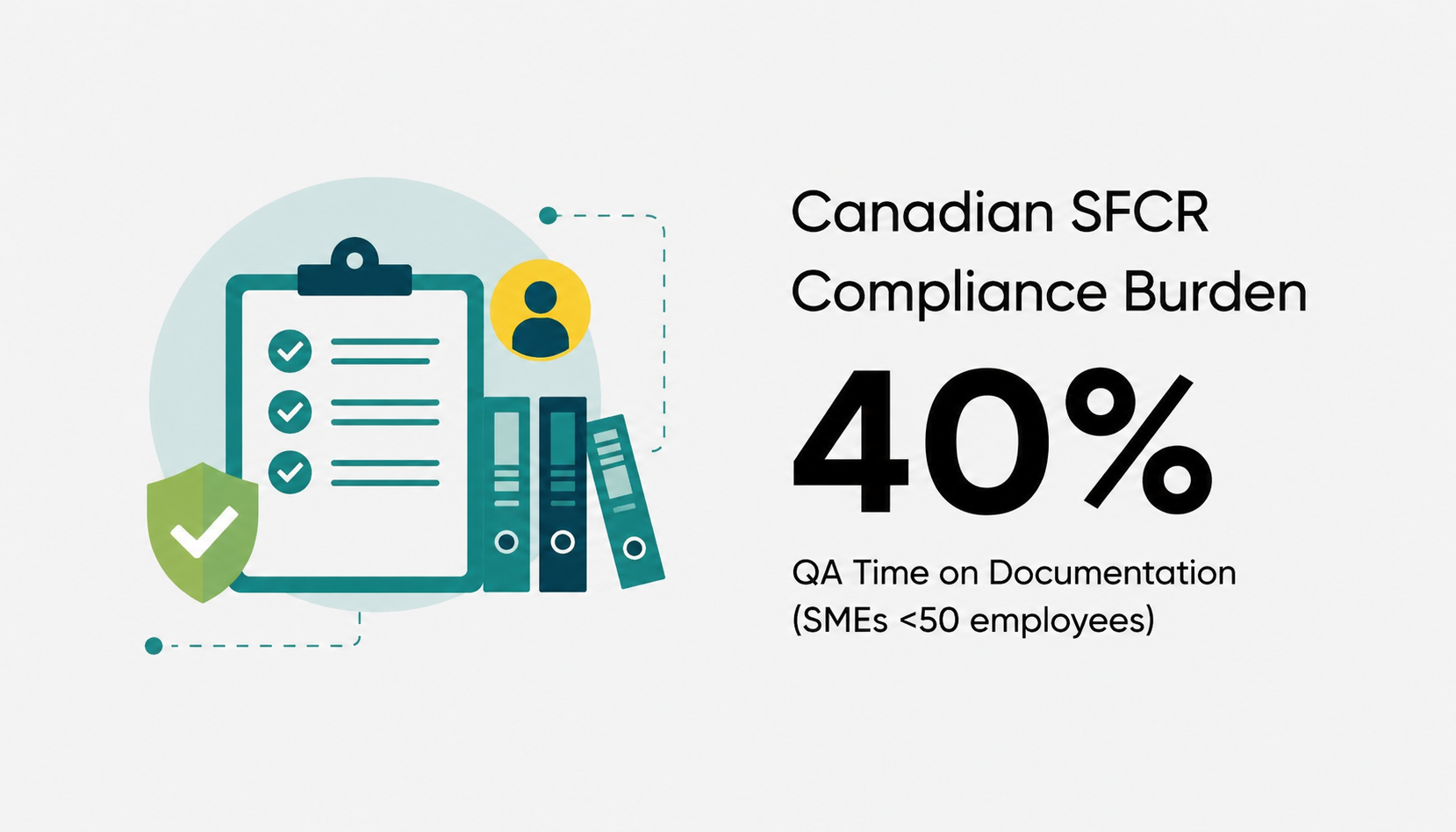
For most Canadian food manufacturing businesses, which are small and medium-sized, it is an ongoing strain. Research of Canadian food processors revealed that QA managers in facilities with under 50 employees devote an estimated 40 percent of their time to documentation and record-keeping tasks, while lacking the resources required to perform the actual food safety work the documentation is intended to support.
The burden compounds during CFIA inspections. A system-based PCP inspection examines whether your control measures are documented, implemented as written, and demonstrably effective. The inspector is looking for evidence, and that evidence lives in your records. When records are scattered across paper files, shared drives, and the personal knowledge of one or two team members, the inspection becomes an exercise in finding things rather than demonstrating compliance. In 2025, CFIA inspectors found non-compliance in 246 out of 1,733 inspected businesses. That is roughly one in seven. Food businesses that have moved to digital audit software are seeing measurably different outcomes.
What happens when non-compliance is found depends on the severity, but the consequences range from corrective action requirements and re-inspections to licence suspension and, in the worst cases, mandatory recall. The compliance burden under SFCR is real, and the cost of getting it wrong is significant.
What AI Brings to the Table
The term "AI" gets used so loosely in food safety conversations that it can mean almost anything, from glorified spreadsheet macros to genuine machine intelligence. That ambiguity is a problem when you are evaluating tools, talking to vendors, or trying to explain to your leadership team why a software investment is worth making.
Before diving into specific SFCR use cases, it is worth grounding the conversation in what AI actually does in a compliance context, where its capabilities sit on a practical spectrum, and how it fits alongside (not replaces) the regulatory framework CFIA already requires. The next three sections cover exactly that.
A plain-language overview of AI in a food safety context
AI in food safety is so noisy at this stage, and not all of it is helpful. And let me boil this back down to what is actually important in SFCR compliance.
In a food safety context, AI means developing software that can read, interpret, and act on food safety data and do so like that of a compliance analyst but at scale and without ceasing. It’s not machines on the production floor. It is not science fiction. It is pattern recognition, document handling and automated monitoring applied to the problems that have always gripped food safety teams: maintaining up-to-date records, identifying problems before they become audit findings, and reconstructing what goes wrong when something does go wrong.
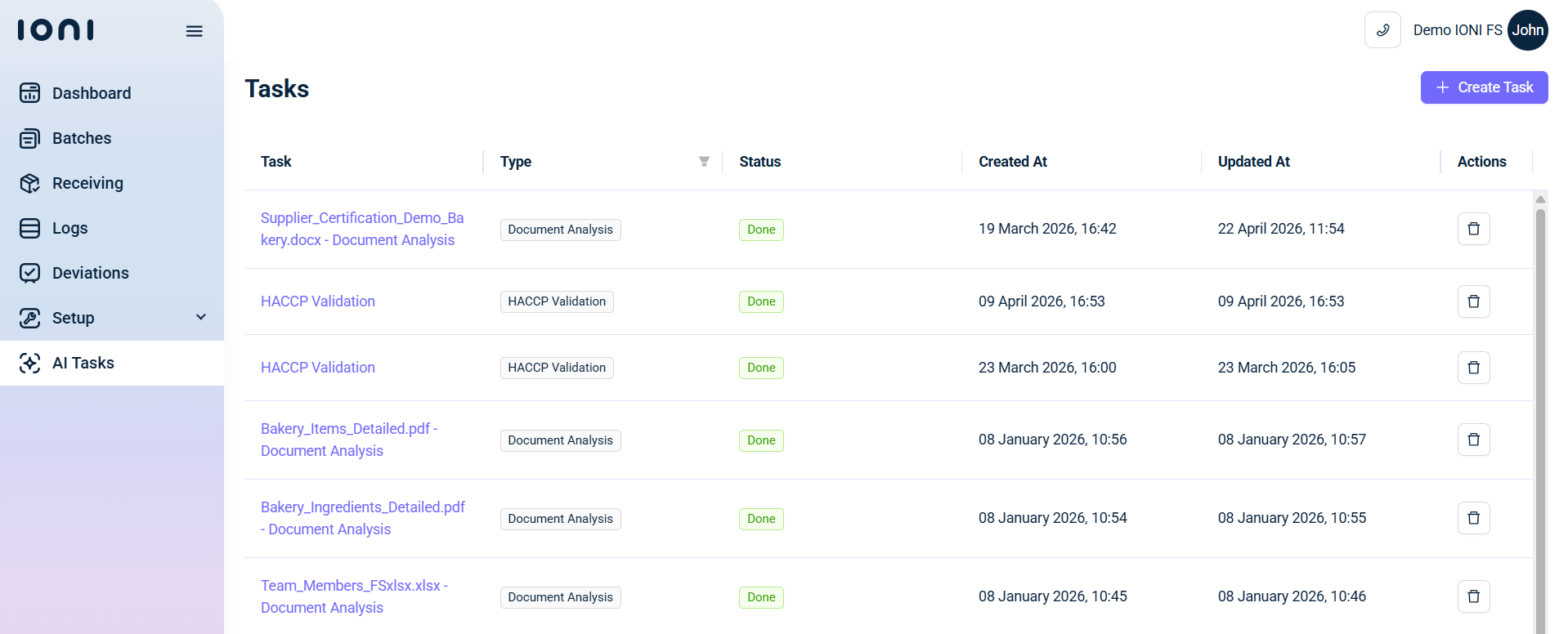
For example, AI in SFCR compliance in practice means a system reading your incoming Certificates of Analysis and flagging values outside your specification limits without anyone manually checking. A platform that maps every ingredient lot to every production batch and every shipped case; trace request returns in a matter of seconds.
A tool that tracks CFIA regulatory updates and informs you exactly what part of your PCP needs to change. That is the actual work. Comparing how manual and AI-generated plans hold up over time shows why this matters.
From automation to prediction: the spectrum of AI capabilities
Not all AI works alike, and knowing the spectrum is important for assessing the tools.
On the simpler end, AI takes care of automation: extracting data from documents, moving information between systems, and generating standard reports from structured data. This is not only practical, but it takes away a large fraction of the SFCR documentation burden.
Meaningful in the middle of the spectrum, AI does interpreting it; for instance, by parsing unstructured text, such as supplier specifications or regulatory guidance, and turning it into structured data, which can then be checked against your existing records and queried (i.e., verified and compared). This is the place where the value really resides for food safety compliance. It is the difference between storing a PDF and knowing what resides within it.
At the more complicated end, AI does prediction: sifting through trends in your monitoring data, supplier history and production records to detect risks before they materialize. Heavy metal value at spec but trending upward across three shipments. An environmental monitoring pattern associated with specific sanitation events. A batch record that indicates drift from normal parameters only hours before the product would fail quality testing.
The real-life sweet spot for SFCR food safety is often between the automation and interpretation layers. The predictive layer works well, but clean, well-structured historical data is what makes it powerful. And most Canadian food businesses must build the foundation first.
How AI fits into an existing SFCR compliance framework
The fundamental concept of AI and SFCR is: AI does not replace the compliance framework that is called for by CFIA.
The Preventive Control Plan, the traceability system, the licensing obligations, the record retention requirements. All of those things still exist, still apply and still need to be done. AI is changing how you meet those, not if you need to.
That’s important because some vendors sell AI as a shortcut around compliance. It is not. And what AI does is create compliance that’s sustainable at the scale modern food manufacturing demands, and it improves the quality of the evidence you can present to an inspector also. Here is a breakdown of the key elements of SFCR that food businesses encounter every day.
AI and SFCR Preventive Control Plans (PCPs)
Under SFCR Part 4, any written PCP needs to contain a hazard analysis, including biological, chemical and physical hazards, descriptions of control measures with supporting evidence, documented Critical Control Points with monitoring and verification procedures, consumer protection measures consisting of labelling and grading, and all related documents used to create the PCP. It must be re-evaluated every year and amended whenever a material change occurs. Ingredients, suppliers, processes, formulations, equipment, production volumes.
This is where AI earns its place. One still must have a lot of experience writing a PCP from scratch. It’s up to a food safety consultant or in-house expert to implement those actual decisions about hazards and control measures. But once a plan is established, sustaining it is where most facilities lag behind, and maintenance is precisely where artificial intelligence can do its job.
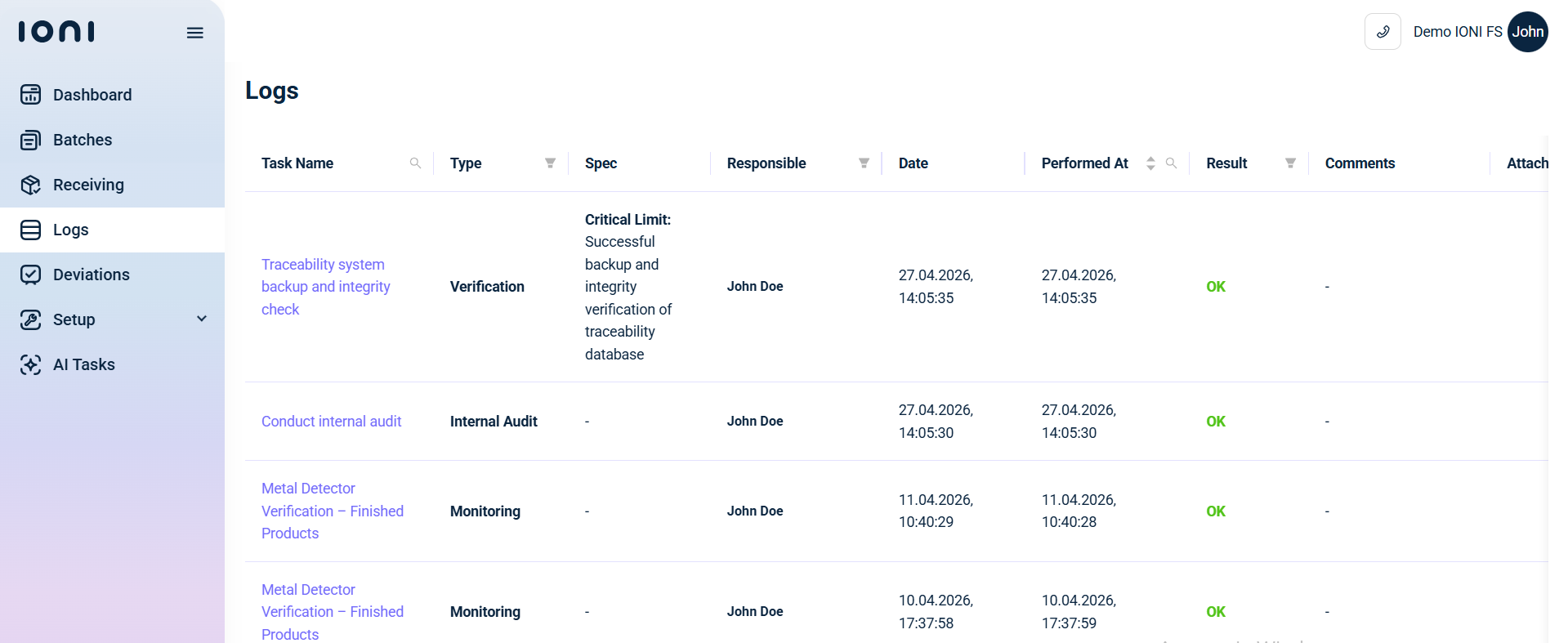
A well-designed AI platform reads your current PCP documents, extracts products, hazards, CCPs, monitoring points, and verification activities into a structured system and then continuously checks your actual records against what the plan details. When you change a supplier, the system flags which hazard analyses, which monitoring procedures, and which supporting documents need updating. When a CCP monitoring record is incomplete or out of specification, you receive an alert before it becomes a non-compliance finding. The system compiles the appropriate data for you to review when an annual reassessment is due, instead of having to make you assemble it from scratch.
If you are still working out the fundamentals of building your first PCP, the core concepts of hazard identification, control points, monitoring, and verification translate directly from HACCP principles to SFCR requirements. AI amplifies a sound plan. It cannot compensate for a weak one.
A Canadian specialty bakery we work with at IONI went from manually updating their PCP every 6-8 months (always behind CFIA expectations) to continuous maintenance that flagged a supplier change within 48 hours. The change came when their flour vendor switched to a new mill, which had different allergen controls. Without automated monitoring, that change would have gone unnoticed until the next annual review.
AI and SFCR Traceability
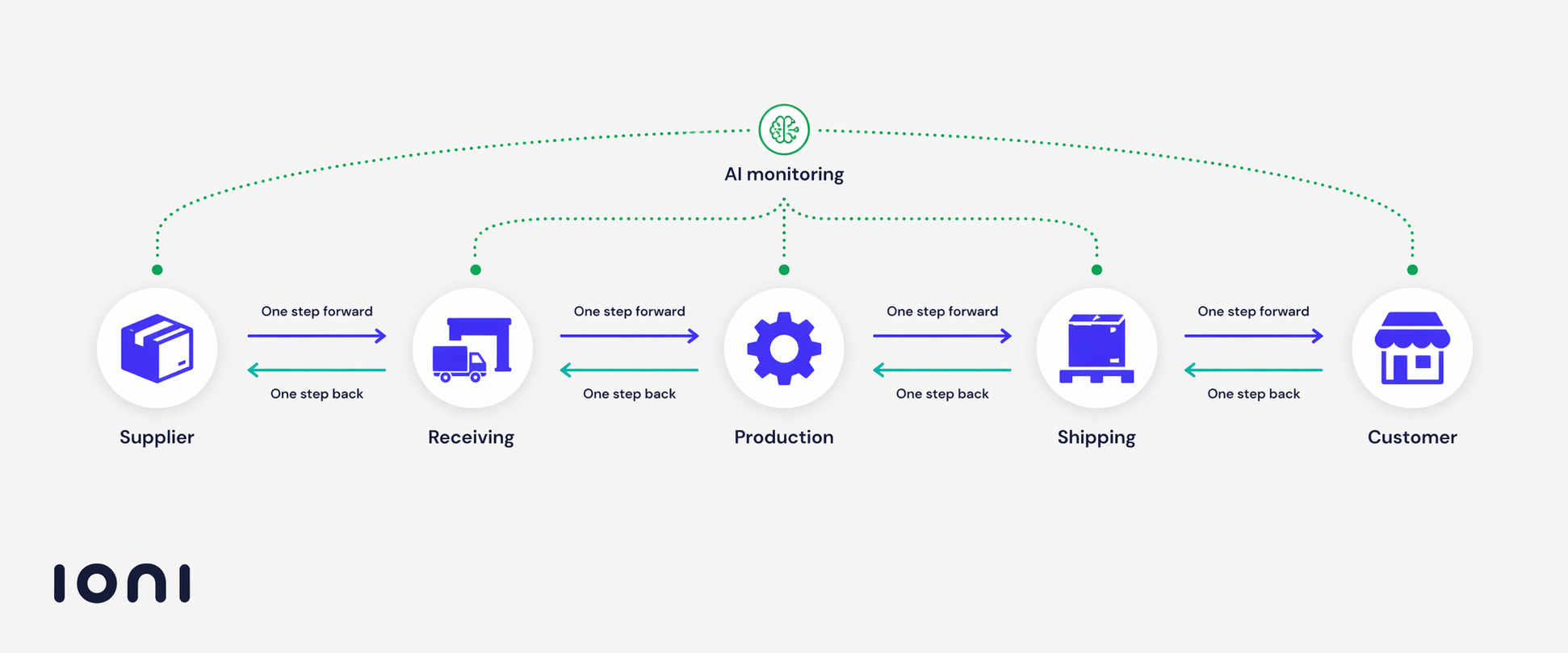
Under Part 5, the system of SFCR traceability means that any food enterprise inside your boundaries will have to trace where food came from (one step back) and where it went (one step forward). Individual batches need a unique lot ID. Records must last two years, be accessible in Canada, and be producible in a single file usable in standard commercial software.
This is where manual systems break first. Tracing one ingredient lot through a week’s production runs to identify every affected finished product and every customer who received it sounds straightforward until you actually do it with paper records. What takes minutes in theory takes hours in practice. When the CFIA issues a call about a suspected contamination, hours make a difference.
AI-driven SFCR traceability changes this - establishing relationships across ingredients, batches, and shipments immediately during work in progress, rather than piecing them together after the fact. So there’s lots of code captured at receiving that flows automatically through every production batch that uses it, every finished case it becomes part of, and every customer shipment it enters. If a supplier reports a contamination concern on a specific lot, the system responds to this in seconds, supplying an affected-product list of all the products. A mock recall that would previously take a day now takes fifteen minutes.
The IONI traceability module, for instance, gathers lot codes upon receiving via OCR or manual entry and associates every ingredient to every batch that uses it and ties the batches to finished product shipments. If a trace is requested by either a customer or CFIA inspector, the system gives a full forward-and-backward chain in one exportable file, which is precisely what SFCR Part 5 expects.
For co-packers and private-label manufacturers producing for multiple brands, this capability is moving from nice-to-have to mandatory. Retailers are increasingly writing traceability readiness into their supplier agreements, and the operational difference between facilities that can trace in minutes and those that need hours is becoming a competitive factor in Canadian retail channels. The operational shift from reactive tracing to continuous digital traceability is what enables this speed.
AI and SFCR Licensing and Record-Keeping
SFCR licensing through the My CFIA portal requires businesses to attest that they have preventive controls in place, provide establishment information, maintain licence conditions, and track renewal deadlines. The licence itself is tied to the activities you conduct, the commodities you work with, and the locations where the work happens.
AI does not apply for your licence. That remains a human responsibility. But AI significantly reduces the record-keeping burden that supports your licence attestations and makes licence renewals easier to prepare. (For the mechanics of the application itself, see our step-by-step walkthrough of how to get an SFC licence.) Every production record, every CCP monitoring log, every training record, every corrective action lives in a single searchable system rather than scattered across folders and binders. When CFIA requests documentation, you produce it. When you renew your licence, you already have the evidence organized.
This matters because SFCR record-keeping requirements include two-year retention for most documents, electronic accessibility, and the ability to produce records in either English or French on CFIA request. AI platforms handle this natively. Paper and spreadsheet systems require a human to do it every time.
AI and Food Safety Risk Management
SFCR risk management is not a unilateral process. Hazards change as ingredients change, as processes evolve, as new pathogens emerge, and as regulatory understanding advances.
AI complements risk management in two ways. First, pattern recognition across your monitoring data can uncover emerging risks much earlier than when you review them manually. Environmental monitoring swabs indicating a small increase in Listeria hits are associated with specific sanitation events. Ingredient specifications that shift across supplier batches. CCP measurements that drift within tolerance but in a direction that indicates something is changing upstream. These signals are often missed by a human reviewer who views this data weekly or monthly. A system observing them nonstop does not.
Second, AI-driven regulatory monitoring tracks what CFIA, Health Canada, and international bodies are publishing and flags what affects your operation specifically. When EFSA updates a contaminant threshold or CFIA issues new guidance on a commodity-specific requirement, the system maps the change to your PCP rather than leaving you to discover it during an audit.
AI and CFIA Inspections
CFIA performs system-based PCP and traceability checks to ensure that your control measures are complete, implemented, and effective. The inspector looks over the documentation, observes operations, interviews personnel, and assesses your evidence against SFCR requirements. If you are non-compliant, you are issued corrective action orders or more severe enforcement measures.
AI updates the inspection dynamic in three practical ways. First, continuous compliance monitoring means you know your readiness state at all times rather than discovering gaps during the inspection. Second, access to evidence is immediate. When an inspector requests that you produce data for a specific date range, product category, or CCP, the system creates it without needing to pull a scramble. Third, traceability demonstrations become fast. If the inspector wants to know how you’d trace a given lot, the demonstration takes minutes rather than hours.
Food companies that have turned to AI-powered compliance platforms such as IONI have said that CFIA inspections for which you previously had to prepare in 2-3 days now require a few hours since the evidence is always assembled. A readiness score on the dashboard shows you before the inspector arrives, so you know whether there are any gaps you need to fill.
The inspectors have observed it, too. CFIA has enshrined this in its 2025-2026 departmental plan - “user-centric digital tools that aim to improve data accessibility and information-sharing” on both the regulator and industry sides. The expectation that food businesses would have digital, auditable, and instantly accessible records is evolving from aspiration to norm.
Making SFCR Compliance Accessible for Small Food Businesses
Most public conversations about food safety technology focus on the big names. Multinational processors with dedicated compliance departments, enterprise software stacks, and budgets that allow them to absorb regulatory complexity without breaking a sweat. But the majority of Canadian food businesses do not look like that. They are bakeries with 12 employees, regional ready-to-eat producers with 40 staff, ingredient importers running lean operations, family-owned co-packers that have grown organically over decades.
The unique compliance challenges SMEs face
SFCR compliance, on the other hand, is as challenging at small and mid-size food companies in Canada as it is for large processors, though they typically do not possess similar resources. A 15-person bakery typically has a QA function of only one person who handles production scheduling, supplier relationships, and customer complaints. At a 50-person ready-to-eat meal producer, for example, two or three workers could be working on their food safety team that will oversee HACCP, sanitation, supplier qualification, training, and audit preparation.
The businesses I partner with generally run into the same pain points. Paper records that are accidentally lost or obscured. Spreadsheets that require hours to update and will quickly become obsolete the second someone changes a supplier or alters a formulation. Traceability requests from customers that last a full afternoon. PCP reassessments that slip because no one has time to sit down and conduct them properly. Audit preparations that morph into two-week fire drills each time.
The Safe Food for Canadians Regulations does not make a clear distinction between a 10-person operation and a 500-person operation. The demands for documentation, traceability and preventive controls are the same. Well, the difference is the ability to meet them. Small businesses usually find themselves in a catch-22 situation, over-investing in compliance to the detriment of growth or under-investing to the point of holding compliance debt that in time catches up with them - either with an audit finding or a recall.
How AI levels the playing field without a dedicated compliance team
The truth is that most small food businesses will never have a dedicated compliance team. The economics do not support it. A full-time QA manager costs $65,000 to $85,000 annually in Canada. A compliance analyst to support them adds another $55,000 to $70,000. For a business with $2 million in annual revenue, those numbers do not work.
AI changes this economic equation. An AI-powered food safety platform provides what dedicated compliance staff would provide, without the headcount. Document parsing, gap analysis, traceability queries, regulatory monitoring, and audit evidence assembly. The platform does the work a compliance analyst would do, and your QA lead spends time on judgment-intensive tasks like hazard analysis, supplier relationships, and process improvements where human expertise is genuinely required.
For SFCR compliance specifically, this means a 20-person food processor can maintain the kind of documentation discipline that used to be available only to facilities with dedicated compliance teams. The PCP stays current. The traceability records stay complete. The training logs stay up to date. The audit evidence stays organized. None of this requires heroics. It requires software that does the administrative work continuously in the background.
Cost and time savings for smaller operators
The numbers for small operators adopting AI-powered SFCR compliance tools are compelling when you look at them honestly. A mid-size Ontario-based bakery that implemented IONI last year reported that their QA lead went from spending 18 hours per week on document control to under 4 hours after implementing an AI platform. That recovered time went into actual food safety work: supplier visits, process improvements, and team training.
A ready-to-eat meal producer in British Columbia that onboarded IONI in late 2025 reduced their CFIA inspection preparation from 10 business days to 2, and completed a supplier audit response in 45 minutes instead of the usual half-day.
Audit preparation showed similar changes. Where previous CFIA and customer audits required two full weeks of assembly and coordination, the same preparation dropped to two or three days. The evidence was already organized, the records were already digital, and the traceability demonstrations were already instant. The auditors noticed the difference, and the inspection outcomes reflected it.
Recall readiness is another area where small operators see outsized benefit from AI. A manual traceability reconstruction for a mid-size facility with multiple product lines can easily consume a full business day. An AI-powered SFCR traceability system does the same reconstruction in under ten minutes. When CFIA calls about a suspected issue, that difference is the line between a targeted recall and a broad, expensive one.
For small food businesses working on constrained budgets, the return on investment usually shows up within the first quarter. Reduced audit prep costs, fewer compliance-related overtime hours, faster customer response times, and dramatically lower recall risk all translate into direct financial outcomes.
How IONI Is Making SFCR Compliance Accessible for Food Businesses
IONI is an AI-powered food safety platform designed specifically for the kind of food businesses that make up the majority of the industry in Canada: small and mid-size manufacturers, co-packers, processors, and importers who need the benefits of AI-driven compliance without the enterprise complexity or enterprise price tag.
We built IONI because we saw the same problem repeated across dozens of Canadian food businesses: the Safe Food for Canadians Regulations require a level of documentation discipline that manual systems cannot sustain, and the platforms available to address it were either too expensive or too complex for the operators who needed them most.
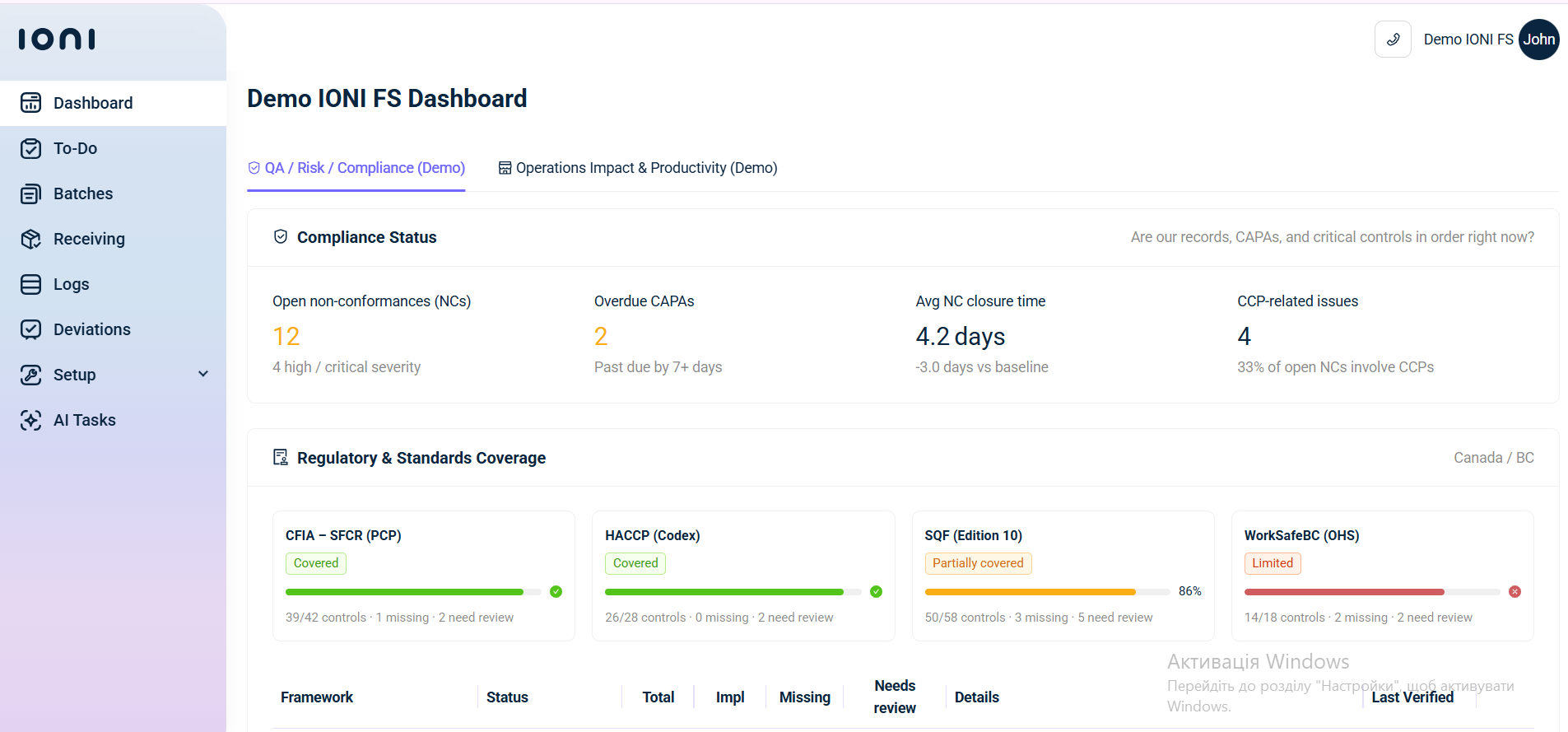
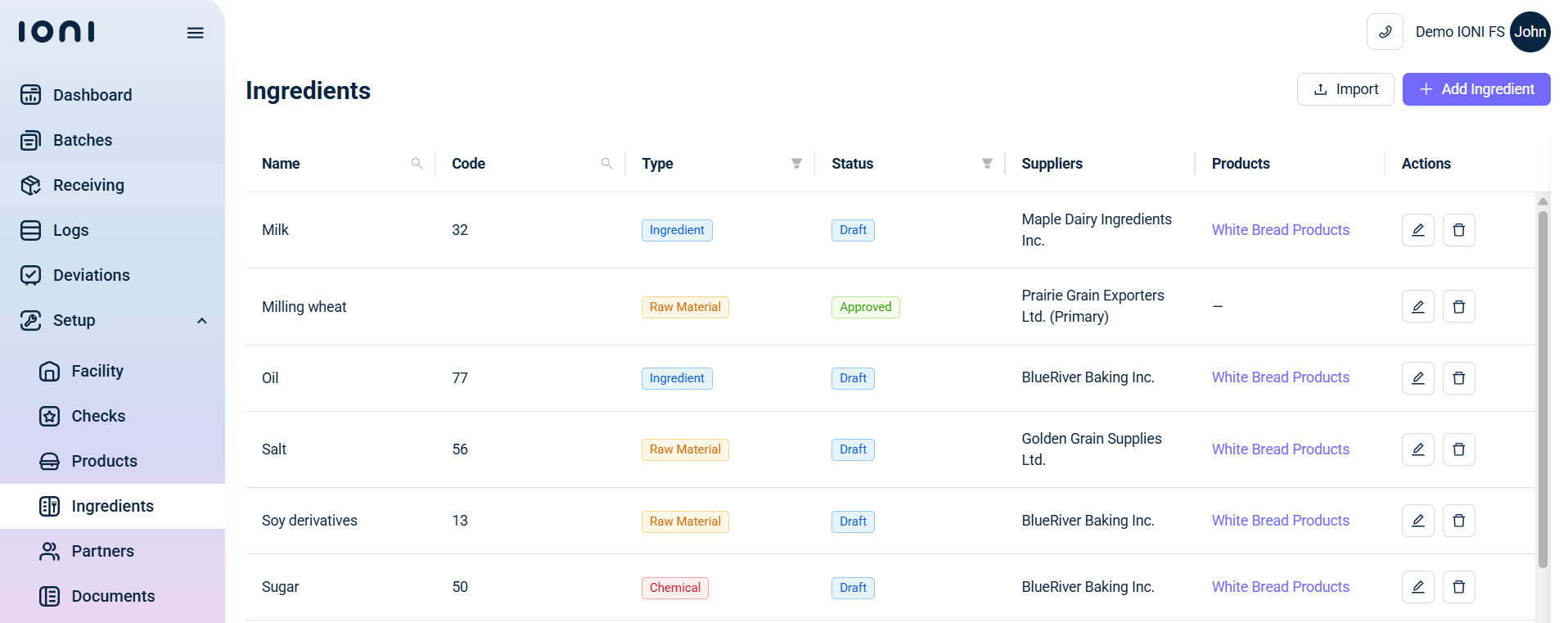
PCP generation and maintenance. IONI's HACCP builder reads your existing documentation, extracts your products, ingredients, process steps, and existing control measures, and generates a complete Preventive Control Plan aligned with SFCR Part 4 requirements. The plan includes hazard analysis, CCP identification, monitoring procedures, corrective action protocols, flow charts, and SOPs. More importantly, the platform maintains the plan over time. When you change a supplier, add a product, or modify a process, IONI flags exactly which parts of the PCP need updating.
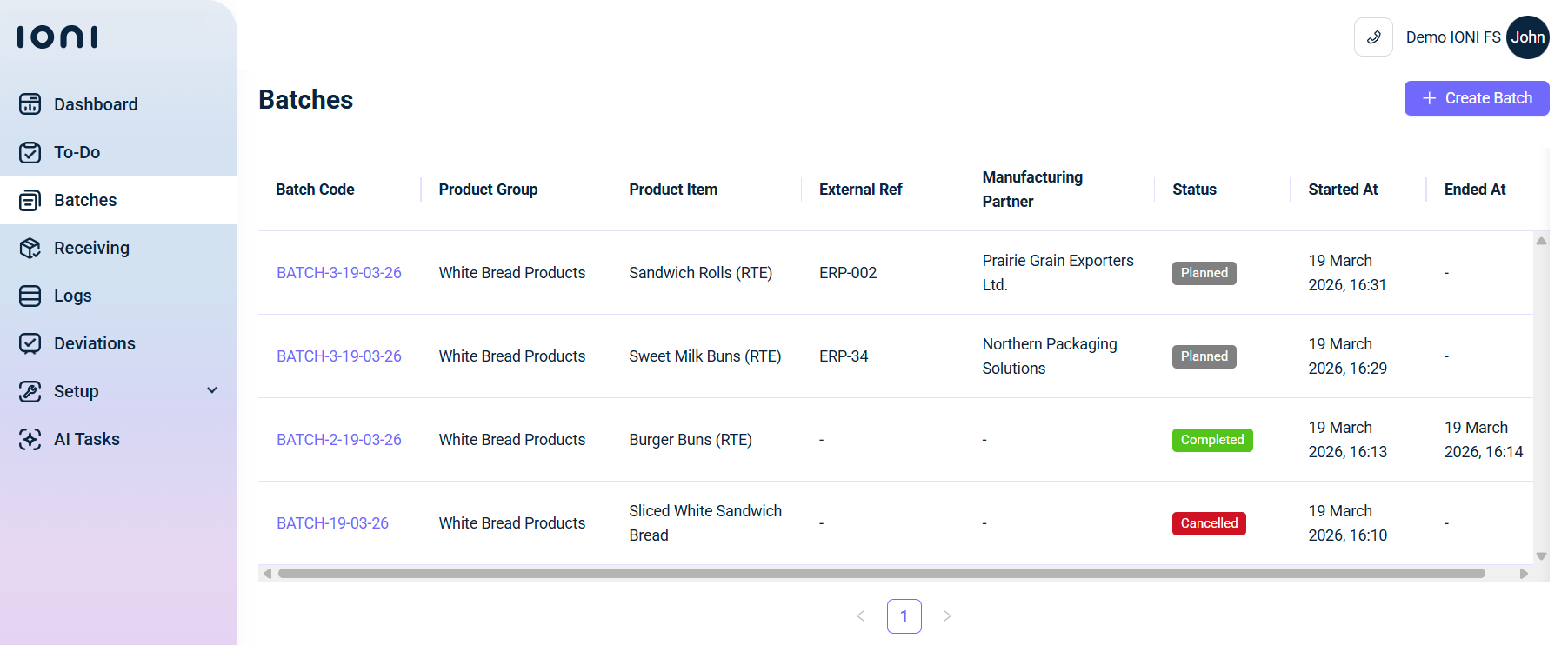
Traceability from ingredient to shipment. IONI's traceability module captures lot codes at receiving, links every ingredient to every batch that uses it, and tracks every batch through to the customer shipments that contain it. When a supplier notifies you about a lot of concern or a customer raises a quality issue, you produce a complete forward and backward trace in seconds. For SFCR traceability, this is exactly what CFIA expects: one step back, one step forward, accessible in a single file, available in minutes rather than hours.
Continuous compliance monitoring. The platform continuously checks your records, logs, and CAPAs against SFCR requirements. When a CCP monitoring record is overdue, when a supplier document is about to expire, when a training requirement lapses, or when a deviation has not been fully closed out, you get an alert before it becomes an audit finding. CFIA inspectors verify that businesses have "documented evidence that their control measures are effective." IONI makes sure you always do.
Audit evidence in minutes. When a CFIA inspection or customer audit is approaching, IONI compiles the complete evidence pack by pulling together monitoring records, CAPA logs, training documentation, document version histories, and verification activities. What used to take your team days of manual assembly happens in minutes. The evidence is organized, the traceability is demonstrable, and the readiness score is visible before the inspector arrives.
Regulatory intelligence for Canadian food businesses. SFCR is not static. CFIA publishes guidance updates, Health Canada adjusts labelling requirements, and international standards evolve in ways that affect Canadian importers and exporters. IONI's regulatory intelligence module monitors these changes and maps them specifically to your operation, so you are not discovering that a requirement changed six months ago during your next audit.
Works with paper, PDFs, and spreadsheets. Most Canadian food businesses we onboard are not starting from a clean digital infrastructure. They have binders, shared drives, and Excel files that have evolved over the years. IONI is designed to work with this reality. Upload what you have, and the AI parses the content, extracts the relevant data, and builds your digital compliance system from your actual operations. You do not need to re-enter years of records or replace existing systems to start getting value.
Pricing that works for small operators. IONI starts at $99 per month for a single facility, with a premium tier at $199 per month for multi-site operations. For context, that is less than a single hour of a food safety consultant's time. For small Canadian food businesses that cannot justify dedicated compliance staff, this pricing makes AI-powered SFCR compliance genuinely accessible.
Ready to try? Feel free to book a demo with us and see how IONI may help you.
The Future and Challenges of AI in SFCR Compliance
Predicting the future of any technology is risky, but predicting where AI is heading in Canadian food safety is less risky than it sounds. The signals are already in the open. CFIA is publicly modernizing its tools. Retailers are tightening supplier expectations. Certification schemes are updating their benchmarks every twelve to eighteen months. International regulators are aligning on traceability standards that Canadian exporters cannot igАnore. The direction is clear, even if the exact pace varies.
Emerging trends in food safety technology in Canada
The 2025 to 2026 CFIA departmental plan makes this clear. The agency is pledging that it will embrace user-centric digital tools, continue to expand the application of analytical technologies for risk prediction, and enhance the utility of digital platforms within its services. This is not speculation. The agency is modernizing its own systems, which creates both opportunity and pressure for the businesses it regulates.
At the industry level, some of the trends are accelerating in 2026. First, AI-driven document processing in ingredient specifications, supplier Certificates of Analysis, and regulatory monitoring is becoming standard. The manual examination of these documents is already evolving towards something near-vestigial, rather than universal. Second, lot-level traceability is moving from one of recall response toward that of being an ongoing operational capability. Retailers are now incorporating traceability readiness into supplier contracts, pushing up the capability so that it goes to every supplier in the chain. Third, periodic self-audits are being replaced with continuous compliance monitoring.
AI brings value to this by measuring behavioral evidence: patterns of training completed, reports of near-misses, employee engagement with compliance tasks, and response times on deviations. Culture still is based on the leadership and management practices, but its measurement is transitioning from anecdotal to data-driven. The role of AI in shifting food safety from reactive compliance to operational excellence is becoming more visible every quarter.
Anticipated regulatory changes and how AI adapts
Several regulatory changes are visible on the horizon for Canadian food businesses. The Feeds Regulations are in their final implementation phase, with PCP requirements having come into force on June 17, 2025. Front-of-pack nutrition labelling rules became fully enforceable on January 1, 2026. PFAS standards for biosolids took effect in late 2024 and continue to expand. Commodity-specific updates under SFCR Part 6 are published regularly, and international alignment with US FSMA, particularly Rule 204, is creating cross-border traceability expectations that affect Canadian exporters.
What makes AI valuable in this environment is adaptability. A regulatory change that would previously have required a manual review of your PCP against the new requirement, a gap analysis, and documented updates across multiple records now happens continuously in the background. The system maps the change to your existing documentation and tells you specifically what needs updating. The work still needs to be done, but the overhead of figuring out what work is needed drops substantially.
This matters more as the regulatory pace increases. Canadian food businesses working with foreign suppliers now need to track CFIA, Health Canada, FDA, EU, and sometimes EFSA changes simultaneously. No manual system keeps up with that volume of regulatory activity across that many jurisdictions. AI systems are not a luxury in this environment. They are becoming a basic operational requirement.
What food businesses should be doing now to stay ahead
The big question for all Canadian food businesses in 2026 is not whether to use AI for SFCR compliance, but where to begin. That’s what I counsel the operators I work with.
Begin with your greatest pain point. If traceability is the weakest point in your current system, fix that first. Capture lot codes at receiving, linked through production, and traceable to shipments. Start there if PCP maintenance is where you're lagging. Digitize your plan, establish automated gap monitoring, and get into the habit of keeping it current rather than catching up once a year. If you find that audit prep exhausts your people for weeks every time, then you will enjoy the fastest ROI. Don’t attempt to remedy everything at once. Businesses that succeed with AI adoption begin with a single problem, demonstrate value, and expand from there. The unsuccessful ones attempt to change everything at once and find themselves with no part of the system operating well.
Use tools that integrate with your documentation. Where a platform needs to rebuild your PCP from scratch before it can help, I would caution you as a potential source of risk for any program. Real AI tools are capable of parsing paper records, PDFs, spreadsheets, and other existing digital systems. They meet you where you are.
AI tools only work if the people using them trust and know what they are doing. To develop that skill in your QA lead, plant manager, and production team, train them on how to respond to AI outputs appropriately. The technology magnifies human expertise. It does not replace it. Plan for regulatory change. The Canadian regulatory environment is increasingly moving toward integrated digitalization in order for industry to adopt, raising the bar on how fast food businesses prepare evidence, execute traces, and demonstrate compliance.
The businesses that build these capabilities now will be well-positioned when expectations fully normalize. Those who remain must cope with a compressed adoption timeline under pressure.
Honest challenges to acknowledge
AI implementation of software compliance to SFCR is not frictionless, and there are some good reasons to be pragmatic about where the pitfalls are. The challenge is data quality. AI tools are only as good as the information they work with, and if you don’t have complete facts about your records, they’ll be just as good as your records - they’re incomplete, inconsistent, or inaccurate, and the AI will inherit those problems. Transitioning from paper to digital typically brings to the surface data quality issues that used to be buried or otherwise concealed. This is not useless, however, as rectifying them increases your compliance base, but requires realistic expectations about the work involved.
Acceptance of regulations is changing. Professionally, CFIA has also been comfortable with digital records and AI-generated documentation, and comfort is a matter for inspectors, commodities, and others. The best way to take the safest approach is to employ AI in a supporting role to a decision, with the human hand on the key issue, rather than replacing professional judgment on food safety.
When an inspector asks how the hazard analysis was generated, "AI drafted it, and our SQF Practitioner reviewed and validated it" is an acceptable answer. “AI wrote it and we trusted the output” isn’t.
Cost and scale matter. AI platforms differ widely in cost and sophistication. The enterprise tools big processors use are overkill for small operations, and cheap tools can lack the depth needed for true SFCR compliance. Match the tool to your business. Don’t over-buy or under-buy products.
Workforce transition is real. The skills that food safety teams require in 2026 are distinct from the skills they required in 2016. Comfort with digital tools, a sound understanding of how to interpret AI-generated insights, judgment about when to override algorithmic recommendations - these skills are increasingly becoming standard. It is as essential to invest in this skill development as it is to invest in the platforms themselves.
Conclusion
Compliance with SFCR (Safe Food for Canadians Regulations) is not going to get easier.
The Safe Food for Canadians Regulations will continue to adjust and evolve, CFIA will further upgrade its analytical capabilities, retailers will raise supplier expectations, and the documentation burden on Canadian food businesses will go up again.
The challenge for each operator is how to satisfy these needs sustainably and avoid destroying business operations or stretching their team. AI is not the only answer, but it is the most important tool for the Canadian food business in 2026. It makes the documentation doable. It renders the traceability immediate. It ensures that the regulatory oversight is constantly on. It standardizes audit preparation as an exercise, not like a sudden emergency. But more important of all, it allows for all of this to be for the small and mid-size operators who form the backbone of Canadian food manufacturing, rather than only the enterprise players who in the first place have always had these capabilities.
By the time the regulatory environment finally normalises around all digital compliance measures, businesses that adopt AI-powered SFCR now will have matured systems. The businesses that wait now will face a harder transition under a greater deal of pressure. This is not about catching the first order. It is about being ready. If, say, SFCR compliance is taking up more time and resources of your team than it ought to, the direction is clearer than previously. Begin with one problem and work your way through it, and use whatever you build upon it.
The technology is ready. A clear regulatory direction awaits. So, the only issue is how quickly you want to go.
Ready to try? Feel free to book a demo with us and see how IONI may help you.
FAQ
What is SFCR compliance?
SFCR compliance refers to meeting the requirements of the Safe Food for Canadians Regulations, which consolidate 14 federal food safety rules covering licensing, preventive controls, traceability, packaging, and labelling. The regulations apply to most food businesses that manufacture, process, treat, preserve, package, label, store, import, or export food for interprovincial trade or international commerce.
Do all Canadian food businesses need SFCR traceability?
SFCR traceability requirements apply broadly to most food businesses within scope of the regulations. The core requirement is one step back (identifying your immediate supplier) and one step forward (identifying who you provided the food to). Some retail and service operations have more limited requirements, but the general expectation under Part 5 of SFCR is that every lot of food can be traced in both directions.
How does AI help with SFCR food safety specifically?
AI helps with SFCR food safety by automating the documentation that would otherwise consume QA team time, providing continuous compliance monitoring instead of periodic self-audits, enabling fast traceability queries that used to take hours, and tracking regulatory changes that affect your operation. It does not replace professional food safety judgment. It makes that judgment more effective by handling the administrative work.
Can a small business with no dedicated compliance team use AI for SFCR compliance? Yes, and this is actually where AI delivers the most value. Small food businesses often cannot justify a dedicated compliance team, which means SFCR compliance competes with everything else the QA lead handles. AI platforms like IONI provide the capabilities a compliance analyst would provide, without the headcount, at prices that work for operations with limited budgets.
What happens if I fail a CFIA PCP inspection?
CFIA's response to non-compliance depends on the severity. Minor deviations typically result in corrective action requirements with defined timelines. Serious non-compliance can lead to control actions, enforcement measures, re-inspections, or in severe cases, SFC licence suspension or cancellation. AI-powered continuous compliance monitoring significantly reduces the risk of discovering gaps during an inspection rather than well before it.
How long does it take to implement an AI platform for SFCR compliance?
Modern platforms designed specifically for food businesses can be operational within days for small operations. The AI reads your existing documentation, extracts your products, ingredients, hazards, and control measures, and builds the digital foundation automatically. Larger operations or those with more complex multi-site setups typically take a few weeks to fully configure, but the time to first value is usually much faster than traditional compliance software implementations.
Does AI replace the need for a food safety consultant?
No. AI complements professional food safety expertise. Consultants are valuable for the initial hazard analysis, complex regulatory interpretation, and situations requiring deep specialized knowledge. AI handles the continuous documentation work, the pattern recognition across records, and the regulatory monitoring that would otherwise require dedicated staff. Most successful Canadian food businesses use both consultants for strategic work and AI for ongoing operational compliance.
How does IONI support SFCR compliance specifically?
IONI provides AI-powered PCP generation and maintenance aligned with SFCR Part 4, SFCR traceability that captures lot codes from receiving through shipment, continuous compliance monitoring against SFCR requirements, audit evidence assembly in minutes, and regulatory intelligence that tracks CFIA and Health Canada updates relevant to your operation. The platform is designed for Canadian food businesses and works with existing paper records, PDFs, and spreadsheets rather than requiring a clean digital infrastructure as a prerequisite.