.png)
Codex Alimentarius, Latin for "food code," is a collection of internationally recognized food standards, guidelines, and codes of practice adopted by the Codex Alimentarius Commission, a joint body of the Food and Agriculture Organization (FAO) and the World Health Organization (WHO). It isn't a law in any single country — it's a voluntary international reference that individual regulators, including FDA and CFIA, and private certification schemes draw on when writing their own binding requirements.
Who runs Codex Alimentarius
The Codex Alimentarius Commission implements the Joint FAO/WHO Food Standards Programme, whose stated purpose is to protect consumer health and ensure fair practices in the international food trade. Member governments and observer organizations participate in developing and adopting each standard, which is part of why Codex carries broad international credibility even though it has no independent enforcement power of its own.
What Codex actually covers
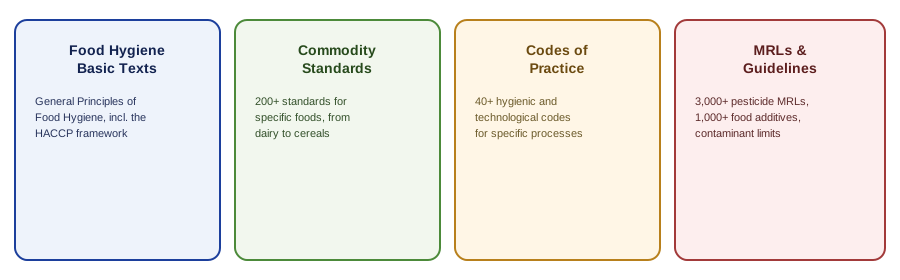
The most consequential part for food manufacturers is the General Principles of Food Hygiene, which lays out hygiene practices from primary production through final consumption and includes the internationally recognized description of the HACCP system and how to apply it. Beyond that foundational text, Codex has developed over 200 commodity standards covering specific foods, more than 40 hygienic and technological codes of practice, evaluated over 1,000 food additives and 54 veterinary drugs, and set more than 3,000 maximum residue limits for pesticides, along with guidelines for contaminants.
How Codex relates to US and Canadian regulations
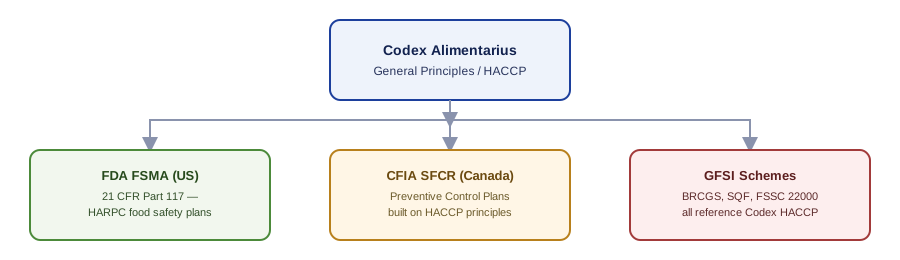
No manufacturer is directly bound by Codex the way they're bound by FDA's HARPC regulation or CFIA's Safe Food for Canadians Regulations. What actually happens is that both regulatory frameworks, and the private GFSI-recognized certification schemes like BRCGS, SQF, and FSSC 22000 built on top of them, use Codex's HACCP framework and food hygiene principles as their shared conceptual foundation. That's why a HACCP-based system built to satisfy a US buyer and one built to satisfy a Canadian or European buyer look structurally similar even though the specific legal requirements differ — they're both variations on the same underlying Codex framework.
Where IONI fits
Whether a facility's HACCP-based plan needs to satisfy FDA's HARPC rule, CFIA's Preventive Control Plan requirement, or a GFSI scheme's audit criteria, the underlying hazard analysis and control logic all trace back to the same Codex principles. See how IONI helps food manufacturers build a HACCP-based food safety system that holds up across frameworks.
Frequently asked questions
Is Codex Alimentarius a law?
No. It's a voluntary collection of international standards and guidelines. Individual countries, including the US and Canada, and private certification schemes reference it when writing their own binding regulations and audit requirements, but Codex itself has no independent enforcement authority.
Does the FDA follow Codex Alimentarius?
FDA's own regulations, including the HARPC requirements under 21 CFR Part 117, are shaped by the same HACCP principles Codex's General Principles of Food Hygiene describe, though FDA's rules are the actual binding US legal requirement, not Codex directly.
What is the relationship between Codex and HACCP?
Codex Alimentarius's General Principles of Food Hygiene contain the most widely used international description of the HACCP system and how to apply it, making Codex the conceptual origin point that most national HACCP-based regulations and GFSI schemes build on.
Who participates in the Codex Alimentarius Commission?
Member governments of the FAO and WHO, along with observer organizations, participate in developing and adopting Codex standards through the Joint FAO/WHO Food Standards Programme.