.png)
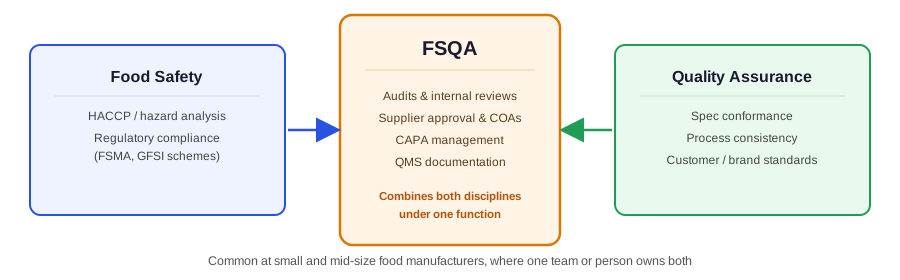
FSQA stands for Food Safety and Quality Assurance: the function in a food plant that keeps products both safe (HACCP, preventive controls, regulatory compliance) and to specification (quality checks, process consistency, customer standards). At small and mid-size food manufacturers, one FSQA team or one person usually owns both. There is no single "FSQA certification"; FSQA staff typically hold PCQI training, HACCP training and SQF practitioner training.
Where FSQA sits: food safety + quality assurance
FSQA vs. QA vs. QC — how the roles differ
Quality Control (QC) is the narrowest of the three: inspecting and testing product against a spec, typically at a single point in the process (incoming, in-process, or finished goods). Quality Assurance (QA) is broader — it's the systems and processes that make consistent quality likely in the first place, not just the inspection that catches defects. FSQA layers food safety compliance on top of quality assurance: an FSQA team owns not just "does this product meet spec" but "is this facility's food safety plan, supplier program, and audit posture defensible," which is why the role usually reports on both regulatory and customer-facing outcomes.
What an FSQA team actually does day to day
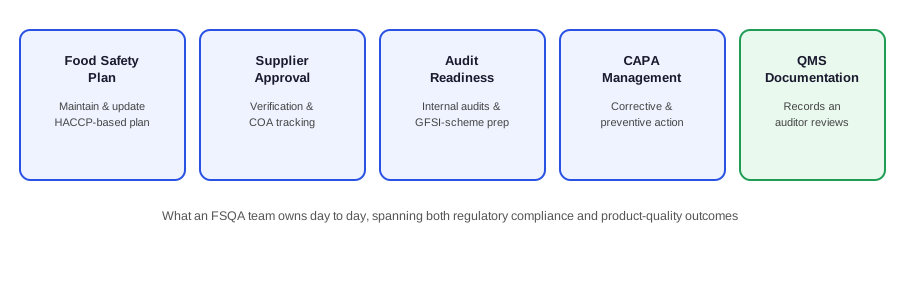
- Maintains and updates the facility's HACCP-based food safety plan and supporting prerequisite programs.
- Runs or coordinates supplier approval and verification, often working from the same supplier quality systems that track COAs and audit documentation.
- Owns internal audits and GFSI-scheme audit prep (SQF, BRCGS, FSSC 22000).
- Manages corrective and preventive action (CAPA) when a nonconformance, complaint, or audit finding comes in.
- Maintains the facility's quality management system (QMS) documentation — the records and processes an auditor actually reviews.
Common FSQA certifications and qualifications
There's no single mandatory credential for an FSQA role, but common qualifications include HACCP certification, PCQI (Preventive Controls Qualified Individual) training required under FSMA for facilities with a food safety plan, internal auditor training for whichever GFSI scheme the facility is certified to, and increasingly a food science or related technical degree for more senior roles.
Why small manufacturers combine food safety and quality into one function
At large manufacturers, food safety and quality assurance are often separate departments with separate leadership. Small and mid-size manufacturers rarely have the headcount to split the two, and in practice the disciplines overlap heavily anyway — a supplier COA failure is both a quality issue and a food safety issue, and an audit finding usually touches both. Combining them into one FSQA function under a single manager is less about following a framework and more about matching team size to what the plant actually needs covered.
See how IONI supports FSQA teams with connected HACCP, supplier, and CAPA documentation: Food Safety Software.
Frequently asked questions
Is FSQA the same as QA?
No. QA is quality assurance broadly; FSQA specifically combines quality assurance with food safety regulatory compliance under one role or team, which is more common at food and beverage manufacturers than at other industries.
What does an FSQA manager do?
An FSQA manager typically owns the facility's food safety plan, supplier approval program, internal and third-party audit readiness, and CAPA process — spanning both regulatory compliance and product quality outcomes.
Do I need a food science degree to work in FSQA?
Not always for entry-level roles, but a food science, microbiology, or related technical background is common for FSQA manager and director positions, often alongside HACCP and PCQI certification.
Is there an FSQA certification?
There is no single, mandatory FSQA certification. FSQA professionals usually build their credentials from PCQI, HACCP and, at SQF-certified sites, SQF practitioner training, plus internal auditor training for their GFSI scheme.