.png)
Cold chain monitoring is the practice of measuring and recording the temperature of refrigerated and frozen food at every stage it passes through, from receiving and cold storage to production and shipping, so any deviation is caught, acted on and documented. For a manufacturer, the record matters as much as the reading.
What Cold Chain Monitoring Covers in a Food Plant
Most guides describe the cold chain as a trucking problem. For a manufacturer it is wider: you receive cold ingredients, hold them in coolers and freezers, pull them into production, store finished product, and ship it out. Each handoff is a place where temperature can drift, and each needs a defined limit, a way of measuring, and a record. Cold tracking at only one stage, such as the outbound trailer, leaves the rest as a gap an auditor or a customer complaint will find.
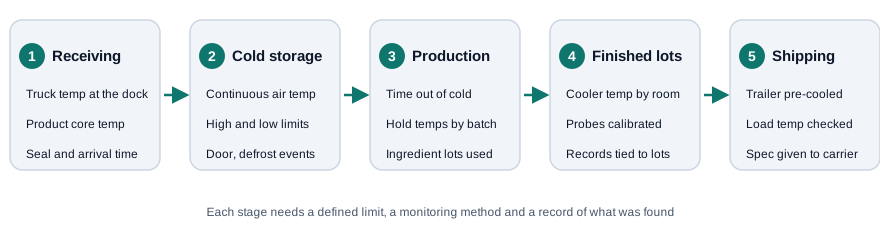
- Receiving: check the vehicle and the product, not just the paperwork. Our receiving inspection checklist covers what to check at the dock.
- Cold storage: air temperature in each cooler or freezer, with limits and alarms.
- Production: how long product sits out of refrigeration, and which ingredient lots went into which batch.
- Finished goods and shipping: room temperature records, trailer pre-cooling and load checks.
The FSMA Sanitary Transportation Rule: Who Does What
Cold chain compliance for transport sits in FDA's Sanitary Transportation of Human and Animal Food rule, 21 CFR Part 1, Subpart O. FDA says it applies to shippers, receivers, loaders and carriers who transport food in the United States by motor or rail vehicle. A manufacturer is often the shipper when product goes out and the receiver when ingredients come in, so you can hold both roles.
Scope and exemptions
Check these before assuming you are covered. A business with less than $500,000 in average annual revenue (as adjusted for inflation, over the preceding three years) is a non-covered business. FDA also lists an exemption for food completely enclosed by a container, but not for food that requires temperature control for safety, so packaged refrigerated product is still in scope. Food in facilities regulated exclusively by USDA under the meat, poultry or egg products acts is excluded as well. Confirm your own status with your regulatory lead.
Responsibilities by role
The temperature duties are in 21 CFR 1.908:
- Shipper: for food that requires temperature control for safety, specify an operating temperature in writing to the carrier, including any pre-cooling phase if necessary, and develop and implement written procedures to make sure the food is transported under adequate temperature control.
- Loader: before loading, verify the vehicle is suitably prepared, including that it has been properly pre-cooled if necessary.
- Carrier: where a written agreement makes it responsible for sanitary conditions, pre-cool mechanically refrigerated compartments as the shipper specifies and, if asked, demonstrate that temperature was maintained, for example with time and temperature data from the shipment.
- Receiver: on receipt, take steps to assess that the food was not subjected to significant temperature abuse, such as checking food temperature, the vehicle's ambient temperature and its setting, and doing a sensory check for off-odors.
Under 21 CFR 1.912, shippers keep records showing they gave carriers their specifications and operating temperatures for 12 months beyond the end of the carrier agreements, and keep their written agreements and procedures for 12 months beyond when they stop being used. Those are the transportation-rule records. Preventive controls records follow a different clock, covered below.
Temperature Limits to Monitor Against
Your own food safety plan sets the critical limits, based on the product and the hazard. For a general reference point, FDA describes the temperature danger zone as usually between 41°F and 135°F (5°C and 57°C). The FDA Food Code is a model code for retail and food service regulators, not a rule for manufacturers, so treat those figures as a reference and set plant limits through your hazard analysis. Our guide to the temperature danger zone explains the range and time limits in more detail.
Cold Chain Monitoring Methods Compared
A cold chain monitor can be as simple as a thermometer and a clipboard or as involved as a network of connected sensors. The right mix usually differs by stage. The comparison below is a general category overview, not a ranking of products, and costs are quote-based or vary by vendor.
| Method | How it works | Alarm capability | Typical use | Tradeoffs |
|---|---|---|---|---|
| Manual thermometer logs | A person reads a probe or dial and writes or types the value at set intervals | None; relies on the person noticing | Receiving checks, spot checks, backup verification | Low cost, but gaps between readings and risk of missed or after-the-fact entries |
| Standalone data loggers | A small device records temperature over time; data is downloaded or printed later | Often local only, such as a light or buzzer | Trailer or shipment tracking, validation studies | Continuous record, but you only learn of a problem after download |
| Wireless sensors | Sensors send readings to a gateway or cloud dashboard at regular intervals | Threshold alerts by text, email or app | Coolers, freezers, warehouse zones | Fast alerts and history; needs network coverage, battery upkeep and calibration |
| IoT or continuous monitoring systems | Many sensors and equipment signals feed one platform with automated reports | Multi-level alerts, escalation rules, sensor-offline warnings | Multi-room plants, multiple sites | Broadest visibility; more setup, vendor dependence and ongoing cost |
Whichever you choose, monitoring instruments need to be accurate. 21 CFR 117.165(a)(1) lists calibration of process monitoring instruments, or checking them for accuracy, as a verification activity. Also note that 21 CFR 117.145(c)(2) lets facilities keep either affirmative records or exception records for refrigerated storage of food that requires time and temperature control, so continuous systems that log excursions can support that approach.
From Alarm to Corrective Action
An alarm without a response plan is just noise. Decide in advance who gets the alert, what they do first, and who decides what happens to the product.
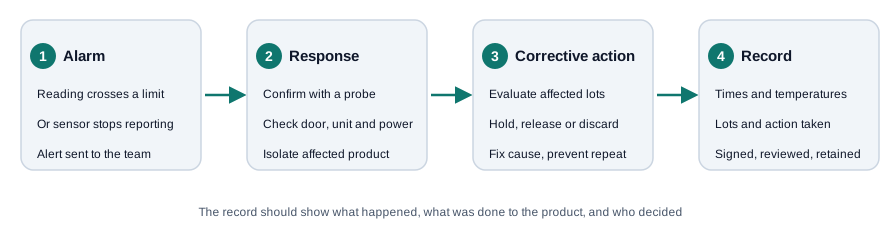
- Acknowledge the alarm. Record the time it fired and who received it. Treat a sensor that has stopped reporting as an alarm, not as silence.
- Confirm the reading. Check with a calibrated probe and look at the obvious causes: door left open, unit off, power loss, a defrost cycle.
- Contain the product. Move product to a working unit or place it on hold, so affected lots are not used or shipped while you evaluate them.
- Evaluate the affected lots. Use the temperature history, how long the excursion lasted, the product and your plan's limits. Involve your preventive controls qualified individual.
- Decide the disposition. Release, rework, hold for further testing or discard, and document who made the call and why.
- Fix the cause. Repair, recalibrate or retrain, and reduce the likelihood of a repeat.
- Record and review. Capture the values, the action and the signatures, then have the record reviewed.
This matches the structure of 21 CFR 117.150(a), which requires written corrective action procedures to identify and correct the problem, reduce the likelihood of recurrence where appropriate, evaluate affected food for safety, and prevent affected food from entering commerce if it cannot be ensured to be safe. Corrective actions must be documented in records.
Records and Retention
For plants under the preventive controls rule, records must contain the actual values and observations from monitoring, be created at the time of the activity, and carry the date, the signature or initials of the person, and where appropriate the product and lot code, per 21 CFR 117.305. Section 117.315 requires keeping them for at least 2 years after they were prepared, and allows offsite storage if records can be retrieved onsite within 24 hours. Under 117.165(a)(4)(i), monitoring and corrective action records are reviewed within 7 working days of creation unless a written justification supports a longer timeframe.
The practical point: a temperature trace on its own is weak evidence. A trace linked to the lot, the alarm, the decision and the signature is the record that holds up in an audit or a customer investigation.
Where IONI Fits
IONI is the production and traceability layer that runs on top of the QuickBooks you already use, not an ERP. Its public pages describe tracking ingredient lots from receiving through production to finished goods, digital checklists and alerts, and CAPA tracking, so it can be where monitoring checks, deviations and corrective actions are logged and linked to lots. IONI's site does not describe sensor or IoT integrations, so treat sensor hardware as a separate purchase and ask about data flow before assuming anything connects. See food manufacturing software from IONI for what the platform covers.
Frequently Asked Questions
What is cold chain monitoring?
It is measuring and recording the temperature of refrigerated and frozen food at each stage, including receiving, storage, production and shipping, so deviations are detected, acted on and documented.
Does the FSMA sanitary transportation rule apply to my plant?
It applies to shippers, receivers, loaders and carriers moving food by motor or rail vehicle in the United States, with exemptions including non-covered businesses under $500,000 in average annual revenue, and food completely enclosed in a container unless it requires temperature control for safety.
Who is responsible for temperature control during transport?
The shipper must specify the operating temperature in writing, the loader verifies the vehicle is pre-cooled if necessary, the carrier handles what its agreement assigns, and the receiver assesses whether the food suffered significant temperature abuse.
How long do I keep cold chain records?
Shipper records under the sanitary transportation rule are kept for 12 months beyond the end of the relevant agreements. Preventive controls records are kept at least 2 years after they were prepared. Confirm which rules apply to you.
Do I need continuous sensors, or are manual logs enough?
The rules require adequate monitoring at a frequency your plan justifies, not a specific technology. Manual logs can work for some checks, while continuous sensors give faster alerts and fewer gaps for cold rooms. Your hazard analysis should drive the choice.
What is cold tracking?
Cold tracking is an informal term for following temperature data for product as it moves through storage, production and shipment, ideally tied to lot numbers so you can show what each lot experienced.
Last updated: October 7, 2026