.png)
GMP training for food plant employees is the instruction each person needs in food hygiene and food safety, matched to their job, before they handle food. Under 21 CFR 117.4, everyone who manufactures, processes, packs or holds food must be qualified for their assigned duties, and records of that training must be established and maintained.
What the Regulation Requires for GMP Training
The training rule sits in the current good manufacturing practice (cGMP) requirements of 21 CFR Part 117. Section 117.4 says management must ensure that everyone who manufactures, processes, packs or holds food is qualified to perform their assigned duties. It then sets out four points that matter for your program:
- Everyone is covered. Each individual engaged in manufacturing, processing, packing or holding food, including temporary and seasonal personnel, and anyone supervising them.
- Qualified means education, training, or experience. A person must have the education, training, or experience (or a combination) needed to produce clean and safe food, as appropriate to the individual's assigned duties.
- Hygiene and food safety training is required. Each person must receive training in the principles of food hygiene and food safety, including the importance of employee health and personal hygiene, as appropriate to the food, the facility and their duties.
- Supervisors carry the accountability. Responsibility for compliance must be clearly assigned to supervisory personnel with the education, training, or experience needed to supervise the production of clean and safe food.
Paragraph (d) is the one auditors and inspectors check: records that document the required training must be established and maintained. If it is not written down, you cannot show it happened. What counts as cGMP training under this rule is deliberately flexible about content and depth, so the real work is deciding what “appropriate to the individual's assigned duties” means in your plant. For the wider cGMP picture, see our guide to good manufacturing practices in food manufacturing.
Related personnel requirements
Section 117.10 covers personnel hygiene. Management must take reasonable measures so that anyone with an illness or open lesion that could contaminate food is kept out of those operations, and personnel must be instructed to report such health conditions to their supervisors. It also lists hygienic practices for people in direct contact with food, such as hand washing before starting work and after each absence from the work station, and removing unsecured jewelry. These are natural topics for your onboarding session.
What Auditors Expect Beyond the Regulation
Certification schemes are more prescriptive than the regulation. The SQF Food Safety Code for food manufacturing (Edition 10) requires, in clause 2.9.1.1 as published by SQFI, a documented and implemented training program that establishes training needs and required competencies, identifies training methods, delivers training in languages personnel understand, determines how often training is conducted, verifies that the trainee is competent to complete the required tasks, and identifies and implements refresher training needs.
BRCGS Food Safety Issue 9 has a dedicated training clause, 7.1, covering staff in raw material handling, preparation, processing, packing and storage areas, as listed in the BRCGS Issue 9 interpretation guideline contents. Read the full clause text in your licensed copy of the standard for the exact wording, because we have only confirmed its title from a public source.
The common thread is competence, not attendance. A signed sheet showing someone sat in a room is weaker evidence than a record showing they were observed doing the task correctly. For SQF-specific culture and documentation expectations, see our post on food safety culture and SQF Edition 10.
How Often Is GMP Training Required?
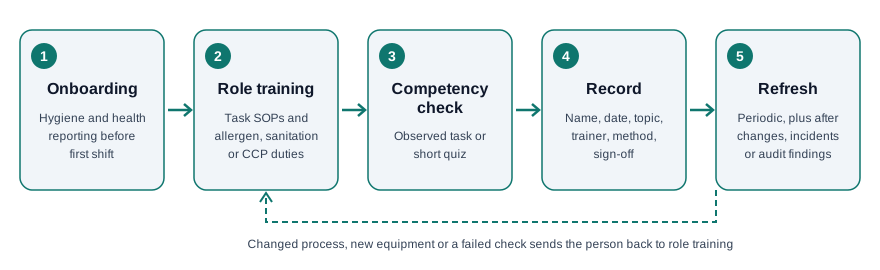
The text of 117.4 does not set a fixed refresher interval. It requires that people be qualified and trained as appropriate to their duties, and that records be kept. SQF requires you to determine the frequency yourself and to identify refresher needs, so your program has to state its own schedule and justify it. In practice, auditors tend to look for three triggers:
- Before work starts. New hires, temporary and seasonal staff, and agency workers are trained on hygiene and the rules for their area before they handle food or food-contact surfaces.
- On a regular schedule. Many plants refresh hygiene and allergen basics yearly. That is a common choice, not a regulatory number, so set the interval based on risk and document why.
- After changes and incidents. A revised SOP, new equipment, a new allergen, a corrective action, or a failed audit or inspection item should trigger targeted retraining.
Training Matrix Template
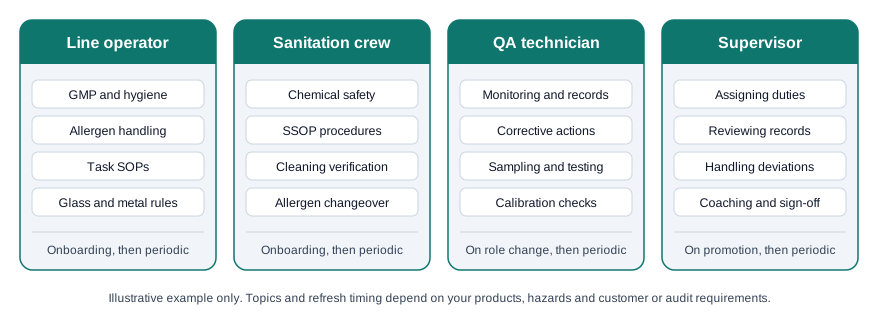
A training matrix maps each role to the topics it needs, how often they are refreshed, and the record that proves it. The table below is illustrative only. Replace the topics and intervals with what your hazards, products and customer requirements call for.
| Role | Topic | Example frequency | Evidence record |
|---|---|---|---|
| All employees and temporary staff | GMP, personal hygiene, illness reporting | Before first shift, then periodic | Signed attendance plus short quiz or observation |
| Line operators | Task SOPs, allergen handling, foreign material rules | On hire, on SOP revision, then periodic | Competency checklist signed by trainer |
| Sanitation crew | Chemical safety, SSOPs, cleaning verification | On hire, on chemical or procedure change | Observed cleaning sign-off |
| QA technicians | Monitoring, record completion, corrective actions | On role change, then periodic | Competency assessment and sample review |
| Supervisors | Assigning duties, reviewing records, handling deviations | On promotion, then periodic | Training record and manager sign-off |
| Food safety lead | Preventive controls and food safety plan | Per plan and regulatory changes | Certificate and training log |
How to Build and Track a GMP Training Program
- List every role and area. Include temporary staff, maintenance, contractors who enter production areas, and supervisors.
- Define the topics per role. Start from your hygiene rules, allergen controls, sanitation procedures and the SOPs each role performs. Link each topic to the document that governs it.
- Set the training method. Classroom, on-the-job shadowing, video or a mix. Use the languages your people actually speak.
- Verify competence. Observe the task, run a short quiz, or have a trainer sign a skills checklist. Attendance alone does not show competence.
- Record it. Capture who, what, when, who trained them, method and result. See the records table below.
- Set refresh triggers. A calendar interval plus event triggers: SOP revision, equipment change, incident, audit finding.
- Review the matrix on a schedule. Check for expired training, new hires without sign-off and roles that changed, and fix the gaps before an audit does.
Training Records: What to Keep
Section 117.4(d) requires records of the hygiene and food safety training. For preventive controls qualified individuals, 117.180(d) adds that applicable training must be documented, including the date of the training, the type of training and the person or persons trained. That is a useful minimum for all training records.
| Record field | Why it matters |
|---|---|
| Employee name and role | Shows who was trained for which duties |
| Date of training | Shows training happened before the person worked unsupervised |
| Topic and document version | Ties training to the SOP or rule that was current |
| Trainer name | Shows the trainer was qualified for the topic |
| Method and language | Shows the training could be understood |
| Competency result | Shows the person can do the task, not just that they attended |
| Next refresh due | Lets you catch expired training early |
PCQI and Other Specialist Training
General GMP training is not the same as preventive controls training. Under 117.180(c), a preventive controls qualified individual must have successfully completed training in developing and applying risk-based preventive controls that is at least equivalent to a standardized curriculum recognized as adequate by FDA, or be otherwise qualified through job experience. FDA's FSMA training page notes that the standardized curricula developed by the Food Safety Preventive Controls Alliance are the ones officially recognized by FDA. Keep the certificate in the same system as your GMP records.
Where Software Fits
A spreadsheet can hold a matrix for a small team. It gets harder when staff turn over, SOPs change often, or you need to produce records quickly during an audit. IONI's food safety software keeps SOPs searchable and version-controlled, replaces paper logs with digital checklists and collects records for audit packages, which supports the evidence side of a training program. Its public page does not describe a dedicated training module or learning management system, so treat it as the records and procedures layer around your training, not a replacement for it. Our posts on digital SOPs and work instructions and SSOPs cover the documents your training should point to.
Frequently Asked Questions
Is GMP training required by FDA?
Yes. Under 21 CFR 117.4, each person engaged in manufacturing, processing, packing or holding food must receive training in the principles of food hygiene and food safety, including employee health and personal hygiene, as appropriate to the food, the facility and their duties.
How often should food plant employees get GMP training?
The regulation does not set a fixed interval. Train people before they start work, refresh on a schedule you define and justify, and retrain after SOP changes, incidents or audit findings. SQF requires you to determine training frequency and refresher needs.
What records do I need for GMP training?
Section 117.4(d) requires that records documenting the required training be established and maintained. A practical record includes the employee, date, topic, trainer, method and a competency result, plus when the next refresh is due.
Does GMP training apply to temporary and seasonal workers?
Yes. Section 117.4(b) explicitly includes temporary and seasonal personnel, as well as anyone supervising them, among the individuals who must be qualified and trained for their duties.
Is PCQI training the same as GMP training?
No. GMP training covers hygiene and food safety basics for all personnel. PCQI training under 117.180(c) covers developing and applying risk-based preventive controls and is for the individual who develops and applies those preventive controls.
What is a training matrix?
A training matrix is a table that maps each role to the training topics it requires, the refresh frequency and the evidence record. It lets you see at a glance who is trained, who is overdue and which roles have gaps.
Last updated: October 7, 2026