.png)
Last updated: October 2026
A food defense plan is a written plan that protects food from intentional contamination, such as tampering or sabotage meant to cause harm. Under the FDA's Intentional Adulteration rule (21 CFR Part 121), most registered food facilities must have one, built from a vulnerability assessment. The FDA's Food Defense Plan Builder helps you draft it. Here are the five parts.
Food defense vs. food safety: what's the difference
Food safety programs like HACCP and a food safety plan address unintentional, accidental hazards, biological, chemical, and physical contamination that happens during normal operations. Food defense addresses deliberate, intentional acts meant to cause large-scale public health harm. The two programs share a documentation structure but protect against fundamentally different threats, which is why the IA Rule requires a separate written plan rather than folding food defense into an existing HACCP plan. Food fraud, assessed through VACCP, is a third distinct category — intentional deception for financial gain rather than malicious harm; see our guide to food fraud, TACCP, and VACCP for how it differs from food defense.

The 5 components of a food defense plan
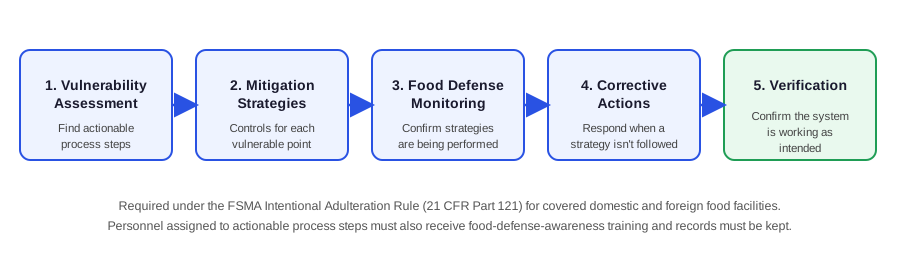
Per the FDA's IA Rule guidance, a compliant food defense plan is built around five components:
- Vulnerability assessment — identify actionable process steps where an attacker could successfully contaminate product, using the FDA's key activity types (bulk liquid handling, secondary ingredient handling, mixing/similar activities, and points of access).
- Mitigation strategies — specific measures assigned to each actionable process step to significantly minimize or prevent the vulnerability.
- Food defense monitoring — procedures to confirm mitigation strategies are being performed as written.
- Corrective actions — steps taken when a mitigation strategy isn't properly implemented.
- Verification — activities that confirm monitoring is being conducted and mitigation strategies are working as intended.
Personnel assigned to actionable process steps, and their supervisors, must also receive food-defense-awareness training, and the facility must keep records documenting the plan's implementation.
Who actually needs a food defense plan
The IA Rule applies to domestic and foreign facilities required to register with FDA as food facilities under the FD&C Act. It's designed primarily to cover larger facilities whose products reach many people; very small businesses (as defined in the rule) have modified requirements, and some activities and facility types are exempt outright, including on-farm activities not subject to Section 415 registration, alcoholic beverage facilities meeting certain conditions, and holding/distribution of packaged food that doesn't require time/temperature control. Because the exemption criteria are specific, manufacturers should confirm applicability against the rule's actual exemption list rather than assuming.
Should you use FDA's Food Defense Plan Builder?
FDA offers a free Food Defense Plan Builder desktop tool that walks facilities through facility information, product/process descriptions, vulnerability assessments, and mitigation strategies. Use of the tool is voluntary and not required to comply with the IA Rule; FDA does not track or access documents created with it. It's a reasonable starting point for a first draft, but it's a static desktop file, not a system that keeps monitoring and corrective-action records connected to the plan itself, which is where many facilities end up rebuilding the process in a dedicated compliance system as their operation grows.
See how IONI helps food manufacturers keep food defense monitoring, corrective actions, and verification records connected and audit-ready: Food Safety Software.
Frequently asked questions
Is a food defense plan the same as a HACCP plan?
No. A HACCP plan and food safety plan address unintentional hazards during normal production. A food defense plan specifically addresses intentional, deliberate contamination and is required as a separate written document under the IA Rule.
Do small food manufacturers need a food defense plan?
Facility size affects the specific requirements, and very small businesses have modified provisions under the rule, but most FDA-registered facilities are covered in some form. Check the rule's exemption criteria for your specific facility type rather than assuming size alone exempts you.
Is the FDA Food Defense Plan Builder required?
No. It's a free, voluntary tool FDA provides to help build a plan. Facilities can create a compliant food defense plan without using it, as long as the plan itself meets the IA Rule's five-component structure.
What happens if a facility doesn't have a food defense plan?
Since all compliance deadlines under the IA Rule have passed, FDA inspections can review a facility's written food defense plan and its implementation on the production floor; not having one is a compliance gap FDA can act on during an inspection.