.png)
Food labelling in Canada is governed primarily by the Food and Drugs Regulations and the Safe Food for Canadians Regulations (SFCR), enforced by the Canadian Food Inspection Agency (CFIA) through its Industry Labelling Tool. Most prepackaged foods sold in Canada need a label that's bilingual (English and French), carries a Nutrition Facts table in CFIA's prescribed format, lists ingredients and allergens by descending weight, and identifies the manufacturer, importer, or distributor — with limited exemptions set out in the regulations themselves.
The core elements a compliant label needs
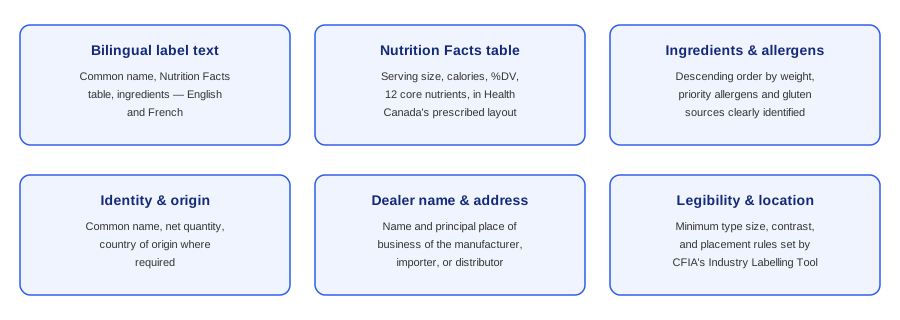
CFIA's Industry Labelling Tool organizes core requirements into categories covering bilingual labelling, common name, country of origin, date markings and storage instructions, the name and principal place of business of the dealer, legibility and location, the ingredient list and allergen declarations, net quantity, and nutrition labelling — plus food-specific rules that vary by category (dairy, meat and poultry, fish, and so on).
Bilingual labelling: not optional
Nearly all mandatory label information — the common name, the Nutrition Facts table, ingredient list, allergen statements, and net quantity — must appear in both English and French. CFIA's bilingual labelling guidance sets out which elements need dual-language treatment and where narrower exemptions apply (for example, some information that's exempt in specific regions). This is one of the most common gaps for US manufacturers entering the Canadian market for the first time, since it has no FDA equivalent.
The Nutrition Facts table
Most prepackaged foods need a Nutrition Facts table showing serving size, calories, % Daily Value, and 12 core nutrients, laid out in the specific format, font size, and nutrient sequence CFIA's nutrition labelling guidance prescribes — it isn't a flexible design element. Exemptions exist for certain food categories and very small packages, but the default assumption should be that an NFT is required unless a specific exemption applies.
Ingredients and allergens
Ingredients must be listed in descending order by weight, and priority allergens, gluten sources, and added sulphites must be clearly identified — either within the ingredient list itself or in a separate "Contains" statement, per CFIA's ingredient and allergen labelling requirements.
How this fits into your broader SFCR compliance
Labelling is one piece of a larger SFCR compliance picture that also covers licensing and your Preventive Control Plan. See our guides to what SFCR requires and what the CFIA is for the regulatory picture labelling sits inside.
Where IONI fits
Manufacturers selling into both the US and Canada often maintain two label formats and two compliance documentation trails at once. See how IONI helps food manufacturers keep compliance documentation audit-ready across FSMA, CFIA, and GFSI requirements.
Frequently asked questions
Does every food product sold in Canada need a bilingual label?
Nearly all mandatory label information must appear in both English and French, with limited regional and category-specific exemptions set out in CFIA's bilingual labelling guidance.
Is a Nutrition Facts table always required in Canada?
Most prepackaged foods require one in CFIA's prescribed format, though exemptions exist for certain food categories and very small packages — check CFIA's nutrition labelling guidance for your specific product.
Who enforces food labelling requirements in Canada?
The Canadian Food Inspection Agency (CFIA) enforces labelling requirements under the Food and Drugs Act, Food and Drugs Regulations, and Safe Food for Canadians Regulations.
How is Canadian food labelling different from US FDA labelling?
The core concepts (nutrition facts, ingredient lists, allergen declarations) are similar, but Canada requires bilingual English/French text, a differently formatted Nutrition Facts table, and its own set of category-specific rules — a US-compliant label is not automatically Canada-compliant.