.png)
Food manufacturers often meet the HACCP vs SQF question at the worst possible moment: when a retailer, distributor, private-label customer, or foodservice buyer asks for SQF certification, and the QA team realizes that its existing HACCP plan may not be enough.
The confusion is understandable. HACCP and SQF are closely connected. A strong HACCP plan is one of the foundations of SQF readiness. But they are not the same thing. HACCP is a food safety system for identifying and controlling hazards. SQF is a third-party certification program that verifies a broader food safety management system against a recognized standard.
In practical terms, HACCP explains how your facility identifies food safety hazards and controls them. SQF asks whether your whole food safety system is documented, implemented, verified, and maintained. That includes HACCP, but it also includes management commitment, prerequisite programs, supplier approval, document control, training, internal audits, traceability, food defense, food fraud, corrective actions, and audit evidence.
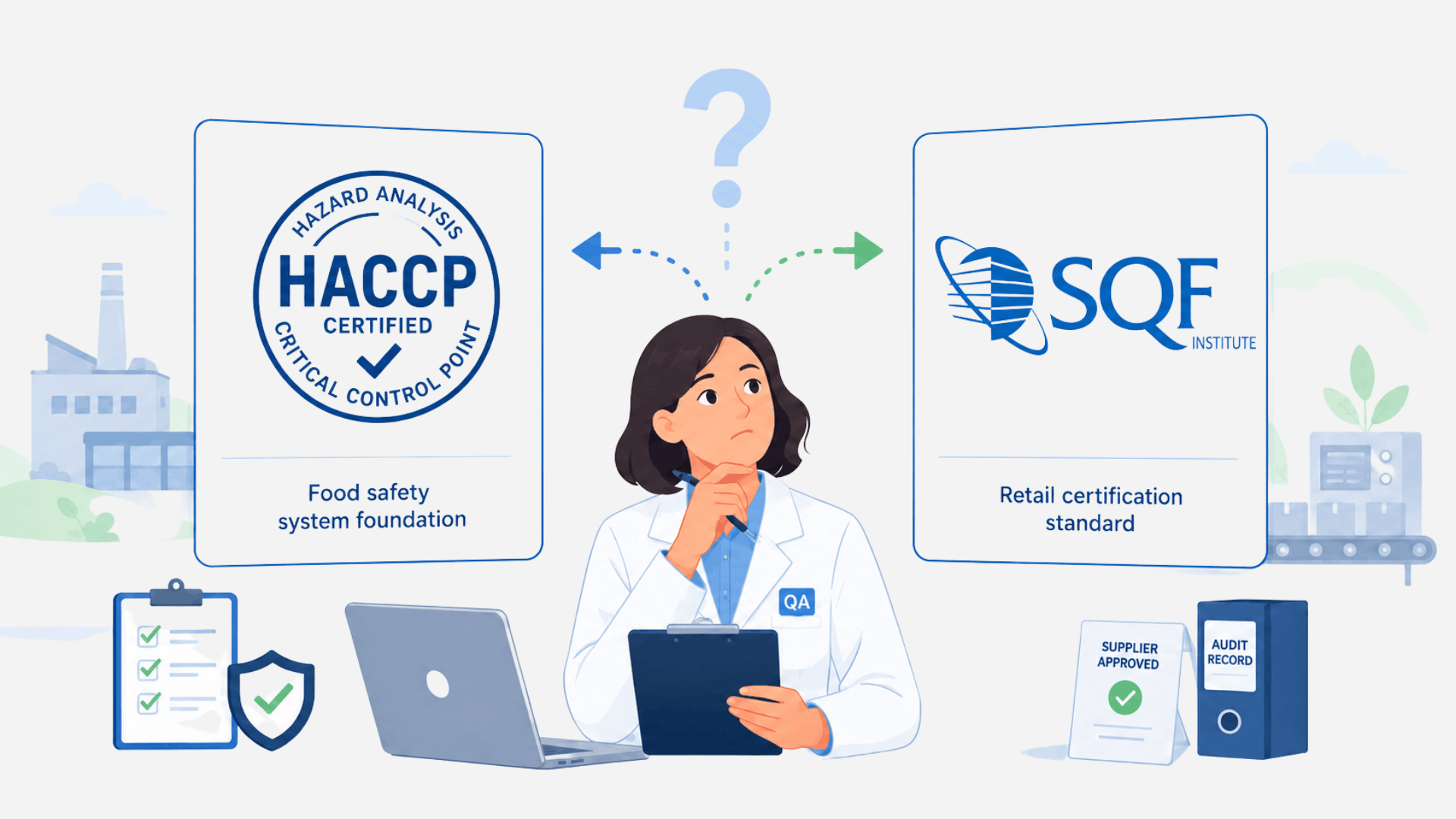
This difference matters because a manufacturer can have a HACCP plan and still be far from SQF certification. A HACCP plan may show that the team understands product and process hazards. SQF certification must show that the site operates a complete system that works every day, not only during audit preparation.
The FDA describes HACCP as a systematic preventive approach used to identify, evaluate, and control biological, chemical, and physical hazards in food production. SQFI describes SQF as a food safety and quality program recognized by retailers, brand owners, and foodservice providers globally. These definitions show the core distinction: HACCP is the hazard-control method, while SQF is the certification framework that validates the broader system around that method.
What is HACCP and What Does It Actually Cover?
HACCP stands for Hazard Analysis and Critical Control Point. It is a preventive food safety system designed to identify significant hazards, define controls, monitor those controls, and document what happens when the process moves outside acceptable limits.
A HACCP plan normally starts with the product, process, ingredients, packaging, intended use, consumer group, and flow of operations. The team reviews the process step by step and determines where biological, chemical, physical, and allergen-related hazards may reasonably occur. The plan then explains how those hazards are controlled, whether through prerequisite programs, preventive controls, CCPs, supplier controls, sanitation controls, allergen controls, or other measures.
In practical terms, HACCP connects each process step to a clear control decision. The plan should explain what hazards could occur, why it matters, where it is controlled, what limits define acceptable performance, how the team monitors those limits, and what happens when the process falls outside control. This is why HACCP is not just a document. It is the logic that connects risk assessment, production controls, monitoring records, corrective actions, and verification.

For example, a ready-to-eat dairy manufacturer may use AI HACCP plan builder to evaluate risks around receiving, pasteurization, cooling, filling, storage, and distribution. A bakery may use HACCP to control allergen cross-contact, foreign material risk, labeling accuracy, and validated baking steps. A frozen meal operation may need to focus on cooking, cooling, metal detection, cold storage, and rework handling.
The FDA’s HACCP principles include hazard analysis, CCP identification, critical limits, monitoring procedures, corrective actions, verification procedures, and record-keeping. Codex Alimentarius also positions HACCP within a broader hygiene system where good hygiene practices form the foundation for safe food operations.
That foundation is important. HACCP gives food manufacturers a structured way to move from general risk awareness to specific control. It prevents teams from relying only on finished product testing, customer complaints, or visual checks after the fact. Instead, it forces the team to decide where control must happen before an unsafe product reaches the customer.
But HACCP does not cover everything an SQF auditor will expect. HACCP is mainly focused on hazard analysis and control logic. It does not automatically prove that supplier approval is complete, training is role-specific, document control is effective, internal audits are performed, corrective actions are verified, traceability works, or management reviews the system.
This is where many small and mid-sized manufacturers misjudge their readiness. The HACCP plan may be technically sound, but the surrounding system may be weak. The CCP log exists, but verification is inconsistent. Supplier certificates are stored somewhere, but COAs are not checked against specifications. Training records exist, but they are not tied to job duties. Corrective actions are written, but root cause and verification are missing. During SQF preparation, those gaps become visible quickly.
A strong HACCP plan is the backbone of food safety. SQF expects the full body around it to function.
What is SQF Certification, and Why do Retailers Require It?
SQF stands for Safe Quality Food. It is a certification program administered by the SQF Institute. For food manufacturers, SQF certification is most often requested by retailers, distributors, foodservice companies, club stores, and private-label customers that need confidence in supplier controls.
Retailers require SQF because they need more than a written food safety plan. They need independent evidence that the manufacturer operates a complete food safety management system. A buyer may not have the resources to perform deep supplier audits at every facility. Instead, the buyer may require certification against a recognized scheme, so supplier approval decisions are based on a common standard.
SQFI describes SQF as a program recognized by retailers, brand owners, and foodservice providers. NSF’s 2025 comparison of GFSI-benchmarked certifications also notes that schemes such as SQF, BRCGS, FSSC 22000, and IFS differ in scope, requirements, and expectations, which is why manufacturers need to confirm which certification their customer will accept before investing in preparation.

This is the commercial reason SQF matters. A facility may be producing safe food and still lose or delay a retail opportunity if it cannot meet the buyer’s certification requirements. For many suppliers, SQF is not treated as a marketing badge. It becomes a condition for onboarding, expanding distribution, supplying private label, or keeping a customer account.
SQF goes beyond HACCP because it evaluates the food safety management system around the HACCP plan. Depending on the applicable SQF Code and product sector, this can include management responsibility, document control, specifications, supplier approval, food safety plans, prerequisite programs, training, validation, verification, internal audits, product identification, traceability, recall and withdrawal, food defense, food fraud, allergen management, environmental monitoring where applicable, and site GMPs.
The result is a different level of proof. HACCP asks whether significant hazards are identified and controlled. SQF asks whether the company has a repeatable system that proves those controls are implemented and maintained.
That distinction becomes clear during an audit. A HACCP review may focus on whether the metal detector is correctly identified as a CCP, whether the critical limit is defined, whether checks happen at the stated frequency, and whether corrective actions are documented. SQF will also look at whether the procedure is controlled, whether employees are trained, whether records are complete, whether calibration supports the control, whether internal audits found issues, whether corrective actions were verified, and whether management is reviewing system performance.
This is why SQF often feels much larger than HACCP. It is not only more paperwork. It is more operational accountability.
If a retailer has asked for SQF and your team is trying to understand the real gap, IONI food safety software helps connect HACCP plans, supplier records, monitoring logs, corrective actions, and audit evidence in one system, so QA can see what is ready and what still needs work.
HACCP vs SQF: the Key Differences at a Glance
The easiest way to understand HACCP vs SQF is to separate the method from certification. HACCP is the risk-control methodology. SQF is the certification framework that uses HACCP as one core part of a broader food safety management system.

A HACCP plan explains how the facility controls food safety hazards. SQF evaluates whether the facility has the management system to keep those controls reliable over time.
This is why a manufacturer can be “HACCP-compliant” in its own internal sense and still not be SQF-ready. The HACCP plan may show correct thinking around hazards and CCPs. SQF readiness requires evidence that the plan is supported by trained people, controlled documents, accurate records, verified procedures, approved suppliers, traceability tests, internal audits, management review, and continuous improvement.
Another way to think about it: HACCP defines the control logic, while SQF tests system discipline. HACCP explains what should happen at each process step. SQF checks whether the team follows it, records it, verifies it, corrects failures, and keeps evidence audit-ready.
That is why SQF preparation often exposes gaps outside the HACCP plan, such as expired supplier documents, uncontrolled procedures, incomplete training records, or corrective actions closed without verification. These gaps do not always mean the HACCP plan is wrong. They usually mean the broader food safety system is not mature enough for certification.
For teams still building this foundation, the right HACCP software can help connect hazard analysis, monitoring records, corrective actions, supplier files, and audit evidence in one workflow.
Do I need HACCP Before Getting SQF Certified?
Yes. In practical terms, you need a HACCP-based food safety plan before you can be ready for SQF certification.
SQF preparation depends on a clear understanding of products, processes, hazards, controls, monitoring, corrective actions, verification, and records. Without that foundation, the rest of the SQF system becomes disconnected documentation. You can start SQF preparation before your HACCP plan is perfect, but you cannot complete SQF readiness without a documented and implemented food safety plan based on HACCP principles.
This does not mean every manufacturer must finish HACCP in isolation before thinking about SQF. In many projects, the HACCP plan is built or rebuilt as part of the SQF preparation process. That is often the right approach when the existing plan is outdated, too generic, or no longer aligned with the actual facility.
The better sequence is to build both layers in a connected way. The manufacturer should first confirm product descriptions, intended use, ingredient risks, packaging formats, process flows, equipment, rework, storage, and distribution. Then the HACCP team should conduct hazard analysis and identify controls. Once that control logic is clear, the company can build the broader SQF system around it.
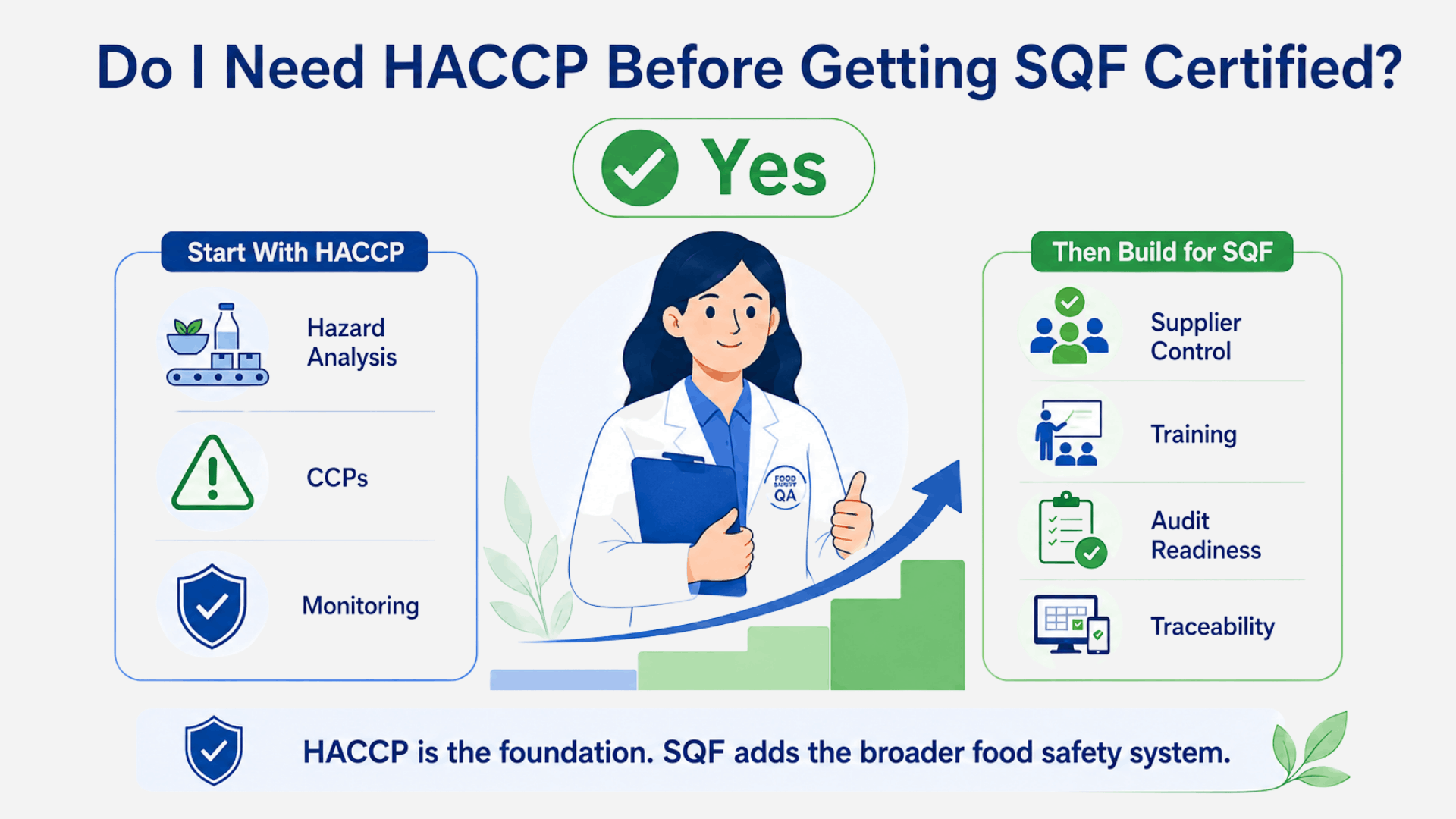
For example, if the HACCP plan identifies an allergen-labeling control, the SQF system should support it through approved labels, controlled specifications, supplier allergen data, line clearance procedures, employee training, label verification records, non-conformance handling, and internal audits. If the HACCP plan identifies a CCP at cooking, the SQF system should support it through equipment calibration, monitoring logs, corrective action procedures, operator training, verification checks, and record review.
The danger is treating SQF as a separate paperwork exercise. The SQF system should not sit next to HACCP. It should reinforce HACCP. Every procedure, form, log, training record, and verification activity should support the actual controls used in the facility.
For manufacturers facing a retailer deadline, the first 30 days should usually focus on confirming the customer requirement, selecting the correct SQF Code, reviewing the HACCP plan, assigning owners, collecting missing supplier information, and performing a gap assessment.
For a more detailed early-stage roadmap, see Your Retailer Requires SQF Certification: What to Do in the First 30 Days.
If You Already Have a HACCP plan, What Do You Still Need for SQF?
If you already have a HACCP plan, you have a useful starting point. But SQF certification requires much more than the plan itself.
The first step is to test whether the HACCP plan still matches reality. Food operations change constantly. New suppliers are approved. Ingredients are replaced. Packaging formats change. New products are introduced. Equipment is modified. Production lines are rearranged. Customer specifications become stricter. If the HACCP plan does not reflect those changes, it may look complete but fail during SQF preparation.
A current HACCP plan should match the facility’s actual products, process steps, materials, equipment, hazards, controls, and records. Flow diagrams should reflect how materials really move through the site. Hazard analysis should identify specific hazards and explain why each is significant or not significant. CCPs and other controls should be justified. Monitoring procedures should match actual practice. Corrective actions should be realistic and documented. Verification should be scheduled and performed.
After that, the manufacturer needs to build or strengthen prerequisite programs. HACCP depends on prerequisite programs because not every hazard is managed at a CCP. Sanitation, GMPs, pest control, allergen management, preventive maintenance, calibration, chemical control, glass and brittle plastic control, water quality, waste handling, storage, and employee hygiene all support the HACCP system. Codex guidance places good hygiene practices as the foundation of food hygiene systems, with HACCP applied to significant hazards that require more specific control.
Document control is another major SQF requirement. The company needs to prove that procedures, forms, specifications, work instructions, and records are current, approved, accessible, and version-controlled. If different supervisors use different versions of the same form, the system is vulnerable. If an old SOP remains active on the production floor, the auditor may treat that as a control failure.
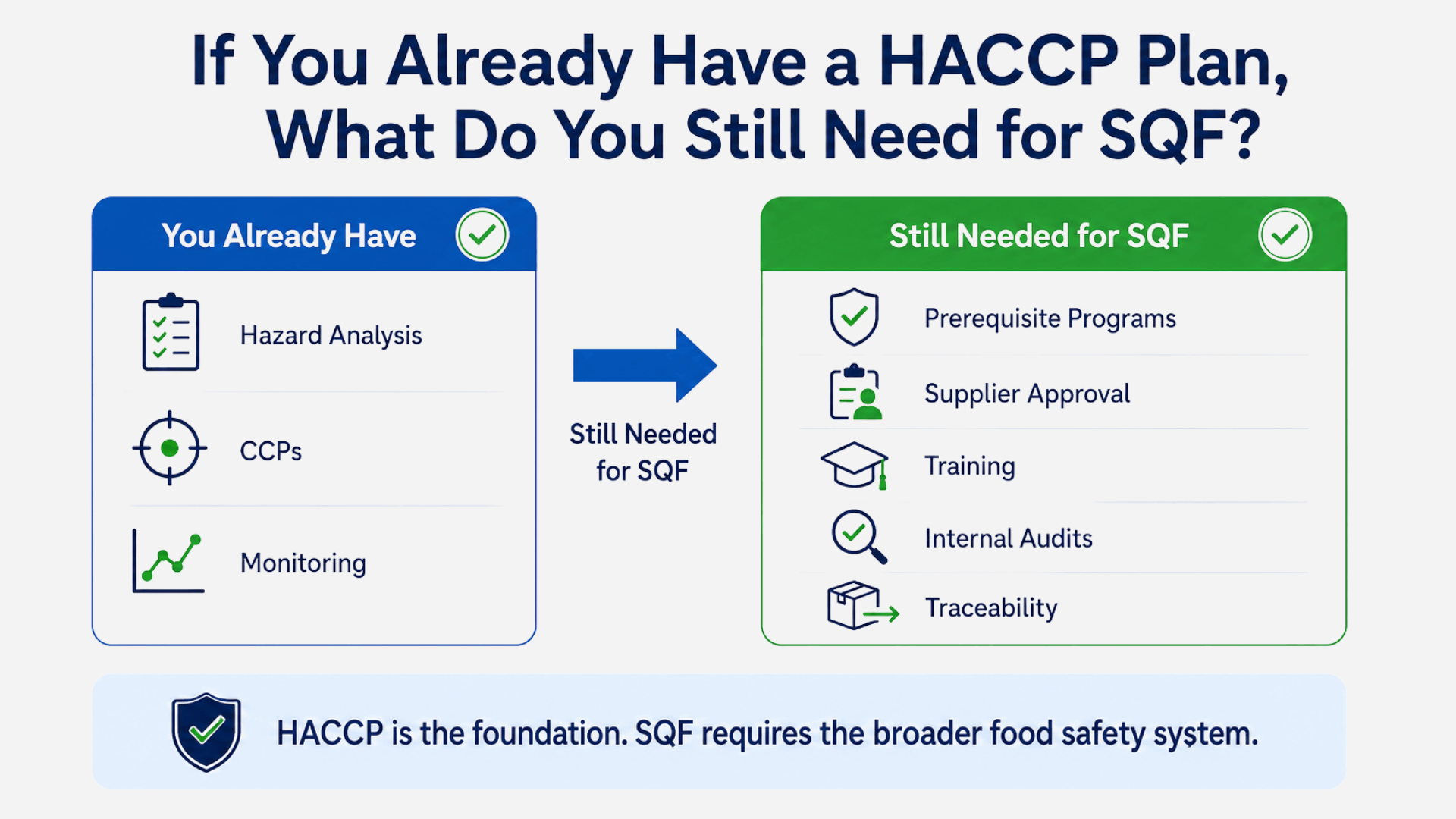
Supplier approval also becomes more demanding under SQF. It is not enough to store supplier documents in folders. The site needs approval criteria, risk assessment, material specifications, COA requirements, supplier review frequency, non-conformance handling, and evidence that incoming materials are checked before use. This is especially important for manufacturers dealing with allergens, imported ingredients, high-risk materials, complex formulations, or private-label customer requirements.
Supplier files are one of the fastest places where SQF preparation becomes messy. IONI ingredients intelligence helps teams organize supplier documents, COAs, specifications, ingredient risks, and approval evidence so QA does not have to chase critical records across email, folders, and spreadsheets.
Training is another area where a HACCP plan alone is not enough. SQF expects personnel to be competent for their assigned responsibilities. A CCP operator must understand monitoring, limits, and escalation. A receiving employee must know when a COA is required and what to do if it is missing. A sanitation employee must understand chemical concentration, contact time, and verification. A supervisor must know how to document non-conformances and escalate unresolved issues.
Internal audits and verification are also essential. HACCP includes verification, but SQF expects a broader system of checking whether procedures are followed, records are complete, deviations are handled, corrective actions are effective, and the food safety system remains suitable. Internal audits should not be treated as a formality before the certification audit. They are one of the main ways a site proves that it monitors its own system.
Traceability and recall readiness must also be tested. A manufacturer should be able to trace raw materials into finished goods and finished goods back to raw materials. It should be able to identify affected lots, customers, quantities, dates, and supporting records. A mock recall should produce evidence of timing, accuracy, gaps, decisions, and corrective actions.
Management commitment is another area that manufacturers often underestimate. SQF is not only a QA project. Senior management must support resources, responsibilities, review, corrective actions, and food safety culture. If the SQF system depends entirely on one QA manager without operational ownership, the gaps usually appear during implementation.
For a practical certification timeline, see SQF Certification in 90 Days: A Week-by-Week Plan for Small Food Manufacturers.
HACCP vs SQF vs BRCGS: Which Certification Does Your Retailer Actually Require?
Previously, we discussed the comparison of the main food safety frameworks: Food Safety Compliance Across FSMA, BRCGS, and SQF. Now, it is time to decide which one to choose.
HACCP is a food safety methodology. SQF and BRCGS are certification programs. Both SQF and BRCGS can be relevant for manufacturers that need third-party certification for retail, foodservice, private-label, or distributor approval. The right choice depends on what the customer requires.
BRCGS Food Safety is one of the major global food safety standards. BRCGS states that its Global Standard for Food Safety is adopted by over 24,500 sites in more than 137 countries and accepted by leading global brands and retailers. That makes it an important certification route for manufacturers serving retail and private-label supply chains.

SQF is also widely used by retailers, brand owners, and foodservice providers. The practical difference is often driven by geography, buyer policy, category, and customer preference. Some North American buyers are very familiar with SQF. Some international or private-label customers may prefer BRCGS. Some buyers accept any GFSI-recognized certification. Others name a specific scheme in the supplier requirement.
This is where GFSI schemes matter. GFSI is not a certification scheme itself. It benchmarks food safety certification programs against shared requirements so buyers can have more confidence in recognized schemes.
However, GFSI recognition does not mean every buyer will accept every scheme in every situation. A retailer may say “GFSI-recognized certification required,” in which case SQF, BRCGS, FSSC 22000, IFS, or another recognized scheme may be acceptable depending on the scope. Another retailer may say “SQF required,” which is more specific. In that case, BRCGS may not satisfy the requirement unless the buyer confirms acceptance.
Before investing in certification preparation, the manufacturer should clarify the buyer’s exact requirements. The most important questions are whether the buyer requires SQF specifically, whether any GFSI-recognized certification is acceptable, which product scope applies, what deadline is tied to supplier approval, and whether certification is needed before
If your customer accepts SQF, BRCGS, or another GFSI-recognized scheme, IONI’s FSMA, BRCGS, and SQF compliance workspace helps your team map documents, supplier records, monitoring evidence, corrective actions, and audit tasks to the framework you actually need.
Why Retailers Care About Certification, Not Only HACCP
Retailers care about HACCP because it shows that the manufacturer has a preventive approach to food safety. But retailers usually care about certification because it gives them broader assurance.
A HACCP plan can be created internally. Its quality depends on the team, the data, the expertise, and the discipline of implementation. SQF certification adds a third-party review against a structured standard. That does not eliminate risk, but it gives the buyer a more consistent way to assess supplier maturity.
Food safety risk remains visible across the market. A 2026 Food Safety Magazine review of 2025 FDA outbreak data reported 28 foodborne illness outbreaks in 2025 and 1,003 outbreak-associated illnesses. This type of risk environment helps explain why retailers continue to push suppliers toward stronger preventive controls, traceability, verification, and certification.
The commercial impact is also significant. A retailer does not want to discover during a complaint, recall, or regulatory event that a supplier had weak supplier controls, incomplete traceability, poor corrective action management, or outdated HACCP documentation. Certification is one way buyers reduce that uncertainty before approving the supplier.
For the manufacturer, this means SQF should not be treated only as an audit requirement. It is also a sales enablement requirement. Certification can unlock retail conversations, private-label opportunities, distributor relationships, and larger accounts that would otherwise be unavailable.
At the same time, certification is not a substitute for daily control. A certificate does not make food safe by itself. The underlying system still has to work. HACCP must be accurate. Monitoring must be done. Records must be reviewed. Deviations must be investigated. Corrective actions must be verified. Suppliers must remain approved. Employees must be trained. Traceability must be tested. Management must stay involved.
Where AI and Automation Fit Into HACCP and SQF Readiness
AI and automation are useful for HACCP and SQF preparation when they reduce the manual work involved in food safety control. The goal is not to replace the QA team’s judgment. The goal is to make the system easier to build, maintain, verify, and prove during an audit.
This is where the transition from spreadsheets and static documents to a connected platform becomes important. A HACCP plan may start as a document. Still, SQF readiness depends on everything around it: supplier records, COAs, monitoring logs, corrective actions, training evidence, internal audits, traceability, and regulatory updates. When those records are scattered across folders, email, paper forms, and spreadsheets, the team spends too much time chasing evidence instead of managing risk.

If your HACCP plan is in a Word document and your supplier COAs are in an email folder, IONI reads both and builds the SQF evidence structure around them. It helps food manufacturers structure their HACCP plan, connect it to supplier and ingredient data, track required records, identify missing evidence, and keep the broader food safety system ready for review.
With IONI, teams can manage the core building blocks of readiness in one place:
- HACCP plan creation and updates based on products, ingredients, process steps, hazards, and controls
- AI Audit flows, hazard analysis, CCP logic, monitoring requirements, corrective actions, and verification tasks
- Supplier approvals, specifications, COAs, ingredient risks, allergen data, and required documents
- Monitoring logs, internal audit findings, CAPA records, verification activities, and traceability evidence
- Regulatory and standard updates connected back to internal documents and compliance tasks
For HACCP, IONI helps teams build and maintain the core food safety logic. The platform can support product descriptions, process flows, hazard analysis, CCP logic, monitoring requirements, corrective actions, and verification tasks. The food safety team still reviews and approves the final plan, but IONI reduces the manual work needed to create a structured, usable version and keep it aligned with current operations.
For SQF readiness, the value is broader. IONI helps teams move from “we have documents somewhere” to “we can prove the system is working.” That means the platform supports:
- Faster identification of missing records before the audit
- Better connection between HACCP controls and daily monitoring evidence
- Easier review of supplier documentation and COA requirements
- Clearer ownership of corrective actions and verification tasks
- Stronger visibility into whether the system is ready for SQF review
For supplier and ingredient control, IONI helps organize supplier approvals, specifications, COAs, ingredient risks, allergen data, and required documentation. This is especially useful for SQF readiness because supplier gaps are often found late, when certificates are expired, COAs are missing, or specifications are not connected to actual receiving checks.
If you want to learn more about suppliers and FSQA workflow context, see Best Supplier Quality Management Software for FSQA Teams in Food Manufacturing 2026
For ongoing compliance, IONI AI regulatory intelligence helps teams monitor relevant regulatory and standard updates and connect them back to internal documents and tasks. This matters because HACCP and SQF systems are not static. New products, new suppliers, customer requirements, and regulatory changes can all create new gaps if the system is not updated.

HACCP becomes easier to update. SQF evidence becomes easier to assemble. Supplier records become easier to verify. Corrective actions become easier to track. The team spends less time managing scattered documentation and more time making food safety decisions.
Book a demo with IONI and see how your team can move from scattered documents to continuous audit readiness.
Practical Roadmap from HACCP Plan to SQF Readiness
A manufacturer moving from HACCP to SQF should start with the actual buyer requirement. If the retailer specifically requires SQF, the roadmap should be built around the applicable SQF Code, product scope, certification body process, and deadline. If the buyer accepts any GFSI-recognized certification, the team should compare SQF, BRCGS, FSSC 22000, and other schemes based on acceptance, operational fit, geography, customer expectations, and internal resources.
Once the certification target is clear, the next step is to review the HACCP plan against current operations. The team should walk through the process, compare the flow diagram to reality, confirm ingredient and packaging inputs, review hazard analysis, check CCP and control justification, and verify whether monitoring records match written procedures.
The next layer is prerequisite programs. The team should confirm that sanitation, GMPs, allergen management, pest control, maintenance, calibration, chemical control, water quality, storage, waste handling, personal hygiene, and foreign material controls are documented and implemented. These programs should not exist only as generic SOPs. They should produce records that prove the work is done.

Supplier approval should be reviewed early because supplier gaps can take time to close. The team should identify approved suppliers, required documents, specifications, COA expectations, allergen data, certifications, risk ratings, review frequency, and missing evidence. If a key supplier file is incomplete, waiting until audit month is too late.
Document control should also be tightened early. Procedures, forms, specifications, and work instructions should have owners, versions, approval dates, and controlled access. Obsolete documents should be removed from use. Employees should know where to find the current version.
Internal audits should be used as a real readiness test. A useful internal audit does not simply confirm that documents exist. It tests whether procedures are followed, employees understand their responsibilities, records are complete, corrective actions are effective, and the system reflects the SQF requirements.
Traceability and mock recall exercises should be performed before the certification audit. The team should test whether it can trace raw materials to finished products and finished products back to raw materials. The exercise should capture timing, accuracy, gaps, decisions, and corrective actions.
Management review should bring the system together. Senior leadership should review audit results, customer complaints, supplier performance, non-conformances, corrective actions, verification results, training status, resource needs, and certification readiness. This helps show that SQF is not just a QA binder. It is part of how the company manages food safety.
For common audit failure patterns, see Why Small Food Manufacturers Fail Food Safety Audits and How to Fix It Before the Auditor Arrives.
Conclusion
The difference between HACCP vs SQF is straightforward, but the business impact is significant.
HACCP is the foundation. It helps the manufacturer identify food safety hazards, define controls, monitor performance, document corrective actions, and verify that the controls work. Without HACCP, the facility lacks a structured method for controlling product and process risk.
SQF is the certification framework. It takes HACCP and places it inside a broader food safety management system that includes management responsibility, prerequisite programs, supplier approval, training, document control, internal audits, corrective actions, traceability, recall readiness, food defense, food fraud, verification, and audit evidence.
If your customer asks for HACCP, they may be asking whether you have a documented hazard-control system. If your customer asks for SQF certification, they are asking for third-party validation that the broader system works.
For most manufacturers, the real question is not whether HACCP or SQF matters more. HACCP is necessary. SQF may be commercially required. The right question is how far your current HACCP-based system is from the certification requirement your customer has placed in front of you.
If you already have HACCP, you are not starting from zero. But SQF readiness requires more than a plan. It requires a connected, implemented, verified system that can prove control every day.
FAQ
Is HACCP a certification or a system?
HACCP is primarily a food safety system and methodology. It is used to identify hazards, define controls, establish monitoring, document corrective actions, verify effectiveness, and maintain records. Some organizations offer HACCP training certificates or sector-specific HACCP-related certification programs, but a HACCP plan is not the same as SQF certification. SQF is a third-party certification program.
Can I get SQF certified if I don't have a HACCP plan yet?
You can start SQF preparation without a finished HACCP plan, but you cannot become genuinely SQF-ready without one. SQF preparation depends on a documented and implemented food safety plan based on HACCP principles. If your facility does not have one yet, build or update the HACCP plan early, then connect it to prerequisite programs, monitoring records, supplier controls, corrective actions, verification, and internal audits.
How long does it take to go from a HACCP plan to SQF certification?
The timeline depends on how mature your current system is. A facility with a current HACCP plan, strong records, trained employees, approved suppliers, internal audits, traceability tests, and management review may move faster than a site with scattered documents and inconsistent records. For a structured timeline, use SQF Certification in 90 Days: A Week-by-Week Plan for Small Food Manufacturers.
Does having a HACCP plan mean I'm ready for an SQF audit?
No. A HACCP plan is necessary, but it is not enough by itself. SQF auditors will also review the broader system around the plan, including document control, prerequisite programs, supplier approval, training, internal audits, corrective actions, traceability, recall readiness, verification, management commitment, food defense, and food fraud controls. HACCP shows your control logic. SQF readiness proves that the full system is implemented.
What is GFSI, and why does it matter for my retail contract?
GFSI stands for Global Food Safety Initiative. It benchmarks food safety certification programs against shared requirements so buyers can have more confidence in recognized certification schemes. GFSI is not a certification itself. SQF, BRCGS, FSSC 22000, IFS, and other schemes may be benchmarked depending on scope and recognition status. For retail contracts, GFSI matters because many buyers use GFSI-recognized certification as part of supplier approval.
Can AI help build a HACCP plan for SQF certification?
Yes, but AI should support qualified food safety decision-making, not replace it. AI can help structure product descriptions, process flows, hazard analysis drafts, monitoring templates, supplier records, corrective action workflows, and audit evidence. The food safety team still needs to review and validate the final system against the actual product, process, facility, customer requirements, and applicable regulations.
IONI food safety software helps manufacturers connect HACCP, supplier documentation, compliance records, and SQF preparation into one workflow.