.png)
Executive Summary
Food safety compliance in 2026 is no longer about having documents. It is about proving control. Most manufacturers have HACCP plans, supplier files, traceability records, and audit evidence, but they are scattered across disconnected systems.
As recalls, audit findings, and FSMA 204 pressure grow, IONI helps teams connect compliance data into one continuous readiness system.
Key Findings At A Glance
Recall risk increases with operational complexity. Sedgwick reported continued recall volatility across major U.S. sectors in its U.S. Product Safety and Recall Index, while Q1 2026 saw a 27% quarter-over-quarter increase in recalled product volume across tracked industries.
Food safety outcomes worsened in 2024. PIRG’s Food for Thought 2025 report found 1,392 illnesses, 487 hospitalizations, and 19 deaths linked to recalled food in 2024, with hospitalizations and deaths more than doubling from 2023.
Allergens remain one of the most persistent failure modes. FDA’s live recalls, market withdrawals, and safety alerts database continues to show undeclared allergens as a recurring cause of FDA-regulated food recalls because allergen control depends on multiple connected workflows: supplier data, formulation, label approval, packaging control, production scheduling, sanitation, and release verification.
Audit findings repeat because execution is fragmented. The BRCGS Annual Report 2024-25 and public summaries of BRCGS Food Safety Issue 9 findings show that non-conformities remain concentrated in practical site standards, including premises, hygiene, equipment, cleaning, and contamination control.
FSMA 204 readiness is a supply chain problem, not just a software problem. FDA’s official Food Traceability Rule page explains that covered entities must maintain Key Data Elements linked to Critical Tracking Events and provide required traceability information to FDA within 24 hours, or within another reasonable time agreed by FDA.
The 70% readiness gap is not one survey statistic. It is IONI’s synthesis of public recall trends, audit non-conformity patterns, FSMA 204 implementation delays, and the continued reliance on manual compliance systems across small and mid-sized manufacturers.
AI-assisted compliance is moving from optional to operational. The highest-value use cases are practical: supplier document review, COA validation, HACCP draft generation, allergen risk mapping, regulatory monitoring, CAPA drafting, traceability preparation, and audit evidence assembly.
The Compliance Gap: Why Most Manufacturers Are Behind
Food manufacturers are not behind because QA teams are careless. They are behind because the compliance operating model has not kept up with the complexity of modern food production.
A mid-sized manufacturer may manage 300 ingredients, 80 suppliers, 150 finished products, multiple allergens, several retailers, one or more GFSI schemes, customer-specific requirements, and changing U.S., Canadian, EU, and local regulations. Yet the actual compliance system may still depend on a QA manager manually checking folders, chasing supplier documents by email, updating HACCP plans in Word, tracking COAs in spreadsheets, and preparing audit evidence before the auditor arrives.
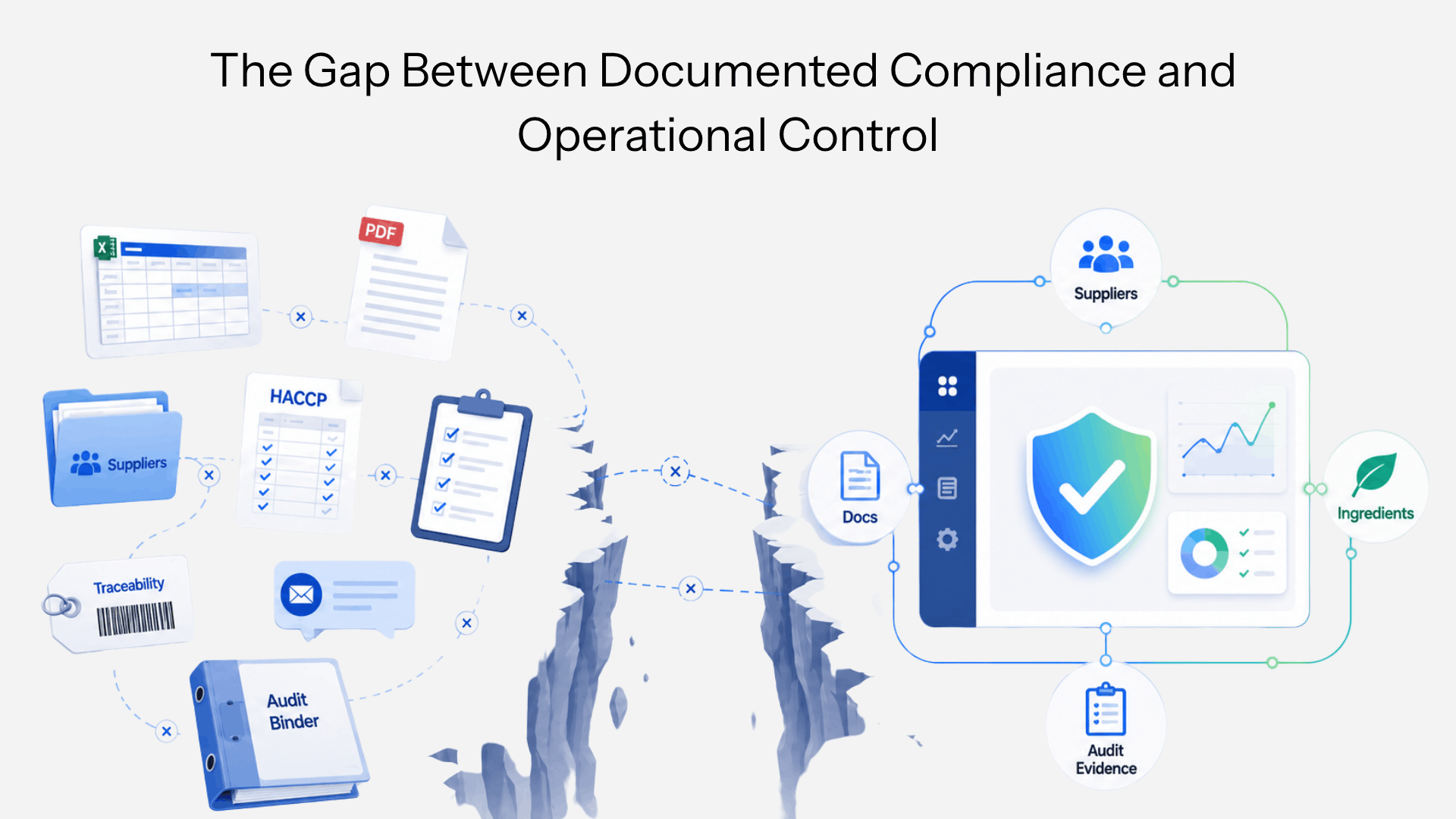
That creates a dangerous gap between documented compliance and operational control.
Documented compliance means the company has procedures. Operational control means the company can prove that the right procedure was followed, at the right time, for the right product, supplier, lot, label, hazard, and corrective action.
That is the difference between a system that looks ready and a system that is ready.
IONI’s work with manufacturers points to a clear conclusion: many food companies do not need another static document repository. They need a connected food safety software layer that turns food safety documents into living workflows.
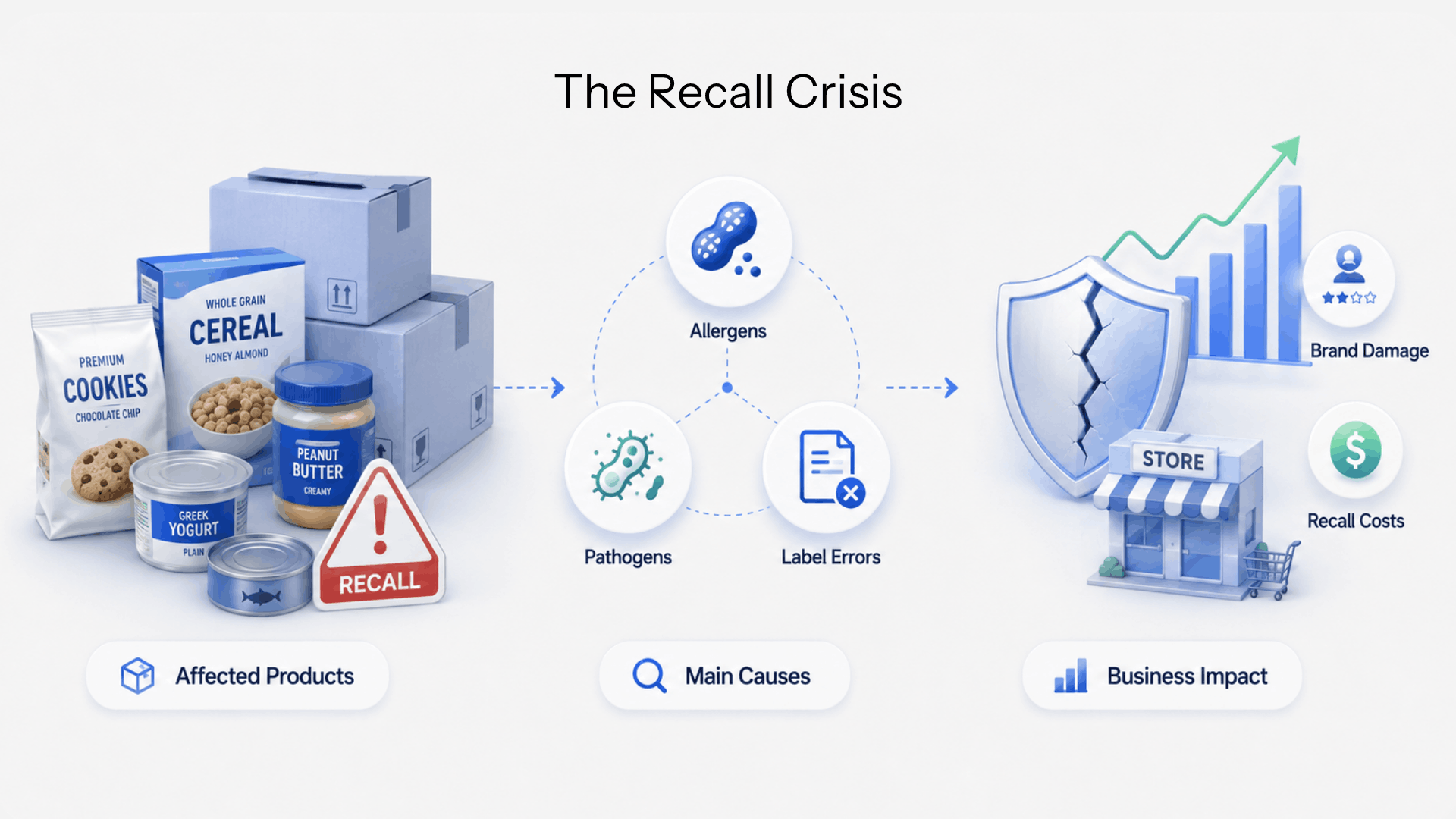
The Recall Crisis: Scale, Causes, and Cost
Recall risk is no longer a rare disruption. It is now a recurring operating condition.
Recall Volumes Reach A 9-Year High In 2025
Sedgwick’s U.S. Product Safety and Recall Index reported continued volatility in 2025 and Q1 2026. Public reporting on the same index showed that FDA food and drink recalls reached a nine-year high in 2025, while USDA-regulated food recalls rose by 20%. In Q1 2026, Sedgwick reported that total recalled product volume across five major U.S. industries increased 27% quarter over quarter, even as recall event counts declined.
The USDA FSIS recall case archive also shows why meat, poultry, and egg product manufacturers need a separate recall-readiness lens. USDA-regulated recalls often involve pathogens, foreign material, misbranding, undeclared allergens, or inspection-related issues that require fast product identification and customer notification.
For food manufacturers, this matters because the recall scale is often more damaging than the recall count.
A single recall can now affect multiple SKUs, co-packers, private-label customers, distributors, online channels, foodservice accounts, and retail banners. One mislabeled ingredient, one missing allergen declaration, one supplier contamination issue, or one traceability gap can spread through the supply chain before the manufacturer fully understands exposure.
The operational question is no longer whether the company has recall records. The real question is whether the company can identify affected lots, connect them to suppliers, ingredients, batches, customers, and labels, prove what happened, and isolate the issue before it becomes a brand-level crisis.
Manufacturers that cannot answer those questions quickly are not recall-ready, even if they have a recall procedure on file.
Allergens: The Number One Cause Nobody Is Fully Solving
Allergen recalls remain one of the clearest signs that food safety systems are fragmented.
Undeclared allergen failures are rarely caused by one missing checkbox. They usually happen because several systems fail to stay aligned. Ingredient specifications change. Supplier allergen declarations are updated late. Product formulas are revised. Packaging artwork is not reapproved. Old labels remain in inventory. Rework is used without full allergen review. Cleaning records exist, but they are not tied to the next product’s allergen risk.
FDA’s recalls and safety alerts show how often undeclared allergens continue to appear in public recall notices. This is not surprising. Allergen control is not one procedure. It is a connected chain of supplier approval, ingredient review, label control, production sequencing, sanitation verification, and release approval.
This is why allergen management cannot be solved by training alone.
A strong allergen program needs to connect ingredient specifications, supplier declarations, product formulas, label approvals, packaging inventory, production scheduling, changeover sanitation, rework rules, COA review, release checks, complaint history, and CAPA evidence. When those controls live in separate files, the risk is not visible until something breaks.
This is exactly where ingredient-level intelligence becomes important. A manufacturer needs to know not only which suppliers are approved, but whether each ingredient lot, specification, COA, allergen declaration, and product formula still match the current risk profile. That is why IONI positions ingredients intelligence for food companies as a core compliance capability, not a nice-to-have data feature.
The $10M Question: What A Recall Really Costs
The food industry often cites the GMA/FMI estimate that the average direct cost of a food recall is around $10 million. The GMA recall-cost analysis, available through the GMA Recall Cost White Paper, found that recall events can create substantial direct financial exposure, including product retrieval, disposal, testing, crisis management, investigation, legal review, and corrective action.
But the direct number does not capture the full commercial damage.
A recall can also create lost retailer confidence, suspended supplier status, higher insurance scrutiny, additional customer audits, legal exposure, lost sales, production downtime, contract penalties, management distraction, and long-term brand damage.
For large companies, a recall may become a shareholder-value event. For small and mid-sized manufacturers, it can become a survival event.
The most damaging recalls are often those that reveal weak systems. A pathogen event is serious. An undeclared allergen is serious. But when the company cannot quickly prove root cause, affected lots, the corrective action, and preventive controls, the recall becomes a trust problem.
That is why recall readiness must be treated as a daily evidence system, not a crisis binder.
Brand Damage Beyond Direct Costs
A recall does not end when the product is removed from commerce.
Retailers may demand a supplier corrective action plan. Certification bodies may review the incident at the next audit. Customers may require additional documentation before placing new orders. Large accounts may put the supplier on probation. The company may need to demonstrate that it has updated HACCP controls, retrained staff, revised supplier approval criteria, or changed release procedures.
The public nature of FDA and USDA recall listings also increases reputational exposure. Once a recall appears in the FDA recalls database or the USDA FSIS recall archive, customers, competitors, auditors, insurers, and retailers can all review the incident.
Brand damage becomes worse when the manufacturer cannot explain the failure clearly.
A strong readiness system helps answer which product was affected, which lots were involved, which ingredients were used, which supplier documents supported release, which monitoring checks were completed, which labels were used, which customers received the product, which corrective action was opened, and which verification proved the fix worked.
When those answers are available quickly, the manufacturer controls the narrative. When they are not, customers and regulators assume the system is weaker than the company claims.
Audit Readiness: What The Data Shows
BRCGS 2024-2025: 100,000+ Non-Conformities, 4.86 Per Audit
BRCGS audit data is useful because it shows what happens inside companies that are already trying to meet a recognized food safety standard.
The BRCGS Annual Report 2024-25 shows the scale of global certification activity and the volume of findings that certified sites must manage. Public BRCGS Food Safety Issue 9 summaries for the 2024-2025 report more than 100,000 non-conformities and an average of 4.86 non-conformities per audit.
That number matters because these are not companies with no food safety system. These are companies already participating in certification.
The lesson is clear: certification does not eliminate readiness risk. It reveals where the operating system is still weak.
Audit non-conformities typically appear where documents and daily behavior drift apart. A procedure says one thing. Records show another. A corrective action exists, but root cause is incomplete. A monitoring log is maintained, but verification is late. A supplier approval procedure exists, but expired documents remain active. A HACCP plan is approved, but it has not been updated after a process change.
These are not just documentation problems. They are control problems.
The Top Failure Categories And Why They Repeat
BRCGS public summaries show that the largest share of non-conformities is linked to Section 4, covering site standards such as building fabric, equipment, hygiene, cleaning, and contamination control. This aligns with the broader picture in the BRCGS Annual Report 2024-25: food safety certification is not only about documented programs, but about practical control inside facilities.
A site can write a strong policy for hygiene, equipment maintenance, zoning, glass and brittle plastic control, pest management, and foreign-body prevention. But auditors evaluate whether those controls are working in the plant.
The repeat pattern is predictable. Equipment repairs are temporary and not risk-assessed. Cleaning records exist, but verification is inconsistent. Building damage is known, but not closed. Foreign-body controls are documented, but not monitored effectively. GMP checks are performed, but corrective actions are weak. Environmental issues are observed, but not escalated.
These findings repeat because food safety risk lives in daily execution. A static document cannot maintain a facility. A spreadsheet cannot verify that a corrective action was effective. A shared folder cannot detect that the same hygiene issue has appeared three times in six weeks.
The Gap Between Documented Systems And Audit Reality
The most common audit readiness problem is the gap between “we have a procedure” and “we can prove the procedure worked.”
The HACCP plan may say a CCP is monitored every hour, but records show missing checks. The supplier approval SOP may require current certificates, but the supplier file contains expired documents. The allergen program may require label review after formulation changes, but the approval record is missing. The internal audit schedule may exist, but findings were closed without evidence. The CAPA form may include root cause, but the root cause only restates the problem. The traceability procedure may require mock recalls, but the test did not include supplier-level or customer-level reconciliation.
This is why manufacturers need to move from audit preparation to audit readiness.
Audit preparation is a project. Audit readiness is a system.
If a company wants to compete for major retail, foodservice, export, or private-label contracts, readiness must become continuous. That is why IONI frames FSMA, BRCGS, and SQF readiness as one connected operating model rather than three disconnected compliance projects.
Use IONI AI Audit to connect HACCP, supplier files, COAs, CAPAs, and audit evidence into one continuous readiness system.
SQF Vs BRCGS Vs FSSC 22000: Where Manufacturers Struggle Most
SQF, BRCGS, and FSSC 22000 have different structures, but the practical readiness failures are similar.
SQF often creates pressure around implementation evidence, validation and verification, supplier approval, internal audits, corrective actions, training, food safety culture, and management review.
BRCGS is especially demanding around site standards, foreign-body control, hygiene, allergen management, traceability, product authenticity, root cause, and senior management commitment.
FSSC 22000 pushes companies toward a management-system model, including ISO-based continual improvement, prerequisite programs, hazard control, internal audits, corrective actions, and documented change management.
The mistake is to ask which scheme is easiest. The better question is whether the system can generate reliable evidence every day.
For teams still comparing HACCP and SQF requirements, IONI’s guide on HACCP vs SQF is a useful starting point. The short version is that HACCP is the foundation, while SQF is a broader certification framework that requires proof that the food safety system is implemented, verified, and maintained.
FSMA 204: The Deadline Nobody Was Ready For
Why FDA Extended The Deadline By 30 Months
FSMA 204 is one of the most important traceability rules affecting food manufacturers, processors, packers, distributors, and supply chain partners handling foods on the Food Traceability List.
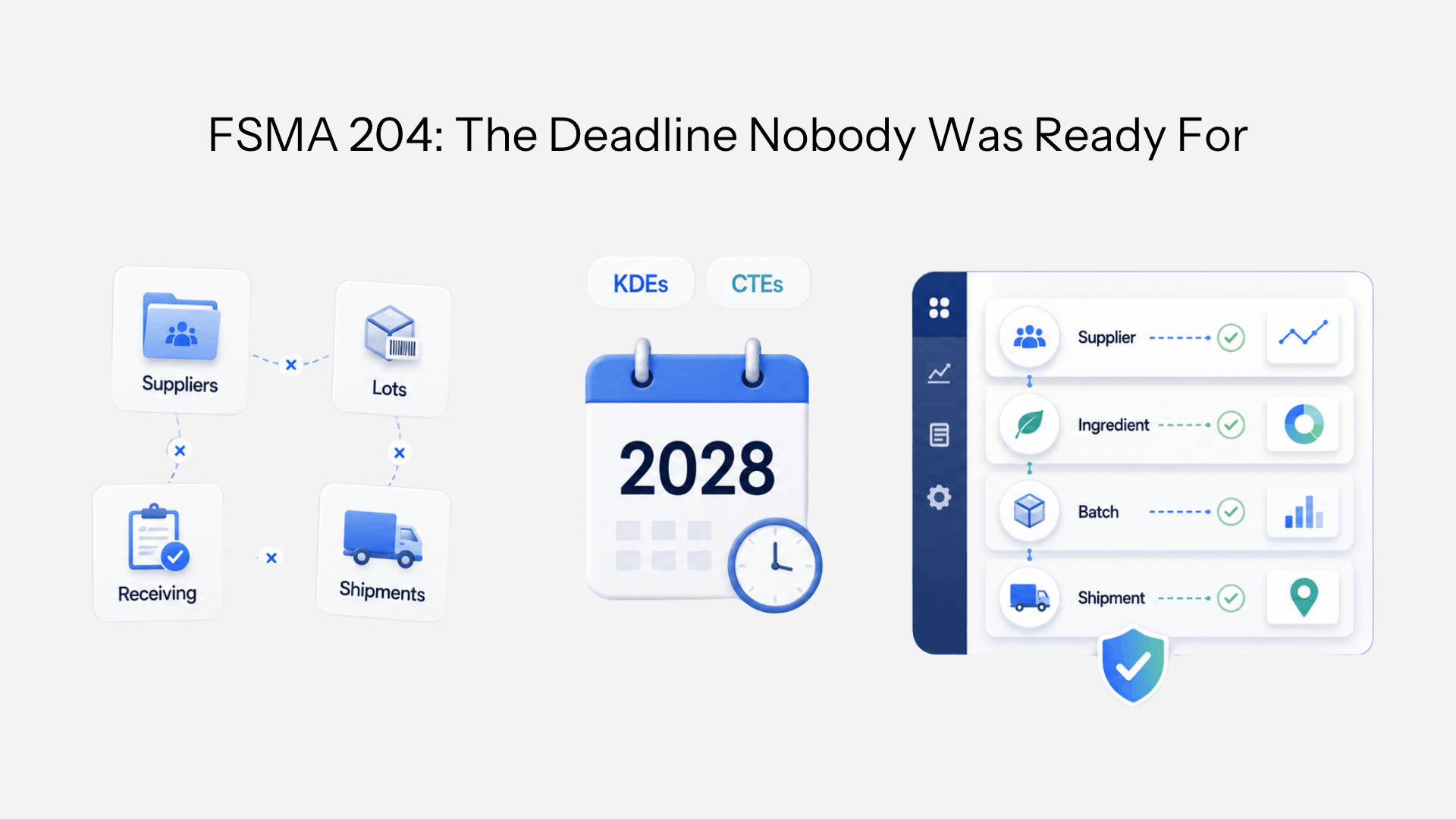
FDA’s official FSMA Food Traceability Rule page explains that covered entities must maintain Key Data Elements linked to Critical Tracking Events. It also states that companies must provide traceability records to FDA within 24 hours, or within another reasonable time agreed by FDA.
FDA originally set the compliance date for January 20, 2026. In 2025, FDA proposed extending the compliance date by 30 months to July 20, 2028. That extension should not be misread as a relaxation of expectations. It is a signal that industry implementation was not ready at the supply chain level.
That sounds straightforward until a manufacturer maps the real workflow.
Traceability data may sit across suppliers, receiving logs, ERP records, production batches, transformation steps, packaging records, warehouse movements, shipping records, brokers, co-packers, and customer documents. Some records may be structured. Others may be PDFs, emails, spreadsheets, handwritten logs, or portal exports.
FSMA 204 is not just a recordkeeping rule. It is a data-connectivity rule.
Who Is Actually Prepared And Who Isn’t
Large retailers and enterprise manufacturers are generally better positioned because they already have structured data systems, EDI workflows, ERP discipline, supplier portals, and traceability investments.
The readiness gap is concentrated among small and mid-sized manufacturers, co-packers, ingredient suppliers, importers, repackers, and regional brands. These companies often have the data, but not in a format that is fast, standardized, and exchangeable.
A company may know which supplier shipped a lot. It may know which batch used that lot. It may know which customer received the finished product. But if that information takes two days, four people, and six spreadsheets to reconstruct, it is not FSMA 204-ready.
IONI’s dedicated guide on FSMA 204 for food manufacturers explains the practical work manufacturers should begin now: identify Food Traceability List exposure, map CTEs, define KDE ownership, standardize supplier data, and run mock retrieval exercises before the deadline pressure returns.
Traceability As A Supply Chain Problem, Not Just An IT Problem
Many companies treat traceability as a software implementation. That is incomplete.
Traceability is a supply chain behavior. It depends on whether each partner captures, validates, and shares data in a usable form.
FDA’s FSMA 204 rule page makes this clear by organizing compliance around Critical Tracking Events and Key Data Elements. Those data points only work if each partner in the supply chain can capture and pass them consistently.
A manufacturer can buy a traceability platform and still fail if suppliers send incomplete lot codes, inconsistent item names, unstructured COAs, unclear country-of-origin data, or late shipment records. The system also fails if internal teams do not connect receiving, transformation, packaging, rework, shipping, and customer records.
The critical work starts with identifying products and ingredients on the Food Traceability List, mapping applicable Critical Tracking Events, defining required Key Data Elements, finding missing or unstructured data, cleaning up supplier records, identifying internal system gaps, and testing how quickly the company can reconstruct a full traceability path under pressure.
This is where custom integrations become important. FSMA 204 readiness may require connecting ERP systems, supplier portals, document storage, QA workflows, warehouse records, production systems, and customer reporting formats.
What “Compliant By 2028” Needs To Look Like Today
July 20, 2028, is the regulatory deadline, not the working timeline.
FDA’s traceability rule guidance gives manufacturers the compliance structure, but each company still has to translate that structure into product lists, supplier requirements, data capture rules, mock retrieval exercises, and internal ownership.
By the end of 2026, manufacturers should already have a documented FSMA 204 applicability assessment, a list of covered ingredients and finished products, mapped CTEs and KDEs, supplier data requirements, a traceability plan, mock recall and mock traceability tests, identified data gaps, CAPAs for failed traceability exercises, and clear ownership across QA, procurement, production, warehouse, logistics, and IT.
Waiting until 2028 creates the same problem many companies faced before the original 2026 deadline: the internal team may be ready, but the supply chain is not.
Use IONI Food Safety Software to map FSMA 204 traceability gaps across suppliers, ingredients, lots, batches, and shipments now.
The Technology Gap
Paper-Based Systems: Where They Break Under Audit Conditions
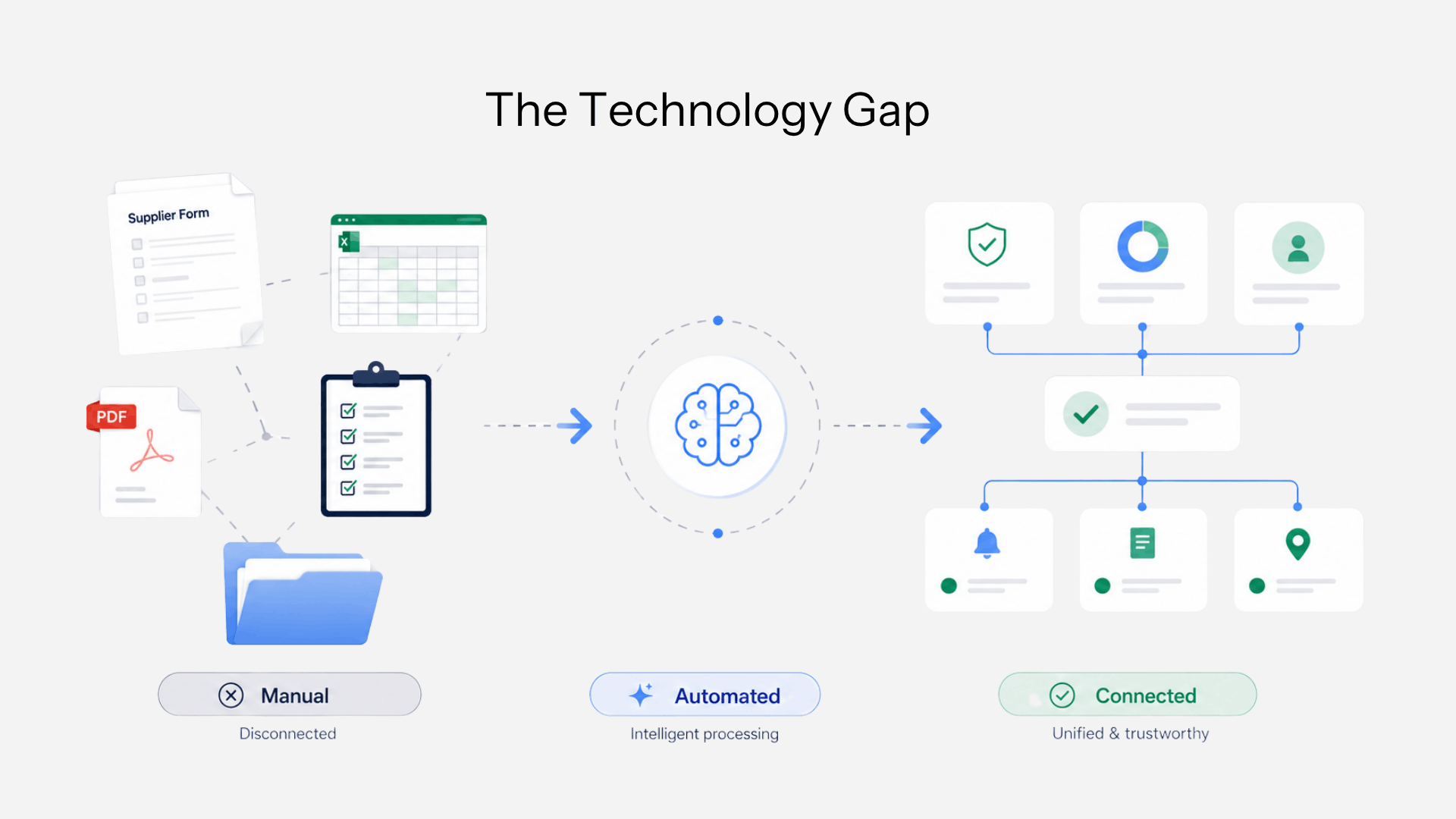
Paper and spreadsheets can support very small operations. They do not scale well under certification, retailer, FSMA, supplier, and recall pressure.
The breaking points are consistent: version control, expired supplier documents, missing signatures, unreviewed SOPs, duplicate templates, inconsistent file names, manual COA checks, late corrective actions, hard-to-retrieve training records, monitoring logs disconnected from CAPA, and traceability data spread across systems.
The biggest limitation is that paper and spreadsheets do not detect risk. They store information after people enter it. They do not automatically flag that a COA conflicts with a specification, a supplier certificate has expired, a HACCP plan needs review after a formula change, or a monitoring record is missing before product release.
That is why manual systems often appear acceptable until the audit, complaint, or recall simulation.
AI Adoption In Food Safety: From Pilot To Mainstream
AI in food safety should not be framed as replacing QA managers. That is the wrong debate.
The real opportunity is using AI to reduce administrative load, improve consistency, and surface risk earlier.
The highest-value AI use cases in food safety are practical: extracting supplier document data, checking COAs against specifications, identifying missing allergen declarations, drafting HACCP hazard analysis from ingredients and process steps, mapping regulatory changes to internal SOPs, summarizing audit gaps, suggesting CAPA structure, assembling audit evidence, monitoring standard and regulatory updates, and finding inconsistencies across documents.
A QA manager still makes the decision. AI accelerates the work needed to reach a better decision.
That is why IONI’s AI regulatory intelligence is designed around impact mapping, not just alerts. A regulatory update only matters when the team can understand which products, SOPs, suppliers, labels, controls, or audit obligations it affects. For a comparison of vendors, see our guide to the best AI regulatory intelligence software for food manufacturers.
What Manufacturers Gain From Compliance Automation
Compliance automation changes the food safety operating model from reactive to continuous.
Instead of preparing for an audit once a year, the team sees readiness gaps as they appear. Instead of chasing expired supplier documents manually, the system tracks document requirements, due dates, risk levels, and approval status. Instead of checking COAs line by line, the system compares values against current specifications and flags mismatches. Instead of rebuilding HACCP plans manually, the system generates a structured draft from products, ingredients, process steps, hazards, controls, monitoring requirements, corrective actions, and verification tasks.
The gains are measurable in daily work: fewer expired supplier records, faster COA review, fewer missing monitoring logs, stronger allergen visibility, faster traceability exercises, cleaner CAPA records, shorter audit preparation cycles, and better evidence for SQF, BRCGS, FSSC 22000, FSMA, and customer audits.
The real value is not “digitization.” The value is decision support.
Build Vs Buy: The Real Cost Of In-House Compliance Infrastructure
Some manufacturers consider building internal compliance tools. For large enterprises with strong IT, data engineering, cybersecurity, QA systems, and integration resources, this can be realistic.
For most small and mid-sized manufacturers, build vs. buy should be evaluated carefully.
A real compliance system needs document control, user permissions, audit trails, supplier workflows, COA validation logic, specification management, HACCP structure, CAPA workflows, training records, traceability mapping, reporting, integrations, data security, backup and recovery, regulatory monitoring, standard updates, and user adoption support.
The hidden cost is not the first internal prototype. The hidden cost is maintaining the system after the first retailer requirement, first certification upgrade, first supplier change, first product launch, first recall simulation, and first regulatory update.
In-house tools often become another spreadsheet with a better interface. A proper compliance platform must understand food safety workflows by design.
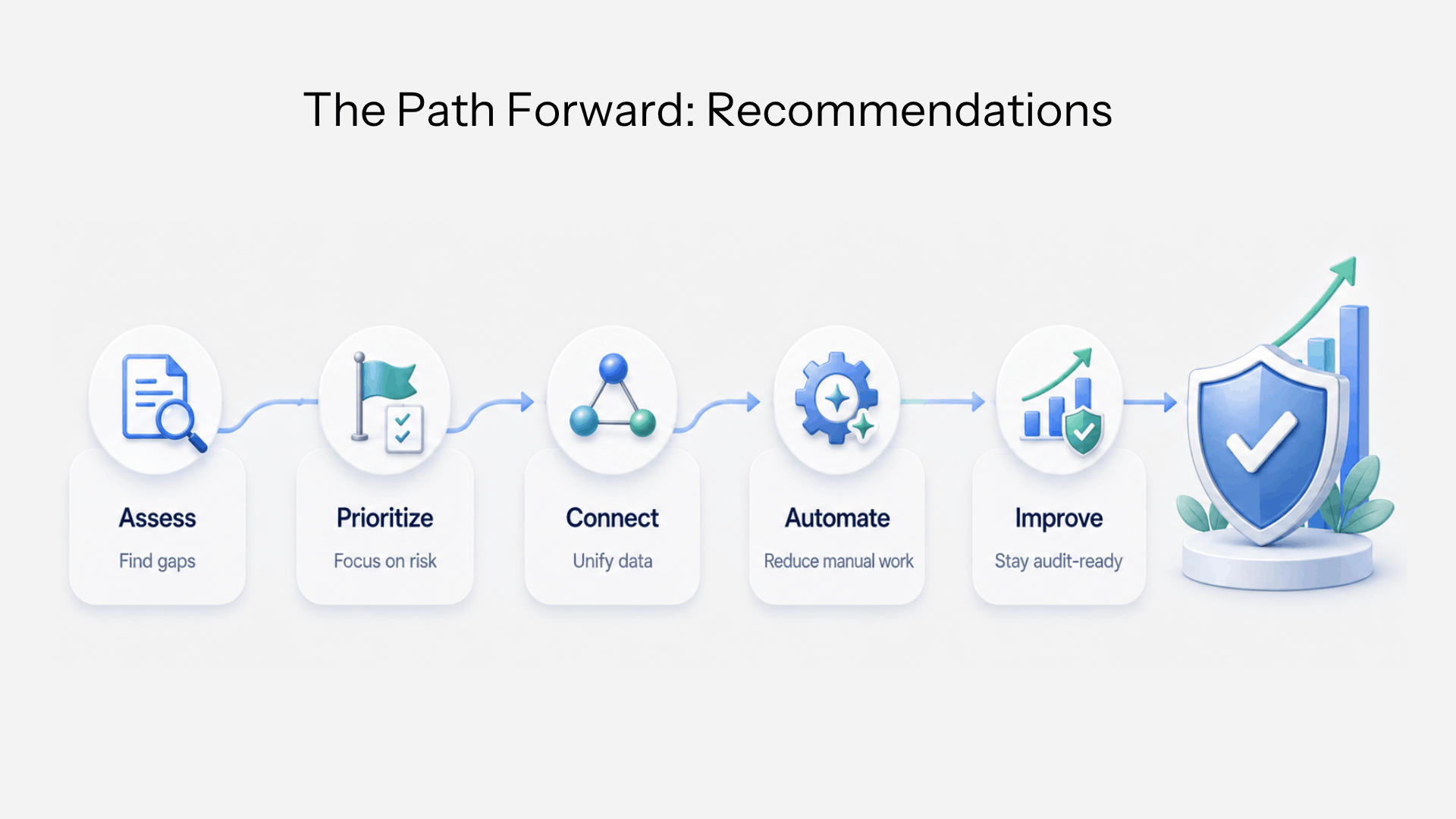
The Path Forward: Recommendations
The Minimum Viable Compliance Stack For 2026
Every food manufacturer should have a minimum viable compliance stack by the end of 2026.
That stack should include current HACCP or food safety plans, controlled SOPs and prerequisite programs, supplier approval workflows, supplier document tracking, ingredient specifications, COA verification, allergen matrix and label control, monitoring logs, corrective actions, CAPA and root-cause workflows, training records, traceability planning, mock recall evidence, internal audit schedules, regulatory monitoring, and GFSI readiness tracking.
The stack does not need to be overcomplicated. But it must be connected.
A HACCP plan that is not connected to ingredients, suppliers, monitoring records, and corrective actions is not a living system. A supplier approval process that is not connected to COAs, specifications, allergens, and expiration dates is not a reliable control. A traceability plan that is not tested against real lots is not ready.
How To Move From Annual Audit Prep To Continuous Readiness
Annual audit preparation creates a false sense of control.
The plant spends weeks cleaning records, chasing documents, closing overdue tasks, reviewing training logs, updating SOPs, and assembling evidence. The audit may pass, but the system returns to reactive mode afterward.
Continuous readiness requires a different rhythm.
Manufacturers should track open CAPAs by risk and age, expired supplier documents, missing COAs, late monitoring logs, overdue verification tasks, failed internal audit findings, unreviewed regulatory changes, traceability test performance, HACCP sections affected by product changes, supplier approval exceptions, allergen matrix updates, and training gaps.
The goal is not to create more work. The goal is to stop discovering problems only when an auditor, customer, or regulator asks.
Supplier Document Management: The Overlooked Weak Link
Supplier document management is one of the most overlooked compliance risks in food manufacturing.
Many companies still treat supplier files as static folders. That is not enough.
A modern supplier control system should connect each supplier and ingredient to approval status, risk rating, specifications, COAs, allergen declarations, certificates, letters of guarantee, food safety questionnaires, country-of-origin data, organic, kosher, halal, non-GMO, or other claims where applicable, expiration dates, review cycles, non-conformance history, and CAPA records.
The key question is not whether the company has the document. The key question is whether the company verified that this document supports the decision to use this ingredient in this product at this time.
That shift changes supplier management from document collection to risk control.
AI-Assisted HACCP: From 3-Week Project To 1-Hour Output
HACCP is one of the clearest opportunities for AI-assisted compliance because the work is structured, evidence-based, and repeatable.
A traditional HACCP update may take days or weeks. The team collects product data, ingredient specifications, process flows, known hazards, control measures, monitoring requirements, corrective actions, validation evidence, and verification tasks. Then it formats the output for internal review, auditor expectations, and customer requirements.
AI can accelerate the first draft by reading existing documents, extracting inputs, suggesting hazards, mapping controls, identifying missing information, and generating a structured HACCP plan for QA review.
That last phrase matters: for QA review.
AI should not replace the food safety professional. It should reduce manual assembly work so the food safety professional can spend more time on judgment, validation, verification, and risk decisions.
The practical result is speed. A HACCP draft that used to take three weeks can become a one-hour structured output, followed by expert review and refinement.
IONI’s 2026 Readiness Framework
IONI’s readiness framework is built around one principle: food safety compliance should not depend on last-minute audit preparation. It should be visible, connected, and controlled every day.
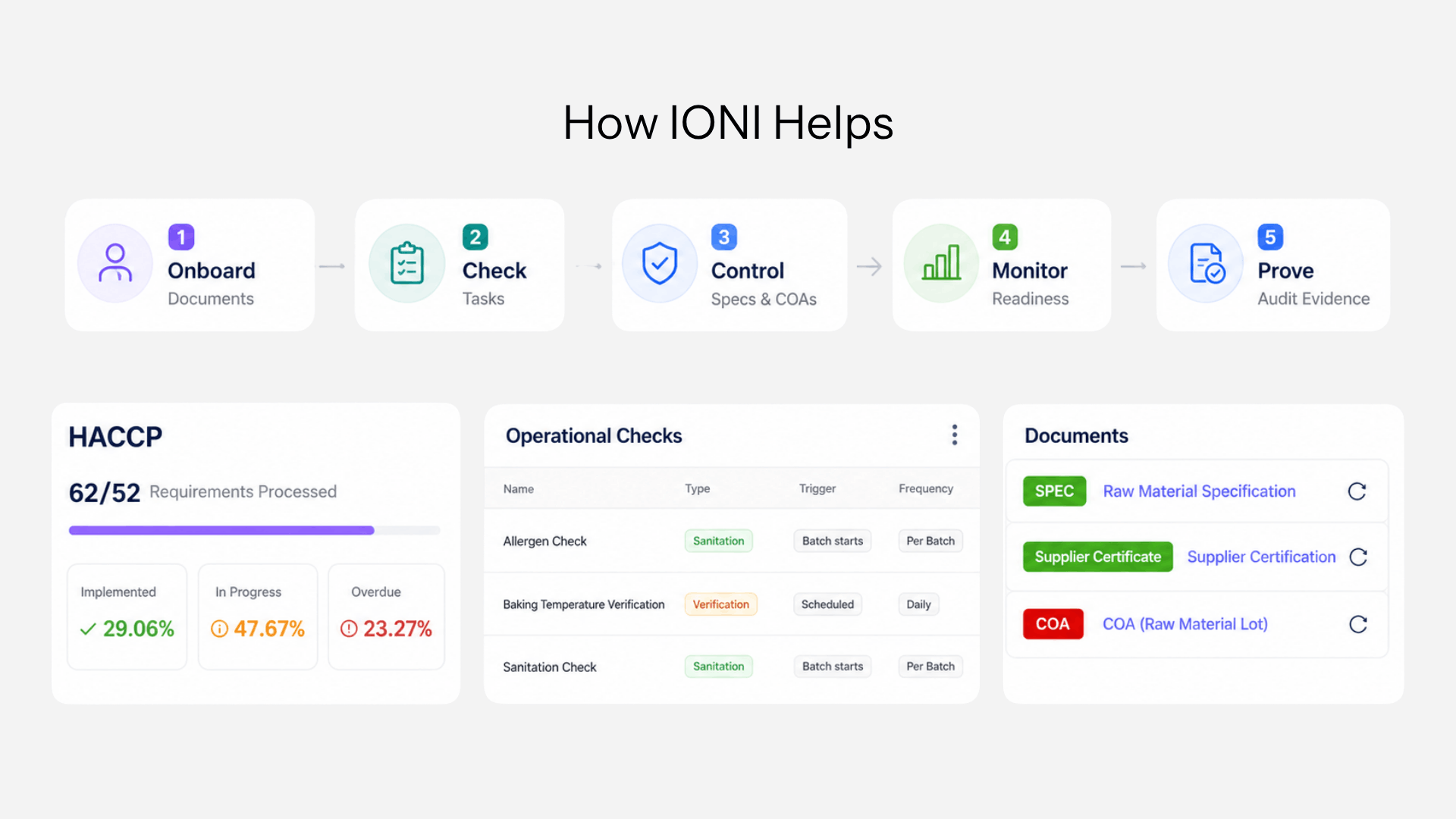
Instead of managing HACCP, supplier approval, COA checks, allergen risk, FSMA 204 traceability, CAPA, audit evidence, and regulatory updates as separate tasks, IONI connects them into one operating system for continuous readiness.
Turn Existing Documents Into A Working Compliance System
Most manufacturers already have SOPs, HACCP plans, supplier files, specifications, COAs, allergen declarations, monitoring logs, and audit records. IONI helps turn those static files into structured workflows, so teams can identify gaps, standardize records, and build readiness from what they already have.
Benefit: faster onboarding, less manual document review, and a stronger foundation for audits.
Connect Suppliers, Ingredients, COAs, And Allergens
Supplier approval is not enough if documents are expired, COAs are not checked, or allergen declarations are disconnected from formulas and labels. IONI connects supplier records, ingredient specs, COAs, certificates, allergen data, and approval status in one place.
Benefit: fewer supplier gaps, stronger allergen control, and better release decisions before production starts.
Make HACCP A Living System
HACCP plans often become outdated when products, ingredients, suppliers, equipment, or processes change. IONI connects HACCP logic to real product and ingredient data, helping teams draft, review, update, and maintain hazard analysis, controls, monitoring requirements, corrective actions, and verification tasks.
Benefit: faster HACCP updates and less risk of outdated controls.
Move From Audit Prep To Continuous Readiness
Traditional audit preparation starts too late. IONI helps teams track missing documents, overdue CAPAs, expired certificates, incomplete monitoring logs, unresolved findings, and traceability gaps before the audit window.
Benefit: fewer surprises, faster evidence retrieval, and cleaner SQF, BRCGS, FSSC 22000, FSMA, and customer audits.
See How IONI Works:
Link Records To CAPA And Verification
Monitoring logs only matters if deviations lead to action. IONI connects checks, failures, corrective actions, root cause, verification, and follow-up evidence, so issues do not disappear into paper forms or spreadsheets.
Benefit: stronger accountability and better proof that problems were fixed.
Prepare For FSMA 204 With Real Traceability Data
FSMA 204 readiness requires more than knowing that records exist. IONI helps connect suppliers, ingredients, lots, batches, transformation steps, and customer shipments, making traceability gaps easier to find before the July 2028 deadline.
Benefit: faster mock recalls, clearer KDE/CTE readiness, and better supply chain traceability.
Map Regulatory Change To Internal Action
Regulatory alerts are only useful when teams know what to do next. IONI connects regulatory and standard updates to affected SOPs, HACCP plans, supplier requirements, labels, specifications, tasks, and audit evidence.
Benefit: less alert fatigue and faster response to FDA, CFIA, SQF, BRCGS, FSSC 22000, and customer requirement changes.
Connect With Existing Systems
Food safety data often lives across ERP systems, supplier portals, shared drives, spreadsheets, warehouse tools, and production records. IONI supports integrations so compliance data can flow into one readiness model instead of being manually copied before audits.
Benefit: less duplicate work and a more reliable single source of truth.
The Practical Outcome
With IONI, manufacturers can move from scattered compliance files to a connected readiness system. QA teams spend less time chasing documents and more time managing risk, preventing audit findings, and proving control when customers, auditors, or regulators ask.
IONI turns HACCP plans, supplier documents, COAs, traceability records, CAPAs, and regulatory updates into one connected readiness system before the audit, recall, or customer request.
Methodology And Sources
This report synthesizes public data from FDA, USDA FSIS, Sedgwick, PIRG, BRCGS public reporting, and recall-cost research historically associated with GMA/FMI.
The scope includes U.S. and global food manufacturers, co-packers, ingredient suppliers, private-label manufacturers, and companies preparing for retailer, GFSI, FSMA, or customer audit requirements.
This compliance challenge is visible across public recall data, audit non-conformity trends, FDA’s FSMA 204 deadline extension, and the ongoing shift from static document storage to continuous compliance control.
Final Conclusion
Food safety compliance in 2026 is moving from document ownership to operational proof.
The winners will not be the manufacturers with the largest binders or the most complex spreadsheets. They will be the manufacturers that can connect suppliers, ingredients, HACCP plans, monitoring records, COAs, allergens, corrective actions, traceability events, and audit evidence into one live readiness system.
The recall environment is too volatile for reactive compliance. Audit expectations are too detailed for disconnected evidence. FSMA 204 is too supply-chain-dependent for manual traceability. Retailer expectations are too high for once-a-year preparation.
The path forward is continuous readiness.
For manufacturers, that means building a system where every ingredient, supplier, batch, document, control, and corrective action can be trusted before the audit, before the recall, and before the customer asks.