.png)
Nutrition label software calculates Nutrition Facts values from a recipe's ingredient data, applies the rounding and format rules in 21 CFR 101.9, and flags the major allergens that must be declared. It does not replace regulatory judgment. The label values remain the manufacturer's responsibility, and borderline products may still need laboratory analysis.
Last updated: October 7, 2026
What Nutrition Label Software Actually Does
Most nutrition label software, sometimes sold as nutritional analysis software or food labeling software, does three jobs. It sums nutrient values from the ingredients in a recipe, converts the totals to a per-serving panel, and formats that panel to match the regulation. Better tools also track recipe versions so you can see which label went with which formula.
What it cannot do is decide your serving size category, confirm that an ingredient supplier's data is right, or tell you whether a nutrient claim is allowed. Those remain judgment calls for your regulatory lead.
Nutrition Facts Rules in 21 CFR 101.9: Rounding and Format
The Nutrition Facts requirements live in 21 CFR 101.9, and the rounding rules are specific by nutrient. A few examples from the regulation:
- Calories: nearest 5-calorie increment up to and including 50 calories, and nearest 10 calories above 50. Under 5 calories may be declared as zero.
- Total fat and saturated fat: nearest 0.5 gram below 5 grams and nearest gram above 5 grams.
- Cholesterol: nearest 5 milligrams.
- Sodium: nearest 5 milligrams from 5 to 140 milligrams per serving, and nearest 10 milligrams above that.
- Total carbohydrate and protein: nearest gram, with "less than 1 gram" allowed for small amounts.
Software that applies these rules automatically removes a common source of errors: a spreadsheet that shows 137 calories on the panel when the rules call for 140. Always check the current regulation text rather than relying on a tool's built-in settings, since rules and guidance do change.
Updated Label Dates and Small-Business Exemptions
According to FDA's industry resources on the updated label, the compliance date for the updated Nutrition Facts label was January 1, 2020 for manufacturers with $10 million or more in annual food sales, and January 1, 2021 for those with less. Those dates have passed, so a label for a new product should follow the updated format.
Some businesses are exempt from nutrition labeling. 21 CFR 101.9 includes a low-volume exemption for food sold directly to consumers by sellers under stated sales limits, and the food must carry no nutrition claims. Separately, FDA's small business nutrition labeling exemption page says a business with fewer than an average of 100 full-time equivalent employees can qualify for a product when fewer than 100,000 units are sold in the United States in a 12-month period. It must file a notice with FDA annually, and low-volume products that bear nutrition claims do not qualify. Confirm eligibility on FDA's page before you rely on it.
Allergen Labeling: FALCPA and the FASTER Act
Allergens belong in any food labeling software workflow, because a nutrition panel is only part of a compliant label. Under FDA's FALCPA page, a food containing a major food allergen must declare it either in a "Contains" statement or by naming the allergen's source in the ingredient list. FDA's FASTER Act page lists the nine major food allergens: milk, eggs, fish, crustacean shellfish, tree nuts, peanuts, wheat, soybeans and sesame, and says sesame must be labeled as an allergen on packaged foods as of January 1, 2023.
When a recipe change swaps an ingredient, the allergen declaration can change even if the nutrition numbers barely move. For the control plan behind the label, see our guide to allergen management for food manufacturers.
Database-Derived Analysis vs Laboratory Analysis
Software calculates values from ingredient databases. Laboratory analysis measures the finished product. Both are used in practice, but they answer different questions. FDA's guidance on developing and using databases for nutrition labeling says the responsibility for the validity of a label's stated nutrient values rests with the manufacturer, and that FDA recommends basing label values on laboratory analysis of each nutrient. The same guidance describes ingredient databases that calculate values from recipes and says they should have a quality management program that includes ongoing comparison with laboratory data.
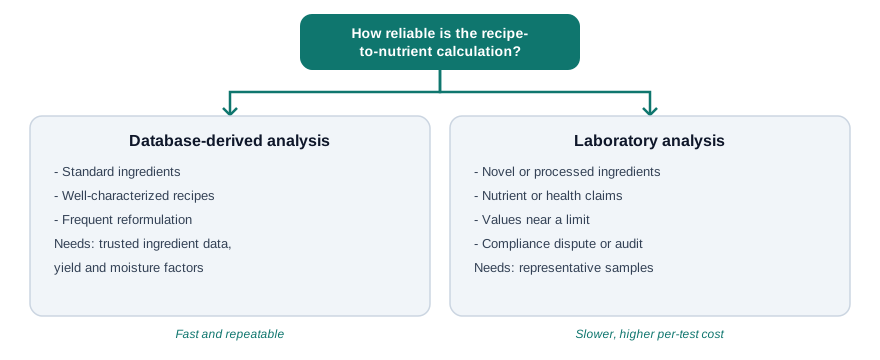
Compliance is judged against the label, not against your method. Under 21 CFR 101.9, a composite of a product's naturally occurring nutrients (Class II) must be at least 80 percent of the declared value, and a composite with more than 20 percent excess of the declared value for nutrients such as calories, sugars, fat, saturated fat, cholesterol or sodium is deemed misbranded. The regulation also allows compliance to be shown through an FDA-approved database, and the FDA guidance notes that submitting a database to FDA is voluntary. So a calculated label is a reasonable starting point, but products near a limit, or products making nutrient content claims, are good candidates for testing.
Tool Categories Compared
This is a neutral comparison of categories, not of specific products. Cost models vary by vendor and are usually quote-based.
| Category | Accuracy | Cost model | Effort | Best for |
|---|---|---|---|---|
| Spreadsheet | Depends on who built it and how current the nutrient data is | Staff time, no license fee | High: manual rounding, manual updates | A handful of stable products |
| Nutrient-database label software | As good as the ingredient data and your yield inputs | Typically a subscription; quote-based | Low once ingredients are entered | Many SKUs and frequent reformulation |
| Laboratory analysis | Measures the actual product, subject to sampling | Per-sample or per-panel testing fees; typically varies | Medium: sampling, shipping, waiting | Novel products, claims, values near a limit |
| Recipe or ingredient platform | Depends on the connected nutrient and supplier data | Typically a subscription; quote-based | Medium to set up, low to maintain | Teams that also need costing, specs and supplier documents |
From Recipe Change to Label Update: A Workflow
Labels go wrong most often when a recipe changes and the label does not. A simple repeatable process fixes this.
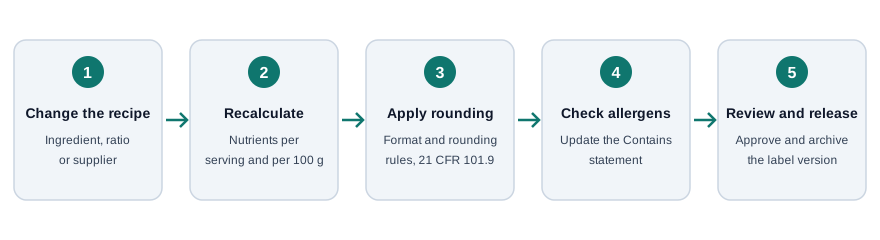
- Log the change. Record the new ingredient, ratio or supplier against a new recipe version.
- Recalculate nutrients. Update per-serving and per-100 g values using current ingredient data and the yield from actual batches.
- Apply rounding and format rules. Check the result against 21 CFR 101.9, including serving size.
- Re-check allergens. Compare the ingredient list to the nine major allergens and update the Contains statement if needed.
- Review and release. Have your regulatory lead approve the label, archive the version and retire old packaging stock.
Recipe changes also move cost. Our guide to recipe and food costing software covers the cost side of the same change.
Where IONI Fits
IONI is not a nutrition label generator, and its public page does not describe producing Nutrition Facts panels. What the page of IONI's ingredient intelligence software describes is the supplier-document side of ingredients: requesting required documents from suppliers, organizing CoAs and certifications, matching CoA results against your specifications and flagging out-of-spec values, tracking certificate expiry, and compiling lot records, CoAs and supplier documents into a package for each batch. The page also lists allergen statements among supplier documents and flags a missing allergen test as a gap. That is useful input for label work, because accurate ingredient and allergen data come from suppliers, but the label itself still needs a nutrient-analysis method like those above.
Frequently Asked Questions
What is nutrition label software?
It is software that calculates Nutrition Facts values from a recipe's ingredients, applies rounding and format rules, and helps declare allergens. The manufacturer remains responsible for the accuracy of the label values.
Can I rely on software-calculated nutrition values?
Often yes for well-characterized recipes, but FDA's database guidance places responsibility for label accuracy on the manufacturer and recommends laboratory analysis as the basis for label values. Products near a limit or making claims are good candidates for testing.
Does my small business need a Nutrition Facts label?
Not always. FDA describes a low-volume exemption for businesses with fewer than an average of 100 full-time equivalent employees and fewer than 100,000 units of a product sold in a 12-month period, with an annual notice to FDA, and products bearing nutrition claims do not qualify. Check FDA's exemption page for current details.
Which allergens must be declared on US food labels?
Milk, eggs, fish, crustacean shellfish, tree nuts, peanuts, wheat, soybeans and sesame. Sesame became the ninth major allergen on January 1, 2023 under the FASTER Act.
What should I do when a recipe changes?
Treat it as a label event: log the change, recalculate nutrients, reapply rounding and format rules, re-check allergens and have the label reviewed before release.