Prerequisite programs (PRPs) are the basic, facility-wide conditions and practices that keep a food plant hygienic enough to make safe food, such as sanitation, pest control, personal hygiene, maintenance and supplier approval. They control general risk, while critical control points (CCPs) control specific hazards at specific process steps.
This guide lists common PRPs with examples, compares PRPs, operational PRPs (OPRPs) and CCPs, and shows how to document them. For the CCP side, see our guide to the critical control point (CCP).
What Prerequisite Programs Are
The term "prerequisite program" comes from HACCP and from schemes such as ISO 22000 and the GFSI-benchmarked standards. In United States regulation, the equivalent baseline is the current good manufacturing practice (CGMP) requirements in Subpart B of 21 CFR Part 117, which cover areas such as personnel, plant and grounds, sanitary operations, facilities, equipment and processes and controls. Under the preventive controls framework, 21 CFR 117.135 lists the types of preventive controls: process, food allergen, sanitation and supply-chain controls, plus a recall plan and other controls such as hygiene training.
In short, PRPs are the foundation. If they are weak, the specific controls built on top of them will not hold.
List of Common Prerequisite Programs With Examples
| Prerequisite program | What it covers | Example records |
|---|---|---|
| Good manufacturing practices (GMPs) | Personnel hygiene, clothing, hand washing, building and grounds | GMP inspection log, hygiene audit |
| Sanitation and cleaning (SSOPs) | Cleaning and sanitizing of food-contact surfaces and the environment | Cleaning checklist, ATP or visual verification |
| Pest control | Prevention, monitoring and response to pests | Pest contractor reports, trap maps |
| Allergen control | Segregation, labeling, changeover and cross-contact prevention | Allergen changeover record, label checks |
| Supplier approval | Approving and monitoring ingredient and packaging suppliers | Approved supplier list, certificates |
| Preventive maintenance and calibration | Equipment condition and measurement accuracy | Maintenance log, calibration certificates |
| Water, air and utilities | Safe water and compressed-air or steam quality | Water test results |
| Training | Competence of staff for their roles | Training matrix, sign-in records |
| Traceability and recall | Identifying and withdrawing product | Mock recall report |
| Waste and chemical control | Safe storage and removal of waste and chemicals | Chemical inventory, waste log |
PRP vs OPRP vs CCP
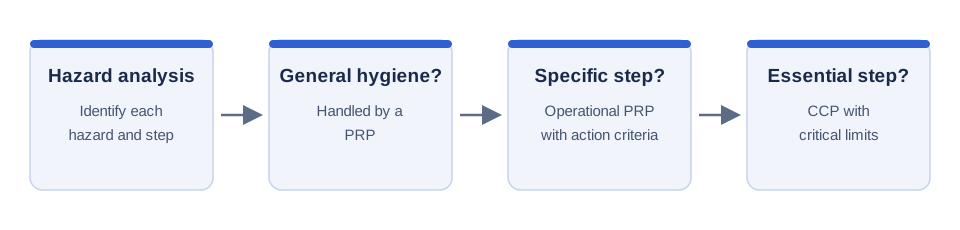
Hazard analysis decides which control category a measure belongs to. The categories differ in scope, in how failure is judged and in the response.
| PRP | OPRP | CCP | |
|---|---|---|---|
| Scope | Facility-wide, general conditions | A specific significant hazard at a specific step | A specific hazard at an essential step |
| How it is judged | Compliance with the program | Action criteria (measurable or observable) | Critical limits |
| Monitoring | Routine checks and inspections | Scheduled monitoring and verification | Defined monitoring with immediate action |
| If it fails | Risk builds up over time; investigate and correct | Raises the likelihood of the hazard; assess the product | Product may be unsafe; hold and evaluate |
| Example | Pest control, hand washing, GMPs | Allergen changeover verification, metal detector checks (where not a CCP) | Cooking to a lethal temperature, pasteurization |
The same control can be classified differently in different plants depending on process design and what controls follow it. OPRPs are a concept from ISO 22000 and related schemes; the FDA rule instead speaks of process, allergen, sanitation and supply-chain controls, with management components such as monitoring, corrective action and verification applied as appropriate to the control. Under 21 CFR Part 117, a critical control point is a point, step or procedure at which control can be applied and is essential to prevent, eliminate or reduce a hazard to an acceptable level.
How to Document a Prerequisite Program
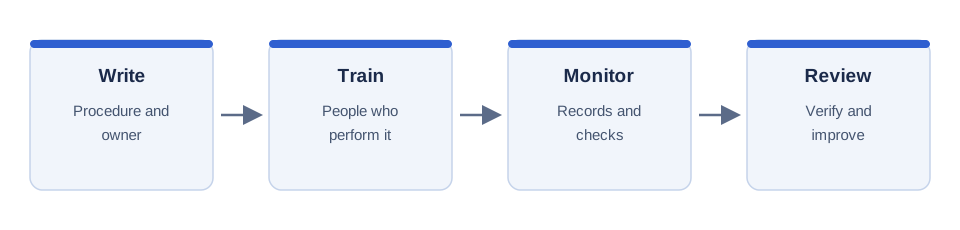
- Name an owner and the scope of the program.
- Write the procedure in plain steps, including frequency and who does it.
- Train the people who perform and check it.
- Define what is monitored and what record proves it was done.
- Define what happens when something is out of order, and record the corrective action.
- Review each program at least annually and after any incident or change.
Related programs are covered in our guides to good manufacturing practices, sanitation SOPs and pest control programs.
Where IONI Fits
IONI is the production and traceability layer that runs on top of the QuickBooks you already have. In its hazard analysis, each step is assigned a risk level on the scale PRP, SOP, MOD, OPRP and CCP, so the classification is recorded alongside the step. Operational checks, logs with reviewer confirmation, deviations and corrective actions, and training records give the supporting records for the programs above.
FAQ
What are prerequisite programs in food safety?
They are the basic facility-wide conditions and practices, such as sanitation, pest control, hygiene, maintenance and supplier approval, that support the safe production of food.
What is the difference between a PRP and a CCP?
A PRP manages general conditions across the facility. A CCP controls a specific hazard at an essential step and has critical limits, such as a minimum cooking temperature.
What is an OPRP?
An operational prerequisite program is a control for a specific significant hazard at a specific step, judged by action criteria rather than critical limits. The concept comes from ISO 22000 and related schemes.
Does FDA use the term PRP?
The FDA rule is framed around CGMPs and preventive controls, which cover what PRPs cover in other schemes. Auditors for GFSI schemes will still expect to see PRPs.
How many PRPs should a food plant have?
There is no fixed number. Cover the areas your hazard analysis and certification scheme require, and document each one.
Last updated: October 21, 2026
Keep the production record where the work happens. Explore IONI's production and traceability software for food manufacturers.