.png)
USDA's National Bioengineered Food Disclosure Standard requires food manufacturers, importers, and certain retailers to disclose ingredients that meet USDA's definition of "bioengineered" (BE), using one of four disclosure methods, for any product containing a BE ingredient above the record-keeping threshold. This is a labeling compliance requirement, not a food-safety hazard - but it carries real regulatory risk, since USDA can pursue enforcement for a missing or inaccurate disclosure.
Where This Requirement Comes From
The National Bioengineered Food Disclosure Standard (7 CFR Part 66) implements a law Congress passed in 2016; USDA's Agricultural Marketing Service (AMS) announced the final standard in December 2018, with mandatory compliance beginning January 1, 2022. AMS maintains a List of Bioengineered Foods that identifies which crops and foods are available in BE form and therefore require recordkeeping to determine disclosure status - the list is updated periodically (sugarcane and squash were added/amended effective December 29, 2023, with mandatory compliance for that update beginning June 23, 2025), so it's worth checking against the current list rather than a saved copy.
Four Ways to Disclose
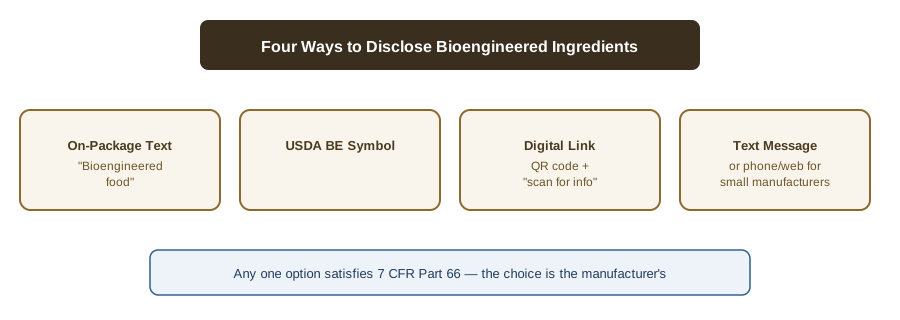
A regulated entity can satisfy the disclosure requirement with any one of the following - the choice is the manufacturer's:
- On-package text, such as "Bioengineered food" or "Contains a bioengineered food ingredient."
- The USDA BE symbol, a standardized graphic AMS provides for this purpose.
- An electronic or digital link (typically a QR code) paired with the instruction to scan for more information.
- A text message disclosure option, with additional phone-number or web-address options available to small food manufacturers or for small and very small packages.
What Manufacturers Actually Need to Do
In practice, compliance starts with checking every formulation against the current AMS List of Bioengineered Foods, then obtaining supplier documentation on whether a listed ingredient (or an ingredient derived from one) is bioengineered. This is a recordkeeping exercise as much as a labeling one - the same kind of supplier-document trail described in our ingredient compliance checklist for brands that outsource manufacturing - a manufacturer needs to be able to show why a product was or wasn't disclosed, not just print a label and move on.
A Note on Ongoing Litigation
Some provisions of the standard - including parts of the digital/text-message disclosure option and the "detectability" requirement - have been challenged in court, and reporting as of 2026 indicates compliance dates for certain provisions may shift as litigation and related rulemaking proceed. Manufacturers should treat the January 1, 2022 baseline as the current requirement but confirm the latest status on USDA AMS's BE Disclosure page before finalizing label claims, rather than relying on any single article - this one included - as the final word on a provision currently in flux.
FAQ
Is GMO labeling mandatory in the US?
Disclosure of bioengineered (BE) food ingredients has been mandatory under USDA's National Bioengineered Food Disclosure Standard since January 1, 2022, using one of four approved disclosure methods. "GMO" is the common consumer term; USDA's regulatory term is "bioengineered."
What are the ways to disclose a bioengineered ingredient?
On-package text, the USDA BE symbol, a digital/electronic link (QR code), or a text message option - with added phone or web-address options for small manufacturers or small packages.
How do I know if my ingredient needs a BE disclosure?
Check the ingredient against USDA AMS's current List of Bioengineered Foods and obtain supplier records confirming BE status - the list is updated periodically, so a one-time check isn't sufficient going forward.
Keep ingredient and label compliance connected to your current formulations. See IONI Ingredients Intelligence for food companies.