Cycle counting is counting a small, rotating slice of inventory every day or week instead of shutting down for one annual physical. In a food plant you count high-risk, high-value or fast-moving items most often, reconcile each variance to a cause, and fix the process that created it.
This guide gives a practical ABC count schedule, a step-by-step reconciliation procedure and the questions to ask about a barcode inventory system. It sits alongside our guides to lot-level inventory management and FEFO vs FIFO rotation.
Cycle Counting vs a Physical Inventory
A physical inventory counts everything at one time, usually once a year. Cycle counting spreads the work across the year so errors are caught while the cause is still fresh, and production does not stop for a full count. Per a common vendor description, cycle counting counts a subset of inventory in specific locations on a recurring schedule, and it can replace the annual count or supplement it (see this cycle count process overview). Whether a cycle-count program is enough for your financial statements is a question for your accountant and auditor.
An ABC Cycle Count Schedule for a Food Plant
ABC analysis ranks items by value, such as unit cost times annual usage, and groups them into classes. The frequencies below are a common convention, not a regulation; adjust them to your risk. In a food plant, add a second lens: allergen ingredients and short-shelf-life items deserve extra attention regardless of dollar value.
| Class | Typical items | Example count frequency | Extra rule for food plants |
|---|---|---|---|
| A | Few items, highest value or usage (proteins, specialty ingredients) | Monthly or more often | Count by lot and expiry date |
| B | Moderate value and usage (common dry ingredients, packaging) | Quarterly | Check allergen segregation while counting |
| C | Many items, low value (low-cost consumables) | Once or twice a year | Count when a bin is emptied |
Review the classes at least annually, because yesterday's slow item can become tomorrow's hero ingredient.
Cycle Count Procedure: Step by Step
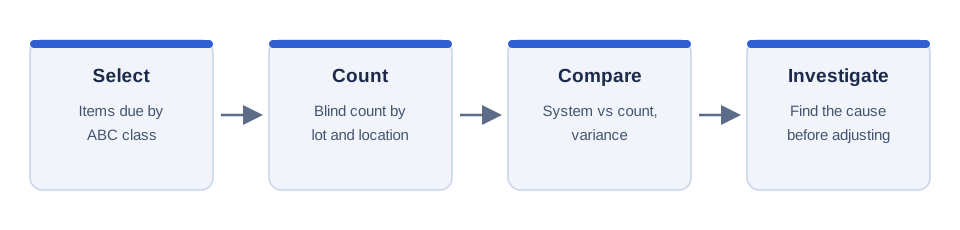
- Pick the items due today from the ABC schedule and any items flagged by exceptions (negative balances, recent receipts, large adjustments).
- Freeze movements on those items for the count window, or record movements during it.
- Count blind: the counter does not see the system quantity.
- Count by lot, location and unit of measure, and note expiry dates.
- Compare the count with the system quantity and calculate the variance.
- Recount anything outside your tolerance before investigating.
- Investigate the cause, using the table below, before adjusting.
- Adjust through an approved entry with a reason code, and keep the count sheet.
Inventory Reconciliation: Finding Why Counts Do Not Match
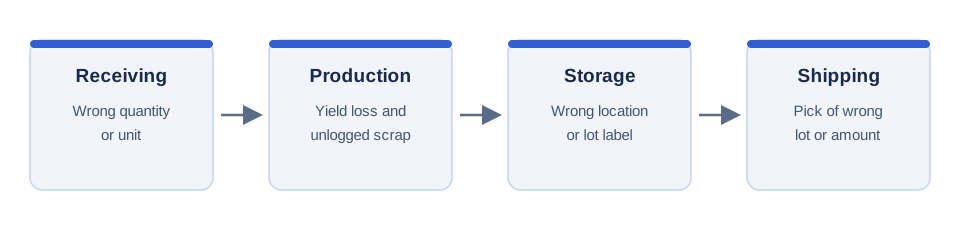
Inventory reconciliation is comparing physical counts with system records and explaining the difference. The adjustment is the last step, not the first. Most variances trace back to a handful of causes.
| Where it starts | Typical cause | Fix |
|---|---|---|
| Receiving | Wrong quantity or unit of measure keyed from the paperwork | Count against the PO at the dock; use one unit of measure per item |
| Production | Yield loss, trim or spillage not recorded against the batch | Record actual quantities consumed and good units produced |
| Storage | Pallet in the wrong location or lot label missing | Label every pallet; relocate through the system |
| Shipping | Wrong lot or quantity picked | Pick by system-suggested lot; scan or confirm before loading |
| Data | Duplicate item records, unlogged transfers, unlogged rework | Merge duplicates; require a record for every transfer |
Barcode Inventory System: What to Ask
A barcode inventory system reduces keying errors, but only at the level it scans. Ask whether it identifies the item only, or the lot and expiry as well, and whether it works with how you receive, store and pick. Barcodes on a case do not tell you which lot is on the pallet unless the lot is encoded or entered. For lot-level control in a food plant, the requirement is that the count, the system record and the label agree on the lot.
Where IONI Fits
IONI is the production and traceability layer that runs on top of the QuickBooks you already have; it does not replace your accounting system. It keeps lot-level stock from receiving, with CSV import and operator receiving against a purchase order, through to batch assembly with FEFO lot suggestions. That gives you a lot-level record to count against. Where your facility uses the QuickBooks integration, quantities can be exported; see manufacturing software that works with QuickBooks.
FAQ
What is cycle counting?
Cycle counting is counting a rotating subset of inventory on a regular schedule, instead of counting everything once a year.
How often should I cycle count?
There is no regulatory frequency. A common approach counts the highest-value or highest-risk items most often, mid-value items quarterly and low-value items once or twice a year.
What is inventory reconciliation?
It is comparing physical counts with system records and explaining the differences before adjusting the system.
Is cycle counting enough instead of an annual physical?
Sometimes. Whether a cycle-count program can replace the annual count depends on your controls and your accountant or auditor, so confirm it with them.
Do I need a barcode inventory system to cycle count?
No. You can count with paper or a spreadsheet. A barcode system reduces keying errors if it scans at the lot level you need.
Last updated: October 21, 2026
Keep the production record where the work happens. Explore IONI's production and traceability software for food manufacturers.