.png)
Food ERP software is an enterprise resource planning system configured for food and beverage manufacturing: alongside standard accounting, purchasing, and inventory, it adds food-specific capabilities such as lot traceability, recipe and formula management, shelf-life tracking, and quality records. For many small and mid-size food manufacturers, though, the real gap isn't the accounting side - QuickBooks already handles that. The gap is the production floor: batches, lots, receiving checks, and food safety records. In that case, a production and traceability layer that runs on top of the QuickBooks you already have can close the gap without replacing your general ledger, payables, receivables, or payroll.
What a Food ERP Includes
An ERP is a single system meant to run most of a business: financials, purchasing, inventory, production, sales, and reporting on one database. A food ERP takes that model and adds the requirements that make food different from assembling identical parts.
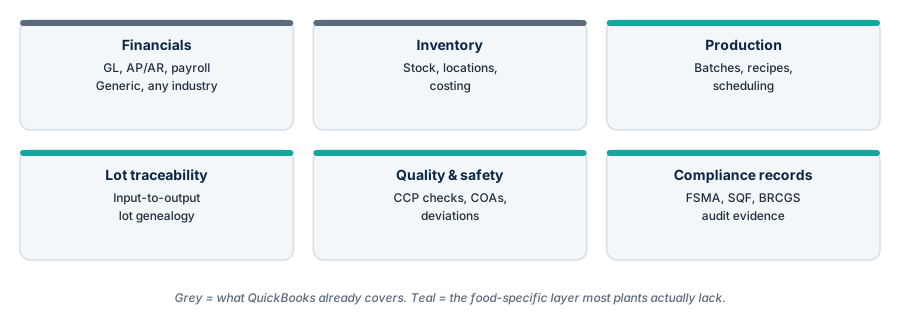
The food-specific capabilities that matter
- Lot traceability. Recording which ingredient lots went into which batch and which finished lots went to which customer, so you can trace forward or backward in minutes.
- Recipes and formulas. Versioned formulas with scaling, yield expectations, and allergen information, rather than a static bill of materials.
- Shelf life and FEFO. Expiration dates that follow each lot, so production uses the shortest-dated stock first.
- Quality and food safety records. Receiving inspections, CCP checks, holds, and deviations tied to the batch they belong to.
- Compliance evidence. Records you can hand to an SQF or BRCGS auditor or an FDA investigator - and, for foods on FDA's Food Traceability List, the Key Data Elements the FSMA 204 traceability rule requires by its July 20, 2028 compliance date.
Everything on that list happens on the plant floor. None of it requires replacing your accounting system.
Why a Full ERP Is Often the Wrong First Move
A full ERP replaces your financial system of record. That means migrating the general ledger, chart of accounts, open payables and receivables, payroll, and years of history, retraining the office as well as the floor, and changing how your accountant works. For a manufacturer with a few dozen employees whose books already close cleanly in QuickBooks, that's a large project aimed mostly at a problem that doesn't exist.
The problems that actually hurt at that size tend to be operational: nobody can say which customer received product made with a recalled ingredient lot, the production schedule lives in a spreadsheet, receiving temperatures are on a clipboard, and audit week means digging through binders. Those are production and traceability problems. Our guide to production planning software for food manufacturers covers the planning side of this in more detail.
Full Food ERP vs. a Production and Traceability Layer
A production layer sits beside your accounting system rather than replacing it. The plant floor records batches, lots, receiving checks, and quality data in a system built for that work; the numbers accounting needs - quantities, receipts, finished goods, cost inputs - sync to QuickBooks. Each system does the job it was built for.
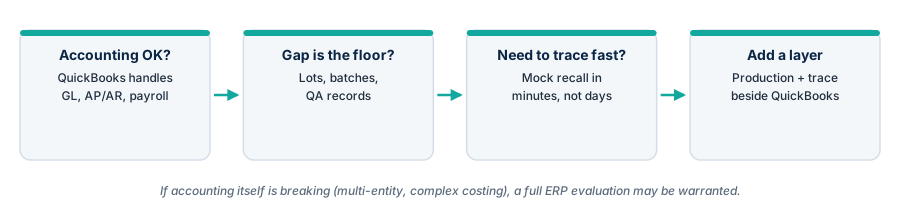
A production layer is usually enough when:
- QuickBooks (or another accounting package) handles your books, payroll, and invoicing without major pain.
- Your biggest gaps are lot tracking, batch records, receiving, and audit-ready quality records.
- You need to run a mock recall in minutes, not days - the core of real batch and lot tracking.
- You want something the floor can adopt in weeks, not a multi-quarter implementation.
A full ERP evaluation makes sense when:
- Accounting itself is the bottleneck: multiple legal entities, complex consolidation, or costing your accounting system can't model.
- You're running several plants and need one financial and operational system across all of them.
- You have the internal team, budget, and time to run a full system replacement.
Questions to Ask Any Food ERP or Production Vendor
- Can it show full input-to-output lot genealogy for a batch, not just lot numbers on inventory?
- How are receiving checks, CCP readings, and deviations tied to the batch record?
- Does it support FEFO picking based on real expiration dates?
- What exactly syncs with QuickBooks, in which direction, and how often?
- How long does a typical implementation take for a plant your size, and who on your team does the work?
- Can it produce a mock recall report and audit evidence without manual spreadsheet work?
If the answer to the last question is "export to Excel and build it yourself," the system isn't solving the traceability problem, whatever it's called. For the specific case of keeping QuickBooks, see our guide to manufacturing software that works with QuickBooks.
FAQ
What is food ERP software?
Food ERP software is an enterprise resource planning system adapted for food and beverage manufacturing. It combines accounting, purchasing, and inventory with food-specific functions like lot traceability, recipe management, shelf-life tracking, and quality records.
Do small food manufacturers need an ERP?
Not always. Many small and mid-size manufacturers already have working accounting in QuickBooks and mainly need production, lot tracking, and food safety records. A production and traceability layer beside QuickBooks can cover that without a full ERP replacement.
What is the difference between a food ERP and a generic ERP?
A generic ERP is built around discrete parts and static bills of materials. A food ERP adds lot genealogy, variable yields, shelf life and FEFO, allergen and formula management, and quality and compliance records specific to food production.
Is IONI an ERP?
No. IONI doesn't include a general ledger, AP/AR, or payroll. It is the production and traceability layer - batches, lots, receiving, and food safety records - that runs alongside the accounting system you already use, such as QuickBooks.
Keep QuickBooks for the books and give the floor a system built for batches and lots. Explore IONI's production and traceability software for food manufacturers.