.png)
SQF Edition 9 expected food safety culture. It did not define exactly what proof should look like.
SQF Edition 10 changes that. According to SQFI guidance on which Code edition to use, Edition 10 audits are expected to begin on January 2, 2027, contingent on the GFSI benchmarking process. From that point, SQF sites will need a formal Food Safety Culture Assessment Plan that is documented, implemented, and auditable.
Auditors will not only read your policy. They will interview floor staff, observe production behavior, and check whether daily practice matches the written food safety system.
For a QA manager at a small food manufacturer, that creates a very practical problem. Food safety culture programs are often written for large organizations with HR teams, training coordinators, and dedicated food safety staff. A facility with 25 employees and one person covering QA, production support, supplier documents, and training needs something different: a practical minimum that holds up during an audit without creating a parallel system nobody can maintain.
This guide explains what SQF Edition 10 requires for food safety culture, what auditors check, and what small manufacturers need to document.
What Food Safety Culture Actually Means and Why SQF Edition 10 Changed the Rules
Food safety culture is the shared values, beliefs, habits, and behaviors that determine how an organization treats food safety in daily decisions. It matters most when no one is watching, when production is behind schedule, and when reporting a problem creates extra work.
The difference between strong and weak food safety culture usually appears in small moments.
An operator flags a temperature deviation even when the line is behind schedule.
A supervisor stops production because a cleaning step was missed instead of continuing and fixing the record later.
A floor employee reports a near-miss because they know the site wants problems raised early, not hidden until an audit.
Under SQF Edition 9, food safety culture was addressed through management commitment and behavioral expectations. Auditors looked for evidence that leadership supported food safety and that employees were trained, engaged, and aware of their responsibilities. But there was no formal requirement to assess, measure, and document culture as a standalone system element.
SQF Edition 10 makes the requirement more direct. The SQFI Edition 10 FAQ states that all Edition 10 SQF Food Safety Codes include a new requirement for sites to have a food safety culture assessment plan in place. SQFI also published a dedicated Food Safety Culture Assessment Plan Guidance Document to explain how sites should approach this requirement.
Three things have changed in practice.
A written Food Safety Culture Assessment Plan is now required. This is not a generic policy statement. It should define objectives, activities, measurement methods, responsibilities, and a review cycle.
Auditors assess culture through records, interviews, and observations. A plan that looks strong on paper but does not match floor behavior will not be enough.
Culture must show improvement over time. A document created shortly before the audit is not the same as evidence of an active culture program.
If your site is still building the foundation of its SQF system, it helps to understand how culture connects to the broader program. IONI’s guide on HACCP vs SQF explains the difference between a hazard-control system and a full certification framework.
What SQF Auditors Actually Check for Food Safety Culture
SQFI’s guidance makes one point very clear: food safety culture is not proven by surveys or training records alone. Auditors assess whether the site’s documented expectations are understood and followed under real production conditions.
That means the audit is built around three types of evidence: records, interviews, and observations.
Records confirm that the plan exists, covers the required elements, includes measurable objectives, and shows evidence of review and improvement. This is usually where the audit starts.
Interviews test whether employees at different levels understand food safety expectations and feel safe raising concerns. Auditors may ask floor staff questions like:
- What do you do if you notice something that could be a food safety problem?
- Has anyone ever told you not to report a concern?
- What happens when a CCP limit is exceeded during your shift?
- Who do you go to if you have a food safety question?
If answers do not match the documented system, the issue becomes a culture gap, not only a documentation gap.
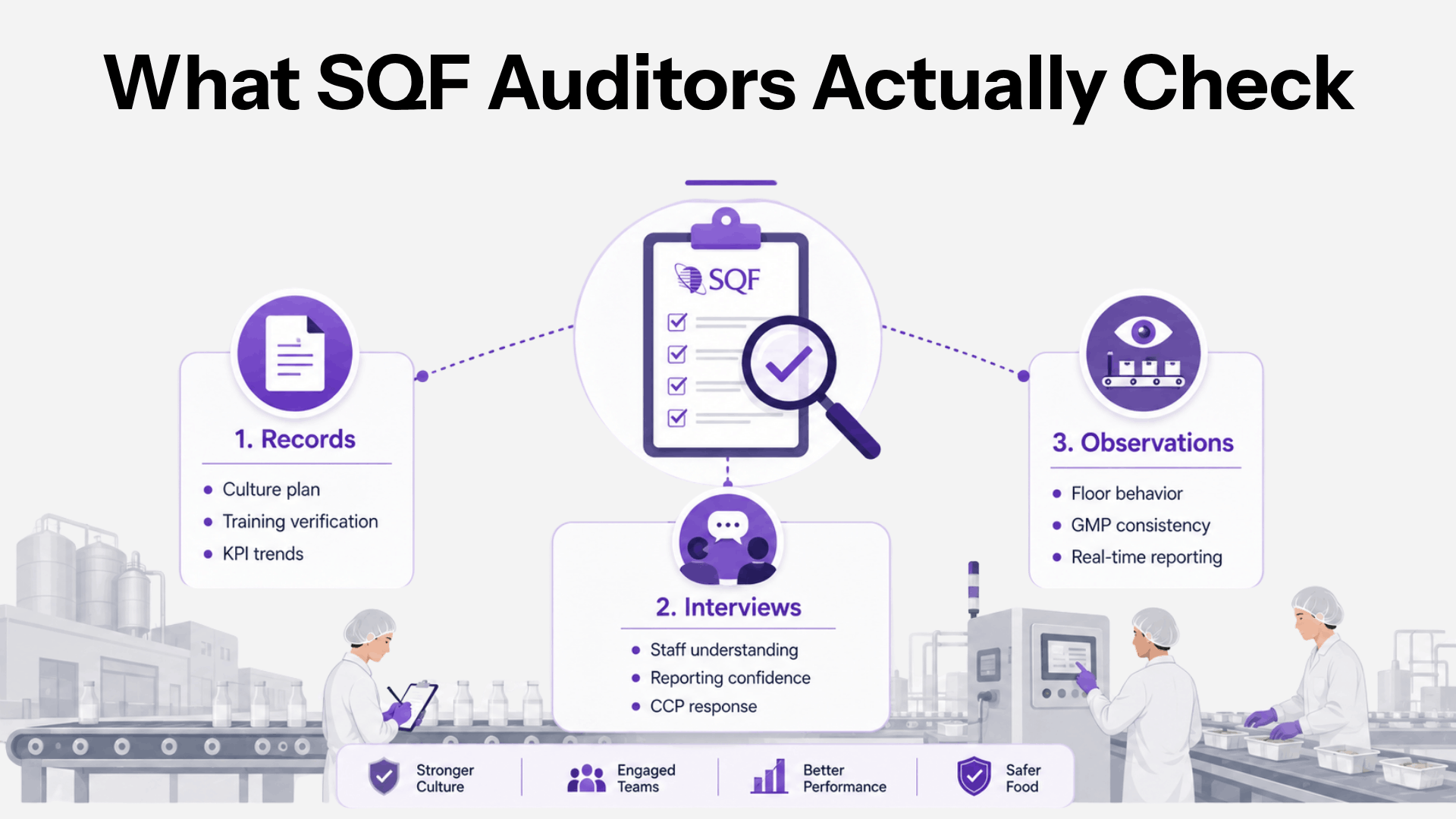
Observations show whether behavior matches procedure during normal production. Auditors watch whether GMPs are followed consistently, whether supervisors reinforce food safety practices, whether deviations are documented when they occur, and whether employees behave the same way when production is under pressure.
The most common food safety culture failure at small facilities is not a missing document. It is the gap between what is written and what is practiced.
The procedures are correct. Training records are complete. But on the floor, shortcuts happen, deviations go unrecorded, and employees avoid reporting issues because they have learned that reporting problems creates friction.
An auditor who interviews three operators and gets three different answers about what to do when a CCP is exceeded has found a culture problem, even if the HACCP plan itself is written well.
This is why food safety culture should be built into daily readiness, not treated as a separate audit folder. The SQF audit checklist for small food manufacturers can help teams connect cultural evidence with the broader audit preparation process.
The 6 Elements of a Food Safety Culture Assessment Plan Under SQF Edition 10
SQFI’s Food Safety Culture Assessment Plan Guidance Document identifies the elements a food safety culture assessment plan should address. For each one, the practical minimum for a small manufacturer is described below.
#1 Leadership Commitment
Leadership must visibly demonstrate that food safety takes priority. This cannot exist only in policy language. It has to appear in decisions, follow-up, and behavior.
What an auditor looks for:
- Management walkthrough records with food safety observations and follow-up
- Meeting minutes where food safety performance is discussed alongside production metrics
- Evidence that production was stopped or slowed for a food safety reason and that the decision was supported
- Resource decisions that show food safety investment
For a small manufacturer, the practical minimum is a documented management floor walk schedule with a simple observation record. Include the date, attendees, what was observed, and what follow-up was required.
Monthly is enough for many small facilities. The record does not need to be elaborate. It needs to exist, be used consistently, and show that management is paying attention to real food safety behavior.
#2 Employee Awareness and Training
Employees at all levels must understand the food safety expectations relevant to their role. They must also be able to explain those expectations when asked.
The distinction between training records and cultural evidence matters here. A signed training form proves attendance. An auditor interview tests understanding. Both are needed, but the interview is where many cultural findings appear.
What an auditor looks for:
- Training records with completion dates and sign-offs
- Competency checks that verify understanding, not only attendance
- Evidence that training happens after procedure changes, not only at onboarding
- Records that include temporary and seasonal workers, not only permanent staff
For a small manufacturer, the practical minimum is a training matrix with roles, required topics, completion dates, and a brief competency verification step. This can be a short verbal check, practical observation, or documented question-and-answer review.
The goal is to prove that food safety culture training turns into a working understanding.
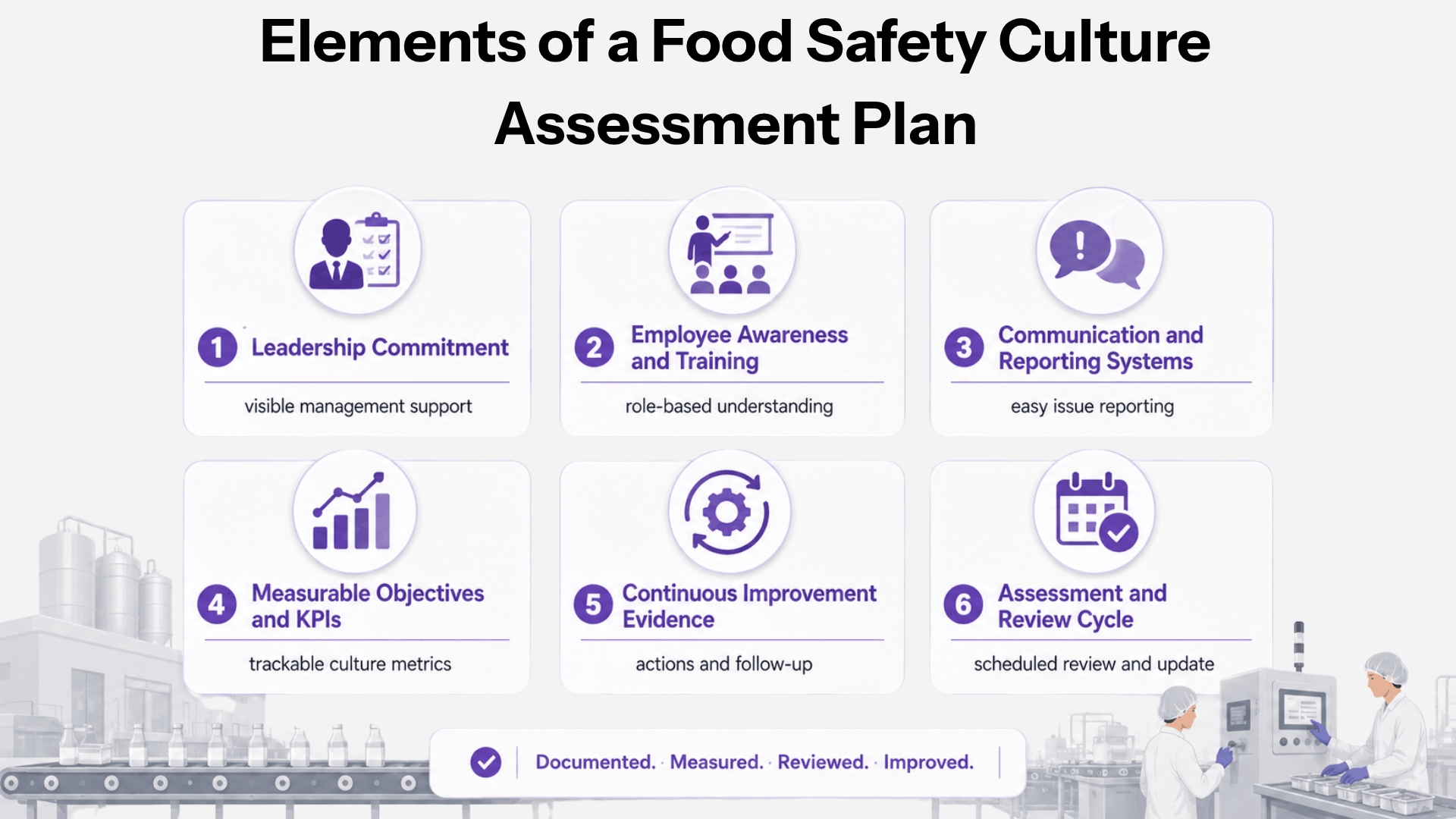
#3 Communication and Reporting Systems
Employees must have a clear and accessible way to raise food safety concerns. Just as important, the system must be used without fear of blame or punishment.
What an auditor looks for:
- A defined reporting pathway for concerns and near-misses
- Records showing concerns have been raised and have received a response
- No pattern of concerns going unaddressed or unlogged
- No evidence that employees have been discouraged from reporting
A small manufacturer does not need an anonymous hotline or complex whistleblower system. It needs a documented process that answers three questions: who employees report to, how the concern is logged, and what happens next.
A near-miss log kept in the production area and reviewed weekly can be enough to show that the reporting system is real.
#4 Measurable Objectives and KPIs
The food safety culture plan must include specific and trackable objectives. General aspirations are not enough.
“We aim to improve food safety culture” is not measurable.
“We will reduce incomplete CCP log entries to zero within 90 days, reviewed monthly” is measurable.
Examples of food safety culture KPIs that work for small food manufacturers include:
- Near-misses reported per month
- Percentage of CCP records completed correctly and on time
- Number of open CAPAs older than 30 days
- Completion rate for food safety training across active staff
- Management floor walks completed versus scheduled
The objective should connect to real operational data. It should have a baseline, target, review frequency, and a responsible person.
Without measurable objectives, there is no evidence of improvement. There is only intent.
#5 Continuous Improvement Evidence
The culture plan must show that the site identifies weaknesses, takes action, and demonstrates change.
What an auditor looks for:
- KPI trend data across two or more review periods
- Corrective actions taken in response to culture findings
- Updates to the culture plan based on review results
- Management review minutes that include cultural performance
For a small manufacturer, this means the culture plan should be reviewed at least annually, with findings and actions documented. A signature alone is not enough. The record should show what was found, what changed, and what still needs attention.
IONI’s Food Safety Compliance Readiness Report explains why many manufacturers struggle, not because they lack policies, but because daily records, corrective actions, and management review evidence are disconnected.
#6 Assessment and Review Cycle
Food safety culture must be formally assessed on a defined schedule using a documented method. The results should feed into the next improvement cycle.
The assessment method does not need to be complex. Practical options for small facilities include:
- Short staff interviews conducted by the QA manager or an independent internal auditor
- A structured observation checklist completed during a floor walk
- A simple employee survey is completed annually or semi-annually
- Review of near-miss reports, CCP records, and CAPA data as culture indicators
Whatever method is chosen, it must be scheduled, documented, and connected to the objectives in the plan.
Running one full assessment cycle, documenting the findings, and showing what was done about them is much stronger than creating a polished plan right before the audit.
What to Document: A Practical Minimum for Small Manufacturers
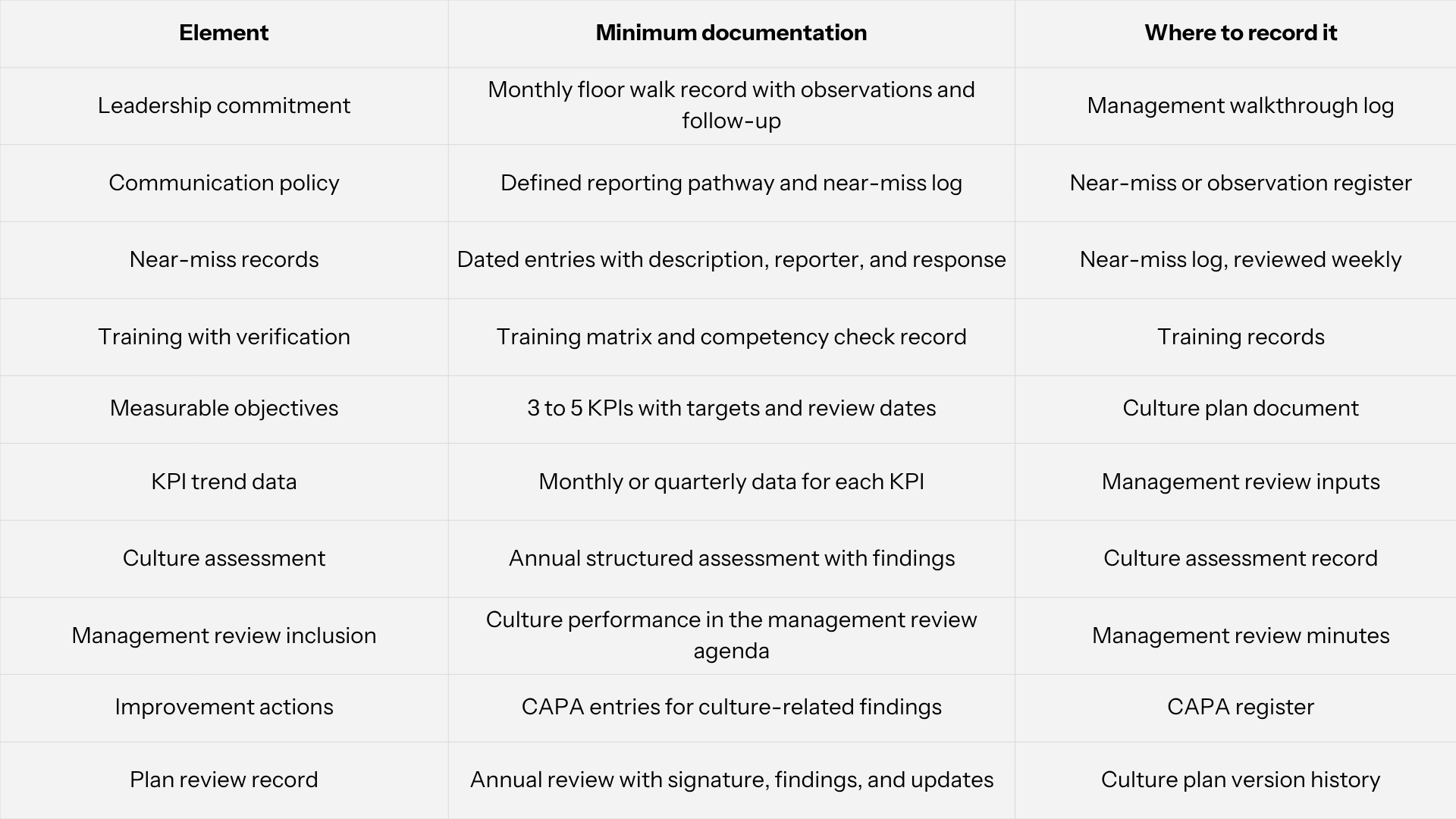
This is what a Food Safety Culture Assessment Plan needs to contain for a manufacturer with 10 to 100 employees and one QA person. Every item is something an SQF auditor can ask to see.
For teams that want to build this evidence from daily operations instead of preparing it manually before each audit, IONI Food Safety Software connects monitoring records, CAPAs, training checks, supplier documents, and management review inputs in one audit-ready system.
The minimum viable culture plan for a small manufacturer usually fits in three to five pages. It defines the objectives, lists the activities and responsible people, sets the KPIs and review schedule, and references the records that serve as evidence.
What makes the plan audit-ready is not its length. It is whether the records it references actually exist and show consistent implementation over time.
One practical note: the evidence base for food safety culture is generated by daily operational activity. Monitoring task completion, corrective action patterns, near-miss reports, training verification, supplier issues, and management review inputs all show whether the food safety system is working in practice.
Manufacturers that already manage these records in a connected system have a significant head start. Culture evidence builds from normal work instead of becoming a separate documentation effort before each audit.
IONI’s food safety software helps teams connect monitoring, CAPA, training, supplier records, and audit evidence in one place, so culture evidence is easier to maintain throughout the year.
See how IONI supports continuous food safety readiness. No credit card required. 30-minute setup with your real documents.
Food Safety Culture vs. Food Safety System: What’s the Difference for an SQF Auditor
A food safety system is the documented set of procedures, records, and controls that define how food safety is managed.
Food safety culture is the environment that determines whether people actually follow that system, especially under pressure.
Both are required. They are assessed differently.
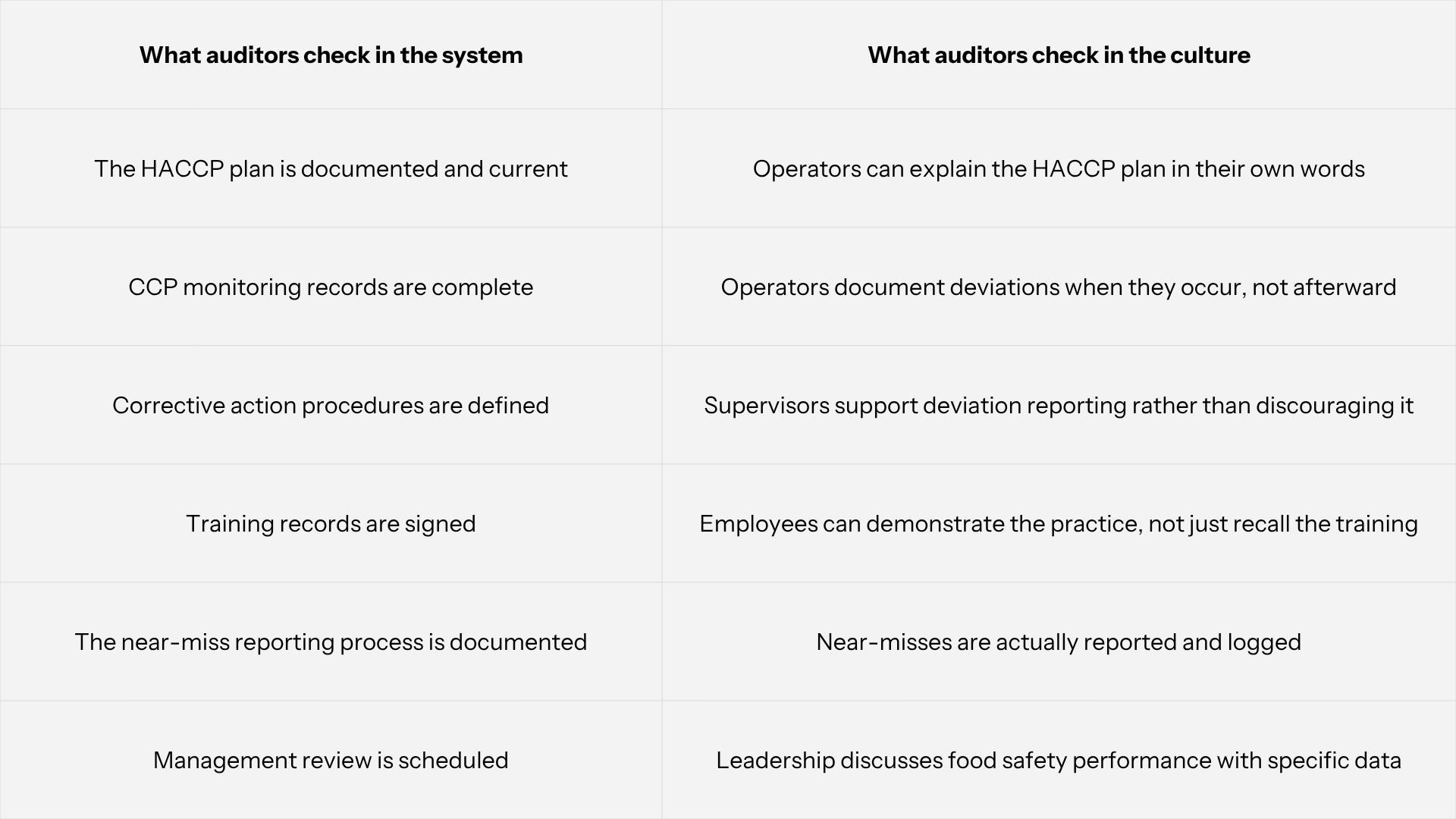
A facility can pass many system checks and still receive a culture finding if floor behavior does not match the documentation.
The reverse can also happen. Visible leadership engagement, consistent operator behavior, and an active near-miss log can demonstrate a strong culture even if some documentation still needs refinement.
Building the system and culture together is more efficient than building them separately. Documentation that reflects how work actually happens is easier to maintain and easier to defend during an audit.
The Codex General Principles of Food Hygiene are useful here because they connect food safety to what actually happens on the floor: hygiene practices, HACCP controls, monitoring, verification, corrective actions, and management responsibility. For manufacturers preparing for SQF, food safety culture should not sit in a separate HR file or annual training deck.
It should show up in daily operations: operators checking limits correctly, supervisors reacting to deviations in real time, sanitation teams following verified procedures, QA reviewing records before issues become trends, and management removing production pressure when food safety is at risk. In practice, culture strengthens the HACCP system by making sure people understand the hazards, follow controls consistently, document monitoring honestly, escalate problems early, and close corrective actions with evidence.
Common Mistakes Small Manufacturers Make with Food Safety Culture Programs
Treating a survey as the culture plan.
An annual employee survey can be useful input for a culture assessment. It is not the assessment itself, and it is not enough to prove a functioning food safety culture program. Surveys identify gaps. Auditors look for evidence that the site acted on those gaps.
Counting training records as cultural evidence.
A signed training form proves that an employee attended training. It does not prove they understood, retained, or applied the content. Culture evidence requires some form of competency verification, such as a brief check, practical observation, or documented discussion about a real situation the employee handled.
Writing a plan that only management has seen.
If the culture plan lives in the QA manager’s folder and no one else knows about it, it is not functioning as a culture program. Floor staff should know what reporting channels exist, what the food safety objectives are, and how their daily work connects to the food safety system.
Using vague objectives.
“Improve food safety culture” has no baseline, no target, and no way to measure progress. Every KPI in the culture plan should have a current baseline, target, measurement method, and review date.
Treating culture as an annual exercise.
A culture plan reviewed once a year, immediately before a certification audit, does not demonstrate continuous improvement. The activities in the plan, including floor walks, near-miss reviews, training checks, and management review inputs, need to happen on the schedule the plan defines.
Keeping culture separate from operations.
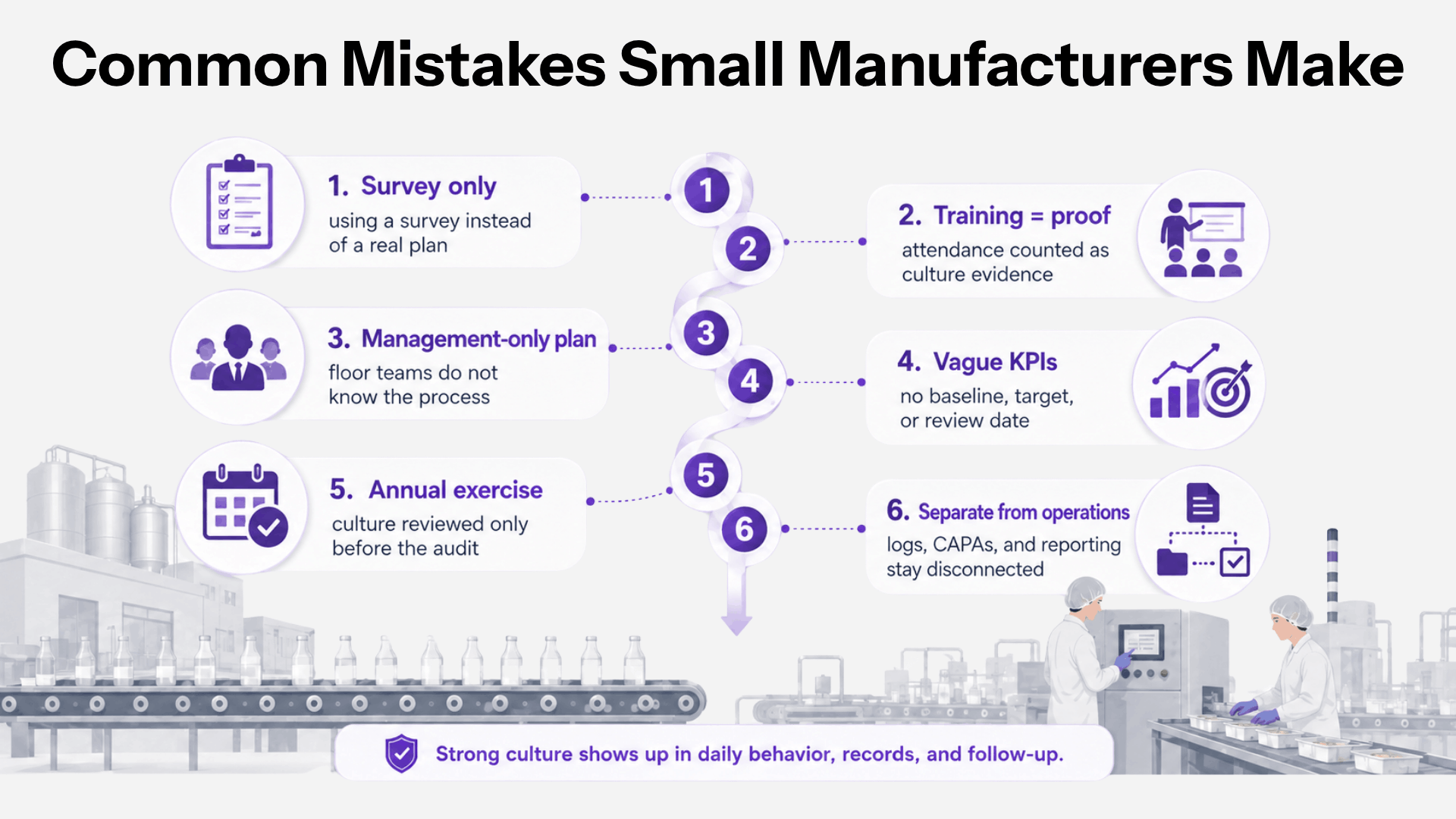
Culture findings and CAPA entries, training verifications and production records, near-miss reports, and corrective actions should not live in disconnected folders. A culture program that is separated from daily operational records is harder to maintain and harder to defend during an audit.
This is especially important for manufacturers managing supplier documents, COAs, ingredients, allergens, and customer requirements at the same time. IONI’s guide to SQF supplier approval program minimum requirements explains how supplier evidence connects to broader SQF readiness, while ingredients intelligence for food companies shows how ingredient and supplier risks can be organized more consistently.
How Food Safety Culture Connects to FSMA, Traceability, and Audit Readiness
Food safety culture is an SQF requirement, but the operational logic goes beyond SQF.
A weak reporting culture affects traceability, corrective actions, supplier approval, allergen controls, environmental monitoring, and recall readiness. If employees do not raise concerns early, the system loses the information it needs to prevent repeat issues.
The FDA’s New Era of Smarter Food Safety emphasizes a more digital, traceable, and prevention-focused food safety system. That direction matters for manufacturers because audit readiness is increasingly tied to how quickly a site can produce accurate records and explain what happened.
FSMA 204 makes this even more practical. If traceability events, batch records, supplier data, and corrective actions are fragmented, the site may struggle to respond quickly when records are needed. IONI’s article on FSMA 204 for food manufacturers explains what manufacturers need to prepare.
Culture supports this work because people create the records. If employees understand why accurate logs, timely corrections, and issue reporting matter, the traceability system becomes more reliable.
For teams preparing for SQF, BRCGS, FSMA, or customer audits, IONI’s FSMA, BRC, and SQF compliance page explains how regulatory and certification requirements can be connected to internal documents, tasks, and evidence.
For manufacturers with ERP, inventory, supplier, or production systems already in place, custom integrations can help connect operational data with compliance workflows instead of forcing QA teams to copy the same information across spreadsheets.
FAQ
What is a food safety culture assessment plan under SQF Edition 10?
A food safety culture assessment plan is a required document under SQF Edition 10 that defines how a site assesses, documents, and improves food safety culture.
It should include measurable objectives, assessment activities, KPIs with targets, responsible persons, a review schedule, assessment results, and improvement actions.
Unlike a general culture policy, it must demonstrate how culture is measured and improved over time, not just that leadership supports food safety in principle.
How does an SQF auditor evaluate food safety culture?
SQF auditors evaluate food safety culture through records, interviews, and observations.
They review the written culture plan and supporting documentation, interview staff at multiple levels, and observe behavior during the production walk.
Common interview questions ask what employees do when they notice a food safety problem, whether they feel safe raising concerns, and what happens when a CCP limit is exceeded during their shift.
Answers that do not match documented procedures indicate a culture gap, even when the written system is complete.
What evidence counts as proof of food safety culture for SQF?
Evidence can include management floor walk records, near-miss and observation logs, training records with competency verification, KPI trend data, CAPA entries for culture-related findings, management review minutes, and documentation showing the culture plan was reviewed and updated.
The strongest evidence is created during normal operations. Records built only shortly before an audit are weaker because they do not show a consistent pattern.
Is a food safety culture assessment plan required for SQF Edition 9?
No. SQF Edition 9 includes management commitment and food safety culture expectations, but it does not require a formal Food Safety Culture Assessment Plan as a defined system element.
SQF Edition 10 introduces the formal plan requirement. Edition 10 audits are expected to begin on January 2, 2027, contingent on GFSI benchmarking completion. Sites audited before the mandatory implementation date are assessed against Edition 9.
How do small manufacturers with one QA person document food safety culture?
The practical minimum includes a three-to-five-page culture plan, 3 to 5 measurable KPIs, a monthly management walkthrough log, a near-miss register, training records with competency checks, and culture performance in management review.
The key is consistency. Records should be created when activities happen, not reconstructed before an audit.
One QA person can maintain this if the activities are built into the operational routine rather than treated as a separate compliance project.
What is the difference between food safety culture and a food safety management system?
A food safety management system is the set of documented procedures, records, and controls. This includes the HACCP plan, SOPs, monitoring logs, CAPA process, supplier approval, traceability records, and management review.
Food safety culture is the organizational environment that determines whether people actually follow that system under real conditions.
A strong system with weak culture produces incomplete records, underreported deviations, and floor practices that differ from written procedures. A strong culture alongside a functional system produces consistent records, active reporting, and operator behavior that matches documentation.
Can software help document food safety culture under SQF Edition 10?
Yes, but with an important clarification.
Software does not replace the food safety culture plan. The plan still needs to be written, owned, reviewed, and improved by the food safety team.
Where software helps is evidence. Near-miss reports, monitoring task completion, corrective action patterns, training verification records, supplier issues, and management review data are generated through daily work. A connected system makes it easier to show culture as a continuous reality instead of a documentation exercise.
Start Building Culture Evidence Before the Audit Date
Culture evidence takes time to build.
A near-miss log with three entries does not demonstrate an active reporting system. A training matrix with completion dates only from the past two months does not show consistent practice. Management walkthrough records from a single month do not establish a pattern.
The manufacturers that will find SQF Edition 10 manageable are the ones building the evidence base in 2026. They will have time to create consistent records, run one full assessment cycle, identify gaps, and improve the system before audit pressure arrives.
If your audit is before the mandatory Edition 10 implementation date, you are still working under Edition 9. Use the transition period to build cultural evidence that reflects how your operation actually runs.
The GFSI food safety culture position paper describes food safety culture as something that has to be embedded and maintained across the organization. That is the practical takeaway for small manufacturers, too. Culture cannot be created in one document. It has to be visible in records, decisions, training, reporting, and daily behavior.
To start building SQF Edition 10 evidence before audit pressure hits, use IONI Food Safety Software to turn existing food safety records into a practical, evidence-based culture that your QA team can maintain throughout the year.