.png)
An SQF internal audit checklist helps food manufacturers verify whether their food safety system is ready before the certification auditor arrives. For small food manufacturers, the checklist should cover Module 2 system elements, your applicable GMP module, HACCP records, supplier approval, COA verification, traceability, CAPA, training, and management review.
If your site is naming or backing up its SQF practitioner, see our guide to what an SQF practitioner is and what the role requires.
But in 2026, there is one important detail that many SQF checklist articles do not explain clearly enough. SQF Edition 10 has already been published, but SQFI states in its Edition 10 FAQ that audits to Edition 10 are anticipated to begin on January 2, 2027, and will not begin earlier. SQFI also notes that the date depends on the progress of the GFSI benchmarking application and may be moved later.
This guide is built around that reality. It provides small food manufacturers with a practical SQF audit checklist for 2026 and shows where preparation for Edition 10 should begin.
Why this SQF Checklist is Different from a Generic Template
Most SQF checklists only tell you which requirements to review. A stronger internal audit tests whether the system will hold up when the auditor asks for evidence.
Instead of asking, “Do you have a supplier approval program?” ask whether every active supplier is approved, risk-assessed, supported by current records, and reviewed on schedule.
Instead of asking, “Are COAs collected?” ask whether results were checked against specifications and can be retrieved for the exact lot selected.
Instead of asking, “Has the HACCP plan been reviewed?” ask whether it reflects current products, ingredients, equipment, packaging, suppliers, and processes.
SQF findings usually come from weak implementation, incomplete records, expired documents, or procedures that no longer match the floor.
SQF Edition 9 vs Edition 10: What Small Manufacturers Need to Know in 2026
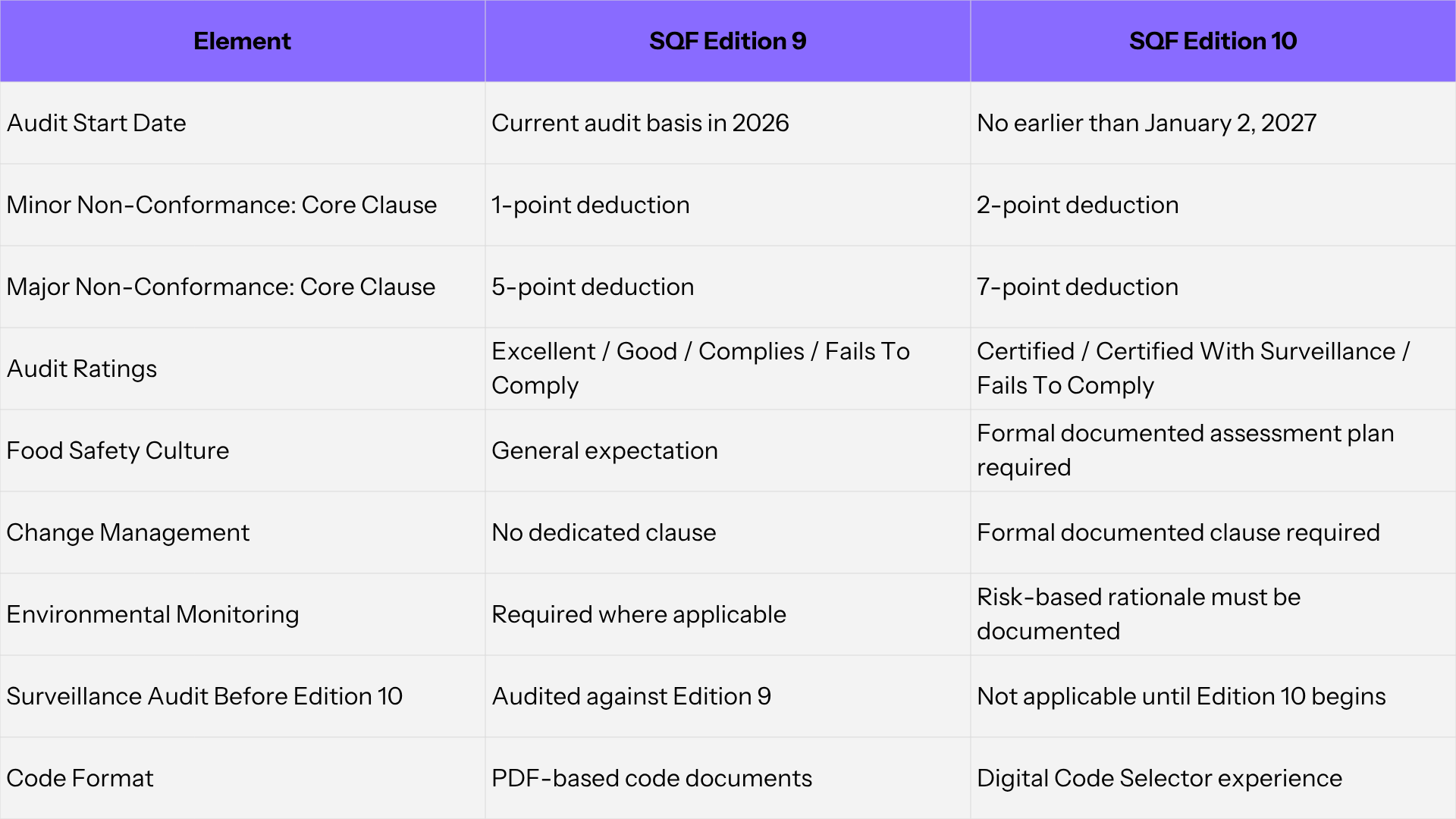
The most important rule is simple: if your SQF certification audit happens before the Edition 10 implementation date, prepare against Edition 9.
SQFI confirms that Edition 10 audits are anticipated to begin on January 2, 2027, but that date depends on GFSI benchmarking progress and will not be earlier than January 2, 2027. SQFI also states that Edition 10 was published in March 2026 and is currently going through the GFSI benchmarking process.
For small manufacturers, this creates a practical transition period.
Your 2026 internal audit should still verify your current SQF system against Edition 9 requirements. At the same time, your team should use the transition period to prepare for Edition 10 changes that may affect your documentation, scoring risk, management review, environmental monitoring, and change management process.
The right approach is not “Edition 9 or Edition 10.”
The right approach is:
- Use Edition 9 for current audit readiness.
- Use Edition 10 for transition planning.
- Keep both workstreams visible in your internal audit process.
Let's take a closer look at comparison table:
Key Edition 10 Changes to Prepare for Now
SQFI describes Edition 10 as a code update designed to strengthen audit credibility, reinforce food safety culture, and provide clearer risk signals. For small manufacturers, the most practical changes to begin preparing for are the following.
Food Safety Culture Assessment Plan
Edition 10 strengthens the expectation that food safety culture is not just discussed informally. Sites should be able to show how leadership communicates food safety expectations, how employees give feedback, how training supports food safety behavior, and how the site measures improvement.
Start preparing now by documenting:
- Food safety communication activities.
- Employee feedback mechanisms.
- Food safety meeting minutes.
- Near-miss or observation reporting.
- Management walkthroughs.
- Food safety objectives and KPIs.
- Culture-related training records.
This does not need to be overcomplicated. For a small manufacturer, the key is to show that food safety culture is planned, measured, reviewed, and improved over time.
Weighted Core Clauses And New Audit Ratings
Edition 10 changes both scoring and final audit ratings.
Edition 9 uses:
- 96–100: Excellent
- 86–95: Good
- 70–85: Complies
- 0–69: Fails To Comply
Edition 10 replaces these with:
- 80–100: Certified
- 70–79: Certified With Surveillance
- 0–69: Fails To Comply
It also increases deductions for Core Clause findings:
- Core Clause minor: 2 points
- Core Clause major: 7 points
This means familiar labels such as “Excellent” and “Good” disappear, and scores below 80 trigger additional surveillance.
For small manufacturers, the practical step is to identify applicable Core Clauses and review them more rigorously during internal audits, especially management commitment, HACCP, CCP monitoring, GMPs, CAPA, verification, and internal audit.
Change Management
Edition 10 places more direct emphasis on managing changes before they go live.
Small manufacturers often make operational changes quickly: a new ingredient, new supplier, new co-packer, new line layout, new label, new product format, new packaging material, new sanitation chemical, or new piece of equipment.
Each of these changes can affect HACCP, allergens, supplier approval, traceability, sanitation, labeling, environmental monitoring, or training.
Start documenting a simple change management trigger now:
- What changed?
- Who approved it?
- Was a food safety risk assessment required?
- Was HACCP reviewed?
- Were specifications updated?
- Were affected employees trained?
- Were monitoring or verification records updated?
This one discipline can prevent many SQF findings.
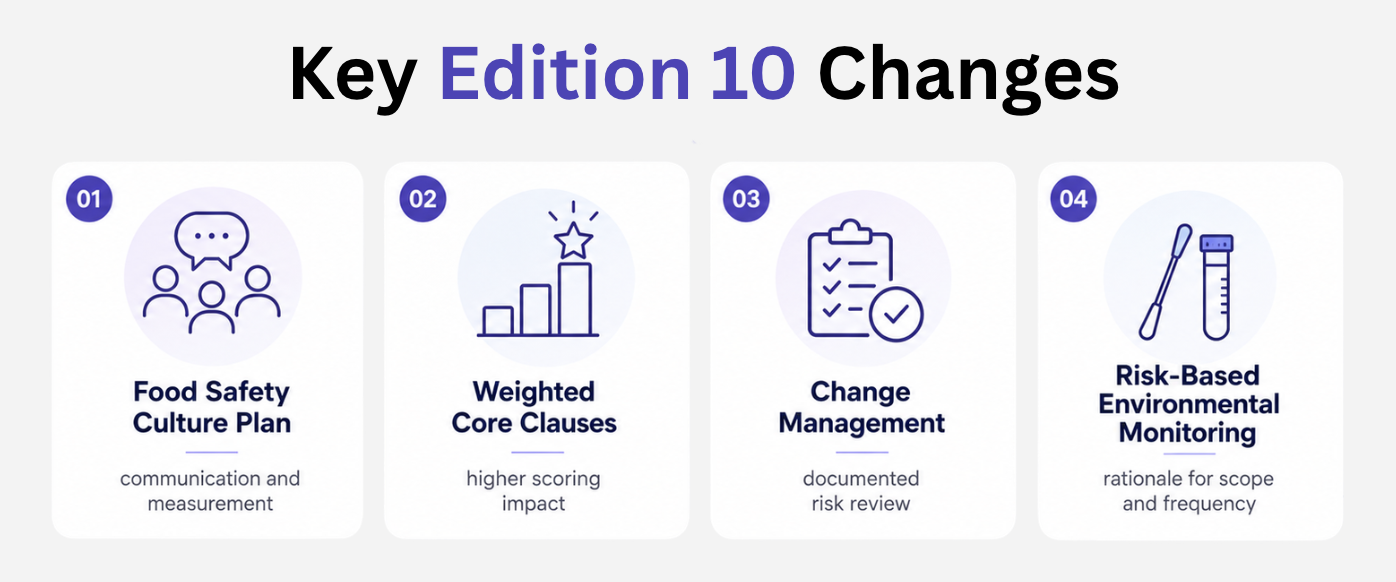
Risk-based Environmental Monitoring
Edition 10 strengthens the need for a documented rationale behind environmental monitoring. Small sites should be ready to explain why they swab certain zones, organisms, rooms, drains, equipment, lines, and frequencies.
If you already have an environmental monitoring program, do not only keep swab results. Document why the program is designed the way it is.
A strong rationale may include:
- Product risk.
- Ready-to-eat exposure.
- Post-lethality handling.
- Traffic flow.
- Drain locations.
- History of results.
- Equipment design.
- Hygienic zoning.
- Past positives or trends.
- Customer or regulatory expectations.
What SQF Auditors Actually Look For
SQF auditors are not only checking whether you have procedures. They are checking whether your procedures, records, and floor practices prove that the system is controlled.
For small facilities, the main problem is usually not that the food safety program is missing. The problem is that the program exists, but the evidence does not hold up.
The most common issues are:
Records Do Not Match the Procedure
Your document control procedure says SOPs are reviewed annually, but the review date is missing. Your sanitation procedure says pre-op checks happen before production, but the form is incomplete. Your supplier program says certificates are reviewed before expiry, but the supplier file has expired documents.
The procedure may be correct, but the record does not prove implementation. For more on what FDA's own recordkeeping requirements expect from your documentation, see our guide to food safety documentation and recordkeeping.
CCP Monitoring Logs Have Gaps
A missing temperature check, an unsigned log, a skipped verification record, or an unclear corrective action can become a serious audit issue. Auditors review CCP records chronologically and look for patterns.
One missing record may be explainable. Repeated gaps suggest the system is not controlled.
Supplier COAs are Collected but Not Verified
Having a COA is not enough. The auditor may ask whether the values on the COA were compared against your ingredient specification. If the comparison is not documented, the record is weak.
This is one of the easiest areas for small manufacturers to underestimate because the COA often looks like sufficient evidence. In SQF audit practice, the stronger evidence is the reviewed COA connected to the approved specification and lot.
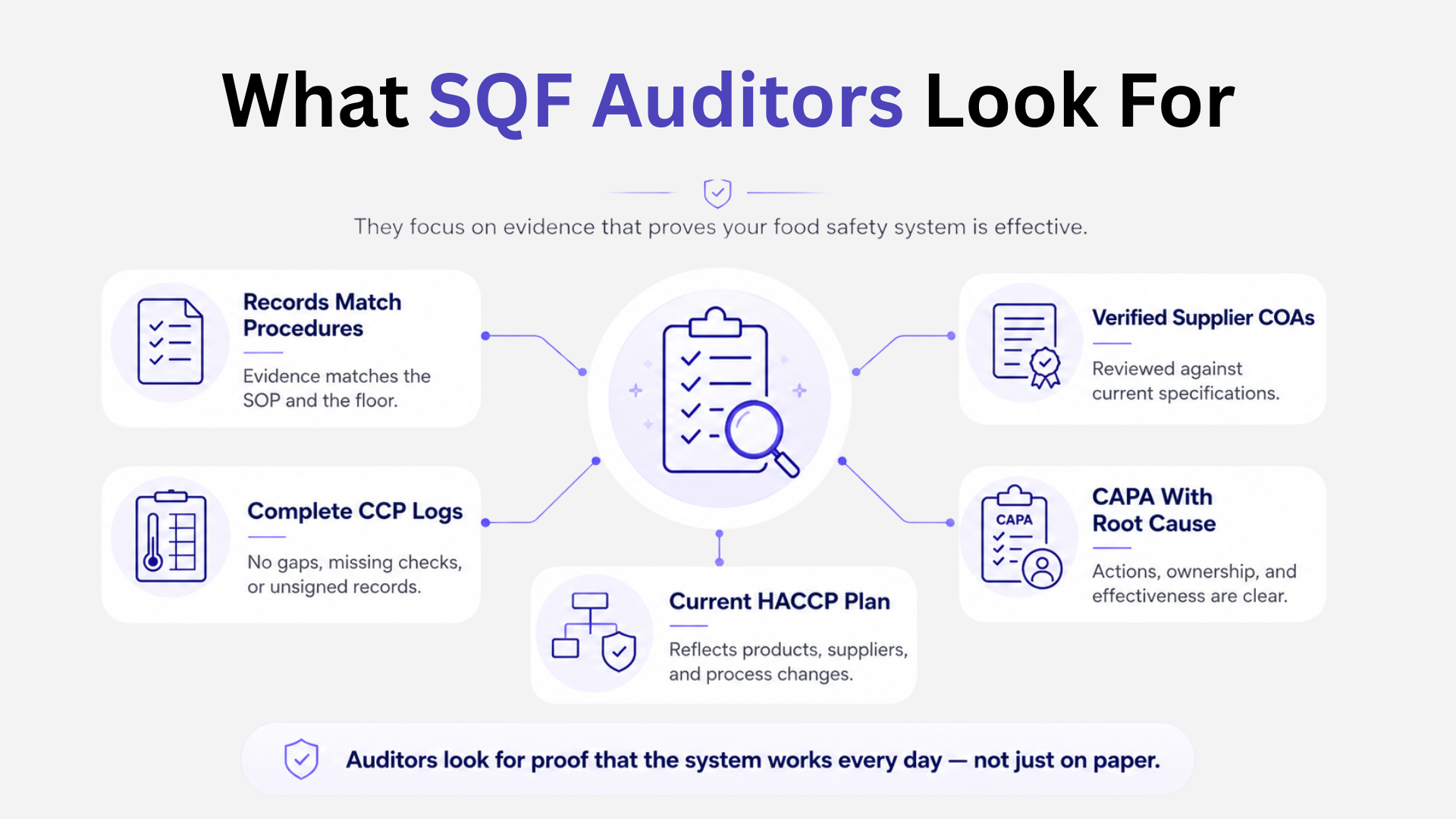
CAPA Records Stop Too Early
A corrective action that says “retrained employee” is rarely enough. SQF auditors expect to see the non-conformance, correction, root cause, corrective action, responsible owner, deadline, and verification of effectiveness.
Training may be part of the fix, but it is rarely the full root cause.
HACCP Does Not Reflect Current Operations
A HACCP plan that was accurate three years ago may no longer be accurate today. New products, ingredients, suppliers, packaging formats, equipment, or process changes should trigger review.
If the HACCP plan does not match the current floor, the auditor will challenge it.
Why SQF Audits Fail at Small Food Manufacturers
Small manufacturers usually do not fail SQF audits because they do not care about food safety. They fail because the food safety system depends too heavily on memory, manual record chasing, and one or two key people.
In a small facility, the QA manager may also handle production support, supplier documents, customer requests, training, internal audits, and CAPA. That creates system pressure.
Audit failure risk increases when:
- Supplier files live in email inboxes.
- CCP records are stored on clipboards.
- CAPA is tracked in a spreadsheet that is not reviewed weekly.
- Training records are updated only before audits.
- HACCP changes depend on someone remembering to tell QA.
- Management review is treated as a once-a-year formality.
- Operators use printed SOPs that may not be current.
- COA review happens informally without a documented comparison.
The issue is not only compliance. It is control.
An SQF audit is designed to test whether the facility can prove consistent control over food safety processes. If records are scattered, outdated, incomplete, or hard to retrieve, the facility looks less controlled than it may actually be.
This problem extends beyond SQF certification. IONI’s Food Safety Compliance Readiness Report 2026 shows how disconnected HACCP plans, supplier files, monitoring records, CAPAs, and traceability data create a broader gap between documented compliance and operational control. The report also explains why manufacturers need to move from annual audit preparation to continuous readiness.
What Happens During an Unannounced SQF Audit, and How Continuous Readiness Protects You
Unannounced audits change the risk profile for small manufacturers.
In a scheduled audit, the team has time to chase missing signatures, organize supplier folders, review open CAPAs, update training records, and clean up obvious documentation gaps. In an unannounced audit, the auditor sees the system much closer to how it operates on a normal production day.
SQFI’s Select Site Program references the unannounced recertification audit protocol and the option for sites to voluntarily elect annual unannounced recertification audits. For manufacturers, the practical message is clear: audit readiness cannot depend only on a calendar reminder.
During an unannounced audit, the auditor may review:
- Facility condition.
- Personnel hygiene.
- Production records.
- CCP monitoring.
- Pre-op records.
- Sanitation verification.
- Allergen controls.
- Supplier approval records.
- COA verification.
- CAPA status.
- Training records.
- Traceability records.
- Management review evidence.
Continuous readiness protects the facility because evidence is created as work happens. CCP logs are completed at the time of monitoring. Supplier documents are reviewed before use. COAs are checked at receiving. CAPAs are assigned and verified before they become stale. Training records update when employees join or change roles.
For small manufacturers, this is the difference between passing an audit because the team prepared intensely and failing. After all, the system is always ready.
If SQF readiness still depends on binders, spreadsheets, and last-minute document chasing, see how IONI helps manufacturers manage audit evidence continuously.
SQF Internal Audit Checklist: Module 2 System Elements
Use this checklist to confirm that each SQF system element is documented, implemented, and supported by evidence.
For every area, ask: Does the evidence exist, and does it match the procedure?
2.1 Management Commitment And Food Safety Policy
Check that:
- The food safety policy is signed, dated, current, and accessible.
- Food safety objectives are measurable and reviewed.
- Management review minutes are complete and signed.
- Reviews cover audits, complaints, CAPA, suppliers, objectives, system changes, and resources.
- Senior management involvement and food safety culture activities are documented.
Common Finding: Management review does not cover performance trends or corrective actions.
How To Close The Gap: Use a structured agenda and attach evidence for every required topic.
2.2 Document And Data Control
Check that:
- Controlled documents have current versions, approval dates, and owners.
- Obsolete documents are removed from production areas.
- Printed SOPs match approved versions.
- A master document list and revision history are maintained.
- External standards, regulations, and customer requirements are controlled.
Common Finding: Operators use outdated printed procedures.
How To Close The Gap: Compare floor copies against the document register and remove obsolete versions.
2.3 Specifications And Product Development
Check that:
- Ingredient, product, and packaging specifications are current and approved.
- Customer and regulatory requirements are included.
- Specifications are reviewed on schedule.
- Product or formulation changes trigger allergen, labeling, supplier, process, and HACCP review.
Common Finding: Specifications exist, but scheduled reviews are overdue.
How To Close The Gap: Create a formal specification review schedule linked to product change management.
2.4 Supplier Approval And Performance Monitoring
Check that:
- The approved supplier list is current and matches purchasing activity.
- All material, packaging, co-packer, storage, and service suppliers are included.
- Supplier approval records and risk ratings are complete.
- COAs and certificates are current and tracked for expiry.
- Supplier performance and issues are reviewed regularly.
- Emergency approvals are documented.
Common Finding: Current purchases include suppliers missing from the approved supplier list.
How To Close The Gap: Compare recent receiving records against the approved supplier list.
2.5 Corrective And Preventive Action
Check that:
- The CAPA process covers correction, root cause, corrective action, ownership, deadlines, and effectiveness.
- Findings from audits, complaints, suppliers, deviations, and environmental results enter CAPA.
- Actions are assigned and tracked.
- Closed CAPAs include effectiveness evidence.
- Trends are reviewed by management.
Common Finding: “Employee retrained” is recorded without root cause or effectiveness evidence.
How To Close The Gap: Make root cause analysis and effectiveness verification mandatory CAPA fields.
2.6 Internal Audit
Check that:
- The audit program covers the full SQF system.
- Audit frequency and auditor competency are documented.
- Auditors are independent of the areas reviewed.
- Findings have owners, deadlines, root causes, actions, and closure evidence.
- Results are reported to management.
- Open findings have interim controls.
Common Finding: Audit findings are recorded but never entered into CAPA.
How To Close The Gap: Manage every internal audit non-conformance through the CAPA process.
2.7 Product Identification, Trace, And Recall
Check that:
- Lot coding is documented and consistently applied.
- Traceability covers raw materials through finished products and customers.
- Mock recall and traceability tests are completed, timed, and reconciled.
- Gaps trigger corrective action.
- Recall that contacts, responsibilities, and notification procedures are current.
.png)
Manufacturers subject to the FDA Food Traceability Rule should also assess whether their traceability system supports FSMA 204 requirements. IONI’s guide to FSMA 204 for food manufacturers explains how to identify Food Traceability List exposure, map Critical Tracking Events, define required Key Data Elements, improve supplier data, and test record retrieval before the 2028 compliance deadline.
Common Finding: The traceability test lacks timing, reconciliation, or corrective action evidence.
How To Close The Gap: Test a lot and document timing, quantities, gaps, and follow-up actions.
2.8 Food Defense And Food Fraud
Check that:
- Food defense and vulnerability assessments are current.
- Access to sensitive areas is controlled.
- Visitors and contractors are managed.
- Food fraud risks are assessed for actual ingredients and suppliers.
- Mitigation measures are assigned, reviewed, and linked to supplier controls.
Common Finding: The food fraud assessment is generic and does not reflect actual ingredient or supplier risks.
How To Close The Gap: Prioritize high-risk ingredients and document the rationale for each risk rating.
GMP Checklist: What The Auditor Checks During The Facility Walk
The GMP module tests whether floor practices match written procedures. For food manufacturers, this is usually Module 11, but the applicable module depends on your food sector category. Confirm it through SQFI’s Code Selector or Library of Codes.
Personnel Hygiene And Practices
Check that:
- PPE and handwashing requirements are followed.
- Hygiene training is current for permanent, temporary, and seasonal staff.
- Visitors and contractors receive hygiene instructions.
- Jewelry, personal items, and illness reporting rules are enforced.
- GMP observations and corrections are documented.
Common Finding: Hygiene rules are applied inconsistently across shifts.
How To Close The Gap: Conduct short shift-level GMP inspections and document corrections.
Allergen Control
Check that:
- The allergen risk assessment is current.
- Allergens are identified, segregated, and controlled.
- Changeover procedures are documented.
- Cleaning validation or verification records are available.
- Allergen rework and labels are controlled.
- Changes trigger HACCP and label review.
Common Finding: The cleaning procedure exists, but there is no evidence that it works.
How To Close The Gap: Attach swab, ATP, visual inspection, or other verification results to the changeover record.
Pest Control
Check that:
- The pest control program and service reports are current.
- Internal checks occur between service visits.
- The bait station map matches actual locations.
- Findings trigger corrective action.
- Repeated activity is reviewed and trended.
- Doors, drains, docks, and exterior areas are inspected.
Common Finding: Repeat pest activity is recorded without documented follow-up.
How To Close The Gap: Review recent pest reports and document corrective action for recurring issues.
Equipment Calibration And Maintenance
Check that:
- Critical devices are identified and calibrated on schedule.
- Calibration records are current and traceable where required.
- Out-of-calibration events are investigated.
- Preventive maintenance records are complete.
- Temporary repairs are controlled.
- Food-contact tools and parts are suitable for use.
Common Finding: Calibration was completed, but supporting certificates are missing.
How To Close The Gap: Maintain a register of critical devices with current calibration evidence.
Sanitation
Check that:
- The master sanitation schedule covers all equipment and areas.
- Completed records match the schedule.
- Pre-operational inspections and verification activities are documented.
- Chemicals are approved, labeled, and stored correctly.
- Deviations trigger corrective action.
- Employees understand chemical concentration, contact time, and safe use.
Common Finding: Sanitation records exist, but verification is missing for high-risk areas.
How To Close The Gap: Compare the sanitation schedule against recent records and close missed tasks with documented review.
.png)
Environmental Monitoring
Check that:
- The program defines zones, organisms, sites, and frequencies.
- Results are recorded and trended.
- Out-of-spec results trigger CAPA.
- Repeated positives are investigated.
- The program is reviewed after product, process, or equipment changes.
For the full zone model and how to design a sampling plan, see our guide to building an environmental monitoring program.
Edition 10 Preparation: Document the risk-based rationale for your environmental monitoring scope and frequency before Edition 10 audits begin.
HACCP Checklist: What Must Be Current Before Audit Day
The auditor will review whether your HACCP plan accurately reflects current operations and is supported by complete monitoring and verification records.
HACCP and SQF are closely connected, but they are not interchangeable. HACCP provides the hazard analysis and preventive control foundation. At the same time, SQF evaluates the broader food safety management system around it, including implementation, verification, internal audits, supplier controls, CAPA, training, and management commitment. For a complete comparison, read HACCP vs SQF: What’s The Difference And What Do You Actually Need?.
Check that:
- The HACCP plan is current, signed, and reviewed.
- The HACCP team and responsibilities are documented.
- Product descriptions and intended use are accurate.
- The process flow diagram matches the floor and has been verified.
- Hazard analysis covers all relevant hazards.
- CCPs and critical limits are justified and validated.
- Monitoring procedures define frequency, responsibility, method, and records.
- CCP monitoring and deviation records are complete.
- Verification activities are documented.
- Changes to products, ingredients, suppliers, packaging, equipment, or processes trigger HACCP review.
Common Finding: The facility has changed, but the HACCP plan has not.
How To Close The Gap: Add a formal HACCP review trigger to the change management process.
Building or updating your HACCP plan before an SQF audit? IONI helps manufacturers manage hazards, CCP logic, monitoring tasks, corrective actions, and verification records in one place: HACCP Builder.
Supplier and COA Сhecklist: The Section Small Manufacturers Underestimate
Supplier verification is one of the most common SQF weak points for small manufacturers.
The audit does not stop at “Do you have a COA?” The next question is usually: “Did you compare the COA against your specification, and can you show me the evidence?”
Check that:
- The approved supplier list is current.
- Each supplier has approval documentation.
- Supplier risk rating is documented.
- Supplier certificates are current.
- Ingredient specifications are approved.
- COAs are collected for required lots.
- COA values are compared against specification limits.
- The comparison is documented.
- Out-of-spec or missing COAs trigger documented action.
- Supplier performance issues are tracked.
- High-risk suppliers receive additional verification.
- Supplier reviews are completed on schedule.
The auditor may choose a raw material lot from the warehouse, ask for the supplier approval record, request the COA, and then ask where the COA values were compared to the specification.
If the comparison lives in someone’s head, it is not strong audit evidence.
How To Run An SQF Internal Audit When You Are The QA Team
Small manufacturers often have one QA manager covering supplier approval, training, documentation, production support, and customer requests. A structured audit process helps the team maintain independence, cover the full scope, and close findings on time.
Confirm Auditor Independence
Internal auditors should not audit work they directly control.
For a one-person QA team, practical options include:
- Cross-training a production supervisor to audit selected QA processes.
- Having QA audit operations while another trained employee audits QA records.
- Splitting audit responsibilities by function.
- Using an external consultant for the annual internal audit.
Document the auditor’s competence, assigned scope, and independence.
Run The Audit 60-90 Days Before Certification
This window gives the team enough time to:
- Find missing evidence.
- Complete root cause analysis.
- Implement corrective actions.
- Verify effectiveness.
- Update management review.
- Close findings before the certification audit.
For facilities beginning SQF preparation, see Your Retailer Requires SQF Certification: What To Do In The First 30 Days.
Start With Records Before The Floor Walk
Review the records most likely to reveal control gaps:
- CCP and pre-op logs.
- Sanitation records.
- CAPA register.
- Supplier and COA files.
- Training matrix.
- Management review minutes.
- Previous audit findings.
- Mock recall records.
- HACCP review history.
Use the results to focus the facility walk on higher-risk processes.
.png)
Phase The Audit If Needed
The full SQF scope does not need to be audited in one day. A small team can divide it into manageable stages:
- Week 1: Module 2 records.
- Week 2: HACCP and CCP monitoring.
- Week 3: Supplier approval and COA verification.
- Week 4: GMP and sanitation walk.
- Week 5: CAPA closure and management review.
Document the scope, auditor, findings, and closure evidence for every phase.
Put Every Finding Into CAPA
Do not leave findings only in the audit report. Each non-conformance should include:
- Issue and requirement reference.
- Immediate correction.
- Root cause.
- Corrective action.
- Owner and due date.
- Effectiveness verification.
- Closure evidence.
This creates a complete audit trail showing that each issue was identified, corrected, verified, and closed.
Common SQF Audit Findings And How To Close Them Before Audit Day
Finding 1: Procedures And Records Do Not Match
This often happens when a procedure is updated but forms, training, or floor instructions are not.
How To Close The Gap:
- Review your most critical procedures.
- Compare each procedure with the current form.
- Confirm operators use the approved version.
- Verify training after the latest revision.
- Remove obsolete documents from the floor.
Finding 2: CAPA Has No Real Root Cause
“Employee error” or “retrained employee” describes the symptom, not the underlying cause.
How To Close The Gap:
- Use a simple 5-Why analysis.
- Attach the root cause record to the CAPA.
- Address the system failure, not only the individual action.
- Verify effectiveness after implementation.
- Review recurrence during management review.
Finding 3: COA Is Filed, But Specification Review Is Missing
A COA is not enough unless the relevant values are compared against approved specifications.
How To Close The Gap:
- Create a receiving verification record.
- List the critical specification limits.
- Compare and document COA results.
- Record pass, fail, or hold status.
- Escalate missing or out-of-spec results.
Link “ingredient specifications” or “COA values” to Ingredients Intelligence For Food Companies.
Finding 4: Training Records Are Out Of Date
New hires, temporary workers, and seasonal staff are common gaps.
How To Close The Gap:
- Include food safety training in onboarding.
- Maintain a current training matrix.
- Review records quarterly.
- Retrain after procedure changes.
- Require sign-off before independent work.
Finding 5: Internal Audit Is Overdue, or Findings Remain Open
An overdue audit or unresolved finding shows weak system control.
How To Close The Gap:
- Complete the audit immediately.
- Enter every finding into CAPA.
- Assign owners and deadlines.
- Close high-risk items first.
- Document interim controls for open findings.
Finding 6: HACCP Was Not Updated After A Change
New products, ingredients, suppliers, packaging, or equipment can make the HACCP plan outdated.
How To Close The Gap:
- Create a change management trigger list.
- Require QA review before changes go live.
- Document whether HACCP review was required.
- Update the hazard analysis when needed.
- Keep the review record even when no change is made.
Edition 10 Preparation: Formal change management will become more important under SQF Edition 10, so build this discipline into operations now.
How Digital Food Safety Software Changes The Internal Audit
When food safety records are spread across binders, spreadsheets, inboxes, and shared drives, the internal audit becomes a search exercise.
The team spends time asking:
- Where is the latest SOP?
- Was this supplier certificate renewed?
- Was the COA checked against the ingredient specification?
- Which CAPAs are still open?
- Was the CCP deviation verified?
- Was the pre-operational sanitation check completed?
That is not the purpose of an internal audit. The audit should test whether the food safety system works, not whether the QA team can locate evidence under pressure.
Digital food safety software changes the process by creating and organizing evidence as work happens:
- Monitoring records are timestamped.
- Missed or overdue checks are visible.
- CAPAs have owners, deadlines, and effectiveness reviews.
- Supplier documents and certificate expirations are tracked.
- COAs are connected to ingredient specifications.
- HACCP reviews can be triggered by operational changes.
- Audit findings flow into corrective actions.
- Management review uses current system data instead of manual summaries.
How IONI Supports Continuous SQF Readiness
IONI brings HACCP, supplier management, monitoring, CAPA, traceability, and audit evidence into one connected food safety system.
Teams can use IONI to:
- Build and update HACCP plans based on products, ingredients, hazards, process steps, and controls.
- Turn monitoring requirements into assigned tasks and digital records.
- Flag missing evidence, overdue checks, and incomplete verification.
- Manage supplier approvals, specifications, certificates, COAs, allergens, and document expirations.
- Compare supplier and ingredient records against internal requirements.
- Capture non-conformances and move them directly into CAPA workflows.
- Track root cause, corrective action, responsibility, due dates, and effectiveness checks.
- Connect process, supplier, ingredient, or equipment changes to HACCP and compliance review.
- Prepare audit evidence without rebuilding folders before every audit.
IONI also helps teams use the documents they already have. SOPs, HACCP plans, specifications, supplier files, and monitoring procedures can be turned into structured workflows, tasks, and audit-ready records instead of remaining isolated files.
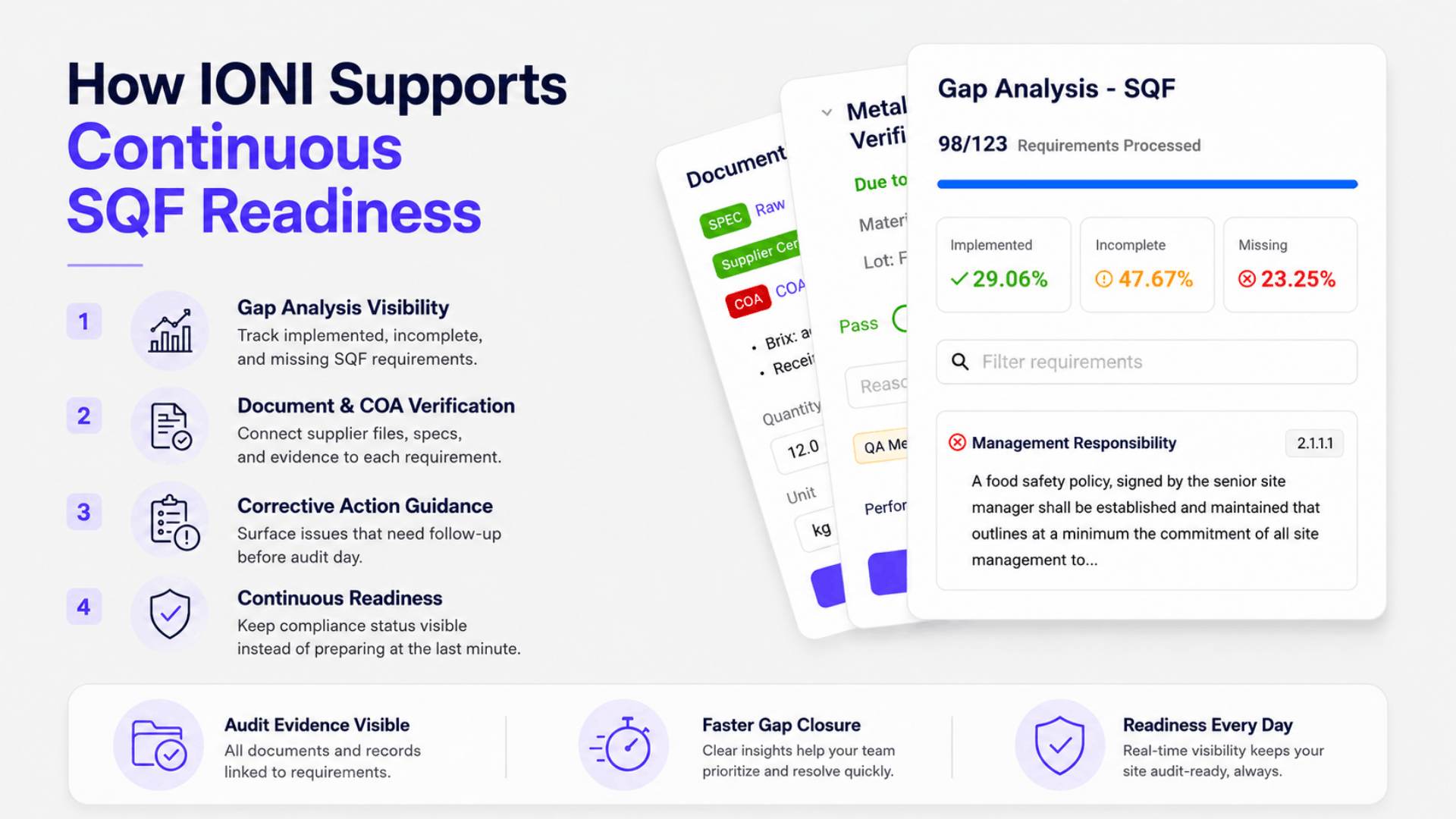
For small food manufacturers, IONI turns audit readiness into an operational advantage. Teams spend less time chasing records, reduce the risk of missed checks and expired documents, and close gaps before they become audit findings.
The practical outcomes include:
- Faster preparation for SQF, BRCGS, FSMA, and customer audits.
- Fewer missed monitoring tasks, incomplete logs, and overdue CAPAs.
- Quicker response to deviations and non-conformances.
- Better visibility into supplier approvals, COAs, specifications, and document expirations.
- More consistent execution across production, receiving, sanitation, and QA.
- Less dependence on one person to know where every record is stored.
- Stronger readiness for unannounced audits, customer requests, and management review.
- More confidence that the HACCP plan and food safety system reflect current operations.
Instead of spending the internal audit rebuilding evidence, QA can use it to improve performance, reduce repeat issues, and confirm that food safety controls are working as intended.
See how IONI helps food manufacturers manage SQF, BRCGS, FSMA, HACCP, supplier records, CAPA, and continuous audit readiness: Food Safety Software.
Final SQF Audit Readiness Checklist
Before your certification audit, confirm that these items are complete:
- Internal audit completed.
- Internal audit findings entered into CAPA.
- CAPAs closed or actively managed with documented justification.
- Management review completed and signed.
- HACCP plan reviewed and current.
- CCP records are complete.
- GMP records are complete.
- Supplier list current.
- Supplier approval records are complete.
- COAs verified against specifications.
- Training matrix updated.
- Mock recall completed.
- Traceability test timed and documented.
- Food defense assessment current.
- Food fraud assessment current.
- Calibration records current.
- Sanitation verification records available.
- Environmental monitoring results trended.
- Pest control records are complete.
- Obsolete documents removed from production areas.
- Edition 10 transition gaps identified.
FAQ
What is an SQF internal audit checklist?
An SQF internal audit checklist is a structured tool used by a food manufacturer to assess whether its food safety system meets SQF Code requirements before the certification audit. It typically covers Module 2 system elements, the applicable GMP module, HACCP, supplier approval, CAPA, training, traceability, and management review.
Which SQF edition should I use for my internal audit in 2026?
For audits before the Edition 10 implementation date, use SQF Edition 9. SQFI states that Edition 10 audits are anticipated to begin on January 2, 2027, and will not begin earlier than that date. Use 2026 to prepare against Edition 9 while also completing a transition gap assessment for Edition 10.
When was SQF Edition 10 published?
SQFI states that Edition 10 was published in March 2026. The code is currently moving through the GFSI benchmarking process, which affects the final implementation date.
How often does SQF require an internal audit?
SQF sites should conduct internal audits at defined intervals and cover the SQF system. In practice, facilities should complete at least one full internal audit cycle per year and ensure all findings are corrected, verified, and reviewed by management.
Can I conduct the SQF internal audit myself?
You should not audit work for which you are directly responsible. The internal auditor must be independent of the area being audited. For a small QA team, this may require cross-training another employee, splitting audit responsibilities, or using an external consultant.
What are the most common SQF audit findings for small manufacturers?
The most common findings include incomplete CCP logs, CAPAs without root cause analysis, supplier COAs that were filed but not verified against specifications, outdated training records, overdue internal audits, and HACCP plans that were not updated after operational changes.
What records does an SQF auditor usually check first?
Auditors often begin with core system records such as the HACCP plan, internal audit report, CAPA log, management review minutes, training records, supplier approval files, traceability test, and CCP monitoring logs. These records help determine where the auditor will focus during the facility walk.
How should small manufacturers prepare for SQF Edition 10?
Start with a gap assessment. Focus on food safety culture planning, change management, weighted Core Clauses, environmental monitoring rationale, and stronger evidence of continuous system control. Your 2026 audit should still be run against Edition 9 if your certification audit occurs before Edition 10 implementation.
Does an SQF checklist replace an SQF consultant?
No. A checklist helps structure preparation, but it does not replace technical judgment. Some small manufacturers use a checklist internally and bring in a consultant for auditor independence, complex HACCP validation, Edition 10 transition planning, or final pre-assessment.