.png)
1. Introduction: Why Food Safety Risk Still Matters
Food safety risk remains one of the most critical and unresolved challenges in food manufacturing.
Despite decades of regulatory frameworks, certification schemes, and audit programs, food recalls continue to increase in frequency, scope, and cost. This trend demonstrates a hard reality that many organizations still underestimate. Compliance does not eliminate risk. It only documents that requirements were met at a specific point in time.
Global data continues to confirm the scale of the problem. According to the World Health Organization, unsafe food causes more than 600 million cases of foodborne illness each year worldwide, resulting in approximately 420,000 deaths annually. In the United States alone, the Centers for Disease Control and Prevention estimate that 48 million people become ill every year due to foodborne disease. These figures have remained stubbornly consistent despite advancements in food safety standards and inspection regimes.
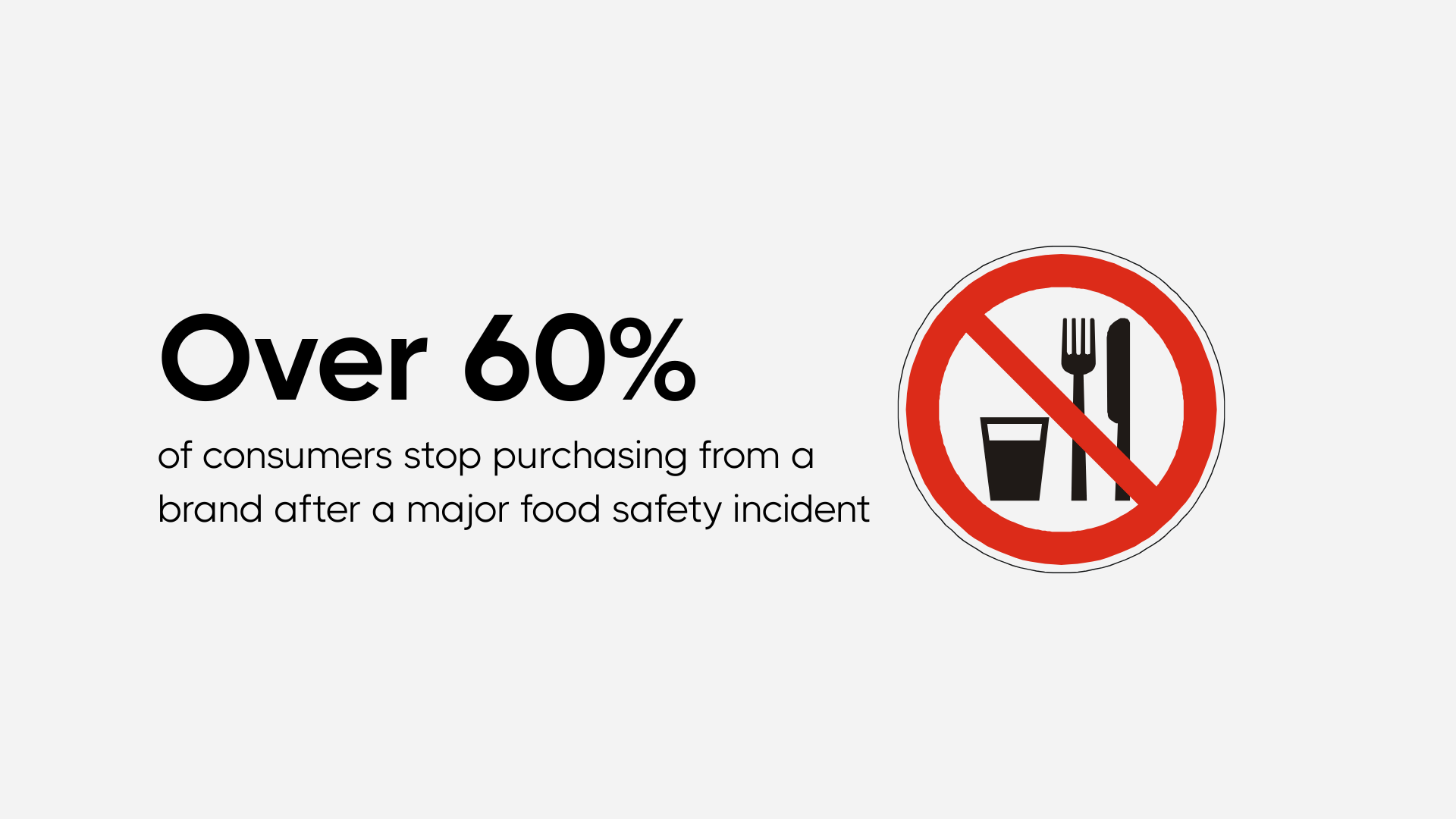
From a business perspective, the financial exposure is equally severe. Analysis referenced by the US Food and Drug Administration and summarized by Food Safety Magazine shows that the average direct cost of a food recall frequently exceeds ten million dollars, while indirect costs related to brand damage, legal action, lost contracts, and long term revenue erosion often surpass that figure. Research published in Food Dive further indicates that more than sixty p¨ercent of consumers stop purchasing from a brand after a major food safety incident, highlighting how quickly trust can be destroyed.
At the same time, regulatory expectations are intensifying. New traceability requirements under FSMA Section 204 require manufacturers to provide detailed product movement data within tight timeframes. Similar regulatory trends are emerging globally. These changes reflect a clear shift in regulatory philosophy. Authorities no longer expect companies to merely react to incidents. They expect active prevention.
In this environment, risk in food safety can no longer be managed through periodic audits and static documentation. Risk evolves continuously. It is shaped by daily operational decisions, supplier behavior, process variability, equipment condition, and human factors. A hazard that appears low risk during an annual review can become critical within weeks due to subtle changes in production or sourcing.
This reality explains why food safety risk management has become a strategic concern at executive and board level. Manufacturers are increasingly expected to demonstrate not only that they are compliant, but that they understand where risk exists in real time and how it is being controlled.
This shift from compliance toward risk intelligence is foundational to preventing recalls in modern food manufacturing.
2. The Problem With Managing Food Safety by Compliance Alone
Regulatory compliance and certification schemes play an essential role in establishing baseline food safety expectations. HACCP, SQF, BRCGS, FSMA, and similar frameworks define what controls must exist, how hazards should be evaluated, and how documentation should be maintained. However, these frameworks were never designed to function as continuous risk detection systems.
Traditional compliance programs are largely retrospective, especially for small manufacturers. Audits confirm that procedures exist and records are complete. Inspections assess whether requirements were met during a defined period. This approach creates a snapshot of performance, not a continuous view of exposure. Between audits, risk can accumulate unnoticed.
History provides clear evidence of this limitation. Some of the most severe food safety incidents have occurred in facilities that were fully certified at the time of the outbreak. Investigations into major recalls frequently reveal that documentation was present, but controls were not consistently effective.
A well documented example is the well-known Peanut Corporation of America case, where a facility received a top audit rating shortly before being identified as the source of a nationwide Salmonella outbreak. The issue was not the absence of procedures, but the failure to detect and act on risk signals that were present in daily operations. Similar patterns have been observed across meat, dairy, ready to eat foods, and ingredient manufacturing.
Compliance based systems often fail in four structural ways.
First, they emphasize documentation over effectiveness. A control can exist on paper while failing in practice. Second, they treat deviations as isolated events rather than signals of systemic risk. Third, they provide limited visibility across suppliers and extended supply chains. Fourth, they reinforce a periodic mindset where safety is assessed at fixed intervals rather than continuously.
IONI addresses this gap directly in its analysis of how food safety is evolving beyond compliance in the article How AI Transforms Food Safety and Quality Management From Compliance to True Operational Excellence, which explains why audit driven approaches struggle to capture real operational risk.
Managing food safety purely through compliance also creates behavioral risk. When passing audits becomes the primary objective, organizations may optimize for appearance rather than prevention. This can discourage early escalation of issues and delay corrective action until problems become visible externally through complaints or regulatory findings.
This is where food risk management diverges from compliance. Compliance asks whether rules were followed. Risk management asks whether controls are still working today and whether new threats are emerging.
3. What Food Safety Risk Management Software Is
Food safety risk management software is designed to address the limitations of compliance focused systems by shifting attention from documentation to decision making. Its primary purpose is to help manufacturers continuously identify, evaluate, and reduce risk across operations.
Unlike traditional compliance software, which focuses on storing records and managing audits, food safety risk management software supports ongoing food safety risk analysis. It aggregates data from across the organization and analyzes it to detect patterns that indicate rising exposure.
This includes data from HACCP monitoring, deviation logs, environmental testing, supplier documentation, audit findings, corrective actions, and traceability records. When combined, these data sources create a living risk profile rather than a static report.
A defining feature of risk management software is risk intelligence. Risk intelligence refers to the ability to convert raw operational data into actionable insight. Instead of simply reporting that a deviation occurred, the system evaluates its severity, frequency, and context. It assesses whether similar deviations are recurring, whether corrective actions are effective, and whether risk is trending upward.
Modern platforms increasingly use artificial intelligence to support this analysis. AI models can identify correlations that are difficult for humans to detect, such as subtle process drift or supplier related patterns that increase contamination likelihood. These insights enable earlier intervention, when corrective action is less costly and less disruptive.
Risk management software also supports dynamic food safety risk assessment. Rather than updating hazard analyses once per year, risk levels are recalculated continuously as new data enters the system. This aligns with how risk actually behaves in food manufacturing.
IONI explores the operational impact of this approach in its article How AI Automation Simplifies SQF, BRC, and FSMA Compliance, which illustrates how continuous monitoring strengthens both compliance and prevention.
By operationalizing risk intelligence, food safety risk management software transforms food safety from a reactive function into a preventive system. It does not replace HACCP or regulatory frameworks. It makes them executable in real time.
Ready to reduce your Food Safety Risks? Feel free to book a demo with us and see how IONI may help you.
4. How Manufacturers Understand and Evaluate Risk
Food manufacturers have long relied on structured methodologies to understand and evaluate risk, most notably HACCP. At its core, HACCP is a form of food safety risk assessment designed to identify hazards, evaluate their significance, and define controls that prevent or reduce them to acceptable levels.
In practice, risk evaluation is based on two primary dimensions. The first is severity. This considers the potential impact on consumer health if a hazard is not controlled. The second is likelihood. This reflects how probable it is that the hazard will occur under current operating conditions. Together, these dimensions define risk in food safety.
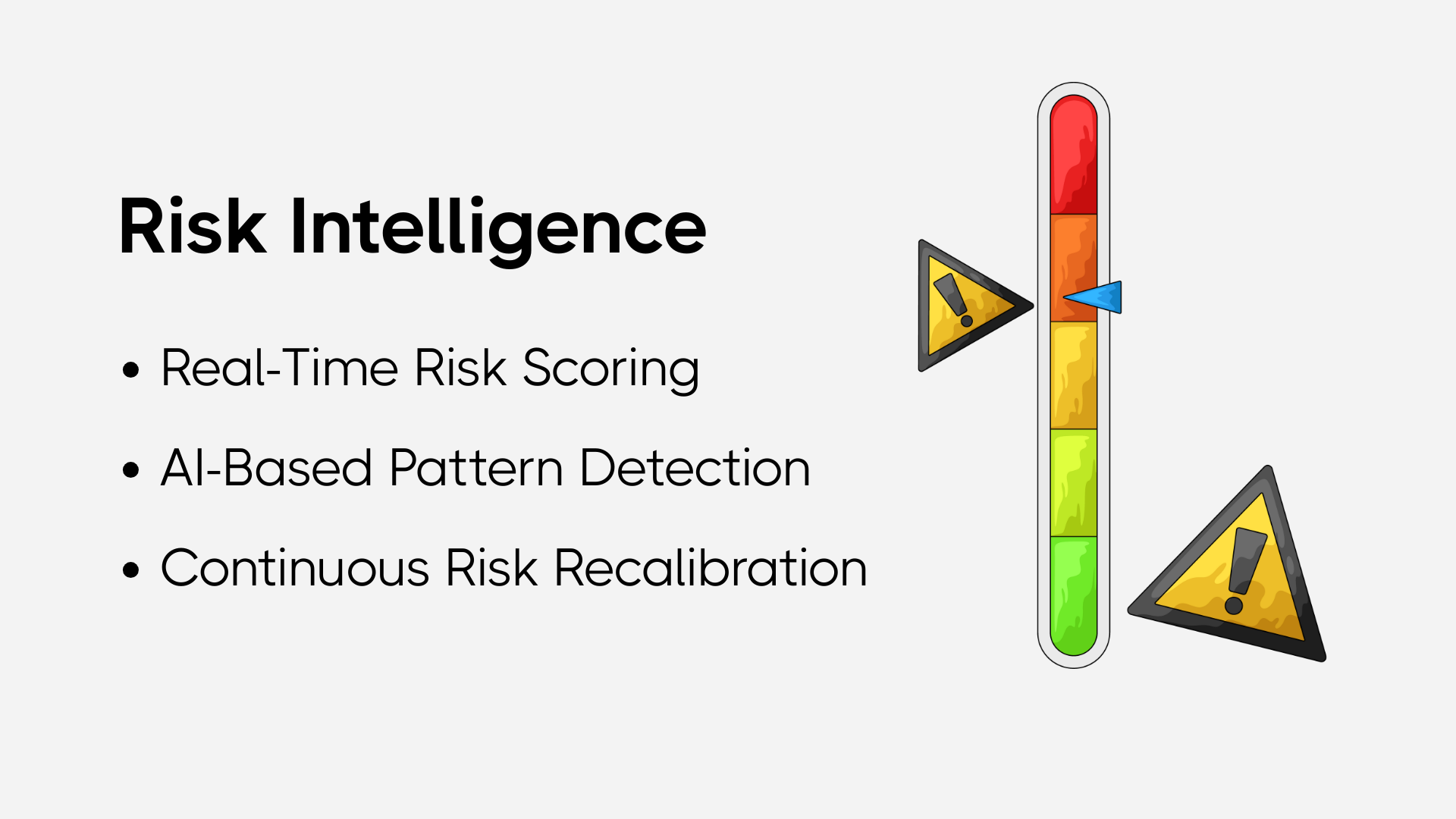
Manufacturers typically perform this evaluation during initial HACCP development and during scheduled reviews. They analyze raw materials, processing steps, equipment, packaging, and distribution. Hazards are documented and control measures assigned. This approach has significantly improved food safety outcomes globally.
However, traditional risk evaluation has important limitations.
First, it is often static. Risk levels are assigned based on assumptions that may change rapidly. Supplier substitutions, process optimization, equipment aging, and workforce turnover all alter likelihood without triggering immediate reassessment.
Second, risk evaluation is frequently qualitative. Teams rely on experience and historical data, which may not reflect emerging threats. Hazards that were once considered low risk can become high risk due to external events such as outbreaks in other regions or changes in consumer behavior.
Third, risk evaluation is often disconnected from day to day operational data. Deviations and near misses are recorded but not systematically linked back to risk scores.
This disconnect is why many manufacturers struggle with food safety risk analysis that reflects reality rather than documentation.
Modern approaches integrate risk evaluation into daily operations. Risk is recalculated continuously as new data becomes available. This includes monitoring trends in deviations, environmental results, supplier performance, and corrective action effectiveness.
IONI discusses this shift toward continuous risk evaluation in the article Food Industry 4.0 vs Food Industry 5.0. What's Changing in the Future of Food Manufacturing, which explains how real time data and AI are reshaping operational control.
By aligning risk assessment with operational reality, manufacturers gain earlier visibility into rising exposure and can intervene before hazards escalate into incidents.
5. Why Recalls Happen in Compliant Facilities
One of the most persistent questions in food safety is why recalls continue to occur in facilities that are certified and regularly audited. Investigations into major recalls consistently show that the issue is not a lack of procedures, but a failure to manage evolving risk.
Recalls typically occur for four reasons.
The first is undetected process drift. Controls that were effective at the time of validation slowly degrade. Equipment performance changes. Cleaning effectiveness declines. Operators develop workarounds. Without continuous monitoring, these changes remain invisible until a failure occurs.
The second reason is ineffective corrective actions. Deviations are identified and closed, but their root causes are not fully addressed. When similar deviations recur, they are treated as isolated events rather than indicators of systemic weakness.
The third reason is supplier related risk. Many recalls originate outside the manufacturing facility. Ingredients arrive with documentation that meets compliance requirements but still carry contamination risk. When supplier performance is not continuously evaluated, manufacturers may unknowingly introduce hazards into otherwise well controlled processes.
The fourth reason is delayed response. Even when issues are detected internally, slow escalation allows products to enter distribution. In several recent FDA communications, regulators highlighted cases where companies identified problems but failed to act quickly enough to prevent exposure.
The fifth reason is that not all recall management software works great. There are many legacy systems that make tons of mistakes leading to troubles.
The reality reinforces the distinction between compliance and food risk food safety risk management. Compliance verifies that controls exist. Risk management verifies that controls are effective right now.
IONI explores the operational cost of unmanaged risk in its article Why ROI Matters in Food Manufacturing and How IONI Is Finally Delivering It, which connects recall prevention directly to financial performance.
6. Using Risk Intelligence to Prevent Recalls
Risk intelligence is the practical application of data driven insight to anticipate and prevent failure. In food safety, risk intelligence enables manufacturers to move from reactive response to proactive control.
Risk intelligence operates on two levels.
Internally, it analyzes operational data. This includes deviations, test results, maintenance records, and process parameters. By evaluating patterns rather than isolated events, risk intelligence highlights where risk is increasing even when individual measurements remain within limits.
Externally, it incorporates industry wide data. Recalls, outbreak reports, regulatory alerts, and supplier incidents all contribute to understanding emerging threats. When these signals are correlated with internal data, manufacturers gain context that would otherwise be unavailable.
A well documented example is the increase in Salmonella recalls linked to low moisture foods such as chocolate and spices. Industry wide data showed a rise in incidents before many manufacturers adjusted their hazard analyses. Companies using external risk intelligence were able to intensify controls early, while others were caught unprepared.
Risk intelligence also supports prioritization. Not all deviations carry equal risk. By scoring issues based on severity and likelihood, manufacturers can allocate resources where they matter most. This reduces alert fatigue and ensures that critical risks receive immediate attention.
IONI addresses the role of risk intelligence in prevention in its article How AI Is Transforming Food Safety, which examines how predictive analysis enables earlier intervention.
By embedding risk intelligence into daily workflows, manufacturers reduce reliance on hindsight and strengthen their ability to prevent recalls.
7. Compliance Software vs Risk Management Software
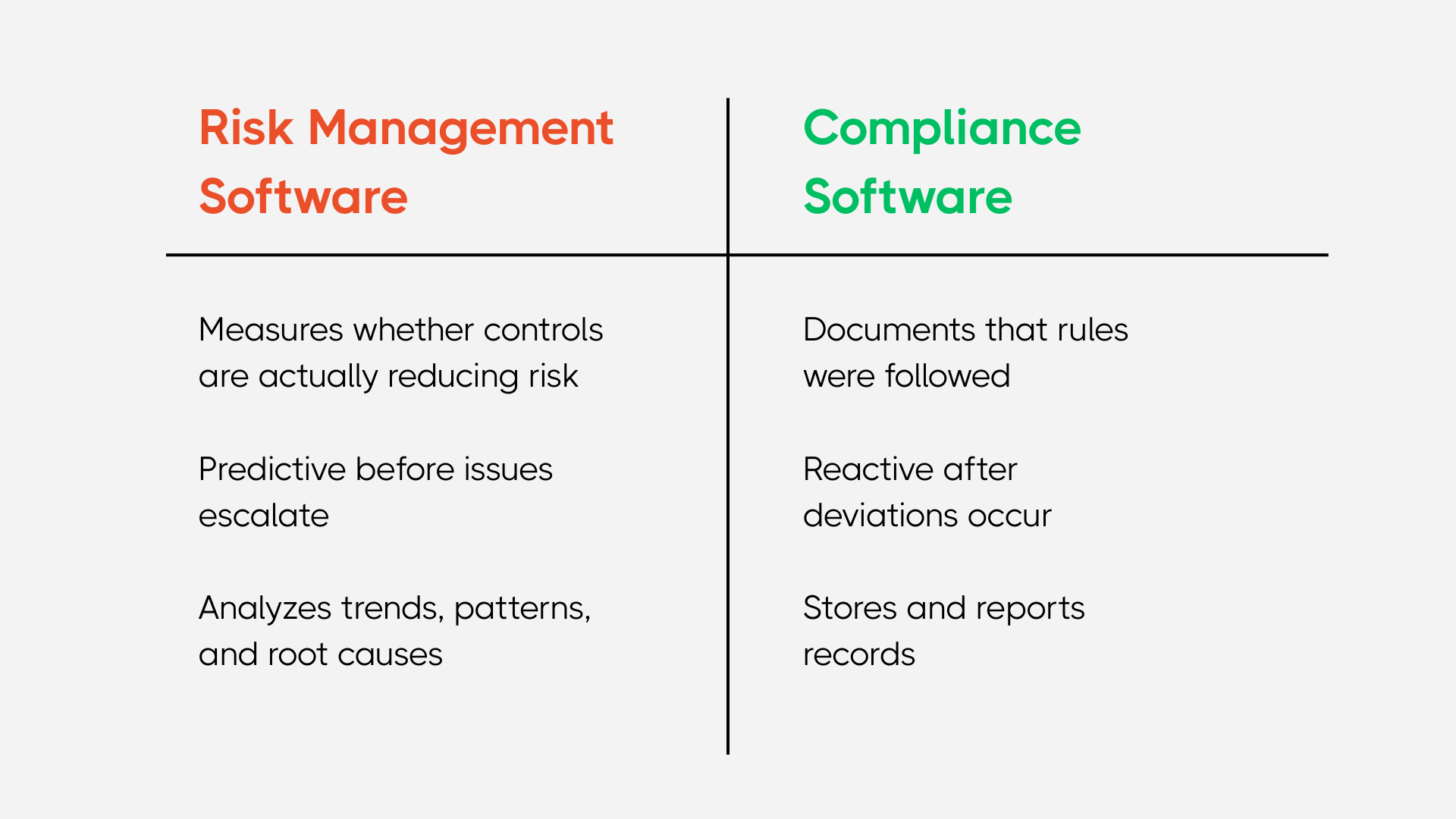
The difference between compliance software and risk management software is not semantic. It reflects a fundamental difference in purpose.
Compliance software is designed to ensure that required tasks are completed and documented. It answers the question of whether procedures were followed. It supports audit preparation, record storage, and regulatory reporting.
Risk management software is designed to evaluate whether those procedures are effective. It answers the question of whether risk is increasing or decreasing and why.
In practical terms, compliance software reacts to events. Risk management software anticipates them.
For example, a compliance system may record that a temperature deviation occurred and was corrected. A risk management system evaluates whether similar deviations are increasing in frequency, whether corrective actions are preventing recurrence, and whether the deviation affects high risk products.
This distinction is critical for food safety risk management. Without risk focused analysis, compliance data remains underutilized.
IONI bridges this gap by combining compliance automation with continuous risk evaluation. Its approach is outlined across several educational resources, including Food Safety Software for Food Recall Management Full Guide 2026, which explains how integrated systems improve response speed and prevention.
By moving beyond compliance toward active risk management, manufacturers gain earlier visibility, faster response, and stronger prevention.
8. What Good Risk Management Software Actually Does
Effective food safety risk management software operates as a continuous control system rather than a passive repository of records. Its value lies not in storing information, but in how it evaluates that information and supports timely decisions.
A core capability of good software is real time visibility. Operational data from HACCP monitoring, environmental testing, equipment checks, and supplier documentation is captured as it is generated. This data is evaluated immediately, not reviewed weeks later during audits. When anomalies occur, they are detected early, when intervention is still low cost and low disruption.
Another defining function is trend analysis. Single deviations rarely cause recalls. Recalls emerge from patterns that go unnoticed. Risk management software evaluates frequency, recurrence, and clustering of deviations. It identifies when controls are weakening even if limits are technically met. This capability is central to effective food safety risk analysis.
Corrective action management is another critical area. In many facilities, corrective actions are closed once immediate fixes are applied. Risk management software evaluates whether those fixes actually prevent recurrence. When similar issues reappear, the system highlights ineffective corrective actions and prompts deeper root cause analysis.
Traceability is also integral. Modern risk management software links ingredients, batches, production steps, and distribution records in a single structure. This enables rapid containment when issues arise and supports targeted recalls rather than broad market withdrawals. Faster traceability directly reduces consumer exposure and financial impact.
IONI explains the operational importance of traceability and response speed in its article Food Safety Software for Food Recall Management Full Guide 2026, which details how integrated systems reduce recall scope and execution time.
Good software also supports continuous learning. Each incident, deviation, and corrective action feeds back into the risk model. Over time, this improves hazard prioritization and strengthens preventive controls. This feedback loop is what differentiates food risk management from static compliance systems.
Ready to reduce your Food Safety Risks? Feel free to book a demo with us and see how IONI may help you.
9. Who Needs Risk Management Software and What to Look For
While all food manufacturers face some level of risk, certain organizations benefit most from structured risk management software.
Manufacturers producing ready to eat foods, infant products, dairy, meat, seafood, and fresh produce operate with inherently higher risk profiles. Facilities with frequent changeovers, complex allergen controls, or global sourcing face increased exposure. Multi site organizations must manage consistency across facilities, which is difficult without centralized risk visibility.
Rapidly growing companies also face elevated risk. As production scales, informal controls and manual processes break down. Risk management software allows growth without proportional increases in food safety headcount.
When evaluating food safety risk management software, manufacturers should look beyond feature lists and focus on outcomes.
The software should support continuous food safety risk assessment, not annual reviews. It should integrate seamlessly into existing workflows rather than create parallel systems. It should provide actionable insight rather than overwhelming users with alerts. Most importantly, it should support both prevention and response.
Food safety risk management software is particularly relevant for the following types of companies:
• Food manufacturers producing ready to eat or minimally processed products where microbial risk is inherently higher.
• Companies with complex allergen profiles, frequent product changeovers, or private label production.
• Manufacturers operating multiple facilities that require consistent food safety controls and centralized visibility.
• Businesses sourcing raw materials or ingredients from multiple countries or high risk regions.
• Food brands supplying large retailers, foodservice chains, or export markets with strict recall expectations.
• Rapidly growing manufacturers where manual food safety processes no longer scale effectively.
• Organizations that have experienced recalls, near misses, or recurring deviations despite being compliant.
• Companies preparing for stricter traceability, recall readiness, or regulatory requirements such as FSMA Section 204.
Selecting the right software is not only a technical decision. It is an operational and cultural one. Systems that support transparency, early escalation, and learning contribute directly to stronger food safety culture.
We discussed practical criteria for evaluating food safety technology in several blog resources, including comparative analyses of compliance and risk focused platforms.
10. How Modern Food Manufacturers Can Prevent Recalls with IONI
Modern food manufacturers prevent recalls by embedding continuous risk intelligence into everyday operations. This approach integrates compliance, monitoring, analysis, and action into a single system.
IONI supports this model by enabling continuous evaluation of control effectiveness rather than periodic verification. HACCP plans are digitized and operationalized. Monitoring data is validated in real time. Deviations are evaluated for severity and recurrence. Corrective actions are assessed for effectiveness rather than simply closed.
Translating Food Safety Data into Actionable Risk Signals
One of the primary challenges in recall prevention is that critical data already exists inside most organizations but is fragmented. HACCP records, monitoring logs, deviations, audits, supplier documents, and corrective actions are often stored in disconnected systems or spreadsheets. This fragmentation prevents effective food safety risk analysis.
IONI's food manufacturing software solutions consolidate these data streams into a single operational environment. By linking production data, monitoring results, and compliance records, the system enables continuous evaluation of risk in food safety rather than retrospective review. Deviations are not treated as isolated events but analyzed in context, including frequency, severity, and recurrence.
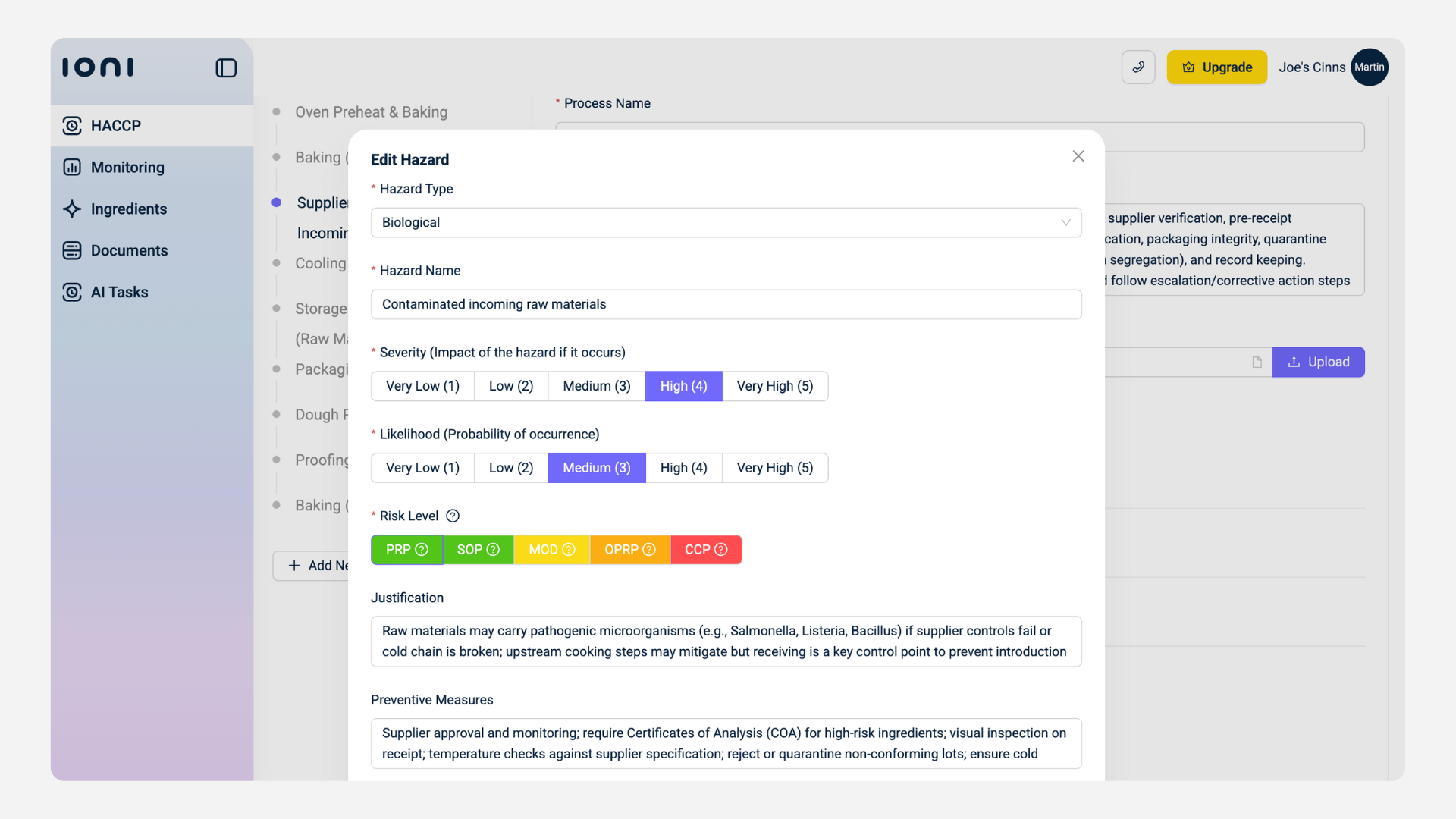
This capability allows manufacturers to detect early warning signals such as increasing deviation trends, weakening control effectiveness, or recurring issues tied to specific products, shifts, or suppliers. These signals are often precursors to recalls when left unmanaged.
Strengthening HACCP Execution in Real Operations
HACCP plans are foundational to food safety, but their effectiveness depends on execution. In many facilities, HACCP exists primarily as documentation rather than as a living control system.
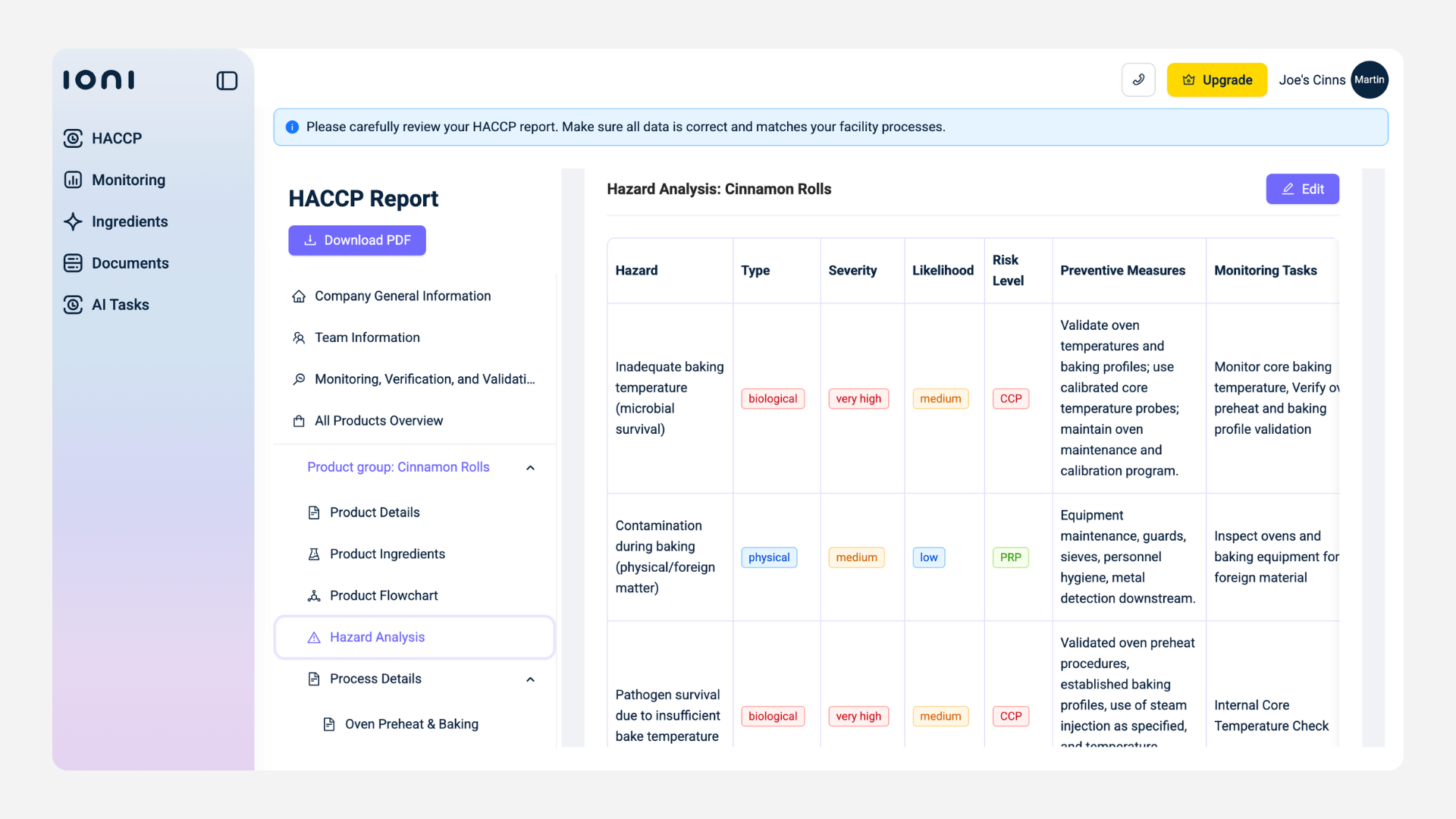
IONI operationalizes HACCP by embedding hazard controls, critical limits, and monitoring tasks directly into daily production workflows. Monitoring data is validated in real time, and deviations are immediately evaluated for risk impact. This supports continuous food safety risk assessment rather than periodic plan review.
When deviations occur, the system ensures they are linked to corrective and preventive actions. Over time, this enables manufacturers to assess whether controls are preventing recurrence or merely documenting failure. This feedback loop is essential to effective food risk management.
Preventing Supplier Driven Recalls
A significant proportion of recalls originate from raw materials and ingredients rather than internal processing failures. Supplier risk is often underestimated because documentation such as certificates of analysis and audits create an illusion of control.
IONI addresses this gap by continuously evaluating supplier performance. Documentation is tracked, but more importantly, supplier related deviations, test results, and external risk signals are incorporated into internal risk profiles. When supplier risk increases, manufacturers can respond proactively through increased testing, supplier engagement, or sourcing adjustments.
This approach supports proactive management of food risk food safety risk across the supply chain rather than reactive containment after contaminated ingredients enter production.
Reducing Recall Scope Through Integrated Traceability
When issues do occur, the speed and precision of traceability determine recall impact. Broad recalls are often the result of uncertainty rather than confirmed exposure.
IONI's manufacturing software links ingredients, production steps, batches, and distribution records in a single traceability structure. This enables rapid identification of affected products and supports targeted recall actions. Faster traceability reduces consumer exposure, regulatory scrutiny, and financial loss.
Integrated traceability also supports regulatory requirements such as FSMA Section 204 and strengthens overall recall readiness.
Validating Corrective Actions and Preventing Recurrence
One of the most overlooked contributors to recalls is ineffective corrective action. Issues are identified and closed, but root causes persist.
IONI evaluates corrective actions over time by linking them to subsequent performance data. When similar issues recur, the system highlights ineffective actions and prompts deeper investigation. This capability strengthens continuous improvement and reduces the likelihood of repeat incidents.
By connecting corrective actions to measurable outcomes, manufacturers improve the effectiveness of their food safety risk management programs.
Enabling Organization Wide Risk Awareness
Finally, recall prevention depends on organizational alignment. Risk intelligence must be visible not only to quality teams but also to operations and leadership.
IONI provides role appropriate visibility into food safety risk across the organization. Operators see real time monitoring feedback. Managers see risk trends and unresolved issues. Executives see aggregated risk indicators tied to operational performance.
This shared visibility reinforces accountability and supports a culture where food safety risk is actively managed rather than passively documented.
IONI's approach reflects a broader industry shift toward integrating food safety with operational intelligence. This shift is explored in depth in Why ROI Matters in Food Manufacturing and How IONI Is Finally Delivering It, which connects recall prevention to measurable business outcomes.
Ready to reduce your Food Safety Risks? Feel free to book a demo with us and see how IONI may help you.
11. Conclusion
Food safety risk has not diminished. It has become more complex.
Global supply chains, evolving hazards, and increasing regulatory expectations have exposed the limitations of compliance only approaches. Recalls continue to occur in certified facilities because compliance verifies documentation, not effectiveness.
Food safety risk management addresses this gap by focusing on how risk behaves in real operations. Through continuous monitoring, analysis, and response, manufacturers gain earlier visibility into emerging threats and stronger control over outcomes.
Risk intelligence transforms food safety from a reactive function into a preventive system. It enables continuous food safety risk analysis, dynamic food safety risk assessment, and effective food risk management.
Manufacturers that adopt this approach are better positioned to protect consumers, safeguard brands, and maintain operational resilience. Preventing recalls is no longer a matter of chance or inspection schedules. It is the result of disciplined, data driven risk management applied every day.