.png)
Food safety documentation, certification audits, and regulatory requirements come with their own language. Some terms are easy to understand. Others sound similar but mean very different things when an auditor is reviewing records, a supplier issue is being investigated, or a food safety plan is being updated.
This food safety glossary covers 56 terms manufacturers encounter most often in HACCP plans, SQF and BRCGS audits, FSMA compliance work, supplier programs, and day-to-day operations.
Each definition explains what the term means in practical manufacturing terms, not just how it appears in a standard. The terms are grouped by category so teams can quickly find what they need.
Certification and Standards
BRCGS (Brand Reputation through Compliance Global Standards)
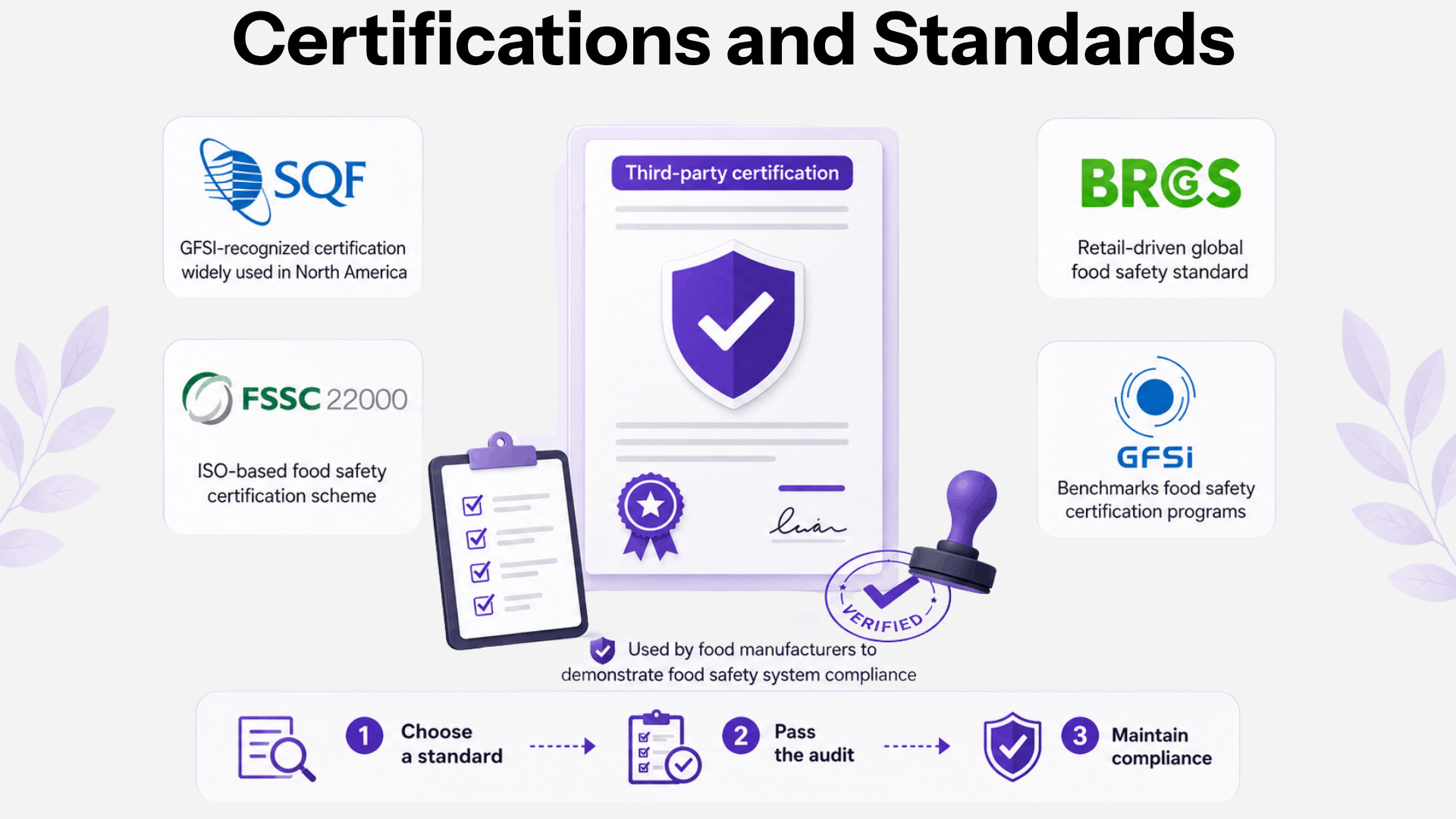
BRCGS is a GFSI-recognized food safety certification standard used by more than 30,000 sites in over 130 countries. Originally developed by the British Retail Consortium and renamed in 2019, it is widely required by UK and European retailers and increasingly used in global private-label supply chains.
The current BRCGS food safety standard is Issue 9. Sites receive a grade such as AA, A, B, C, or D based on the number and severity of non-conformities found during the audit.
Certification Body (CB)
A certification body is an accredited third-party organization that conducts SQF, BRCGS, FSSC 22000, and other certification audits.
Certification bodies are accredited by national accreditation bodies and authorized by the standard owner to issue certificates. A site cannot self-certify. It must be audited by an approved certification body.
Examples include NSF, SGS, Bureau Veritas, and Intertek.
FSSC 22000 (Food Safety System Certification)
FSSC 22000 is a GFSI-recognized food safety certification based on ISO 22000 and ISO/TS 22002 requirements. It is often selected by facilities that already operate within an ISO-based management system.
The scheme is accepted by retailers and foodservice buyers internationally and is managed by the Foundation FSSC 22000. Recertification audits take place every three years, with surveillance audits completed annually between certification audits.
GFSI (Global Food Safety Initiative)
GFSI is a non-profit organization that benchmarks food safety certification schemes against a common set of requirements.
SQF, BRCGS, FSSC 22000, and other schemes that meet GFSI benchmarking requirements are generally accepted by major retailers as comparable evidence of food safety system maturity.
GFSI does not certify food manufacturers or conduct audits. The certification body issues the certificate, not GFSI.
SQFI (Safe Quality Food Institute)
SQFI is the organization that owns and administers the SQF certification program. It is part of FMI, The Food Industry Association.
SQFI publishes the SQF Code, trains SQF Practitioners, approves certification bodies, and maintains the SQF Assessment Database. Every SQF-certified site must be registered with SQFI before its certification audit, and the registration must remain current at the time of the audit.
SQF (Safe Quality Food)
SQF is a GFSI-recognized food safety and quality certification program administered by SQFI. It is widely used across North America and commonly accepted by major retailers, including Walmart, Costco, Whole Foods, Kroger, and other retail buyers.
The SQF Food Safety Code is the version most food manufacturers work with. Edition 9 remains the active version in 2026. SQF Edition 10 was published in March 2026, with audits expected to begin no earlier than January 2, 2027, subject to completion of GFSI benchmarking.
For a practical breakdown of what SQF requires beyond the glossary terms, see our guide to HACCP vs. SQF and what food manufacturers actually need.
SQF Practitioner
An SQF Practitioner is a required role at every SQF-certified site. This person is responsible for developing, implementing, and maintaining the SQF system.
The Practitioner must be employed by the site and have appropriate HACCP training and food industry knowledge. An external consultant can support the system, but cannot act as the site’s non-resident SQF Practitioner.
During an SQF audit, the Practitioner is often one of the first people the auditor will interview to determine whether the system is genuinely understood and implemented.
Preparing for certification? Use our SQF audit checklist for small food manufacturers to review the records, programs, and operational evidence auditors expect to see.
HACCP and Food Safety Plans
CCP (Critical Control Point)
A Critical Control Point is a specific process step where a control measure is applied to prevent, eliminate, or reduce a food safety hazard to an acceptable level.
CCPs are identified through hazard analysis. Each CCP requires a critical limit, monitoring procedure, corrective action, verification activity, and supporting records.
Common examples include cooking temperatures, pasteurization, and metal detection. A stronger HACCP plan does not necessarily have more CCPs. It has the right CCPs for the actual risks in the process. Read the full guide to critical control point (CCP) examples and limits.
CL (Critical Limit)
A critical limit is the maximum or minimum value that must be met at a CCP. If the limit is exceeded, a deviation has occurred and immediate corrective action is required.
Critical limits must be supported by scientific evidence, regulatory requirements, or validated process data. They cannot be selected simply because they are convenient for production.
For example, a validated cooking temperature for a poultry product may be a regulatory or scientifically supported critical limit. A site may choose a stricter operating limit, but should be able to explain and support that decision.
Codex Alimentarius
Codex Alimentarius is an international collection of food standards, guidelines, and codes of practice developed jointly by the Food and Agriculture Organization of the United Nations and the World Health Organization.
Codex provides the foundation for many national regulations and food safety certification standards. The 2020 revision of the Codex General Principles of Food Hygiene, including HACCP guidance, is the version reflected in BRCGS Issue 9 and SQF Edition 9 expectations.
Facilities with HACCP plans developed before 2020 should review whether their plans still align with the current Codex structure and terminology.
HACCP (Hazard Analysis and Critical Control Points)
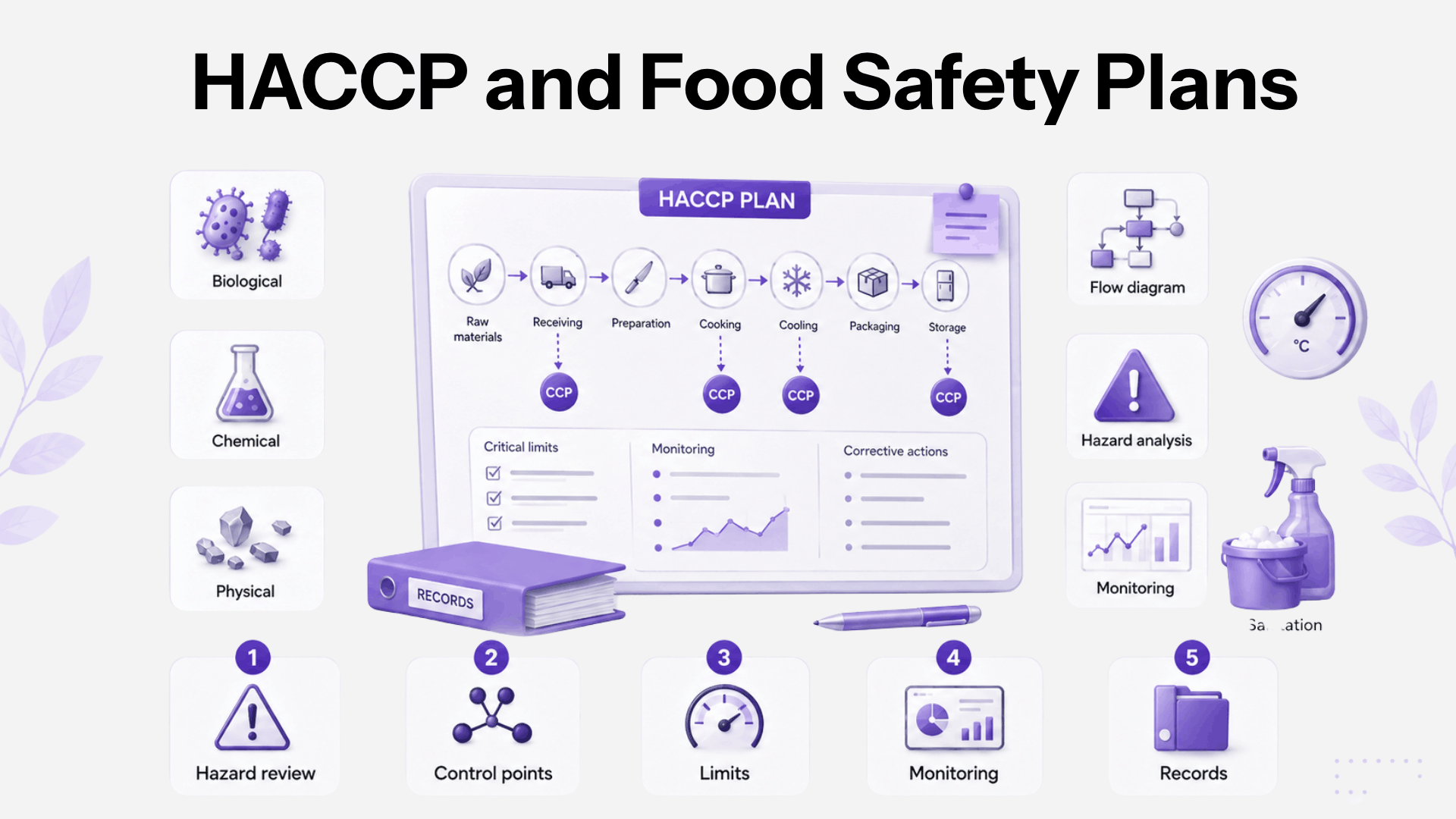
HACCP is a science-based system for identifying, evaluating, and controlling food safety hazards in production.
It is built around seven principles:
- Conduct a hazard analysis
- Identify critical control points
- Establish critical limits
- Establish monitoring procedures
- Establish corrective actions
- Establish verification procedures
- Establish record-keeping and documentation procedures
HACCP is required or expected under FSMA Preventive Controls, SQF, BRCGS, FSSC 22000, and USDA food safety requirements for applicable products.
HACCP is a methodology, not a certificate. Having a HACCP plan is not the same as holding third-party HACCP certification.
For the full acronym breakdown, letter by letter, and where HACCP came from, see our guide to what HACCP stands for.
Hazard Analysis
Hazard analysis is the foundation of every HACCP plan. It identifies potential biological, chemical, physical, and allergen hazards at every step in the process, then determines which hazards are significant enough to require controls.
If the hazard analysis is weak, the rest of the food safety plan is built on unreliable assumptions. Auditors often trace findings back to incomplete hazard analysis, particularly where allergen controls, supplier risks, environmental pathogens, or rework have not been fully assessed.
OPRP (Operational Prerequisite Program)
An Operational Prerequisite Program is a control measure used for a significant food safety hazard when the control does not meet the formal critical-limit and monitoring requirements of a CCP.
OPRPs sit between general prerequisite programs and CCPs in the food safety risk hierarchy. They are formally used in ISO 22000 and FSSC 22000 systems.
SQF and BRCGS sites may manage the same type of risk through hazard analysis without using the term OPRP explicitly.
PRP (Prerequisite Program)
Prerequisite Programs are the basic conditions and procedures that need to be in place before HACCP can operate effectively.
PRPs manage background food safety risks, including sanitation, pest control, employee hygiene, allergen management, supplier approval, equipment maintenance, water quality, and training.
Without reliable PRPs, a HACCP plan becomes overloaded with controls that should be managed through routine operational programs. GFSI-recognized standards require PRPs to be documented, implemented, monitored, verified, and supported by records.
Validation
Validation is evidence that a control measure can control a hazard when it is implemented correctly.
Validation answers one question: Will this work?
Examples include scientific literature showing that a time and temperature combination achieves the necessary pathogen reduction, or allergen swab results showing that a cleaning process consistently removes allergen residues below the defined limit.
Validation happens before or during system design. It is different from verification.
Verification
Verification is the ongoing confirmation that the food safety system is operating as intended.
Verification answers a different question: Is this working?
Examples include calibration of monitoring equipment, review of CCP records, finished-product testing, internal audits, and management review.
Monitoring happens in real time at a CCP. Verification checks whether the wider system is functioning reliably over time.
Audit and Compliance
Announced Audit
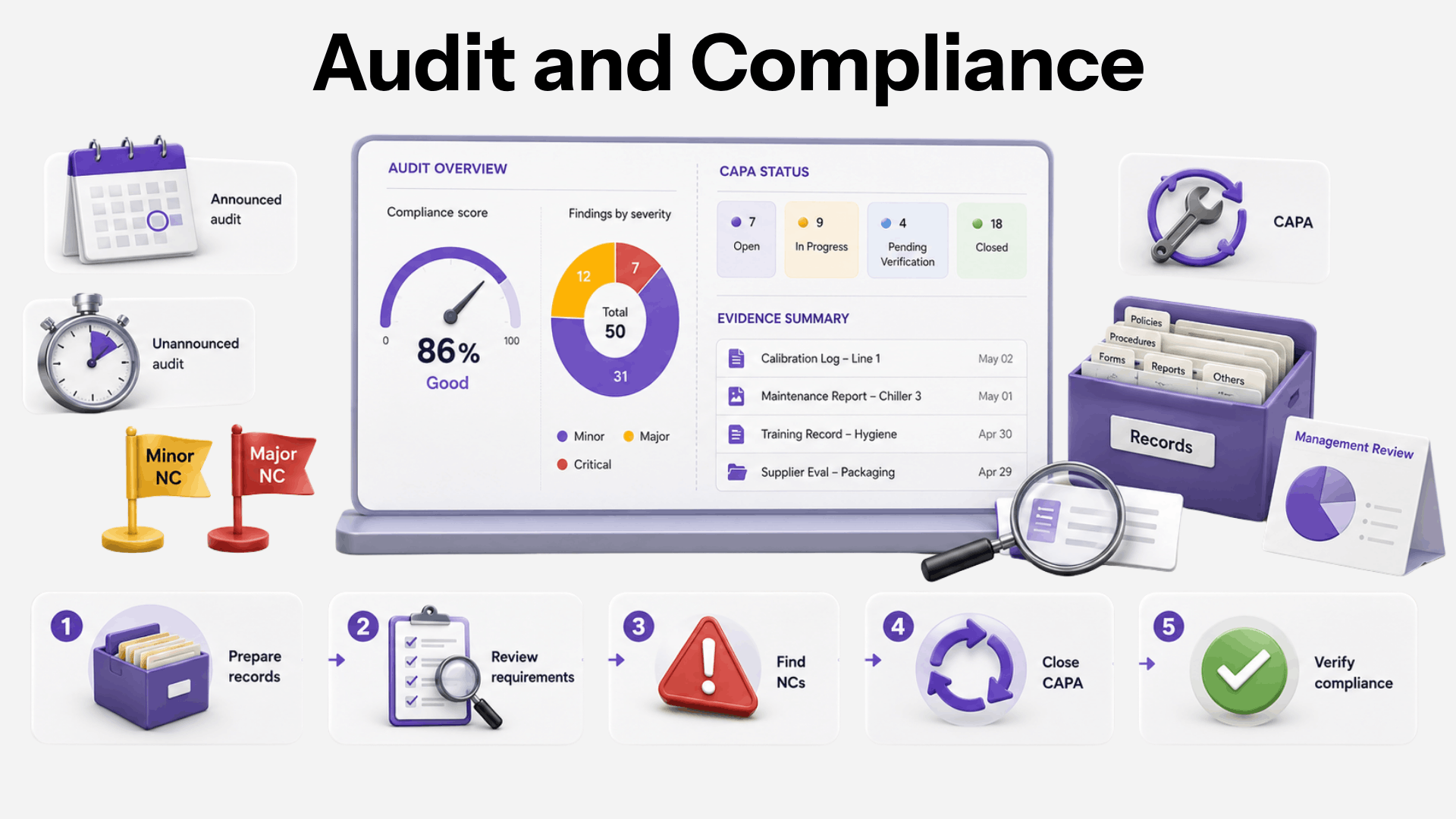
An announced audit is scheduled in advance. The site knows when the auditor will arrive and can prepare the relevant records, personnel, and production access.
Most first-time certification audits are announced. Unannounced audits, by contrast, evaluate how the food safety system performs on a normal operating day.
CAPA (Corrective and Preventive Action)
CAPA is a structured process for identifying, investigating, correcting, and preventing recurrence of a non-conformity.
A complete CAPA record usually includes:
- A description of the non-conformity
- The immediate correction taken
- Root cause analysis
- Corrective action
- The responsible person
- A completion date
- Effectiveness verification
The two most common gaps in CAPA records are weak root cause analysis and missing effectiveness checks. “Employee retrained” is not a complete CAPA unless the team has identified why the problem occurred and how retraining addresses the true cause.
Corrective Action
Corrective action is the action taken to eliminate the cause of a non-conformity and prevent it from happening again.
It is different from a correction. A correction resolves the immediate issue. Corrective action addresses the underlying cause.
For example, if CCP monitoring logs are repeatedly incomplete, the correction may be to complete the missing records. The corrective action should address why the records were missed in the first place, such as unclear ownership, weak shift handover, poor form design, inadequate supervision, or training gaps.
Deviation
A deviation is a failure to meet a critical limit at a CCP.
It is not simply another term for a general non-conformity. A deviation specifically refers to a CCP limit being exceeded.
When a deviation occurs, the facility should immediately assess the affected product, document the event, take corrective action, and maintain complete records. Auditors reviewing CCP records expect to see what happened, which product was affected, how the product was handled, and how recurrence was prevented.
Fundamental Clause
Under BRCGS Issue 9, fundamental clauses are requirements where a major non-conformity leads to non-certification, regardless of the site’s overall audit performance.
The 12 fundamental clauses cover:
- Senior management commitment
- HACCP
- Internal audits
- Supplier management
- Corrective actions
- Traceability
- Facility layout and product flow
- Housekeeping and hygiene
- Allergen management
- Control of operations
- Labelling and pack control
- Training
Each fundamental clause should be treated as a high-priority audit area. A single major finding against one of these clauses can override an otherwise strong audit result.
Management Review
Management review is a formal evaluation by senior management of the performance of the food safety management system.
It is required by SQF, BRCGS, FSSC 22000, and ISO 22000. Typical management review topics include audit results, non-conformity trends, complaints, supplier performance, food safety objectives, resource needs, and corrective-action status.
The review should be documented with attendance, discussion points, decisions, assigned actions, and due dates. A management review with no findings, challenges, or follow-up actions often looks like a paperwork exercise rather than a meaningful review.
Minor Non-Conformity
A minor non-conformity is an isolated failure to meet a requirement that does not show a systemic breakdown or an immediate food safety risk.
Under BRCGS Issue 9, a site with five or fewer minor non-conformities can achieve Grade AA. Minor non-conformities must still be addressed through documented corrective action, typically within 28 days of the audit.
Major Non-Conformity
A major non-conformity is a significant failure in the implementation of the food safety management system, or a failure that could affect food safety, legality, or quality.
Under BRCGS, a major non-conformity against a non-fundamental clause lowers the site’s grade. A major non-conformity against a fundamental clause results in non-certification.
Major non-conformities require a documented corrective action response, root cause analysis, and objective evidence within the required audit closeout period.
NC (Non-Conformity)
A non-conformity is any failure to meet a requirement of the standard being audited.
It may be classified as minor, major, or critical depending on severity. Every non-conformity requires documented action, but the type of response should match the seriousness and scope of the issue.
Recurring findings, weak corrective actions, and repeat non-conformities across audit cycles usually tell an auditor more about the system than a single isolated finding.
Unannounced Audit
An unannounced audit takes place without advance notice of the exact audit date. The auditor arrives within a defined audit window and evaluates the facility as it operates under normal conditions.
For BRCGS, a successful unannounced audit receives a “+” suffix, such as AA+, A+, B+, C+, or D+. BRCGS requires sites to complete at least one unannounced audit during each three-year certification cycle.
Some retail supply programs also require unannounced SQF audits. For many buyers, an unannounced grade provides stronger evidence that the system is implemented consistently, not only when the audit is expected.
Regulatory and Legal
CFIA (Canadian Food Inspection Agency)
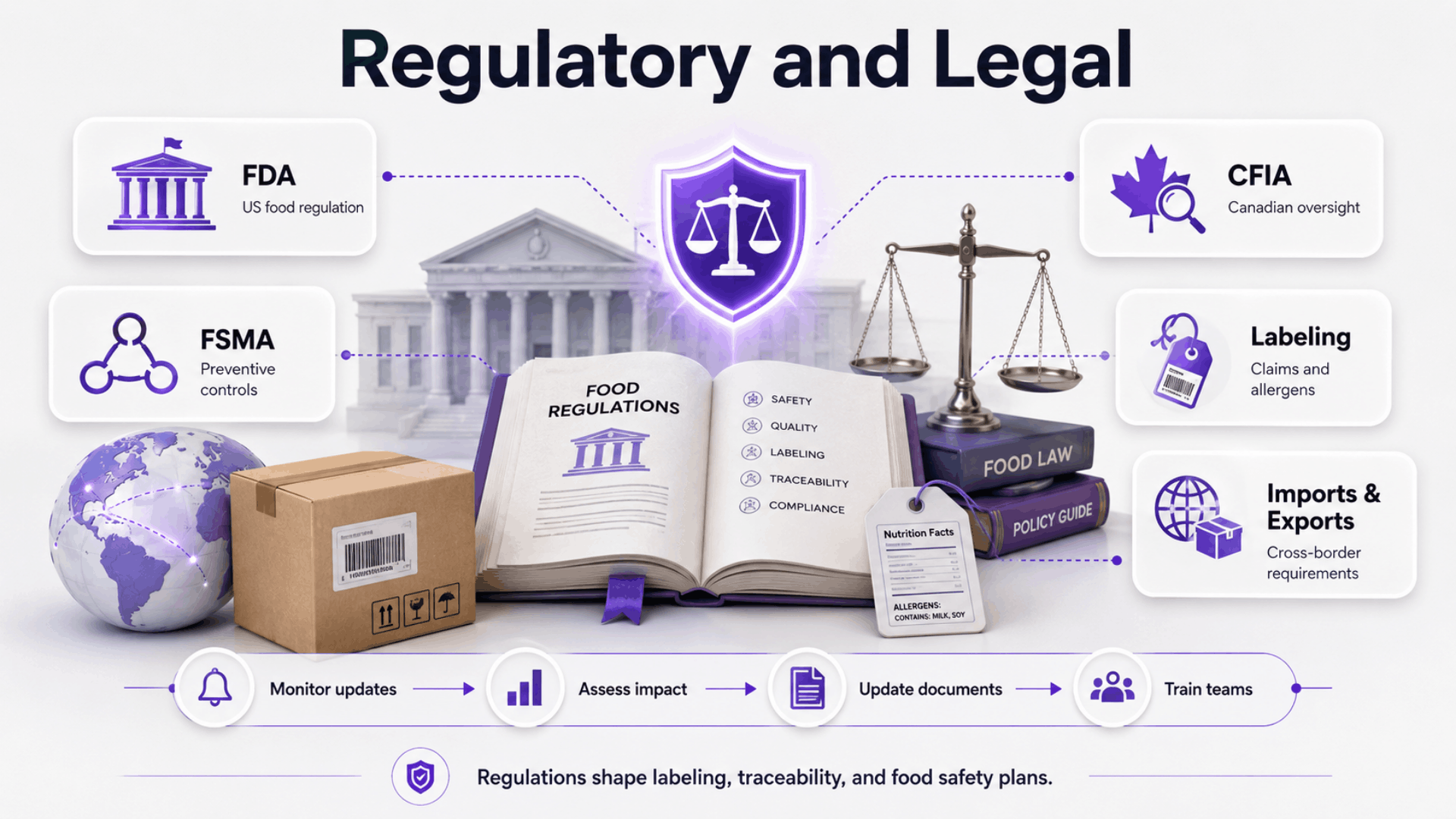
The Canadian Food Inspection Agency is Canada’s federal authority for food inspection, labelling enforcement, and import and export controls.
For manufacturers, CFIA administers the Safe Food for Canadians Regulations. These rules require many federally licensed food businesses to maintain preventive controls and, where applicable, a written preventive control plan.
Canadian manufacturers can review the CFIA preventive control plan guidance to understand how SFCR preventive-control requirements apply to their operations.
CFIA also enforces the Food and Drugs Act and the Consumer Packaging and Labelling Act.
FDA (Food and Drug Administration)
The US Food and Drug Administration is the federal agency responsible for food safety oversight for most human and animal food products.
FDA administers the Food Safety Modernization Act, including Preventive Controls requirements, the Produce Safety Rule, the Food Traceability Rule, and the Foreign Supplier Verification Program.
FDA also regulates food labelling, food additives, and facility registration. Meat, poultry, and processed egg products are primarily regulated by USDA, not FDA.
FSMA (Food Safety Modernization Act)
The Food Safety Modernization Act is US legislation signed in 2011. It shifted the regulatory focus from responding to foodborne contamination after the fact to preventing it before food reaches consumers.
For food manufacturers, key FSMA rules include:
- Preventive Controls for Human Food under 21 CFR Part 117
- The Food Traceability Rule under FSMA Section 204
- The Foreign Supplier Verification Program
FDA enforces FSMA requirements.
FSMA 204 (Food Traceability Rule)
FSMA 204 refers to the FDA Food Traceability Rule. It requires businesses that manufacture, process, pack, or hold foods on the Food Traceability List to maintain enhanced traceability records and provide required information to FDA within 24 hours of a request.
The rule applies to covered foods and covered activities, with exemptions and partial exemptions that depend on the food, the type of business, the supply-chain activity, and other regulatory conditions. There is no blanket exemption based simply on annual sales below $1 million.
The compliance date is July 20, 2028. Manufacturers handling covered foods should use the FDA Food Traceability Rule guidance to confirm whether their products and activities are covered.
GMP (Good Manufacturing Practice)
Good Manufacturing Practices are the basic operating and environmental conditions needed to produce food safely.
GMPs cover facility design, equipment maintenance, employee hygiene, sanitation, pest control, storage, and production practices.
They are required under FDA regulations, USDA requirements for applicable products, and all GFSI-recognized food safety standards. In SQF, GMP performance is assessed through the relevant food sector category module.
A strong HACCP plan cannot compensate for poor GMP execution.
Preventive Controls
Preventive controls are risk-based measures required under FSMA to significantly minimize or prevent food safety hazards.
They may include process controls, allergen controls, sanitation controls, supply-chain controls, and recall plan requirements.
Facilities subject to the Preventive Controls for Human Food rule must maintain a written food safety plan. Applicability and modified requirements depend on the facility, food, activity, and exemption status, not only on revenue.
Traceability
CTE (Critical Tracking Event)
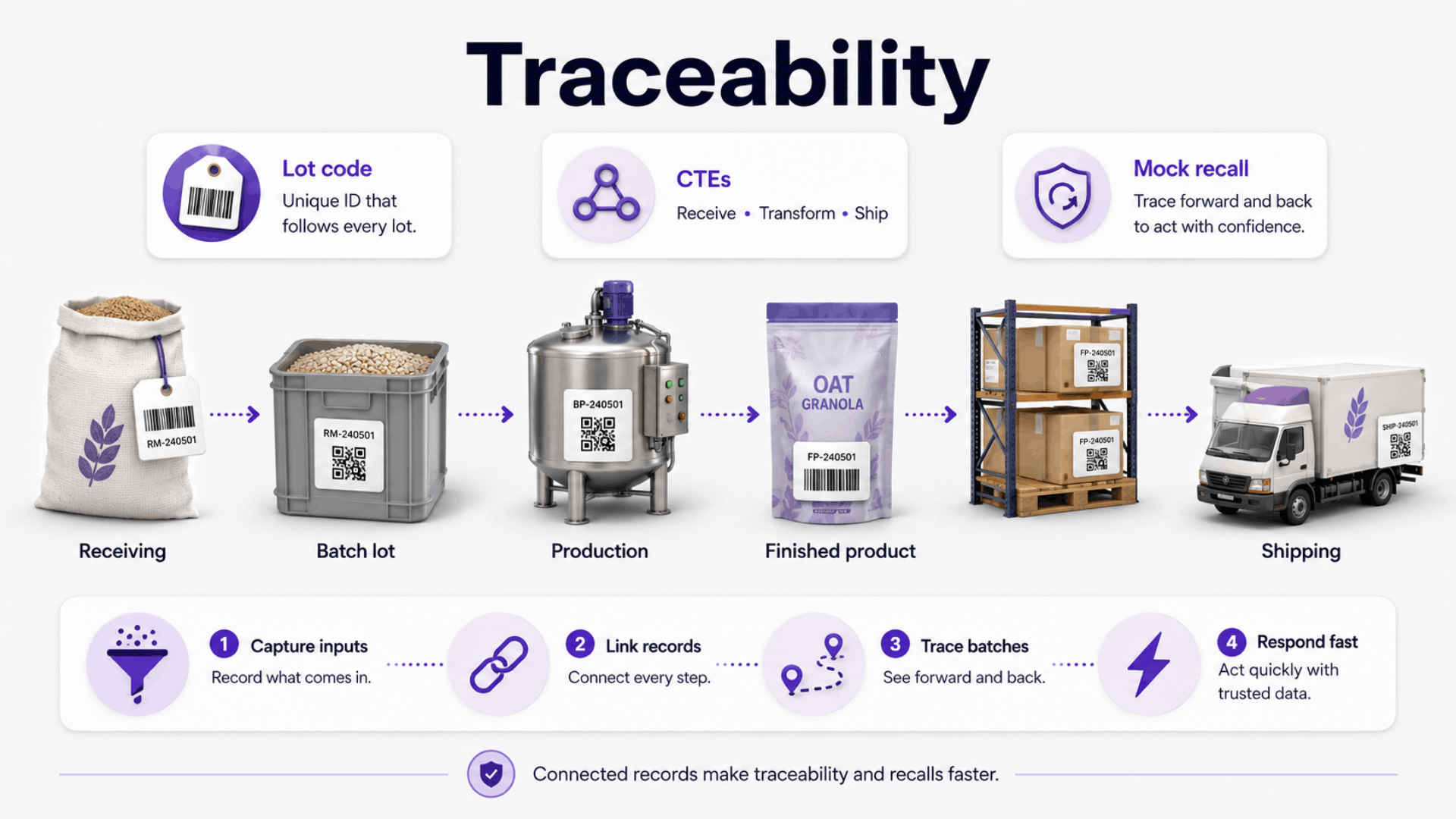
A Critical Tracking Event is a point in the supply chain where traceability records must be created under FSMA 204.
For food manufacturers, the most relevant CTEs are often:
- Receiving covered ingredients
- Transformation of covered ingredients into a new product
- Shipping covered finished product
Each CTE requires specific Key Data Elements to be created, maintained, and retained for the required period.
KDE (Key Data Element)
Key Data Elements are the specific data points required at each Critical Tracking Event under FSMA 204.
At receiving, KDEs may include supplier details, traceability lot code, date received, quantity, and reference documents.
At transformation, the records should link input traceability lot codes to the output lot code, along with the date and location of the activity.
At shipping, the records should identify the traceability lot code, recipient, shipment date, quantity, and reference document.
The records must be available to FDA within 24 hours of a request.
Lot Code
A lot code is an alphanumeric identifier assigned to a defined quantity of product made under the same conditions.
Lot codes support traceability by linking finished product to incoming raw materials, production records, and customer shipments.
Under FSMA 204, a Traceability Lot Code is a specific regulatory identifier that must connect to the relevant Key Data Elements. An internal batch number may support a compliant system, but it is not automatically the same as a Traceability Lot Code.
Mock Recall
A mock recall is a planned exercise that tests a facility’s ability to trace a product lot through the supply chain and account for all affected units.
SQF and BRCGS expect mock recalls to be completed at least annually. The exercise should be timed and reconciled, meaning the selected lot must be fully accounted for.
A complete exercise traces the lot backward to raw materials and forward to all customers who received it. Selecting the cleanest or most recent batch every time does not prove that the traceability system will work under pressure.
Traceability
Traceability is the ability to identify and follow food, ingredients, packaging, and related records through defined stages of production, processing, and distribution.
A functioning traceability system links incoming materials to production batches and finished products to customers.
During SQF and BRCGS audits, auditors often select a lot and time how quickly the team can complete a trace. Connected, lot-level records make this manageable. Scattered paper records and disconnected spreadsheets turn it into a high-pressure search exercise.
TLC (Traceability Lot Code)
A Traceability Lot Code is the identifier used under FSMA 204 to connect traceability records across the supply chain.
A covered food receives a TLC when required by the rule. When covered ingredients are transformed into a finished product, the new product should receive a new TLC that links back to the input TLCs.
The TLC must appear on or travel with the food and connect to the required KDEs at each relevant CTE.
Supplier Management
Approved Supplier
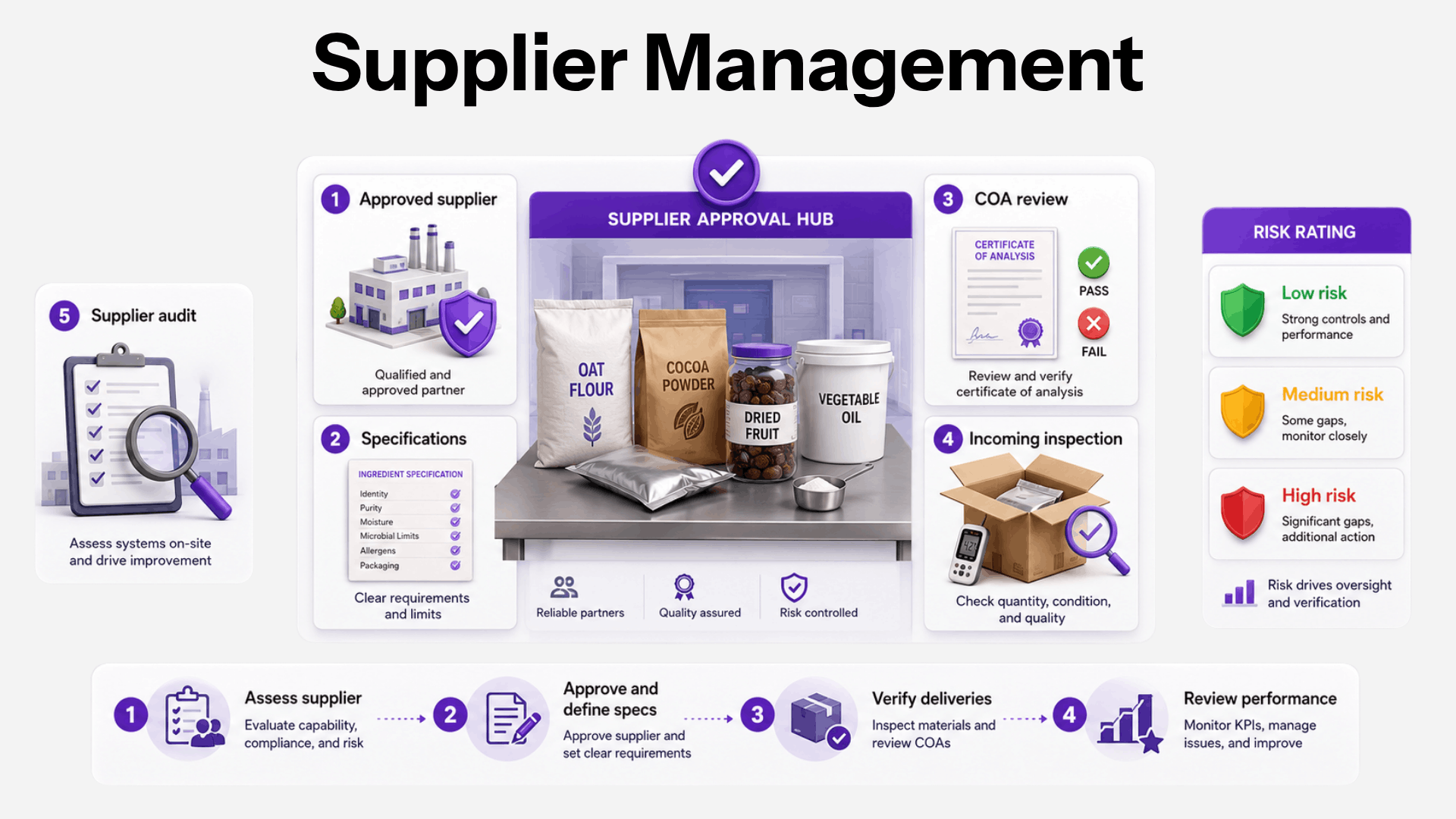
An approved supplier is a supplier that has been formally assessed and approved as capable of meeting the site’s food safety and quality requirements.
Approval should be based on risk and supported by documented evidence. Depending on the supplier and material, this may include questionnaires, third-party certifications, audits, testing, supplier history, or other verification.
Supplier approval must be reviewed on a risk-appropriate schedule. Long-term purchasing history without formal assessment does not meet SQF, BRCGS, or FSSC 22000 expectations.
COA (Certificate of Analysis)
A Certificate of Analysis is a supplier document showing that a specific lot meets defined requirements.
COAs can report microbiological, chemical, physical, allergen, or other test results. Receiving the COA is not enough. The site must compare those results against the approved specification and document the review.
An auditor who sees COAs stored in a folder but no evidence of specification comparison may treat the process as incomplete.
Incoming Inspection
Incoming inspection is the process of checking that raw materials, ingredients, and packaging meet purchasing and specification requirements before they are released for production.
The process may include visual inspection, temperature checks, COA review, certificate-of-conformance review, seal integrity checks, label verification, sampling, or testing.
Records should show what was checked, what the result was, and whether the material was accepted, rejected, or placed on hold.
Specification
A specification is a controlled document that defines the required characteristics of a raw material, ingredient, packaging material, or finished product.
Specifications may include physical, chemical, microbiological, allergen, labelling, packaging, and storage requirements.
They must be current, approved, and aligned with what the site actually purchases or produces. COA results should be assessed against the approved specification, not informal expectations or general industry norms.
Supplier Audit
A supplier audit is a formal review of a supplier’s food safety management system, usually completed at the supplier’s site by a qualified auditor.
It is often used as an approval or verification activity for high-risk suppliers. The auditor should have appropriate food safety knowledge and audit training.
A questionnaire is not a supplier audit. A supplier audit report should document the scope, observations, findings, corrective actions, and follow-up requirements.
Operations and Production
Allergen
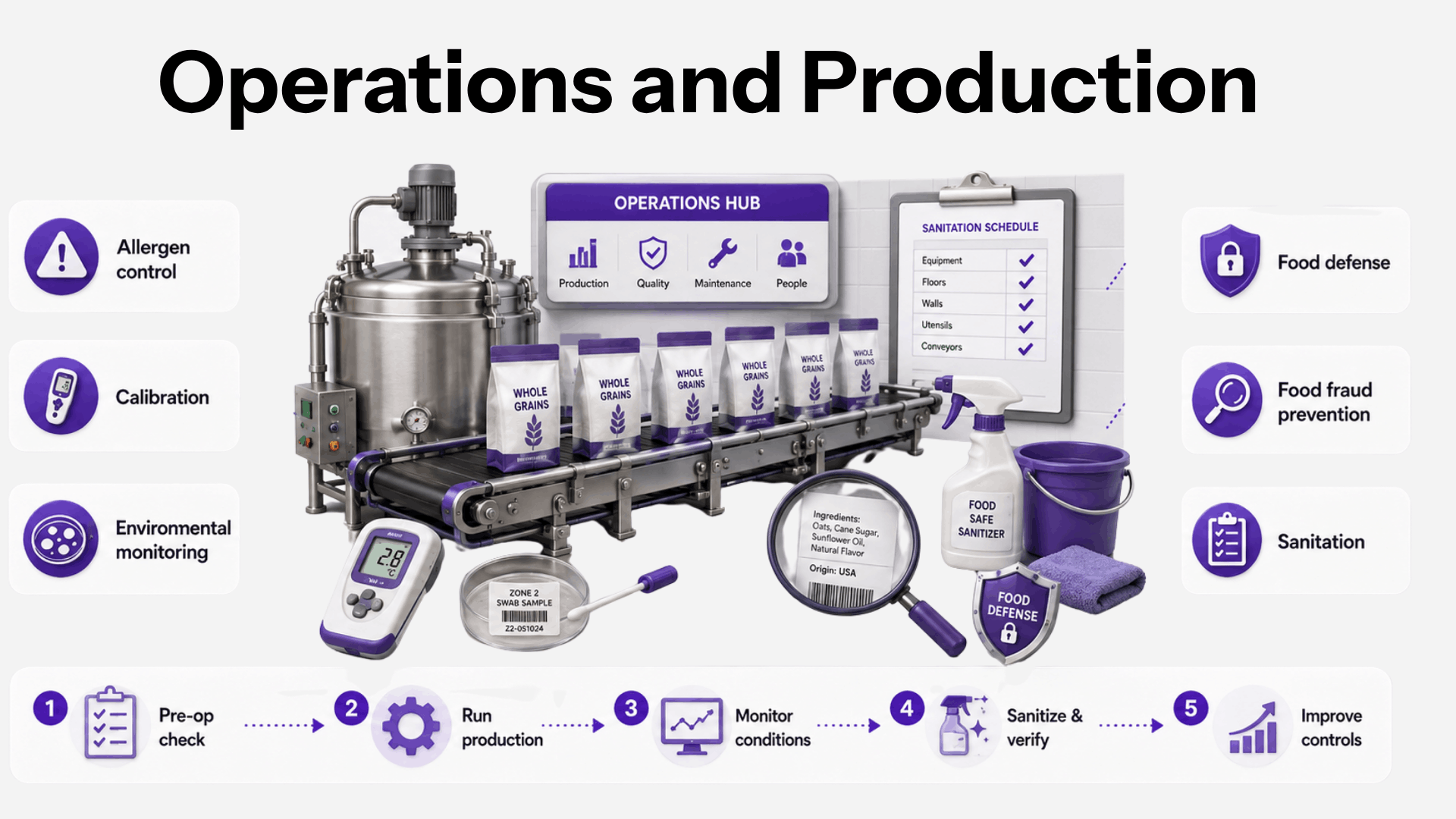
An allergen is a substance that can trigger an allergic reaction in sensitive individuals.
In the United States, the major food allergens are milk, eggs, fish, crustacean shellfish, tree nuts, peanuts, wheat, soybeans, and sesame.
Canada identifies a broader group of priority allergens and related label declarations, including peanuts, tree nuts, sesame, milk, eggs, fish, crustaceans and molluscs, soy, wheat or triticale, mustard, and sulphites.
Allergen management is a fundamental clause under BRCGS Issue 9. A major non-conformity in this area can result in non-certification.
Allergen Cross-Contact
Allergen cross-contact is the unintentional introduction of an allergen into a product that is not intended to contain it.
It can happen through shared equipment, shared production areas, rework, airborne particles, employee practices, ingredient handling, or contaminated cleaning tools.
Unlike many pathogens, allergens are not destroyed by cooking. Heat treatment does not make a product with unintended allergen residues safe for allergic consumers.
Calibration
Calibration is the comparison of a measuring instrument against a known standard to confirm that it is accurate.
Critical equipment such as thermometers, scales, pH meters, probes, and metal detectors must be calibrated at defined intervals, with results documented.
When equipment is found out of calibration, the facility should investigate whether product produced since the last valid calibration may have been affected. Calibration records should be traceable to a recognized standard, such as NIST in the United States.
Environmental Monitoring
Environmental monitoring is a program for testing the production environment to confirm that sanitation and hygiene controls are effective.
It often includes swabbing defined zones such as food-contact surfaces, drains, equipment bases, or nearby walls for indicator organisms, pathogens, ATP, or other measures.
Under SQF Edition 10 and BRCGS Issue 9, the program should have a documented, risk-based rationale for the selected sites, organisms, frequencies, methods, and corrective-action approach.
Food Defense
Food defense covers measures designed to protect food from intentional contamination or tampering.
A food defense program may include vulnerability assessments, access controls, visitor management, employee screening, restricted areas, and incident response procedures.
Food defense is different from food safety, which focuses on unintentional contamination, and food fraud, which focuses on economically motivated deception.
Food Fraud
Food fraud is the intentional adulteration, substitution, dilution, mislabelling, or counterfeiting of food for economic gain.
Examples include substituting a cheaper oil for a premium oil, watering down a product, misrepresenting origin, or using an undeclared ingredient.
SQF and BRCGS require sites to complete food fraud vulnerability assessments and assign mitigation measures based on the risks associated with ingredients, suppliers, and supply chains.
Food Safety Culture
Food safety culture is the set of values, decisions, and behaviours that show how seriously a business treats food safety in daily work.
It becomes visible when production pressure increases, staffing is limited, or a problem needs to be escalated. Auditors assess culture through documents, staff interviews, management behaviour, and floor observations.
Under SQF Edition 10, sites must maintain a formal Food Safety Culture Assessment Plan with measurable objectives and evidence of progress over time. A policy statement alone does not demonstrate culture. Routine decisions and actions do.
Master Sanitation Schedule (MSS)
A Master Sanitation Schedule lists the equipment, surfaces, and areas that must be cleaned, together with the frequency, method, responsible person, and chemical or tool used.
The MSS is a core part of the sanitation prerequisite program. Auditors compare it against the actual facility and review recent cleaning and verification records.
Equipment missing from the schedule, or pre-operational records that never identify an issue, can both raise questions about whether the sanitation program reflects reality.
Pre-operational Inspection
A pre-operational inspection is a documented check completed before production begins to confirm that the facility and equipment are clean, in good repair, and ready for use.
When the inspection identifies a problem, the site should take and document corrective action before production starts.
Pre-operational records that never show a finding may be questioned. Clean facilities are not suspicious, but a realistic inspection program should occasionally identify and correct minor issues.
Root Cause Analysis
Root cause analysis is a structured investigation into why a non-conformity happened, not merely what happened.
Common tools include 5-Why analysis and fishbone diagrams. Effective root cause analysis identifies the system weakness behind the event.
“Employee error” is rarely a sufficient root cause. It identifies who was involved, but not why the process allowed the error to occur. Corrective actions built on a superficial cause often fail at the next audit.
Documentation and Records
Document Control
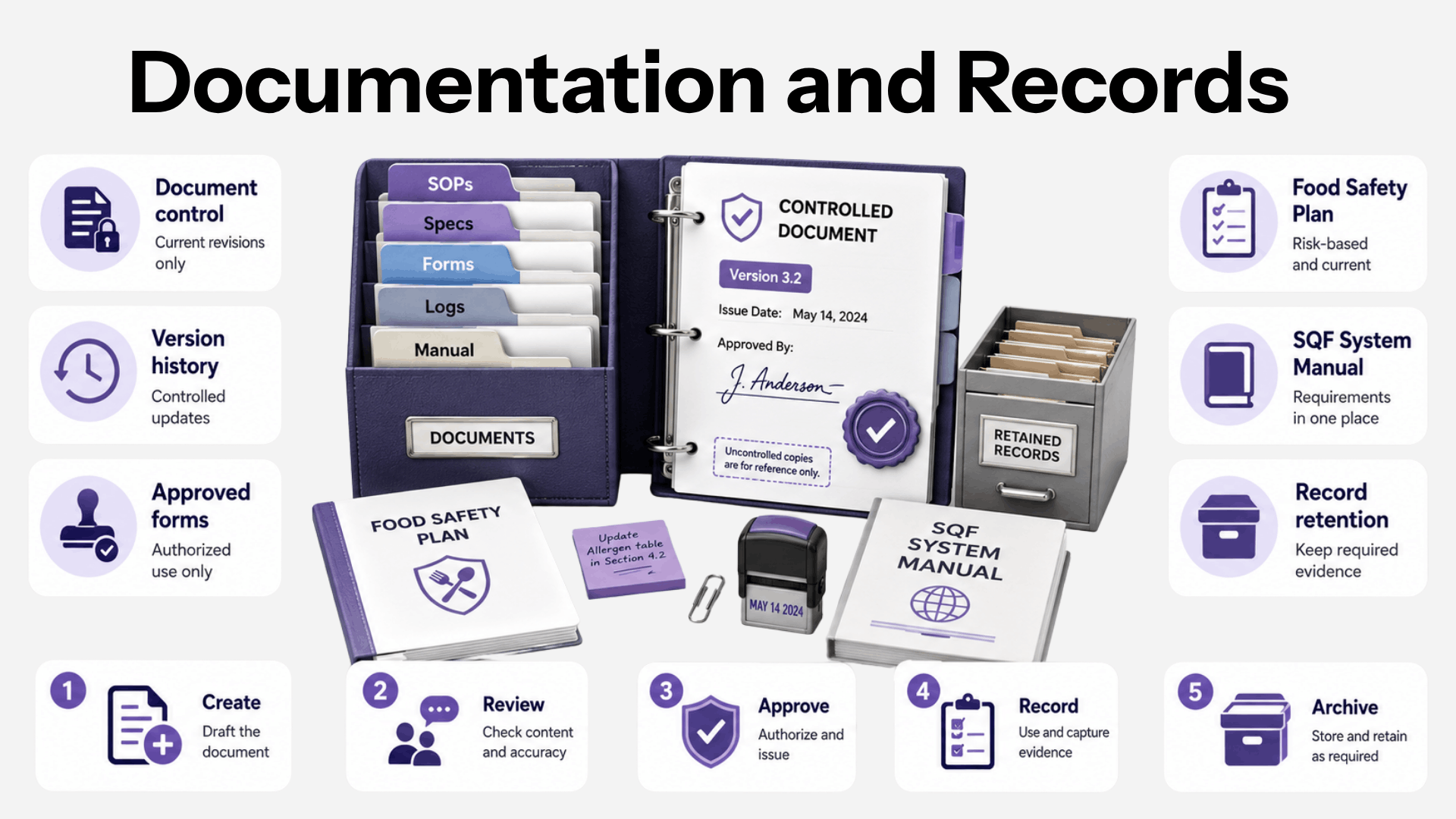
Document control is the system used to manage the creation, approval, revision, distribution, and removal of controlled documents.
Controlled documents, including SOPs, forms, specifications, and procedures, should have version numbers, approval dates, revision history, and named owners. Obsolete versions must be removed from production areas.
One of the most common document control findings is an operator using a printed SOP that was replaced months earlier.
Food Safety Plan
A Food Safety Plan is the formal documentation required under FSMA Preventive Controls for facilities subject to 21 CFR Part 117.
It includes hazard analysis, preventive controls, supply-chain controls, recall procedures, monitoring procedures, corrective-action procedures, and verification activities.
Under SQF and BRCGS, the equivalent is the HACCP plan combined with the supporting food safety management system documentation.
SQF System Manual
An SQF System Manual is a required document that describes how the site’s food safety management system is organized.
It acts as the framework document for the SQF system by explaining which procedures are in place, who owns them, and how records and programs are maintained.
Auditors usually review the System Manual before or during the desk audit. A manual that does not match current operations creates unnecessary audit risk.
Turn Food Safety Terms Into Daily Controls
A glossary helps teams use the same language. A working food safety system helps them connect that language to procedures, monitoring records, supplier documents, corrective actions, and audit evidence.
See How IONI Connects Food Safety Documentation
Food Safety Quick Reference
Key Terms
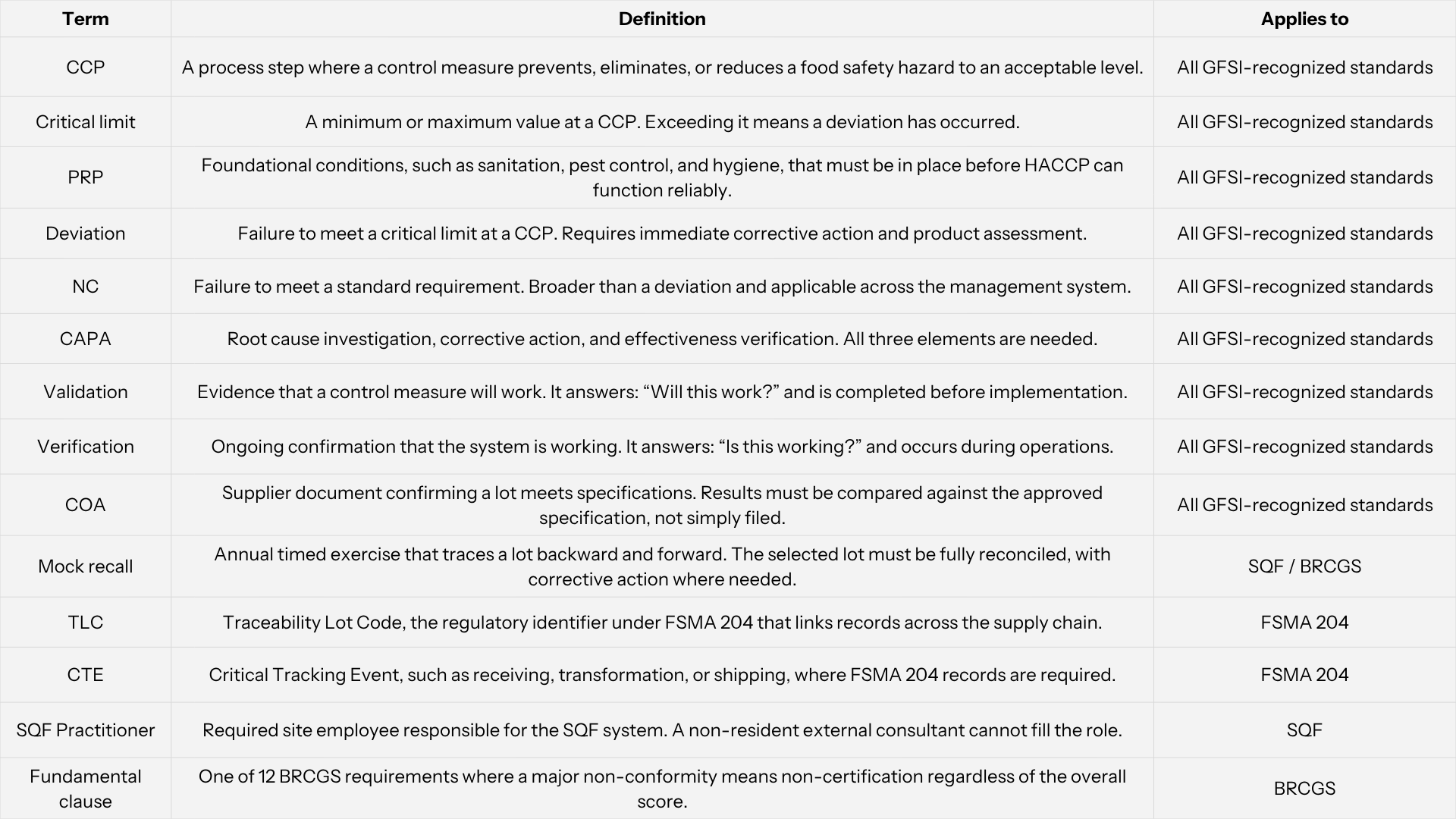
The 7 HACCP Principles
- Conduct a hazard analysis
- Identify critical control points
- Establish critical limits
- Establish monitoring procedures
- Establish corrective actions
- Establish verification procedures
- Establish record-keeping procedures
BRCGS Issue 9: 12 Fundamental Clauses
- Senior management commitment, clause 1.1
- Food safety plan and HACCP, clause 2
- Internal audits, clause 3.4
- Supplier management, clause 3.5.1
- Corrective actions, clause 3.7
- Traceability, clause 3.9
- Layout and product flow, clause 4.3
- Housekeeping and hygiene, clause 4.11
- Allergen management, clause 5.3
- Control of operations, clause 6.1
- Labelling and pack control, clause 6.2
- Training, clause 7.1
A major non-conformity against any fundamental clause results in non-certification, regardless of the overall audit performance. BRCGS is preparing the next revision (Issue 10); this glossary will be updated once it’s published.
Commonly Confused Terms
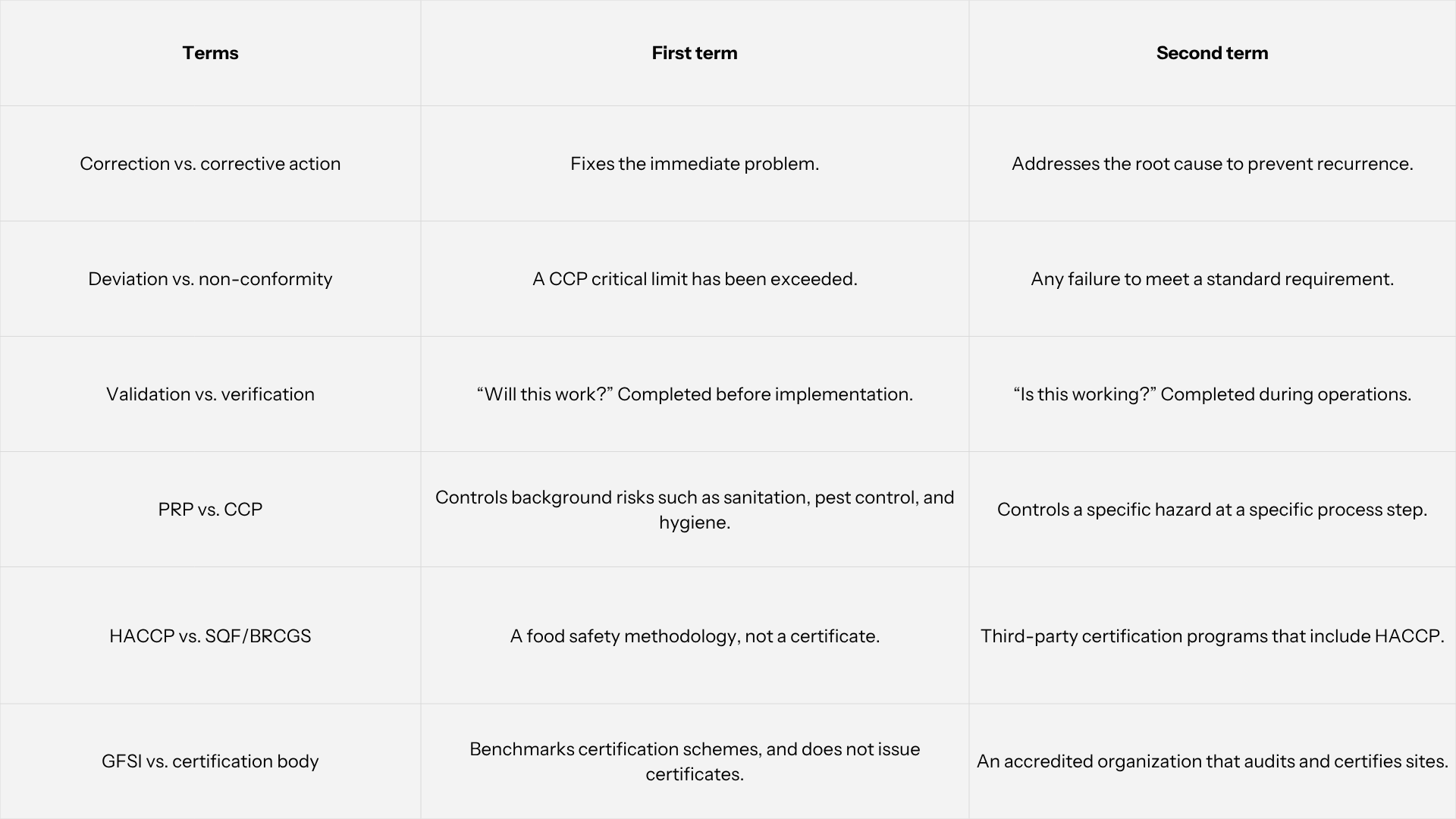
BRCGS Audit Grades
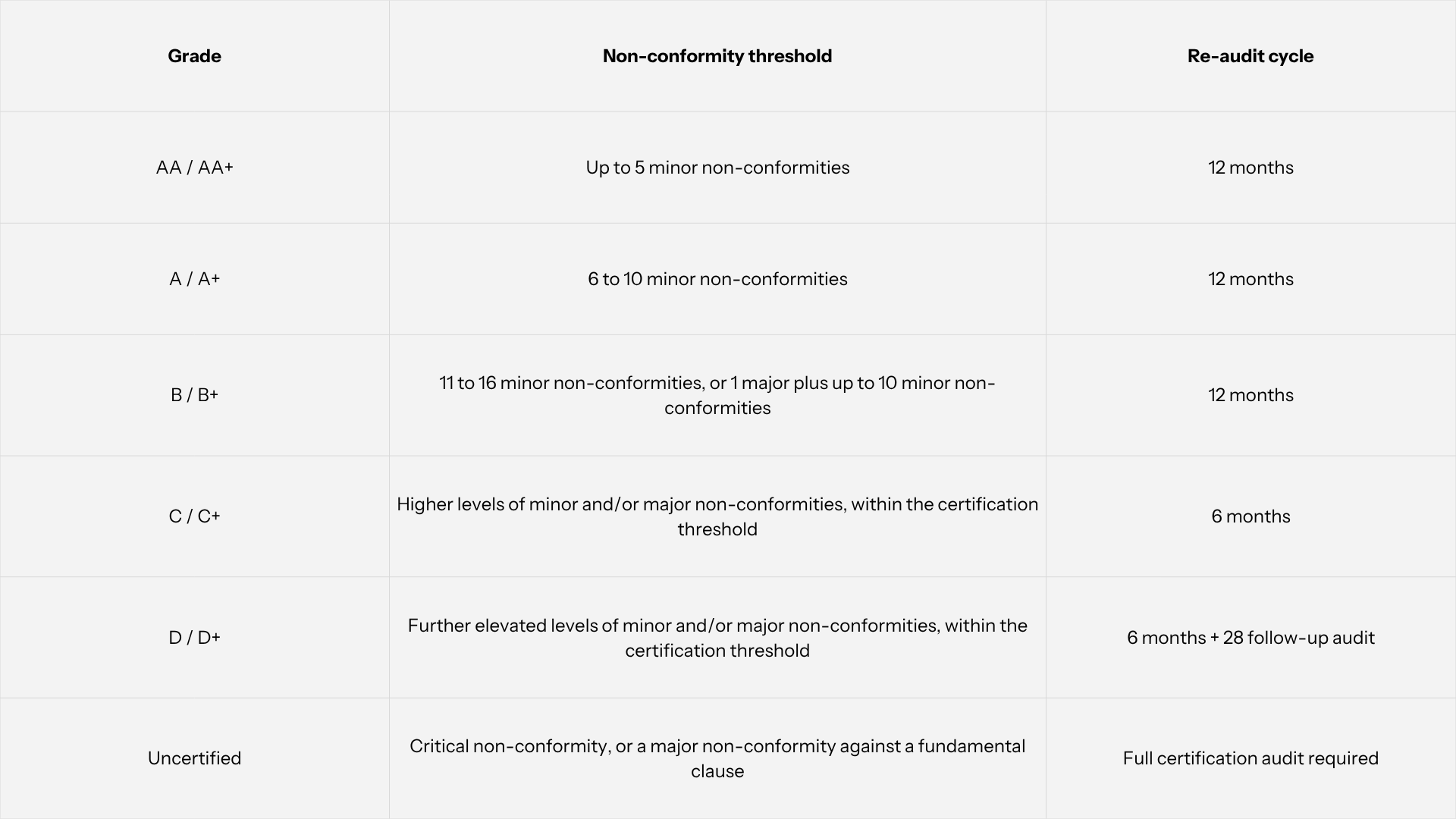
The “+” suffix means the audit was unannounced. BRCGS requires at least one unannounced audit during each three-year certification cycle.