The Foreign Supplier Verification Program (FSVP) is the FDA rule under FSMA that makes U.S. food importers verify that each foreign supplier produces food meeting U.S. safety standards. The FSVP importer must analyze hazards for each food, evaluate and approve each supplier, run verification activities, take corrective action when needed, keep records, and identify itself at entry.
Last updated: October 29, 2026
FSVP is codified at 21 CFR Part 1, Subpart L (sections 1.500 to 1.514) and explained on FDA's FSVP rule page. It is a distinct FSMA requirement, separate from a standard domestic supplier-approval program and from FDA food facility registration. For the wider picture, see our guide to the FSMA rules overall.
Who Is the FSVP Importer?
FDA defines the importer as the U.S. owner or consignee of the food at the time of entry. If there is no U.S. owner or consignee, the importer is the U.S. agent or representative of the foreign owner or consignee, confirmed by a signed statement of consent (21 CFR 1.500). That person or company is responsible for having an FSVP for each food and each foreign supplier. It is not always the same party as the customs importer of record, so confirm who owns the food at entry.
The FSVP must be developed and carried out by a qualified individual: someone with the education, training or experience needed for the activity, who can read and understand the language of the records they review. An employee of the importer can qualify, but employment is not required (21 CFR 1.500). If you bring in ingredients, private-label products or finished goods from outside the U.S., this responsibility generally falls on you even when your foreign supplier holds its own certifications.
FSVP Requirements Step by Step
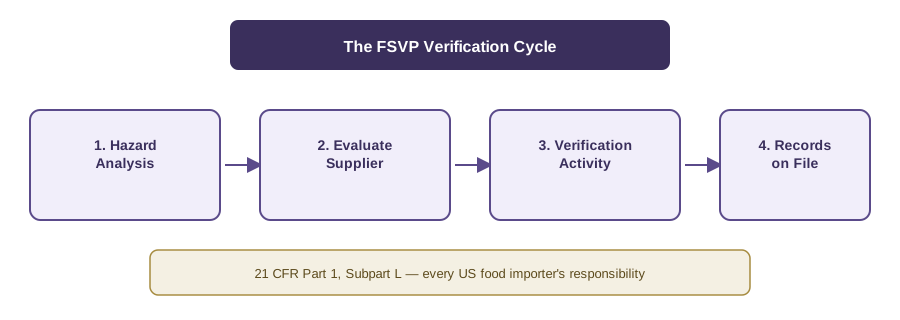
Each importer repeats this cycle for every food and supplier combination:
- Use a qualified individual. They develop the FSVP and perform or oversee each activity.
- Analyze the hazards in each food. Identify the biological, chemical and physical hazards, and which need a control (21 CFR 1.504).
- Evaluate the food and the supplier. Consider the hazard analysis, which party will control each hazard, the supplier's food safety procedures and practices, its compliance history with FDA (including warning letters and import alerts), and its food safety history (21 CFR 1.505(a)).
- Approve the supplier. Approve foreign suppliers based on that evaluation and document the approval (21 CFR 1.505(b)).
- Run verification activities. Choose and document the activity or activities that fit the hazard (see the table below) (21 CFR 1.506).
- Take corrective action when a supplier does not meet requirements, and document it (Subpart L, 21 CFR 1.508).
- Reevaluate. Reevaluate promptly when you learn new information about the hazards or the supplier, and at least once in any 3-year period, documenting the result (21 CFR 1.505(c)).
- Identify yourself at entry and keep records. For each line entry of food, provide your name, email address and a unique facility identifier FDA recognizes as acceptable when filing entry with CBP; FDA recognizes the DUNS number (21 CFR 1.509(a)).
Verification Activities: Which One When
The importer must determine and document which verification activities are needed and how often, before importing the food. The rule lists onsite audits, sampling and testing, review of the supplier's food safety records, and other appropriate activities.
| Situation | Typical verification | Citation |
|---|---|---|
| Hazard with a reasonable probability of serious adverse health consequences or death, controlled by the supplier | Onsite audit of the foreign supplier before first import and at least annually after, unless you document that other activities or less frequent auditing are appropriate | 21 CFR 1.506(d)(2) |
| Other hazards controlled by the supplier | Onsite audit, sampling and testing, review of the supplier's food safety records, or another appropriate activity, documented with its frequency | 21 CFR 1.506(d)(1) |
| Hazard controlled later by you, your customer or a later distribution step | The supplier evaluation and verification can be skipped when the rule's conditions are met, such as a documented system or annual written assurances from your customer | 21 CFR 1.507 |
You may rely on verification activities another entity performs if you review and assess the results, but you may not rely on the foreign supplier itself or its employees, except for sampling and testing (21 CFR 1.506(e)).
Exemptions and Modified Requirements
Not every import needs a full FSVP. The categories below come from FDA's FSVP rule page.
| Category | Status |
|---|---|
| Juice and seafood from suppliers compliant with HACCP (21 CFR Parts 120 and 123), and certain ingredients for them | Exempt |
| Food for research or evaluation, or for personal consumption | Exempt |
| Low-acid canned foods (21 CFR Part 113), for the microbiological hazards covered there | Exempt for those hazards only |
| Alcoholic beverages and certain ingredients for them | Exempt |
| Food imported for processing and future export | Exempt |
| Certain meat, poultry and egg products regulated by USDA at importation | Exempt |
| Very small importers (under $1 million a year in human food sales, averaged over three years) | Modified requirements |
| Food from certain small foreign suppliers, such as qualified facilities under the preventive controls rules | Modified requirements |
| Dietary supplements (depending on whether it is a finished product or an ingredient) | Modified requirements |
| Food from a country whose food safety system FDA recognizes as comparable or equivalent | Modified requirements |
Is There an FSVP Certification?
No. FSVP is a program the importer builds, runs and documents, not a certificate anyone issues. Training does exist: courses built on the FSPCA FSVP curriculum are offered by universities and training providers, for example Washington State University, and completing one is one way to show an individual is qualified. A supplier's GFSI certificate or third-party audit can be an input to your evaluation, but it does not replace your own documented verification. You must review and assess any audit you rely on, and you cannot rely on the foreign supplier's own say-so.
FSVP vs Supplier Approval vs Supplier Onboarding
| FSVP | Supplier approval program (SQF/BRCGS) | Supplier onboarding | |
|---|---|---|---|
| Required by | FDA (law), for importers | Certification scheme | Your own process |
| Applies to | Foreign suppliers of imported food | All suppliers of inputs | New suppliers |
| Core evidence | Hazard analysis, evaluation, verification, reevaluation every 3 years | Approved supplier list, risk assessment, specs, COAs | Documents, certificates, contacts |
A general onboarding workflow covers useful ground, as in our guide to supplier onboarding software, but it does not satisfy FSVP on its own: FSVP needs a documented hazard analysis tied to each imported food and verification chosen for that hazard's risk. For how an auditor reads the certification-scheme side, see the SQF supplier approval program minimum requirements.
FSVP Records Checklist
- The hazard analysis for each food
- Supplier evaluation and approval
- Verification results: audit reports, COAs, test results, reviewed supplier records
- Corrective actions
- Reevaluations, at least every 3 years
- The qualified individual's qualifications
- Retention: keep records at least 2 years after you created or obtained them, and records about your procedures and evaluations at least 2 years after you stop using them (21 CFR 1.510(c))
Keeping FSVP Evidence in One Place
FSVP is a records problem as much as a rules problem. IONI does not run your FSVP for you, but it keeps related evidence together: suppliers are tracked as partners with approval status and certificates, required supplier documents are set in facility settings, QMS document folders hold procedures such as your hazard analysis, and on a received lot you can attach a certificate of analysis and have it checked against the supplier's spec. For the COA side, see our guide to certificates of analysis and IONI Ingredients Intelligence, and for the broader documentation picture, our ingredient compliance checklist for brands that outsource manufacturing.
FAQ
What is FSVP in food safety?
FSVP (Foreign Supplier Verification Program) is an FDA requirement under FSMA that obligates U.S. food importers to verify that their foreign suppliers produce food that meets U.S. safety standards, through a documented hazard analysis, supplier evaluation and approval, verification activities, corrective actions and reevaluation.
Who is responsible for FSVP compliance?
The FSVP importer: the U.S. owner or consignee of the food at entry, or the U.S. agent of the foreign owner if there is no U.S. owner or consignee. A qualified individual develops and carries out the program.
What are the FSVP requirements?
For each food and foreign supplier: a qualified individual, a hazard analysis, supplier evaluation and approval, verification activities, corrective actions, reevaluation at least every 3 years, identification of the importer at entry, and records.
Is there an FSVP certification?
No. FSVP is a program the importer maintains, not a certificate. FSPCA-curriculum FSVP training exists and can help show an individual is qualified.
Do I need an FSVP if my foreign supplier is GFSI certified?
Usually yes. A GFSI certificate or third-party audit can inform your evaluation and verification if you review and assess the results, but it does not replace the importer's own documented FSVP, and you cannot rely on the foreign supplier itself for verification other than sampling and testing.
How long must FSVP records be kept?
At least 2 years after you created or obtained the records, and records about your processes, evaluations and determinations at least 2 years after their use stops (21 CFR 1.510).