.png)
Process manufacturing software for food is software built for recipe-based, batch production: it manages formulas, ingredient lots, batch records and traceability. ERP runs the business and its books, MES executes and records the work on the floor, and MOM is the wider operations category above it. Many small plants only need a production layer beside their accounting.
What Is Process Manufacturing Software for Food?
Food plants make product from ingredients that are combined, cooked, mixed or fermented, then split into lots and shipped. You cannot take a sauce apart again, so the record of what went into each batch is the product’s history. Software for production management in this setting has to handle recipes, ingredient lots, yield, rework, allergens and shelf life, not just bills of materials and routings.
The industry has a standards family for exactly this kind of production. ISA-88, known as the batch process control standards, names “batch processing in pharmaceuticals, food and beverage industries, chemicals and other batch processing industries” in its scope. It defines recipe models and, in Part 4, batch production records that provide “a framework for structuring batch data that supports traceability and completeness.” Those two ideas, the recipe and the batch record, are the core of manufacturing process management software for food.
ERP, MES and MOM: What Each Term Means
The acronyms get used loosely by vendors, so it helps to anchor them to the standards bodies and government sources.
ERP
NIST describes enterprise resource planning systems as commercial applications that provide the backbone for company-wide operations. In practice that means the finance system of record, plus purchasing, inventory and order management, in one database. A “food ERP” adds food-specific features such as lot traceability and recipes on top.
MES
NIST describes a manufacturing execution system as “manufacturing operations management software that accounts for inputs and outputs,” and notes that it collects data from many components, so it can feed an ERP. The MESA International models, which trace back to a 1996 model of 11 core MES functions, include scheduling and sequencing, maintenance and quality.
MOM
Manufacturing operations management is the category, and MES is one kind of system inside it. In the ISA-95 model, Level 3 is “manufacturing operations management” and covers manufacturing execution systems, while Level 4 is “business planning and logistics.” ISA-95 (also published as IEC 62264) primarily addresses the interface between those two levels. So manufacturing operations management software sits between the business system and the equipment, and ERP sits above it.
Comparison: Process Manufacturing Software, MES, MOM and ERP
| Category | Scope | Typical cost model | Setup effort | Best fit |
|---|---|---|---|---|
| ERP (including food ERP) | Finance, purchasing, inventory, orders, often production | Typically a license or subscription plus implementation services; quote-based | Largest: replaces or absorbs the back office, with data migration and process change | Multiple plants or legal entities, finance and inventory in one system |
| MES | Executing and recording production: work, materials, quality, genealogy | Typically quote-based; NIST notes costs “vary greatly” | Significant: often tied to equipment, lines and ERP integration | Plants with automated lines or detailed execution control |
| MOM | The wider operations category: production, quality, inventory and maintenance operations | Typically quote-based, often a suite of modules | Significant to large, depending on modules | Larger or multi-site operations coordinating plant systems with the business |
| Production and traceability layer | Batches, lots, receiving, shipments and food safety records beside existing accounting | Typically a subscription; quote-based | Smaller: keeps the books where they are | Small and mid-size plants running QuickBooks |
Prices are deliberately not listed. Every category here is quote-based in practice, and the spread within each one is wide. NIST’s own advice for small manufacturers is that costs vary greatly and that you should confirm a provider can migrate your historical data.
How the Layers Fit Together
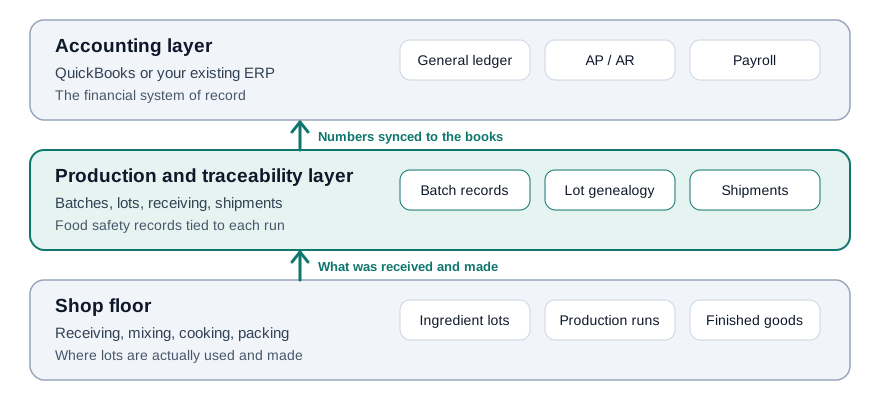
Think of three layers. The shop floor is where ingredient lots arrive, get used and become finished goods. The accounting layer, QuickBooks or an ERP, holds the general ledger, payables, receivables and payroll. The layer in the middle captures what was received and made, ties it to lot and batch records, and passes the numbers up to the books. NIST makes the same point about MES data: it can feed an ERP, and combining production data with ERP inventory and order data helps small and medium manufacturers respond to demand changes.
The planning side is a separate question. Manufacturing planning software has to understand allergen sequencing, sanitation windows and shelf life, which is why generic MRP often disappoints in food. Our post on production planning software for food manufacturers covers that gap in detail.
What Small Plants Actually Need
Most small food plants do not have an ERP problem. Their books close, their payroll runs, and QuickBooks does its job. What they lack is a reliable record of production: which ingredient lots went into which batch, which lots shipped to which customer, and where the checks were recorded. That is the heart of food manufacturing management on the plant floor.
- Lot-level records. Receiving, production and shipping tied together so a mock recall takes minutes, not a day of paper. See our guide to batch and lot tracking software.
- Digital batch records. Replacing paper batch sheets with records you can search. See electronic batch records for food manufacturers.
- A clean handoff to accounting. Cost and inventory numbers that reach the books without retyping. See manufacturing software that works with QuickBooks.
- Room to grow. Exports or integrations so a later ERP or MES does not mean starting over.
A full ERP becomes the better answer when you run several plants or legal entities and need finance, purchasing and inventory in one system. Our post on food ERP software and when a full ERP is overkill walks through that threshold. An MES or MOM system becomes the better answer when you have automated lines and need machine-level execution control.
How to Choose Software for a Food and Beverage Plant
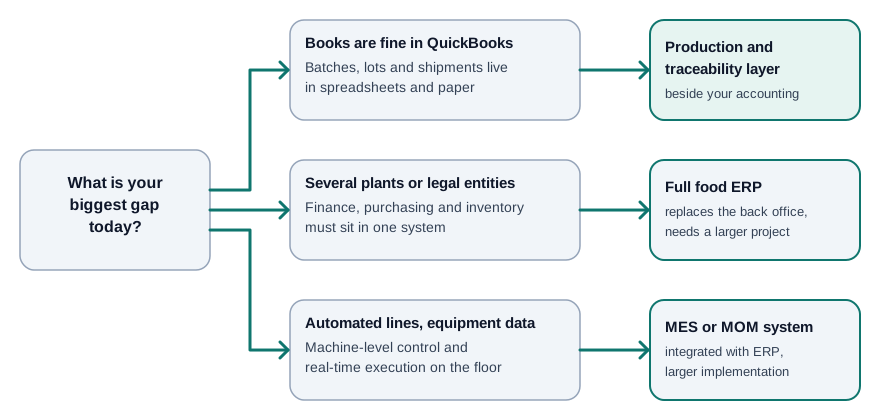
For food and beverage manufacturing software, work through the decision in this order.
- Name the gap. Write down whether the problem is accounting, production records, traceability, or equipment control. These need different tools.
- Keep what works. If your books are fine, avoid replacing them just to get lot tracking.
- List the records you must produce. Batch records, ingredient lot genealogy, shipment records and food safety checks for customers and auditors.
- Check integration. Ask how the system connects to your accounting software, by API, CSV or a native connection.
- Test with a mock recall. Pick a finished lot and ask each vendor to trace it back to ingredient lots and forward to customers.
- Get quotes in writing. Ask for implementation, training and data migration costs separately from the subscription.
Where IONI Fits
IONI is not an ERP and has no general ledger, accounts payable or receivable, or payroll. According to its food manufacturing software page, IONI tracks batches, lots, receiving and shipments in one system, ties each ingredient lot from receiving through production to finished goods, and runs alongside the QuickBooks you already use. It can also connect to an existing ERP or production system by API or CSV import. It is the production and traceability layer in the middle of the stack above, not a replacement for your accounting.
Frequently Asked Questions
What is process manufacturing software?
It is software for recipe-based, batch production. It manages formulas, ingredient lots, batch records and traceability. The ISA-88 batch standards cover this style of production, including food and beverage.
What is the difference between MES and MOM?
MOM is the broader category of manufacturing operations management, and MES is one kind of system within it. In the ISA-95 model, both sit at Level 3, between the plant equipment and business planning at Level 4.
Is an MES the same as an ERP?
No. An ERP is the business backbone for finance, purchasing and inventory, while an MES executes and records production. NIST notes an MES can feed data into an ERP, so many plants use both.
Do small food plants need an ERP or an MES?
Not always. If accounting already works in QuickBooks, many small plants need a production and traceability layer for batches and lots instead. A full ERP or MES makes more sense with several plants or automated lines.
How much does process manufacturing software cost?
It typically varies and is quote-based. NIST says MES costs vary greatly. Ask vendors to price subscription, implementation, training and data migration separately.
Can production software work alongside QuickBooks?
Yes. A production and traceability layer can record batches, lots and shipments and sync the relevant numbers to your books, so you keep QuickBooks for accounting.
Last updated: October 7, 2026