Shelf life testing is how a food manufacturer finds out how long a product keeps its safety and quality under stated storage conditions, so it can print a defensible date. It combines real-time storage, accelerated testing and checks on sensory, microbial, chemical and physical attributes.
This guide compares the main methods, walks through a study step by step and explains how the result becomes a label date. The date then drives rotation and traceability; see our guides to lot codes and date coding and FEFO vs FIFO.
What Shelf Life Is and Who Sets It
Shelf life is the period during which a product, stored as directed, stays safe and keeps the quality you promise. The manufacturer decides it and must be able to back the decision with data. A product can reach the end of its shelf life because of safety (for example, microbial growth), quality (flavor, color, texture) or both, and the limiting factor is different for a refrigerated sauce than for a dry mix.
Real-Time vs Accelerated Shelf Life Testing
| Method | How it works | Strengths | Limits |
|---|---|---|---|
| Real-time testing | Store samples at the intended conditions and test over time until the product fails | The most direct evidence | Takes as long as the shelf life itself |
| Accelerated shelf life testing | Store samples at higher temperature or humidity to speed up deterioration, then estimate shelf life at normal conditions | Much faster, useful for product development | Only valid if the same deterioration pathway applies at the higher condition |
| Challenge or inoculation study | Add a target organism and measure whether it grows or survives in the product | Directly tests a microbial hazard | Needs a qualified laboratory and a written protocol |
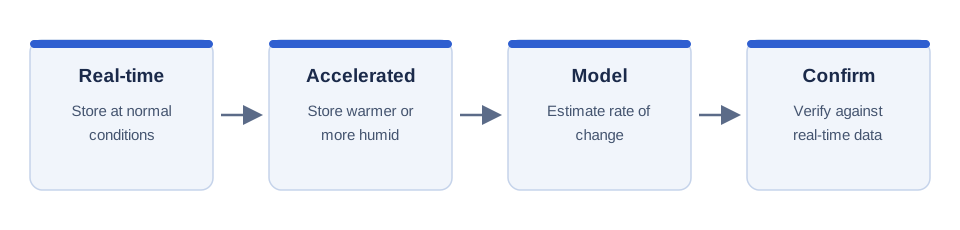
The abstract of a published article on accelerated temperature testing (the full text is in Thai) says the Q10 equation and/or kinetic reaction models are often used to calculate shelf life, that accelerated studies take less time than testing under normal storage, and that the test design should match the deterioration characteristics of the food (article abstract). Q10 expresses how much the reaction rate changes for each 10 degrees C rise in temperature. Treat an accelerated estimate as a forecast to be confirmed with real-time data.
What to Test
| Attribute | Examples | Typical failure |
|---|---|---|
| Sensory | Appearance, aroma, flavor, texture | Rancid or stale flavor, color fade, hardening |
| Microbial | Total plate count, yeast and mold, target pathogens or spoilage organisms | Growth beyond your limit |
| Chemical | Water activity, pH, peroxide value, moisture | Oxidation, drift outside spec |
| Physical | Texture, separation, package integrity | Syneresis, caking, seal failure |
How to Run a Shelf Life Study, Step by Step
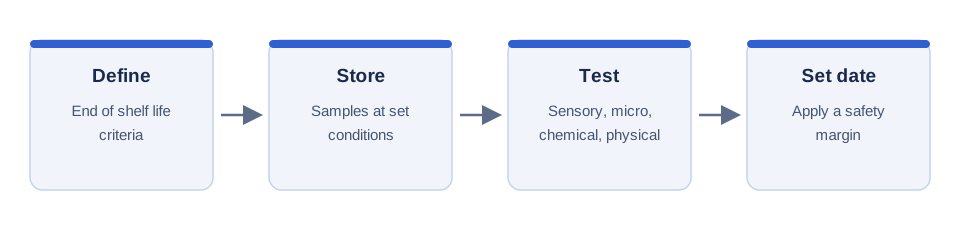
- Define what counts as the end of shelf life: a sensory score, a microbial limit, a spec value.
- Choose storage conditions that match real distribution, including a worst realistic case.
- Make the samples from representative production lots, in final packaging.
- Set the pull schedule so you test before, at and after the expected end date.
- Test each pull for the attributes above and keep the raw data.
- Find the point where the first failure occurs, then apply a safety margin to set the date.
- Re-test when the recipe, process, packaging or storage conditions change.
Date Labels: What FDA and USDA Say
Except for infant formula, manufacturers are not required by federal law or regulation to place quality-based date labels on packaged food, according to FDA. Infant formula must carry a "Use-By" date (USDA FSIS). FDA also says it supports efforts to make "Best if Used By" the standard phrase for the date when a product will be at its best flavor and quality. Check any state, customer or export-market requirements separately, because they can differ.
Quality dates do not remove your safety obligations. Where a hazard such as microbial growth limits the life of the product, your food safety plan and any required studies should reflect it, with advice from a qualified laboratory or process authority.
Microbial growth often limits shelf life, and our guide to FATTOM explains the conditions that drive it.
Where IONI Fits
IONI is the production and traceability layer that runs on top of the QuickBooks you already have. Product records hold shelf life, and batch assembly suggests lots first-expired-first-out. IONI does not run your shelf life study or decide the date; it carries the date you set through to the lots you make and ship.
FAQ
What is shelf life testing?
It is the set of tests a manufacturer uses to find how long a food stays safe and keeps its quality under stated storage conditions, so it can set a date.
What is accelerated shelf life testing?
It stores samples at higher temperature or humidity to speed up deterioration and estimates shelf life at normal conditions, usually then confirmed with real-time data.
Is a date label required on food in the United States?
Generally not under federal law. Infant formula is the exception and must carry a "Use-By" date. Some states and customers have their own requirements.
What does "Best If Used By" mean?
FDA supports it as the standard phrase for the date a product will be at its best flavor and quality. It signals a quality date.
How long should a shelf life study run?
Long enough to see the product fail, with pulls before, at and after the expected end date. Accelerated testing shortens this but should be confirmed in real time.
Last updated: October 21, 2026
Keep the production record where the work happens. Explore IONI's production and traceability software for food manufacturers.