.png)
Introduction
Bacteria do not grow by accident. They need the right conditions: available nutrients, suitable acidity, sufficient time, favorable temperature, an adequate oxygen environment, and sufficient usable moisture. Take away enough of those conditions, and growth slows or stops. Leave too many of them uncontrolled, and a food that looks normal can still become unsafe.
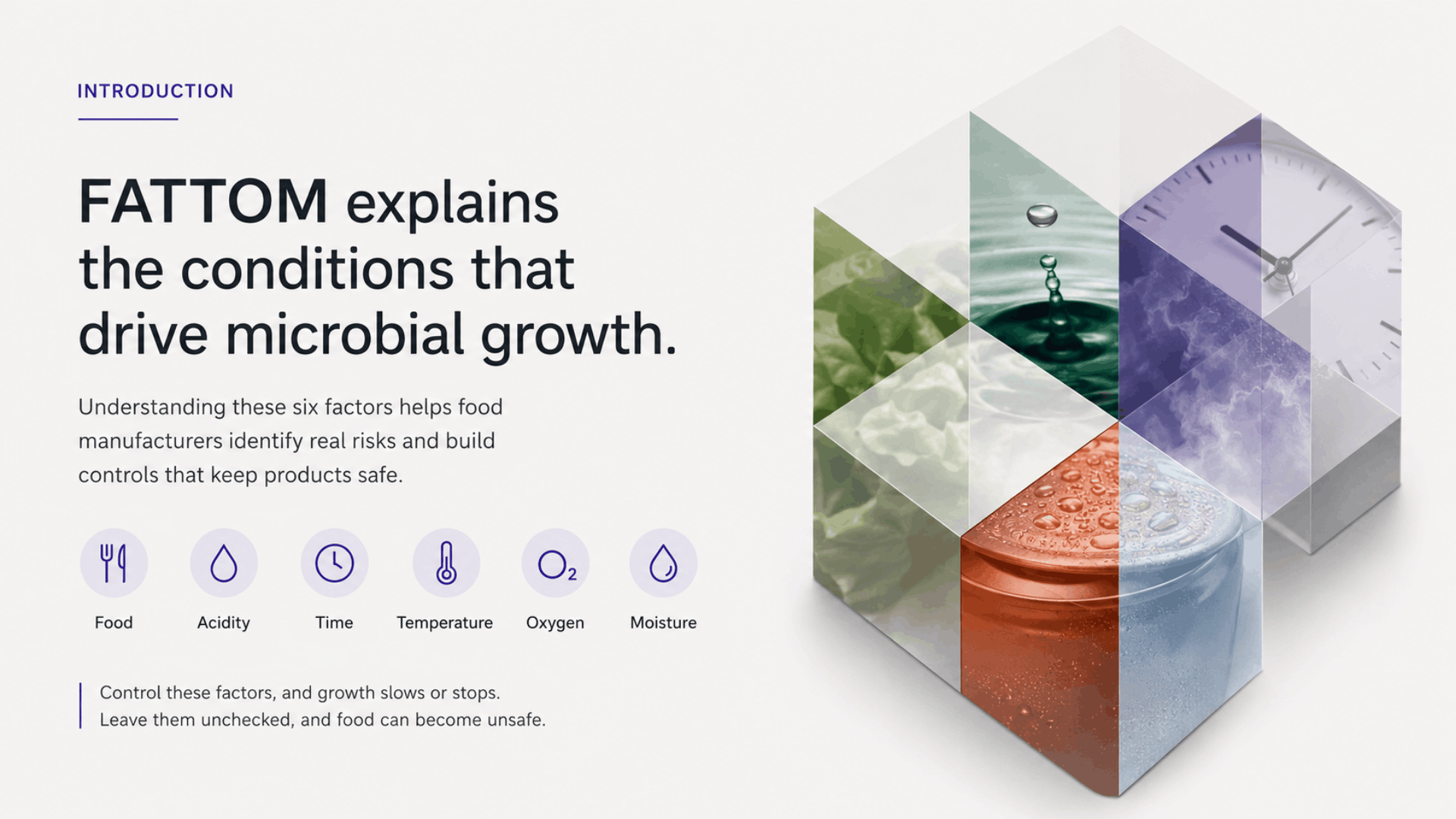
Here is why FATTOM matters in food safety.
For a food handler or restaurant worker, FATTOM helps explain why everyday rules exist. For a QA manager or food manufacturer, it helps connect microbiological risk to real controls, including CCPs, prerequisite programs, product specifications, supplier controls, and audit evidence.
What FATTOM Stands For
FATTOM stands for Food, Acidity, Time, Temperature, Oxygen, and Moisture. It is a simple acronym, but it explains much of the logic behind refrigeration rules, cooking limits, cooling procedures, pH controls, shelf-stable products, vacuum packaging risks, and HACCP plans.
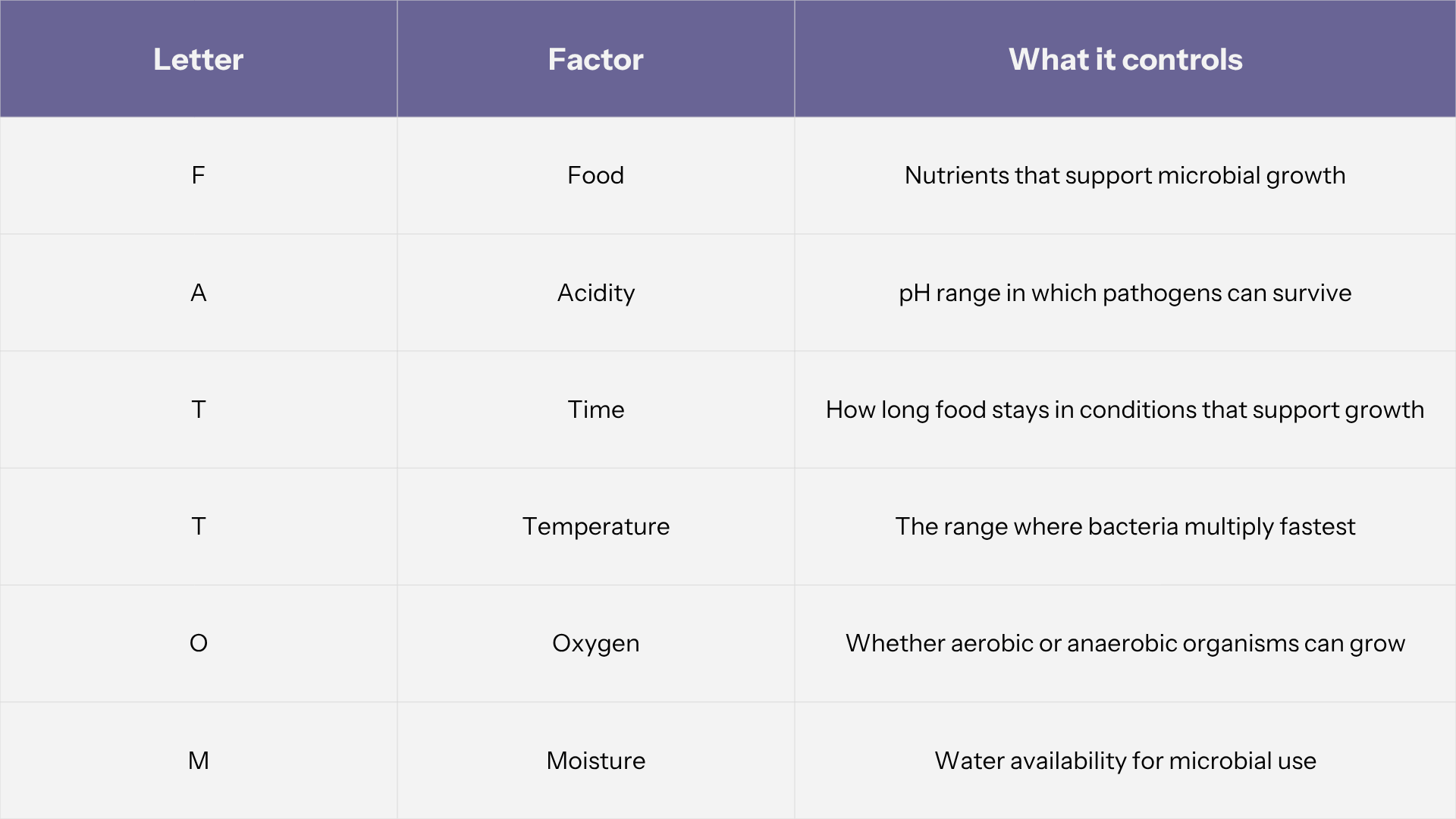
These six factors do not work separately. They overlap.
A food with low pH may stay safe even when moisture is present. A dry product with low water activity may tolerate room temperature because microorganisms cannot use enough water to grow. A vacuum-packed food may last longer from a spoilage perspective but can create new risks if pH, temperature, or water activity are not controlled.
That is why strong food safety programs do not treat FATTOM as trivia. They use it to decide which controls matter for a specific food, process, package, and shelf life.
F, Food (Nutrients)
Pathogens need nutrients to grow. Foods rich in protein and moisture, such as meat, poultry, seafood, eggs, dairy, cooked rice, cooked pasta, and many prepared meals, provide a favorable environment for bacterial multiplication. Dry, low-moisture, low-protein foods such as crackers or hard candy are generally less hospitable.
This is why a cooked chicken breast left on a counter for three hours is a very different risk from a loaf of bread left in the same place. The chicken has nutrients, moisture, and a neutral pH. The bread may still spoil over time, but it usually does not support rapid pathogen growth in the same way.
In practice, food manufacturers rarely control the nutrient factor directly. You cannot make chicken stop being a high-protein food. You cannot make cooked rice stop being a starch that supports Bacillus cereus if time and temperature are abused. What you can do is control the conditions around the food.
So, we may see the logic behind refrigeration, cooking, hot holding, cooling, acidification, drying, formulation controls, and shelf-life validation. The food itself may support growth, so the process must prevent growth.
The FDA Food Code uses the concept of TCS foods, or Time/Temperature Control for Safety foods, to describe foods that need time and temperature control because their characteristics support pathogen growth. For manufacturers, this logic also affects ingredient specifications, supplier approval, receiving checks, and production hold-time limits.
FATTOM is microbiological risk. It does not replace allergen control. For allergen hazards, manufacturers need a separate control plan covering ingredient approval, label review, segregation, cleaning validation, changeovers, rework, and verification. See our guide to allergen management for food manufacturers for that side of the food safety system.
A, Acidity (pH)
Acidity is measured by pH. The scale runs from 0 to 14. A pH of 7 is neutral. Lower values are more acidic. Higher values are more alkaline.
Most foodborne pathogens grow best in the relatively neutral range where many meats, dairy products, cooked vegetables, sauces, and prepared foods sit. Once pH is low enough, growth of many pathogenic bacteria becomes difficult or impossible.
The key regulatory threshold is pH 4.6. Foods at or below this level are generally considered high-acid or properly acidified from a pathogen-growth perspective. The US regulation for acidified foods, 21 CFR Part 114, requires acidified foods to reach an equilibrium pH of 4.6 or below.
That threshold matters because Clostridium botulinum, the organism associated with botulism toxin, cannot grow and produce toxin under properly controlled high-acid conditions. This is why vinegar-based pickles, properly acidified sauces, and many citrus-based products can be shelf-stable when the formulation and process are validated.
But acidity is not magic. A chicken product at pH 6.2 still needs time, temperature, or another validated control. A sauce with inconsistent mixing may test safely in one sample but not in another. A product that relies on acidification needs clear specifications, calibrated pH meters, defined sampling points, and documented corrective actions when pH is out of range.
T, Time
Time is the factor that turns a small risk into a serious one.
When conditions are favorable, bacteria can multiply quickly. A product does not need to look spoiled for pathogen levels to become unsafe. This is one of the hard parts of food safety: visual inspection is not enough. A food can look, smell, and taste normal even after it has spent too long in unsafe conditions.
The practical rule most people know is the 2-hour rule. USDA guidance on the temperature danger zone says perishable food should not be left out of refrigeration for more than 2 hours. If the temperature is above 90°F, that time drops to 1 hour.
For food service teams, time control usually means limiting how long food sits between cooking, holding, serving, and refrigeration.
For food manufacturers, time control can appear in more places:
- Receiving delays for chilled ingredients
- Staging time before production
- In-process hold times
- Cooling time after heat treatment
- Rework holding time
- Line stoppages
- Packaging delays
- Warehouse loading and unloading
- Sample retention and lab release holds
A common weakness is that teams control final storage temperature but do not control the time between steps. For example, a product may be cooked correctly and refrigerated correctly, but spend too long waiting for packaging. If that waiting time is not defined, monitored, and recorded, the HACCP plan may miss a real exposure point.
Time controls should be specific. “As soon as possible” is weak. “Product must enter cooling within 15 minutes after cooking” is auditable. “Rework must be used within 4 hours under refrigeration or discarded” is actionable. Strong food safety systems turn vague expectations into measurable limits.
T, Temperature
Temperature is the FATTOM factor most people recognize because it is easy to observe, easy to measure, and central to many food safety rules.
The commonly used temperature danger zone is 40°F to 140°F, or 4°C to 60°C. Within this range, many pathogens can grow quickly. Below refrigeration temperatures, growth slows. At proper cooking or pasteurization temperatures, pathogens are reduced or destroyed when the time and temperature combination is validated.
A few details matter.
First, refrigeration slows growth. It does not always stop it. FDA notes that Listeria monocytogenes can grow at refrigeration temperatures. This is why ready-to-eat foods, especially foods that will not receive a kill step before consumption, need controls beyond cold storage alone.
Second, freezing does not reliably kill pathogens. It stops growth while the food remains frozen. When the product thaws, surviving microorganisms may resume growth if other FATTOM factors allow it.
Third, cooking only works if the correct internal temperature is reached for the required time. Surface heating does not guarantee safety in thick products, filled products, mixed products, or products with uneven heat transfer. A validated cook step needs a defined target, a monitoring method, equipment checks, and corrective action rules.
Temperature failures often happen during transitions, not during the obvious steps. A cooler may be working, but product may sit on the dock. A kettle may hit the target, but the cooling step may be too slow. A freezer may hold temperature, but pallets may sit too long before loading.
For manufacturers, temperature control is only as strong as the records behind it. That means receiving logs, cooler logs, cook records, cooling records, calibration records, deviation records, and corrective actions need to connect. If you are preparing for certification, our guide to FSSC 22000 certification for food manufacturers explains how documented controls and audit evidence fit into a broader food safety management system.
O, Oxygen
Oxygen is one of the most misunderstood FATTOM factors.
Many spoilage organisms need oxygen. Molds, many spoilage bacteria, and some yeasts grow better when oxygen is available. Removing oxygen through vacuum packaging, modified-atmosphere packaging, oil submersion, or sealed packaging can extend shelf life by slowing the growth of these organisms.
But removing oxygen does not automatically make food safe.
Some dangerous organisms grow without oxygen. Clostridium botulinum is the major concern. Clostridium perfringens is another. These organisms are anaerobic, meaning oxygen-free environments can support them if other factors, such as pH, temperature, and water activity, are not controlled.
There are also facultative anaerobes, which can grow with or without oxygen. Salmonella, E. coli, Listeria, and Staphylococcus aureus fall into this broader risk category. This is why oxygen control alone is never enough for food safety.
Garlic in oil is the classic example. Oil limits oxygen exposure, which may reduce some spoilage signs. But if the product is not acidified, refrigerated, or otherwise controlled, the oxygen-free environment can support botulinum toxin formation. The product may still look and smell normal.
For manufacturers, oxygen risk should be reviewed whenever packaging changes. Moving from open packaging to vacuum packaging is not just a shelf-life decision. It can change the hazard profile.
A HACCP review should consider whether the new package reduces oxygen, whether the product has a neutral pH, whether water activity is high enough to support microbial growth, whether the product will be refrigerated, what could happen if cold chain control fails, and whether shelf life has been validated under the new packaging condition.
Packaging innovation can create commercial value, but it needs food safety review before launch. This is also where regulatory monitoring matters. New rules, guidance, or market expectations can affect packaging, labeling, claims, and shelf-life assumptions. Our article on regulatory intelligence for food manufacturers explains how teams can track those changes before they become audit or market-access issues.
M, Moisture (Water Activity)
Moisture in food safety does not mean how wet a food looks. The more precise concept is water activity, written as aw.
Water activity measures how much water is available for microorganisms to use. Pure water has an aw of 1.0. When salt, sugar, drying, or other formulation methods bind water, microorganisms have less available water even if the product still feels moist.
FDA’s guidance on water activity in foods explains why available moisture is a key factor in microbial growth. A food with high total moisture can be stable if its water activity is low. A food that looks dry can still be risky if it absorbs moisture during storage or handling.
Useful thresholds include:
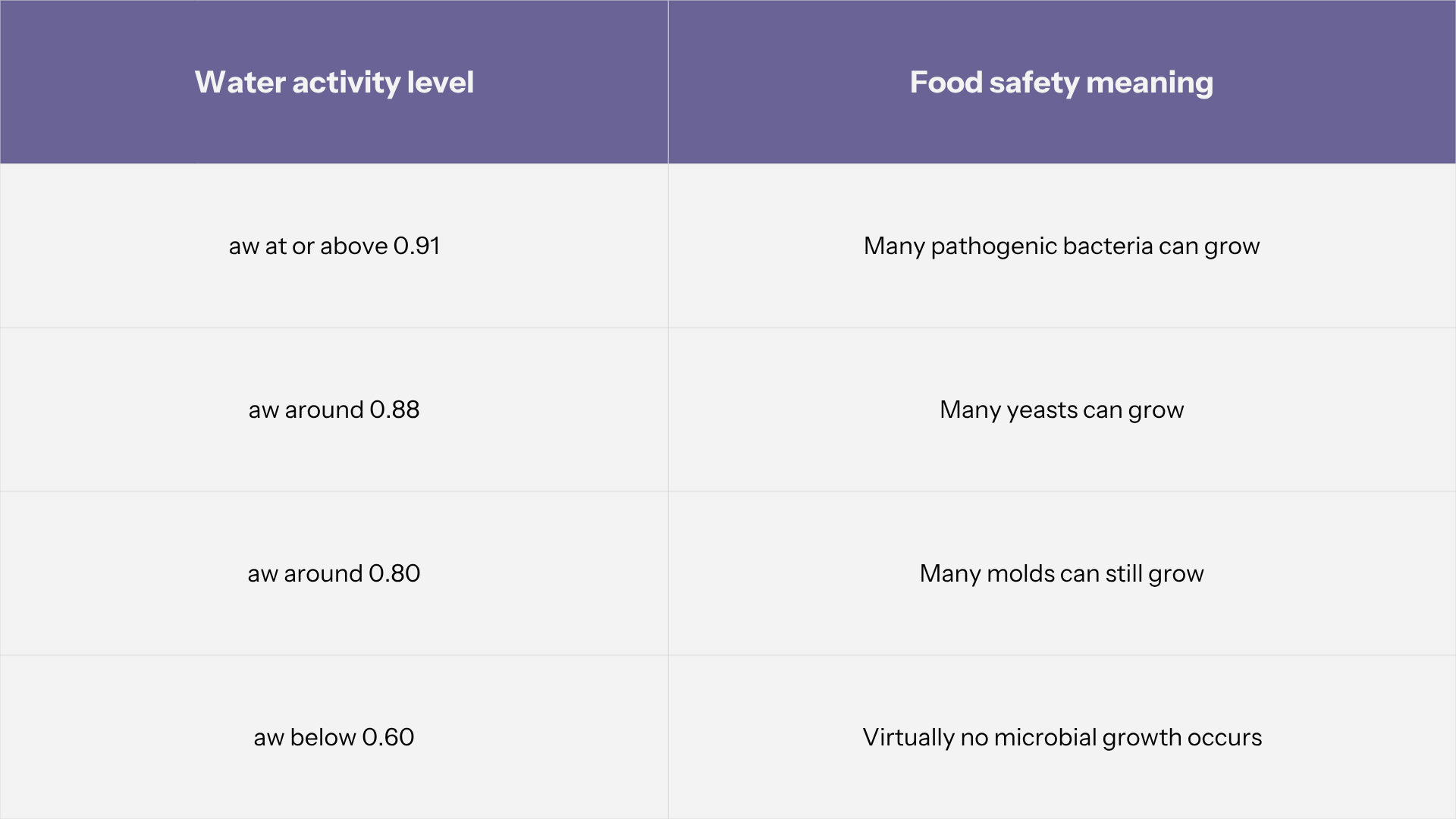
Jerky, dried fruit, crackers, honey, and some hard cheeses are shelf-stable because water activity is low enough to prevent microbial growth. Honey may contain spores, but low water activity prevents those spores from germinating and multiplying under normal conditions.
The distinction between moisture and water activity matters in real production. A product may pass a “dry enough” visual check but fail water activity. A formulation change may add a syrup, filling, coating, or inclusion that changes aw. A packaging change may allow moisture migration. A supplier change may introduce an ingredient with a different water profile.
For low-moisture products, the main hazard may not be growth during storage. It may be survival. Pathogens such as Salmonella can survive in low-moisture foods for long periods, then become a problem if the food is rehydrated, added to another product, or exposed to moisture in the process environment.
That's why dry-product facilities still need sanitation controls, environmental monitoring, supplier approval, and clear handling procedures. Low water activity reduces growth risk, but it does not excuse weak hygiene.
How the Six Factors Work Together
FATTOM factors compound. A food that fails on several factors at once carries more risk than a food that has one favorable condition but compensates with others.
Raw ground beef held at room temperature for four hours is high risk because several factors are unfavorable at the same time:
- It has nutrients.
- It has high moisture.
- It has near-neutral pH.
- It has had enough time for growth.
- Oxygen is not providing a reliable control.
A properly made beef jerky is different. The product still contains protein and may have near-neutral pH, but low water activity does the heavy lifting. Temperature and time are less critical because microorganisms cannot access enough water to grow.
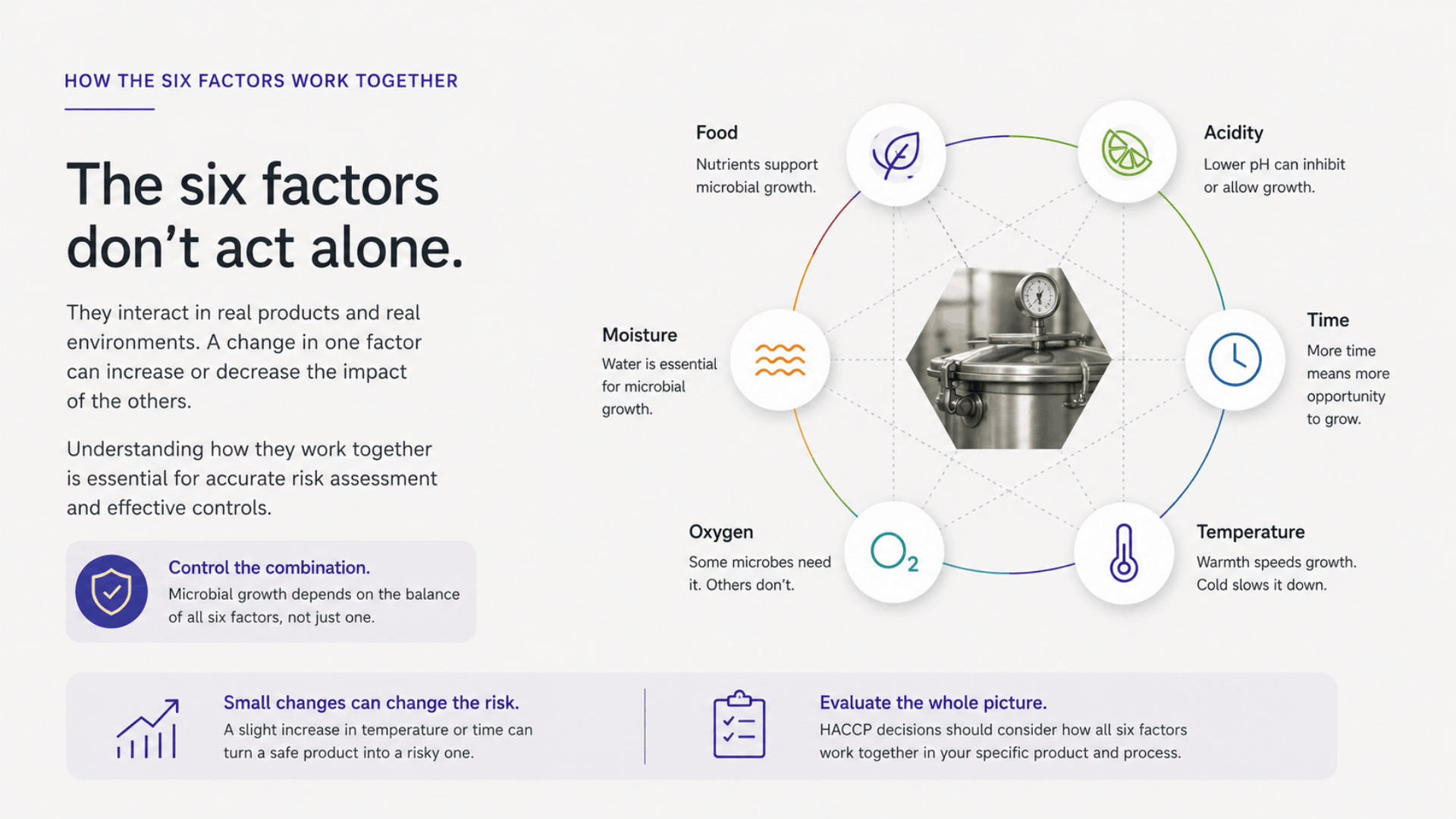
Acidified pickles are different again. They may contain moisture, but pH controls pathogen growth. Frozen raw meat is different because temperature prevents growth, although pathogens may survive. Vacuum-packed ready-to-eat foods are different because oxygen has been reduced, but that may increase concern for anaerobic pathogens unless pH, temperature, shelf life, and formulation are controlled.
Food safety is rarely about one factor. It is usually about the combination of factors that either allows growth or blocks it.
This is the same logic behind hurdle technology. Instead of relying on one extreme control, a food may use several controls together: moderate acidity, reduced water activity, refrigeration, preservatives, validated packaging, and limited shelf life. Each hurdle reduces risk. Together, they create a safer product.
FATTOM and HACCP: How They Connect
This section is most relevant for food manufacturers, food science students, and QA professionals. Food handlers and restaurant workers can skip to the FAQ.
HACCP, or Hazard Analysis and Critical Control Points, is the systematic approach food manufacturers use to identify, evaluate, and control food safety hazards. Every CCP or preventive control in a HACCP plan should connect back to a specific hazard and a specific condition that must be controlled.
FATTOM helps explain why those controls exist.
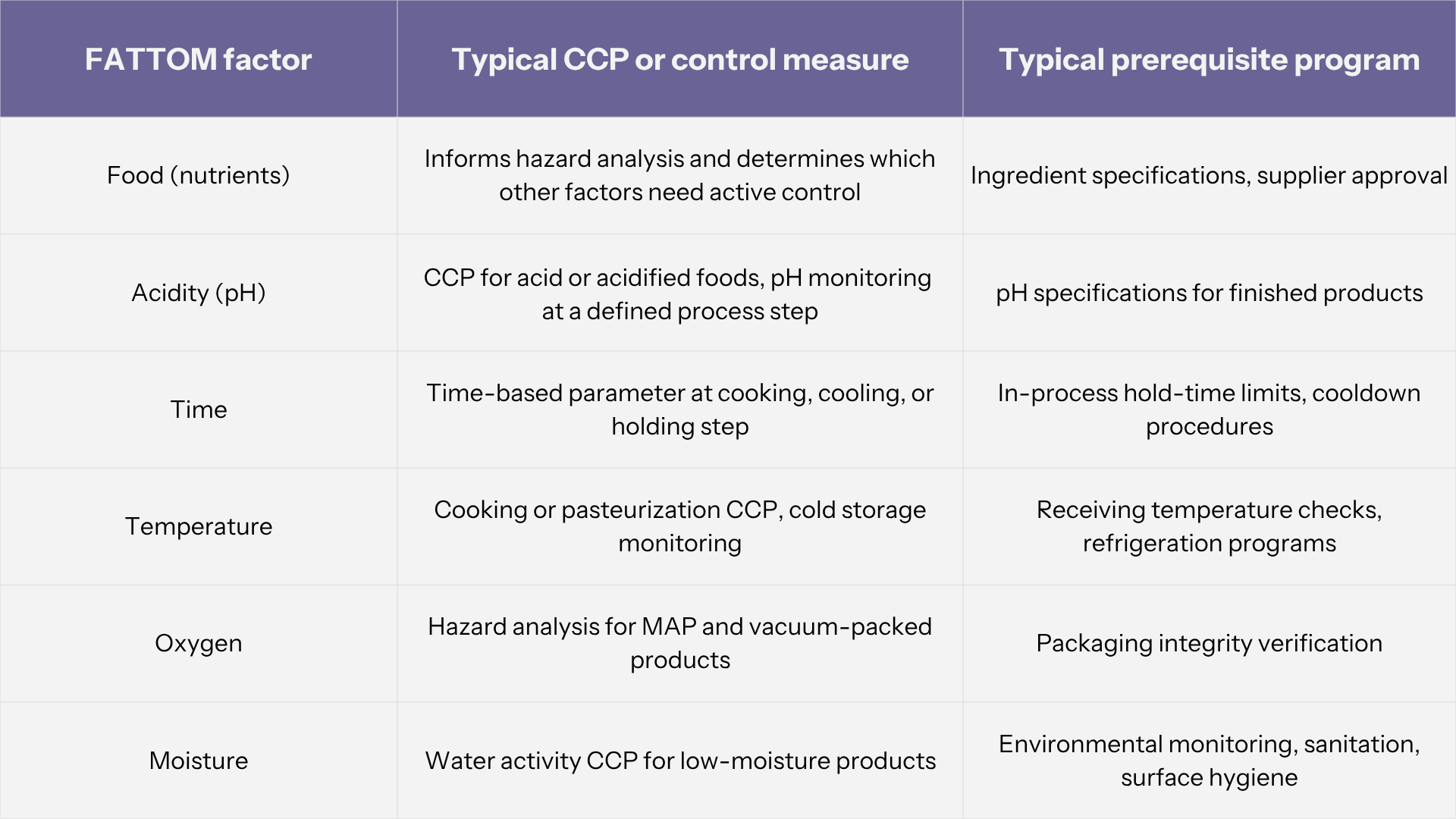
A temperature-only hazard analysis can leave gaps. Reformulation may change water activity. Acidified products still need verified equilibrium pH. Vacuum packaging can introduce anaerobic pathogen risk. Chilled ingredients may sit too long before processing, and rework may be allowed without clear time and temperature limits.
Each of these is a FATTOM issue. Each can become an audit finding, a deviation, or a food safety incident.
Prerequisite programs handle background FATTOM risks across the facility. Sanitation reduces residues and moisture. Pest control limits contamination and nutrient access. Supplier approval controls ingredient quality. Refrigeration programs protect the cold chain. Calibration ensures instruments can be trusted. Packaging checks help manage oxygen exposure and product integrity.
CCPs and preventive controls then focus on hazards that cannot be controlled by prerequisite programs alone.
For worked critical control point examples with critical limits and sources, see our CCP guide.
This is also where food safety culture becomes practical. Culture is not just posters, slogans, or annual training. It shows up when operators understand why a limit matters, when supervisors do not ignore repeated deviations, and when corrective actions fix the system rather than just the record. For SQF teams, our guide to food safety culture under SQF Edition 10 explains how to document that behavior in a way auditors can evaluate.
FAQ
What does FATTOM stand for in food safety?
FATTOM stands for Food, Acidity, Time, Temperature, Oxygen, and Moisture. These are the six factors that affect whether pathogenic microorganisms can grow in food to dangerous levels. Controlling one or more of these factors can prevent or slow microbial growth.
FATTOM is used in food safety training because it makes the science easier to remember. It also helps explain the logic behind HACCP hazard analysis, prerequisite programs, TCS food rules, time and temperature limits, acidified food controls, and water activity specifications.
What is the temperature danger zone in FATTOM?
The temperature danger zone is commonly described as 40°F to 140°F, or 4°C to 60°C. Within this range, many pathogenic bacteria can multiply quickly when other FATTOM conditions are favorable.
Food should not remain in this range for more than 2 hours. If the surrounding temperature is above 90°F, that window drops to 1 hour. This rule is especially important for TCS foods such as cooked meats, poultry, seafood, dairy products, cooked starches, cut produce, and prepared meals.
Listeria monocytogenes is an important exception to the idea that refrigeration fully stops growth. It can grow at refrigeration temperatures, which is why ready-to-eat foods need additional controls beyond cold storage alone.
What pH level prevents bacterial growth?
Most pathogenic bacteria are strongly inhibited below pH 4.6. This is why pH 4.6 is a major regulatory threshold for acid and acidified foods.
Foods at or below this level can often be shelf-stable if the formulation, process, and packaging are properly controlled. Foods above pH 4.6 are considered low-acid and usually need other controls, such as refrigeration, heat treatment, water activity reduction, preservatives, or validated shelf-life limits.
Acidity alone does not control every risk. Yeasts, molds, and some acid-tolerant organisms may still matter depending on the product. It is the reason why pH controls need to be part of a complete food safety plan.
What is water activity and why does it matter?
Water activity, or aw, measures how much water is available for microorganisms to use. It is not the same as total moisture content.
Most pathogenic bacteria need relatively high water activity to grow. Reducing aw through drying, salt, sugar, formulation, or processing can make a product shelf-stable. This is why jerky, honey, crackers, dried fruit, and some hard cheeses can remain safe without refrigeration when properly made.
Water activity matters because a food can look moist but be microbiologically stable, or look dry but still become risky if it absorbs moisture or is rehydrated.
How does FATTOM connect to HACCP?
Every CCP or preventive control in a HACCP plan should control one or more FATTOM factors.
A cooking CCP controls Time and Temperature.
An acidification step controls Acidity.
A water activity specification controls Moisture.
A vacuum-packaging review addresses Oxygen.
Receiving and storage programs control Time and Temperature.
Ingredient specifications help account for Food, pH, moisture, and other product characteristics.
Understanding which FATTOM factor a control manages helps teams explain why the control exists, what limit must be met, and what can happen if the control fails.
For companies that need monitoring records, supplier data, ERP records, lab results, or QA documents to connect across systems, IONI custom integrations help bring operational food safety data into a more usable compliance workflow.
What is the 2-hour rule in FATTOM?
The 2-hour rule comes from the Time and Temperature factors. Perishable food should not remain in the danger zone, 40°F to 140°F, for more than 2 hours total. If the surrounding temperature is above 90°F, the limit drops to 1 hour.
After that time, a high-risk food may allow enough bacterial growth to become unsafe, even if it still looks and smells normal.
For food manufacturers, the same concept applies beyond food service. It can affect receiving, staging, cooling, in-process holding, rework, packaging delays, and distribution.
Does FATTOM apply to dry foods?
Yes. For dry or low-moisture foods, the Moisture factor is usually the main protective factor. Low water activity prevents most microbial growth.
But dry foods are not automatically risk-free. Some pathogens can survive in dry environments for long periods. The risk may appear later if the product is rehydrated, mixed into another product, exposed to moisture, or handled in a contaminated environment.
This is why low-moisture food manufacturers still need strong sanitation, environmental monitoring, supplier approval, hygienic zoning, and ingredient controls.
Understanding FATTOM Makes Food Safety Rules Make Sense
Most food safety rules that seem arbitrary become easier to understand when you trace them back to FATTOM.
Cooked chicken needs time and temperature control. Acidified pickles rely on low pH. Vacuum-packed foods need extra review because the oxygen level changes. Jerky is stable because water activity is controlled. Refrigeration helps, but it is not a full safety system. Freezing pauses growth, and test results only matter when the process and measurements are reliable.
Once teams understand which FATTOM factor a control is managing, the rule becomes easier to follow and easier to defend. That matters for food handlers making fast decisions, students learning food safety basics, and QA professionals building HACCP plans that need to survive real audits.
For food manufacturers, the real value is not memorizing the acronym. The value is using it to find weak points before they become deviations, complaints, audit findings, or recalls.
For manufacturers, the practical question is whether the product’s risk factors are clearly understood and whether the controls are strong enough to manage them. That means checking the real drivers of risk, confirming that limits can be measured, making sure records are complete, and verifying that deviations lead to proper corrective action instead of just another completed form.
Modern compliance teams also need to track changing regulations, guidance, and customer requirements that may affect those controls. IONI’s AI Regulatory Intelligence helps food companies monitor relevant changes, assess operational impact, and keep decisions connected to products, ingredients, suppliers, and internal procedures.
Upload your HACCP plan, SOPs, product specs, supplier files, and monitoring records. IONI turns them into a connected food safety system so your team can find gaps, prepare for audits, and prove controls are working.