.png)
Last updated: October 2026
What Regulatory Intelligence Means for Food Manufacturers
Food regulatory intelligence is the work of tracking changes from the FDA, USDA, CFIA and other food regulators, deciding which ones apply to your products and markets, and updating the SOPs, labels and plans they affect. Done well, it turns a stream of notices into a short list of decisions. This guide covers the sources, the workflow and the tools.
For a food manufacturer, that means tracking FDA guidance documents, CFIA enforcement notices, FSMA rule updates, Health Canada labelling changes, and GFSI scheme revisions. It also means understanding which updates actually affect your products, ingredients, processes, labels, supplier files, and audit documentation.
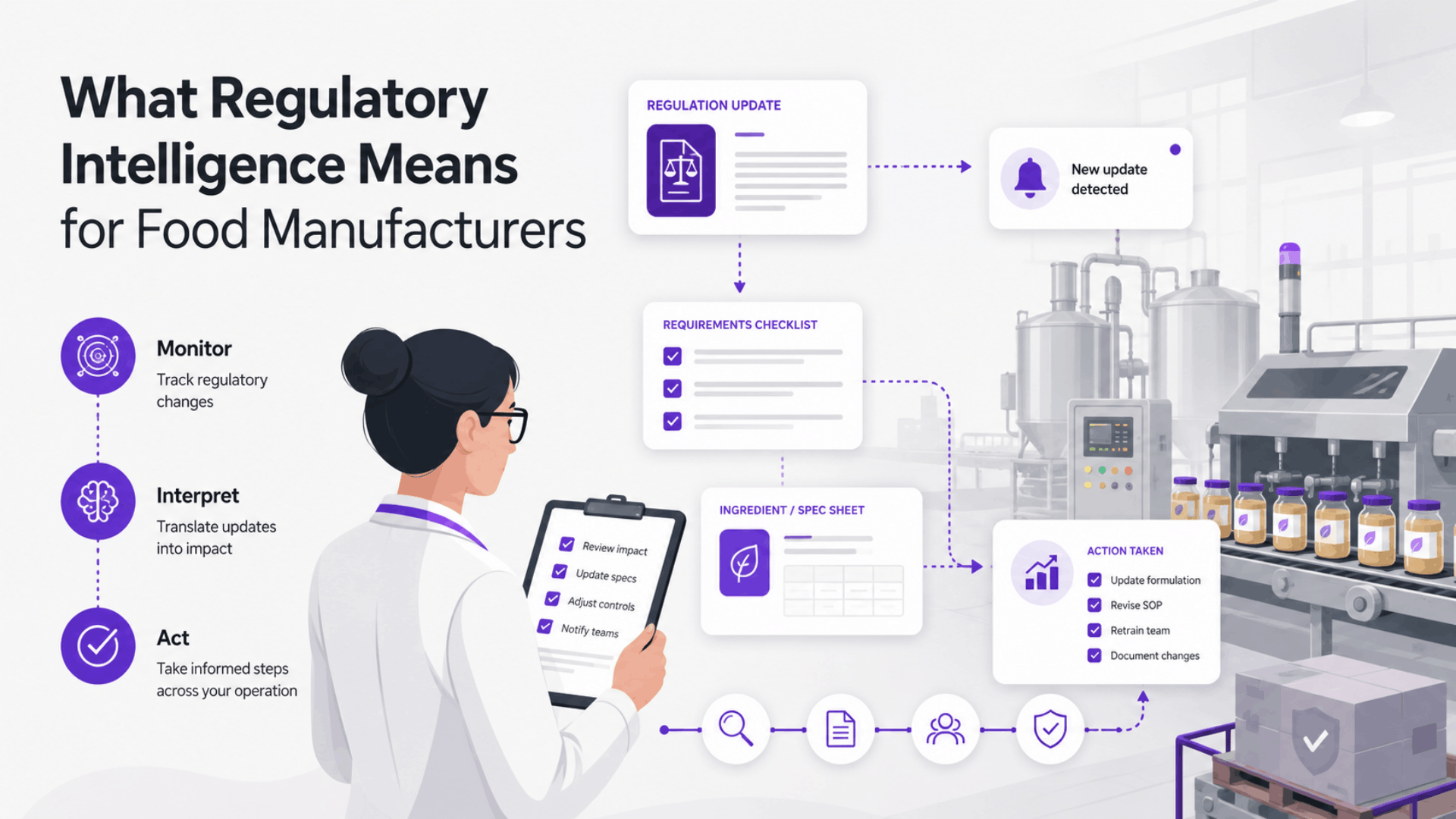
The word “intelligence” matters. A new guidance document on FDA.gov or a new CFIA labelling notice is only raw information. It becomes useful when someone connects it to your facility, product category, ingredient list, CCPs, supplier controls, and records. That connection is what turns regulatory monitoring into regulatory intelligence.
Most small and mid-sized food manufacturers do not have a dedicated regulatory affairs team. The QA manager, food safety manager, or production manager is often responsible for regulatory updates while also managing audits, corrective actions, suppliers, production issues, and daily records. For that person, the gap between “something changed” and “we know exactly what to update” can easily become weeks, or never get closed at all.
What Food Regulatory Affairs Actually Involves
Food regulatory affairs work looks different at every stage of the supply chain, but for manufacturers it comes down to one thing: staying ahead of requirements that touch your products, your processes, and your paperwork at the same time.
Broad scope, fragmented sources. A single facility may need to monitor FDA, CFIA, USDA/FSIS, Health Canada, Codex Alimentarius, GFSI, SQFI, BRCGS, FSSC 22000, and retailer-specific requirements, often all at once. Updates arrive from multiple agencies and scheme bodies on no predictable schedule, which is what makes food regulatory compliance harder to manage manually than a single-agency function.
Operational, not just strategic. Regulatory affairs in food industries feeds directly into live food safety systems. A single rule change can affect what your HACCP plan says, which hazards need review, how CCPs are monitored, what labels must show, how supplier approval is documented, and what evidence an auditor expects at the next audit.
Short response windows. If FDA issues a warning letter about sanitation or Listeria controls at a facility similar to yours, the relevance is not theoretical. It can affect how inspectors view your own environmental monitoring, corrective actions, and verification records. If CFIA makes a labelling requirement enforceable, existing labels, artwork, inventory, and customer requirements may need immediate review.
Standards overlap. A manufacturer selling to major retailers, foodservice customers, and cross-border distributors may be working across SQF, BRCGS, FSMA Preventive Controls, FSMA 204, SFCR, and retailer programs at the same time. Each requirement set changes independently, which is why global regulatory intelligence for food manufacturers has to track several frameworks in parallel rather than one certification path in isolation.
Key Regulatory Sources for US and Canadian Manufacturers
Effective regulatory intelligence starts with knowing which sources actually matter for your operation.
FDA: Food and Drug Administration
- FSMA rules and guidance, including Preventive Controls for Human Food, the Food Traceability Rule, also known as FSMA 204, Produce Safety Rule, and Foreign Supplier Verification Program
- Warning letters and import alerts, which show where enforcement attention is focused
- Draft guidances, which often signal where expectations are moving before a final requirement is enforced
- Constituent updates and Federal Register notices
CFIA: Canadian Food Inspection Agency
- Safe Food for Canadians Regulations updates
- Licensing and preventive control plan requirements
- Labelling requirement changes, including front-of-package nutrition symbols
- Inspection notices and enforcement actions
- Import and export requirement updates
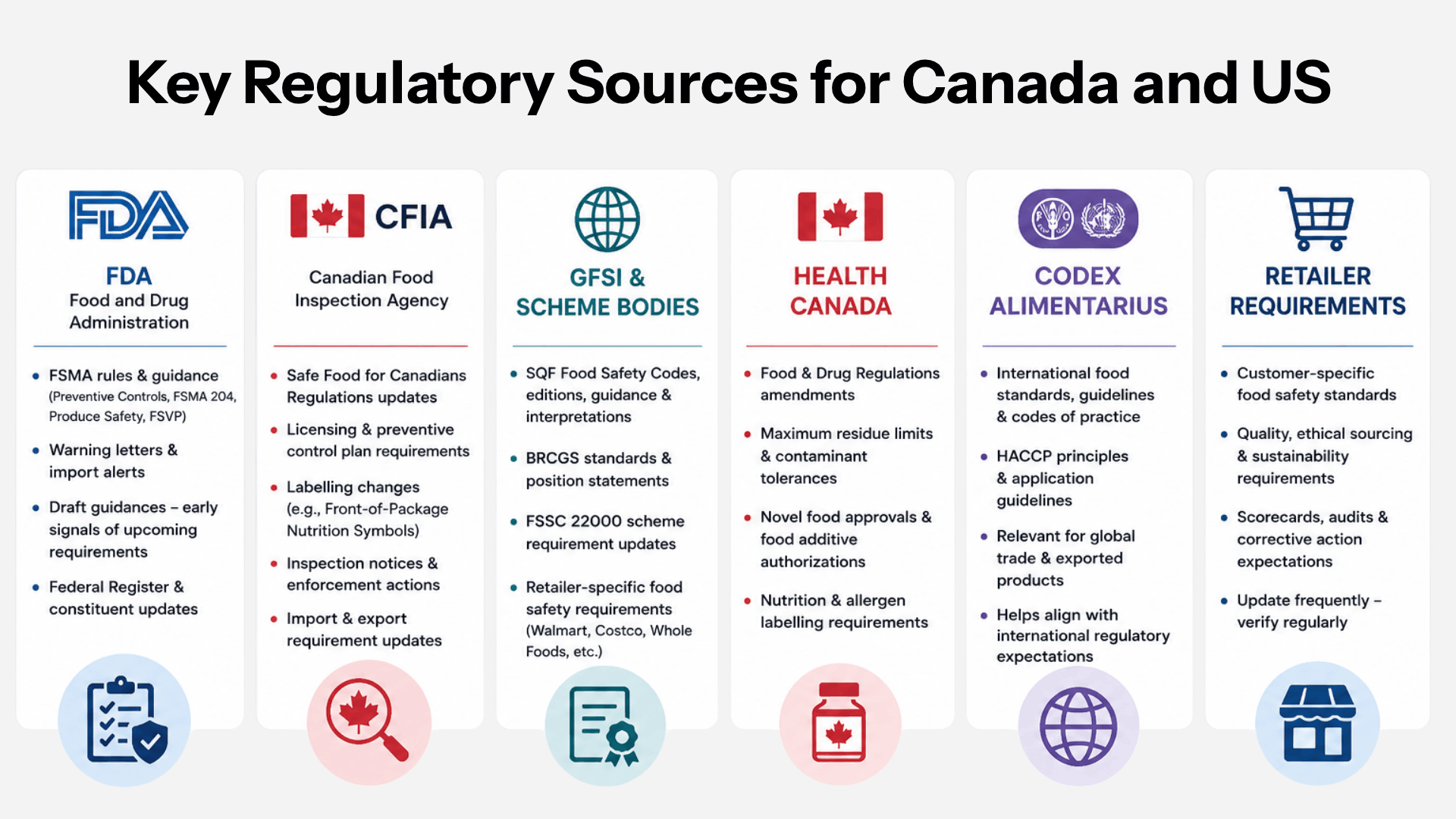
GFSI and Scheme Bodies
- SQF Food Safety Codes, code editions, guidance, and interpretation updates
- BRCGS standards and position statements
- FSSC 22000 scheme requirement updates
- Retailer-specific food safety requirements from customers such as Walmart, Costco, Whole Foods, and other major buyers
Health Canada
- Food and Drug Regulations amendments
- Maximum residue limits and contaminant tolerances
- Novel food approvals and food additive authorizations
- Nutrition and allergen labelling requirements
Codex Alimentarius
Codex Alimentarius is especially relevant for manufacturers exporting internationally, working with internationally traded ingredients, or aligning HACCP and hygiene programs with globally recognized principles.
The challenge is not simply identifying these sources. Most QA managers already know they exist. The harder part is monitoring them consistently, catching changes buried in technical documents, and quickly deciding what each change means for the facility.
What Regulatory Intelligence Covers in Practice
For a food manufacturer, regulatory intelligence is not one task. It covers several types of regulatory activity, each with different operational consequences.
New rules and rule amendments. FDA’s FSMA 204 traceability compliance date moved from January 2026 to July 2028. That change does not remove the need to prepare. It changes the working timeline for supplier data, traceability records, batch documentation, and internal system readiness. For a practical breakdown, see our guide on what food manufacturers actually need to do for FSMA 204. In Canada, CFIA’s front-of-package labelling requirements became enforceable on January 1, 2026, which means label compliance must be actively checked against current rules.
Draft guidances and proposed rules. FDA often publishes draft guidance before finalizing expectations. Manufacturers that catch draft guidance early can review procedures, labels, records, and training before the final requirement becomes urgent.
Enforcement signals. FDA warning letters and import alerts show where regulators are finding problems. A pattern of findings around sanitation, allergen control, supply chain controls, or environmental monitoring can help QA teams identify weak points before those same issues appear during their own inspection.
Scheme requirement updates. SQF Edition 10 introduces stronger expectations around food safety culture, change management, and risk-based documentation. Audits to Edition 10 are expected to begin in 2027, according to SQFI public guidance. If your facility is preparing for certification, it is useful to connect regulatory monitoring with audit readiness. Our SQF audit checklist for small food manufacturers explains what teams should organize before the audit window.
Labelling and ingredient changes. Allergen declarations, nutrition labelling requirements, additive authorizations, contaminant limits, and import rules can change at different times across markets. Missing a labelling update can create rework, shipment delays, customer complaints, or product already in market that needs review.
Supplier and ingredient controls. Regulatory changes often affect ingredients before they affect finished goods. A change to additive permissions, allergen declaration rules, supplier documentation, country-of-origin requirements, or import conditions may require updated supplier approval records. For teams building this process, our guide to SQF supplier approval program minimum requirements explains the baseline documentation auditors expect.
The Three Stages: Monitoring, Analysis, Action
Regulatory intelligence has three practical stages: monitoring, analysis, and action. Many manual systems handle monitoring inconsistently and leave analysis and action to memory, email, or spreadsheets.
Monitoring
Monitoring is the continuous process of watching regulatory sources for relevant updates. Done manually, this means someone bookmarks multiple websites, signs up for newsletters, checks government pages when time allows, and tries to remember what changed.
That approach breaks down quickly when the same QA person is also managing production issues, CAPAs, supplier files, training, and audit preparation.
Done with software, monitoring becomes more reliable. The system watches configured sources, detects changes when they appear, and alerts the team. But monitoring alone is still not enough.
Analysis
Analysis is where information becomes intelligence. A regulatory update has arrived. Now the team has to decide whether it applies to the facility.
The practical questions are:
- Which products are affected?
- Which ingredients are affected?
- Which suppliers are affected?
- Which markets are affected?
- Which SOPs, HACCP elements, labels, specifications, or records need review?
Without this layer, monitoring creates noise. A QA manager receiving dozens of general regulatory alerts each month will eventually ignore them unless the system helps separate relevant changes from background updates.
Action
Action closes the loop. Once a change is assessed as relevant, something needs to happen.
A document may need revision. A supplier may need to provide updated evidence. A label may need review. A CCP limit, verification step, or monitoring record may need to be checked. A training record may need to be created. A management review item may need to be added.
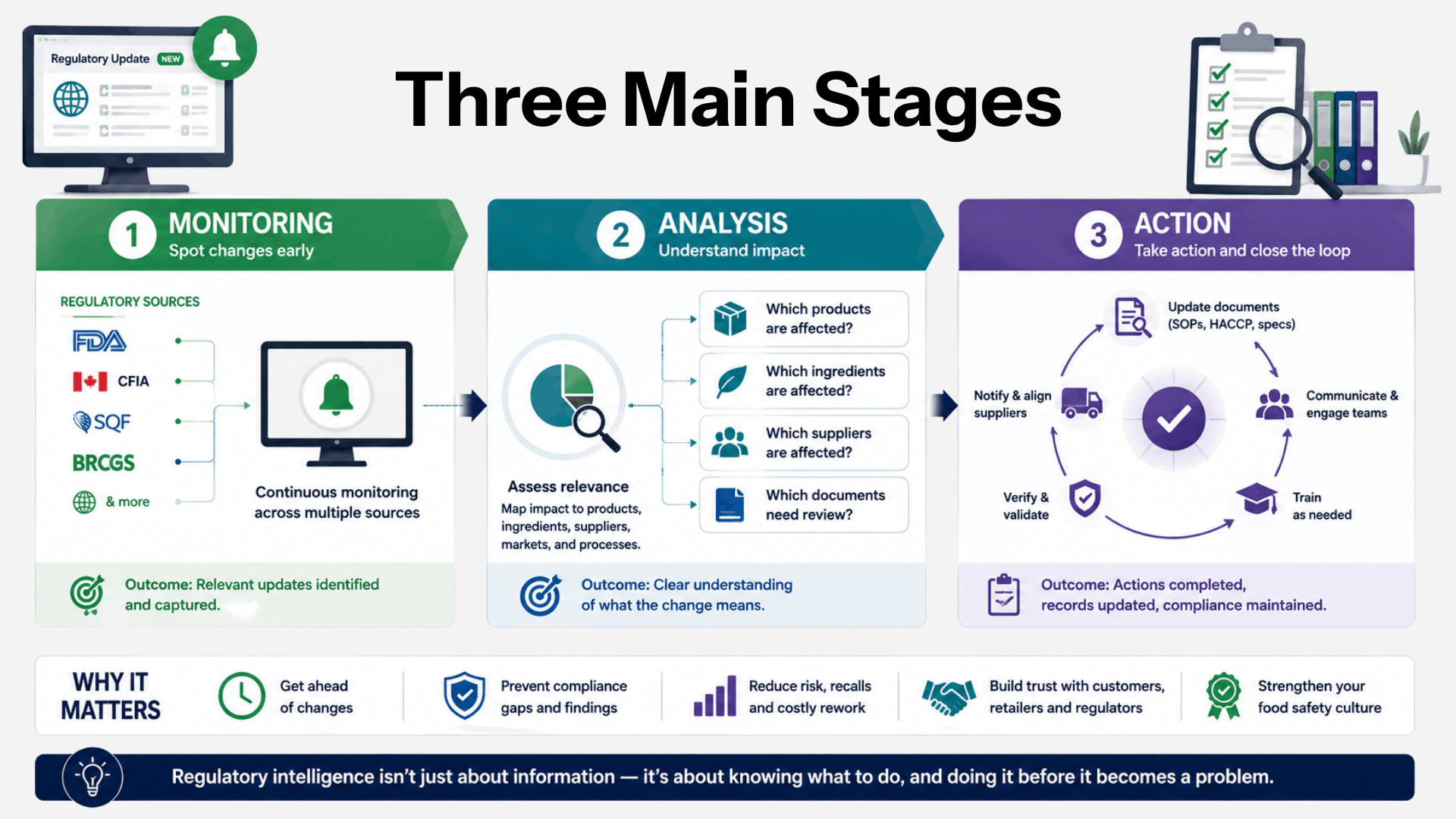
Regulatory intelligence only has value when it produces action before the auditor, retailer, or inspector finds the gap first.
Who Needs It and When
Regulatory intelligence is not always labelled as a separate function inside food manufacturing companies. But the need appears at several common moments.
Getting a new retail contract. Major retailers often require GFSI-benchmarked certification, stronger supplier controls, traceability evidence, current HACCP documentation, and proof that the food safety system is actively maintained. If your facility is moving toward SQF or BRCGS, your compliance system has to reflect current scheme requirements. IONI’s FSMA, BRCGS, and SQF compliance software is designed for teams that need to connect certification requirements with live documentation.
Preparing for an audit. Third-party GFSI audits and FDA or CFIA inspections both test whether documentation is current and consistent with applicable requirements. A HACCP plan that references outdated controls, a supplier file missing current documents, or an SOP that does not reflect a recent scheme update can become a finding. For a broader audit-readiness view, see our Food Safety Compliance Readiness Report.
After a warning letter or inspection observation. If FDA, CFIA, or a certification auditor has flagged an issue at your facility, regulatory intelligence helps the team understand what the agency or scheme expects and where existing documentation falls short. It also helps teams review similar risks before they create repeat findings.
Ownership change or new QA hire. New management or a new QA manager often discovers that regulatory monitoring has been informal. Establishing a structured process is usually one of the first steps toward stabilizing the food safety system.
Scaling to additional facilities or markets. Adding a facility, entering Canada, selling into the U.S., or moving into a new retail channel adds regulatory complexity. A system that worked for one facility selling domestically may not be enough once the company is managing SFCR, FSMA, SQF, BRCGS, customer specifications, and supplier approval requirements together.
Moving from paper to digital systems. Many small manufacturers start with binders, shared folders, and spreadsheets. That can work at the beginning, but it becomes fragile as the number of products, suppliers, ingredients, and audit requirements grows. A modern food safety software system helps teams connect documents, records, tasks, suppliers, and regulatory updates in one place.
How AI Changes the Process
Manual regulatory intelligence has a structural problem: it depends on the last time someone checked. If a source changed two weeks ago and the next manual review is scheduled for next month, your team is operating with outdated information during that gap.
AI-based regulatory intelligence tools change the workflow by automating monitoring and helping with relevance assessment. The strongest use case is not replacing QA judgment. It is reducing the manual work required to find, sort, connect, and track regulatory updates. If you are comparing options, our review of the best regulatory intelligence software for food manufacturers covers what to look for.
Continuous source monitoring. The system watches FDA, CFIA, GFSI scheme bodies, and other configured sources. Instead of relying on someone to check websites manually, the team receives updates when relevant changes appear.
Relevance assessment. More capable platforms assess whether a regulatory change applies to the company’s products, processes, facilities, suppliers, and operating regions. This is the difference between a generic alert and a useful compliance signal.
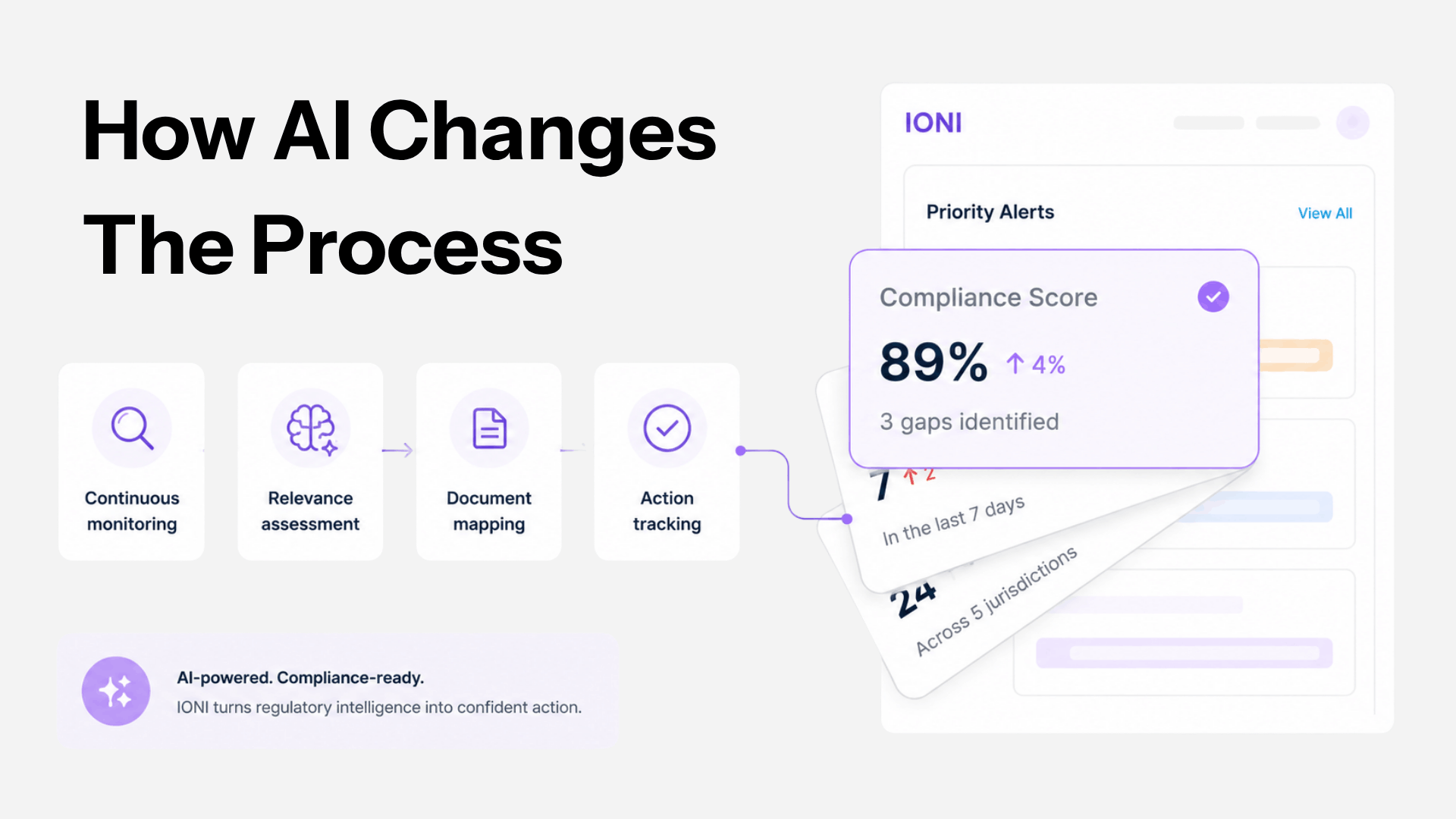
Document mapping. The most valuable systems do not stop at “something changed.” They identify which SOPs, HACCP plans, supplier files, specifications, labels, or monitoring records may be affected. This is where AI can remove a large amount of manual cross-checking.
Ingredient and supplier intelligence. Many regulatory changes are linked to ingredients, allergens, additives, countries of origin, supplier documents, or COAs. IONI’s ingredients intelligence for food companies helps teams connect ingredient-level data with compliance requirements, supplier evidence, and risk review.
Audit trail. A complete record of what was monitored, when a change was identified, who reviewed it, and what action was taken helps demonstrate due diligence. This matters during audits, inspections, customer reviews, and internal management review.
Integration with existing systems. Regulatory intelligence becomes stronger when it is connected to ERP, inventory, supplier portals, document control, or production systems. IONI supports custom integrations for teams that need regulatory and food safety data to work across their existing technology stack.
IONI connects regulatory monitoring directly to your food safety compliance system. When FDA, CFIA, SQFI, BRCGS, or another configured source publishes a relevant update, IONI helps identify which internal documents and workflows may be affected. Regulatory intelligence is not treated as a separate dashboard. It is embedded into the same system used to manage HACCP plans, operator checklists, supplier certificates, corrective actions, and audit readiness.
See how IONI maps regulatory changes to your compliance documents.
Common Gaps in Manual Monitoring
Manual regulatory intelligence tends to fail in predictable ways.
Inconsistent coverage. Someone checks the FDA website regularly but has not reviewed CFIA updates in months. Or an SQF update is published early in the year and only gets noticed during pre-audit preparation. The problem is not lack of effort. It is that manual coverage is hard to sustain.
No relevance filter. When a regulatory update is caught, there may be no consistent way to assess whether it applies to the facility’s products, suppliers, ingredients, processes, or markets. The update lands in an inbox and waits until someone has time to interpret it.
Disconnected documentation. Even when the team identifies a relevant change, connecting it to the right SOPs, HACCP records, labels, specifications, and supplier documents is often manual. In a busy facility, this step can be delayed until an auditor asks for evidence.
No audit trail. If there is no record of when updates were reviewed, who assessed them, and what action was taken, the facility may struggle to demonstrate active regulatory monitoring. During an inspection or certification audit, “we check websites when we can” is not strong evidence.
Update lag. Newsletters, webinars, and consultant briefings can be useful, but they are often retrospective. By the time a change appears in a general industry update, it may already require action.
Supplier file drift. Supplier approvals often become outdated quietly. Certifications expire, COAs are missed, specifications change, and new ingredients enter production without a full risk review. A stronger supplier approval process helps close this gap before it becomes an audit finding.
HACCP misalignment. Regulatory changes can affect hazards, preventive controls, CCPs, OPRPs, monitoring records, and verification activities. If the HACCP plan is not reviewed when requirements change, it can become inconsistent with real operations. For teams comparing certification and HACCP requirements, this guide explains the difference between HACCP and SQF.
Food safety culture not linked to action. SQF Edition 10 places more emphasis on documented food safety culture assessment and follow-up. Regulatory intelligence should not only track rules. It should support management review, training, corrective action, and accountability. Our guide to food safety culture under SQF Edition 10 explains how to document that process.
FAQ
What’s the difference between regulatory intelligence and food safety compliance management?
Regulatory intelligence is about monitoring what is changing externally, including new rules, updated guidance, enforcement signals, scheme revisions, and retailer expectations. It also includes interpreting what those changes mean for your operation.
Food safety compliance management is about execution. It includes your HACCP plan, SOPs, corrective actions, operator checklists, supplier files, monitoring records, verification records, training, and audit evidence.
The two are related but not the same. You can have a well-organized compliance system and still miss a regulatory update that requires changing it. Regulatory intelligence is the early warning function. Compliance management is the operating system that turns requirements into records and actions.
How often do FDA and CFIA update food safety regulations?
Continuously, and not on a predictable schedule. FDA publishes guidance documents, draft rules, final rules, warning letters, import alerts, and constituent updates throughout the year. CFIA issues labelling updates, licensing information, enforcement notices, inspection guidance, and import/export updates on an ongoing basis. GFSI scheme bodies release new code editions, interpretation guidance, and program updates on their own cycles.
In 2025 and 2026 alone, FDA moved the FSMA 204 compliance timeline to July 2028, CFIA’s front-of-package labelling requirements became enforceable on January 1, 2026, and SQFI published Edition 10 of the SQF Food Safety Codes. Each of these changes required affected manufacturers to review documentation, timelines, or audit preparation.
Does a small food manufacturer really need formal regulatory intelligence?
Yes, and often more urgently than a large company. Large food companies usually have dedicated regulatory affairs teams. At a 30-person facility, the QA manager may also be responsible for production oversight, supplier management, audit preparation, corrective actions, training, and floor issues. Regulatory monitoring can easily become occasional instead of systematic.
The question is not whether regulatory intelligence matters. The real question is whether the person responsible has a reliable system, or whether the facility is relying on memory, newsletters, and last-minute audit preparation.
What’s the first regulatory source food manufacturers should prioritize?
It depends on your market and certification path.
For U.S. manufacturers, FDA FSMA guidance, Preventive Controls requirements, FSMA 204 updates, warning letters, and import alerts are usually high priority.
For Canadian manufacturers or companies selling into Canada, CFIA updates, SFCR requirements, and Health Canada labelling rules are critical.
For manufacturers pursuing GFSI certification, SQF, BRCGS, or FSSC 22000 updates should be monitored alongside regulatory sources.
Most manufacturers need more than one source. A facility selling to U.S. customers, Canadian distributors, and major retailers may need FDA, CFIA, Health Canada, SQFI, BRCGS, customer requirements, and supplier documentation all tracked together.
How does IONI support regulatory intelligence for food manufacturers?
IONI monitors FDA, CFIA, GFSI scheme bodies, and other configured regulatory sources continuously. When a relevant update is published, the system helps assess which internal compliance documents may be affected, including SOPs, HACCP plans, supplier certificates, specifications, and monitoring records.
Regulatory monitoring is integrated with the food safety management system, not treated as a separate tool. That means regulatory updates can be connected to the same workflows used for HACCP, supplier approval, operator records, corrective actions, audit readiness, and document review.
Every new client gets a setup session with the IONI team, where the system is configured using actual documents, products, ingredients, suppliers, and compliance requirements.
Book a demo to see how it works.
Related Reading
- Best Food Safety Regulatory Intelligence Tools for Manufacturers in 2026
- Best HACCP Software for Food Manufacturers in 2026
- How to Create a HACCP Plan: Step-by-Step Guide for Food Manufacturers
- SQF Audit Checklist for Small Food Manufacturers
- Food Safety Compliance Readiness Report
- FSMA 204 for Food Manufacturers: What You Actually Need to Do