.png)
Choosing food safety software usually starts with pressure: a retailer request, an audit deadline, a supplier issue, or a QA team stuck in spreadsheets.
Allera helps manufacturers digitise FSQA forms, supplier documents, approvals, and daily records. IONI starts with the documents the plant already has - SOPs, HACCP files, specs, COAs, and supplier records - and turns them into connected compliance workflows.
Both approaches can work. The right choice depends on whether your plant needs structured digitisation, document-driven automation, or both.
Why This Comparison Matters Right Now
Most food manufacturers do not start evaluating food safety software because they have extra time. They start because something urgent has changed. A retailer may require SQF certification before approving a new supplier agreement.
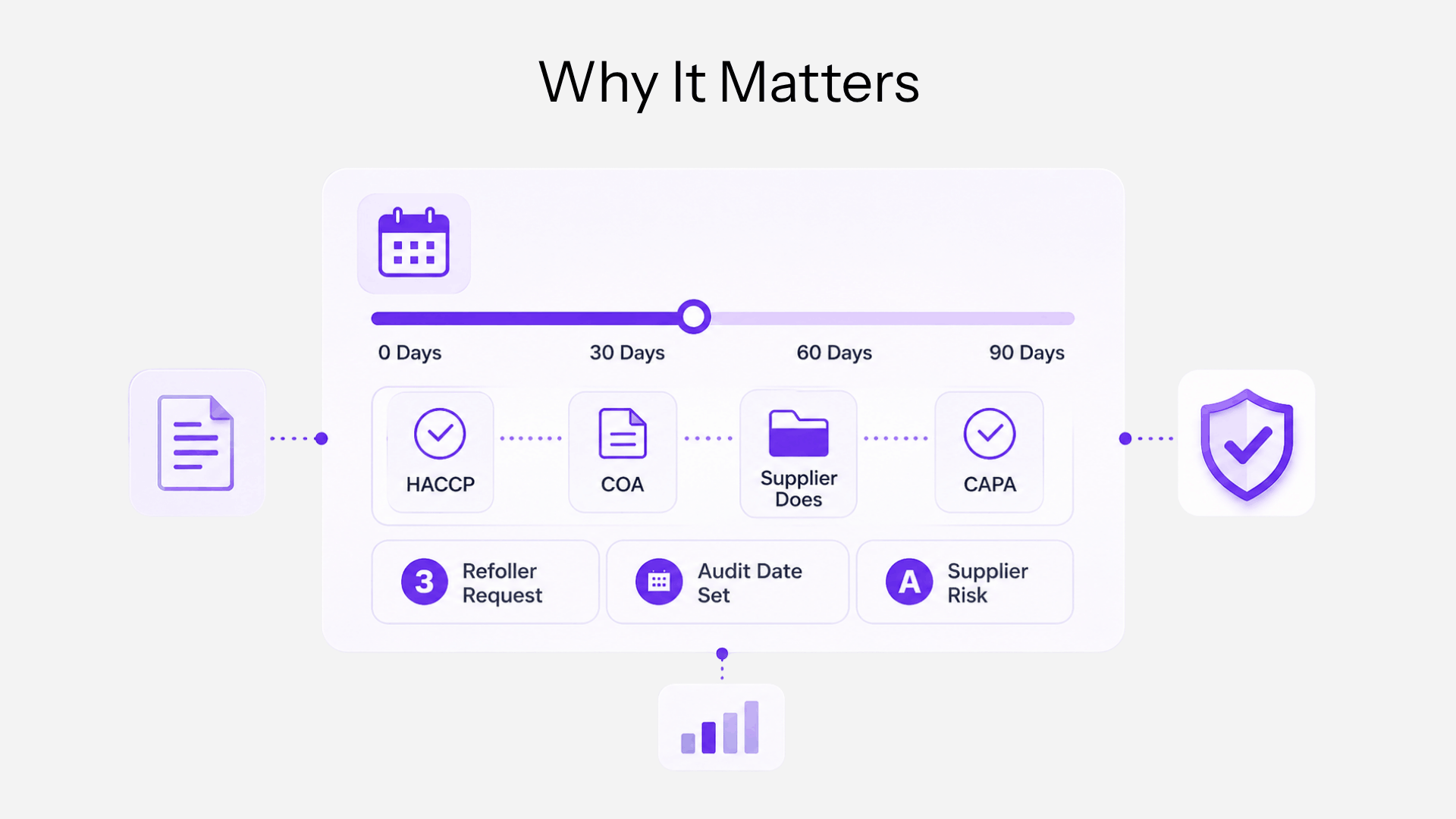
Both Allera and IONI sell speed, but they mean different things: Allera focuses on digitizing FSQA forms, supplier records, and document control, while IONI starts from existing SOPs, HACCP plans, specs, supplier files, COAs, and monitoring requirements to structure the system around the real plant.
That distinction matters when a 30- or 90-day audit deadline leaves little room for manual configuration, and the real question is which platform gets the operation audit-ready faster.
If you are still defining broader requirements, IONI’s guide to food safety software is a useful starting point. If the buying trigger is a retailer asking for certification, the article Your Retailer Requires SQF Certification: What To Do In The First 30 Days gives a more tactical first-month plan.
The Core Difference: How Each Platform Handles Your Existing Documents
The most important difference between IONI and Allera is what happens to the documents you already have.
Most food manufacturers already have food safety knowledge inside the company. It is just fragmented. Some of it is in SOPs. Some of it is in HACCP plans. Some of it is in Excel monitoring sheets. Some of it is in supplier folders. Some of it lives in the head of the QA Manager. Some of it is buried in old audit prep folders that only one person knows how to navigate.
Allera is strongest when the goal is to digitise FSQA paperwork into forms, approvals, dashboards, supplier requests, and controlled documents. Its public materials emphasise digital forms, document control, supplier management, automatic document collection, expiration tracking, and document review workflows.
That is useful for a team that wants to move from paper to structured digital workflows. If the current problem is that sanitation records, pre-op checks, receiving logs, supplier certificates, and SOP revisions are scattered across binders and email, Allera’s form-first system can create order.
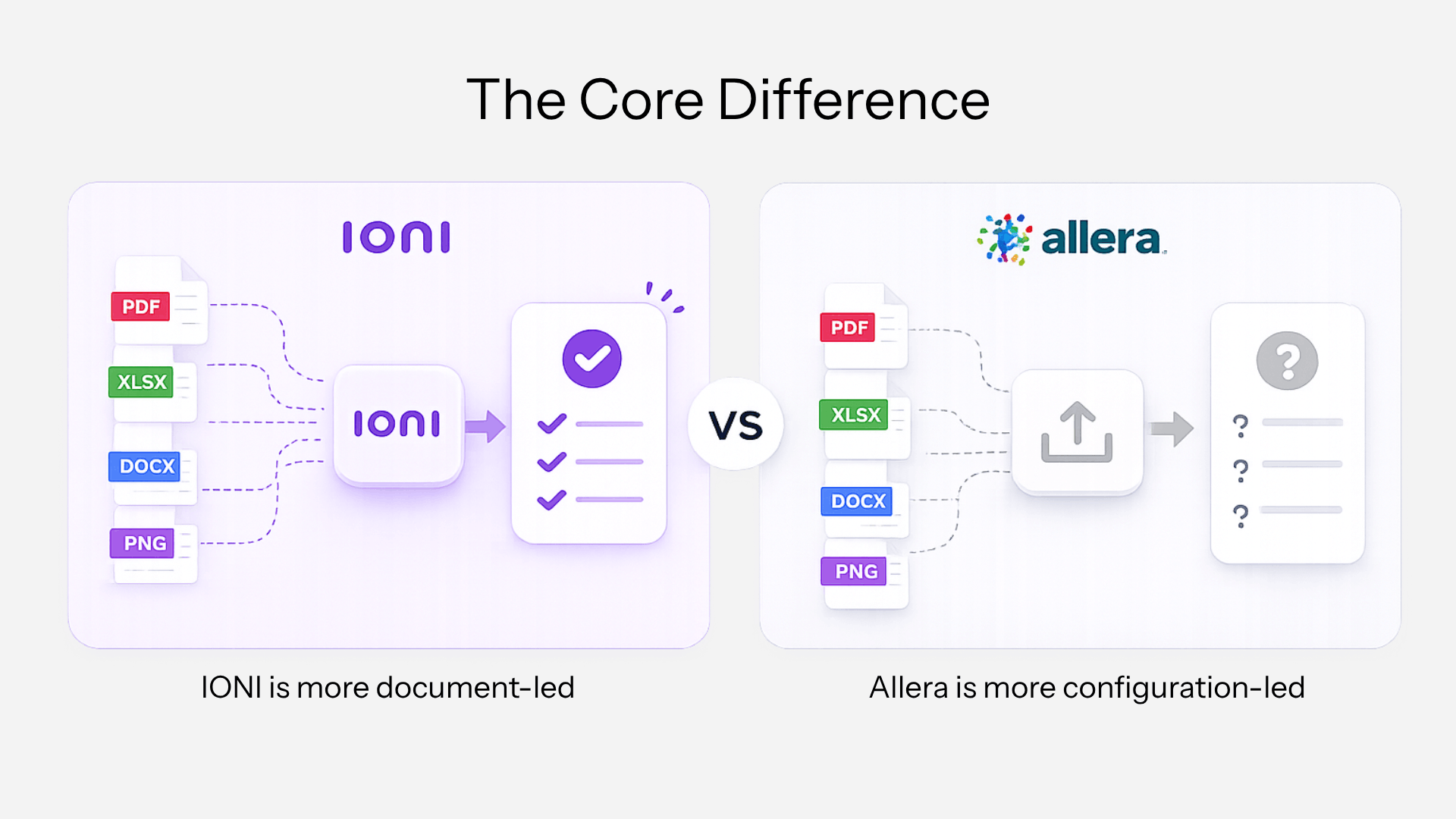
IONI starts from a different premise. It assumes the plant already has documents that describe how the facility works. The job is not only to digitize those documents. The job is to read them, structure them, connect them, and turn them into a live food safety system.
That is why IONI is a better fit when the manufacturer already has SOPs, HACCP plans, supplier specifications, ingredient data, product records, monitoring procedures, and audit documentation. The platform uses those materials to build operational workflows: HACCP structure, CCP monitoring, prerequisite programs, corrective actions, supplier requirements, COA checks, and audit evidence.
This is especially important for small and mid-sized manufacturers. These teams usually do not have a large implementation department. They have one QA Manager, one Production Manager, maybe a Food Safety Consultant, and a limited number of people who understand the full operation. Every week spent rebuilding documents manually is a week taken away from training, verification, supplier follow-up, and production readiness.
Allera is more configuration-led. IONI is more document-led. That is the core difference.
Feature-By-Feature Breakdown
A feature list only helps if it reflects how the platform works in a real plant. The table below focuses on the capabilities that matter most for small and mid-sized food manufacturers, comparing IONI and Allera:
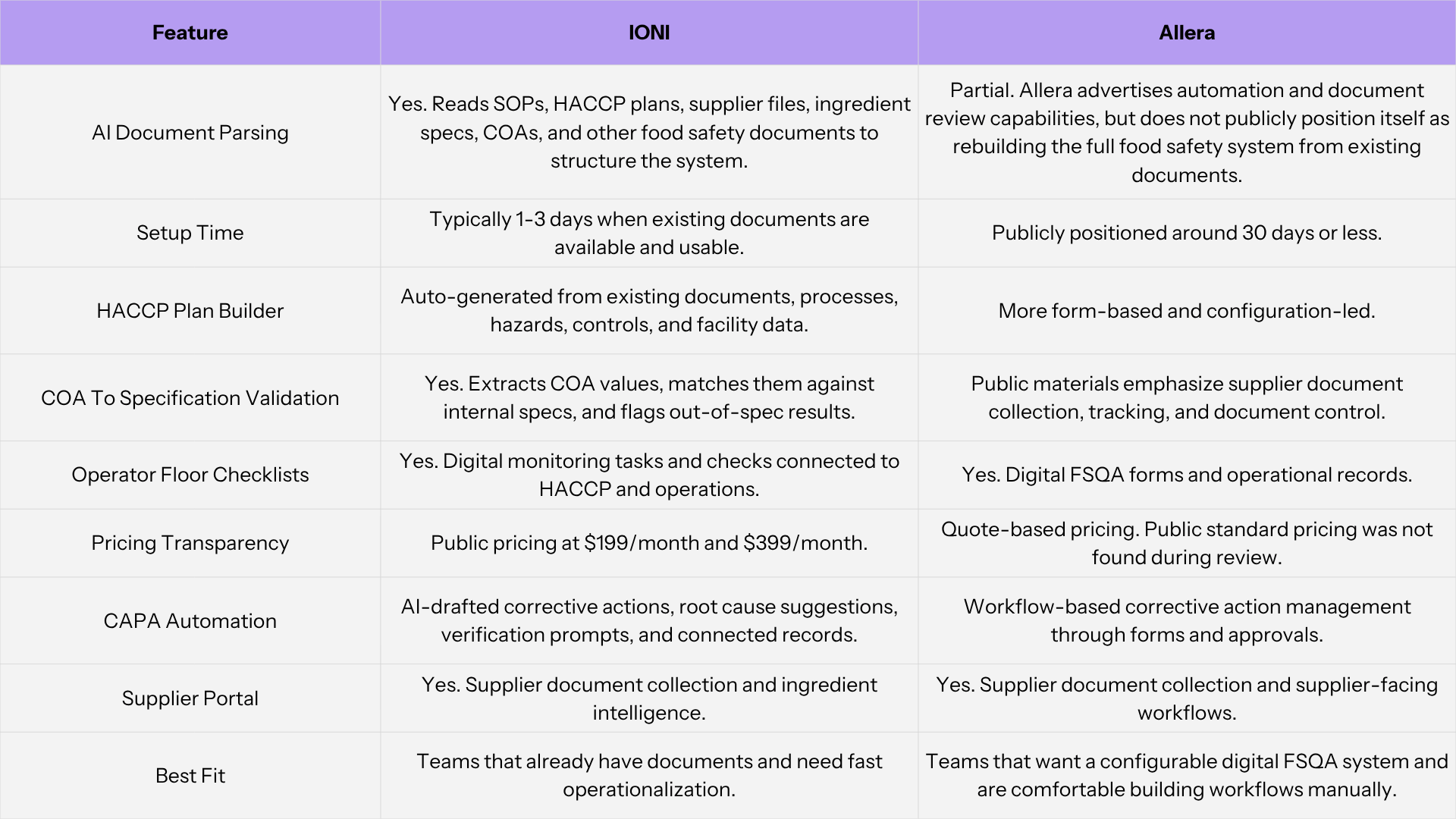
This comparison should not be read as “Allera is weak” or “IONI is always better.” They solve. For a broader supplier quality software comparison, see Best Supplier Quality Management Software For FSQA Teams In Food Manufacturing 2026.
Supplier COA Management: Where The Real Difference Shows Up
Supplier COA management is where many food safety systems look similar in a sales conversation, but behave very differently in production.
A typical supplier workflow has three levels.
- First, the system stores documents.
- Second, the system tracks whether the document is current.
- Third, the system reads the COA and checks whether the actual values match the specification for that ingredient, supplier, lot, or product.
A COA can exist and still be wrong for your operation. It can be attached and still show an out-of-spec moisture value. It can be current and still miss a required microbiological result. It can be filed correctly and still belong to the wrong lot, supplier, or ingredient.
That is the gap IONI is designed to close. IONI’s Ingredients Intelligence module reads supplier COAs, extracts values, compares them against internal ingredient specifications, and flags issues before the ingredient is released into production.
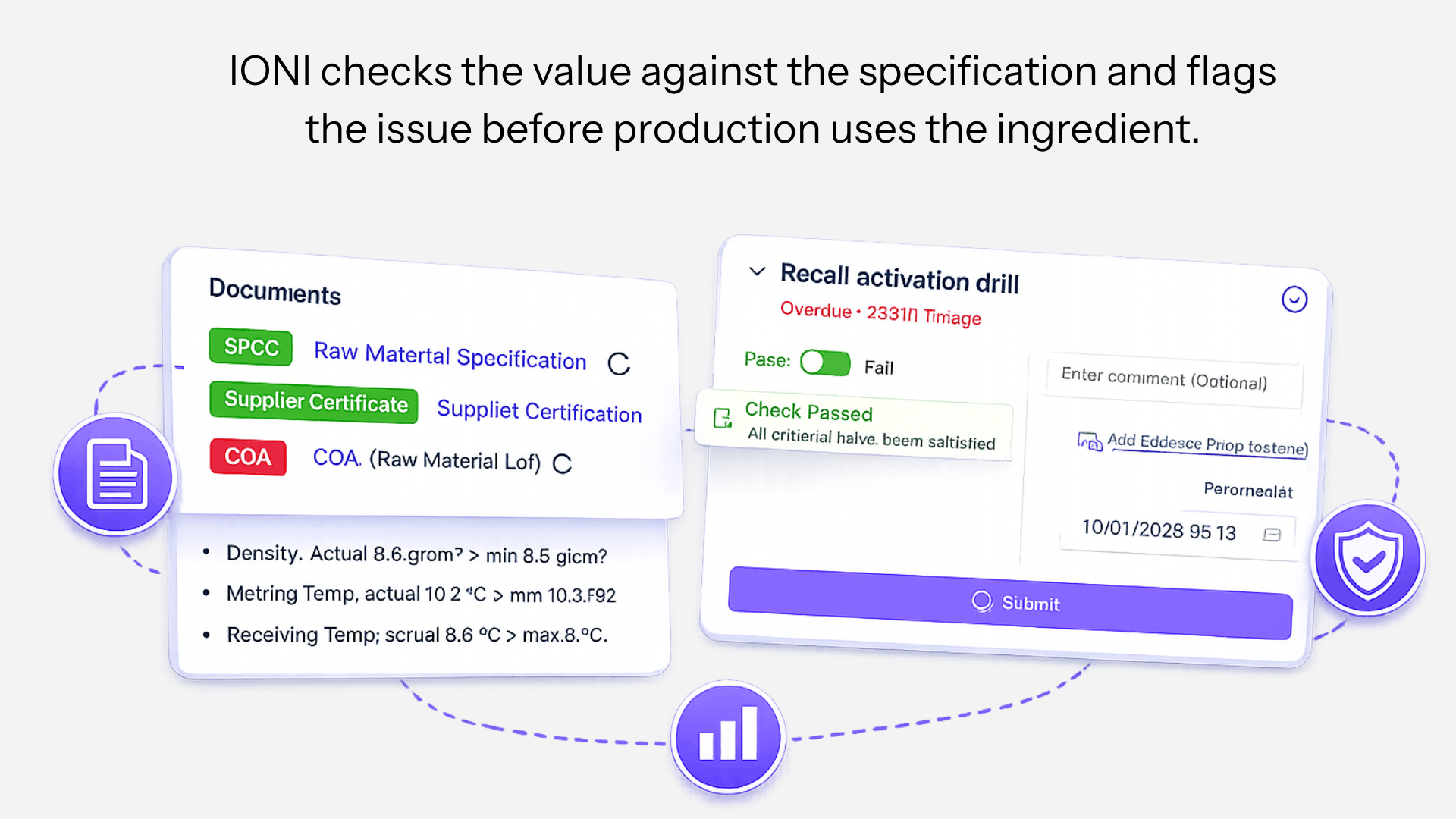
Here is a practical example.
A shipment of flour arrives at a bakery. The supplier uploads the COA. The document includes moisture, protein, ash, lot number, and microbiological results. The facility’s internal specification allows moisture up to a defined limit. The COA shows a value above that limit.
For a plant with five suppliers, this may not feel urgent. For a plant with 30, 50, or 100 suppliers, it becomes one of the highest-value parts of the system.
HACCP Plan Builder: Templates vs Your Actual Documents
Most HACCP software comparisons focus on whether a platform “has HACCP” instead of how the system actually gets built and used.
Allera is better for teams that want configurable forms, document control, and structured FSQA workflows. IONI is stronger when the manufacturer already has SOPs, HACCP files, specs, and process documents that can be turned into connected HACCP, monitoring, CAPA, and audit workflows automatically. That matters because HACCP is not just a document. It is the operational system behind daily food safety control.
SQF and BRCGS both expect manufacturers to show not only that food safety documentation exists, but that it is implemented and maintained. SQFI’s Food Safety Code for Food Manufacturing, Edition 9, applies across a wide range of food processing categories, including dairy, bakery and snack foods, beverages, confectionery, preserved foods, ingredients, ready meals, oils, cereal grains, repackaging, and processing aids. BRCGS Food Safety Issue 9 is also widely adopted and, according to BRCGS, is used by more than 22,000 sites in more than 130 countries.
For teams that are deciding between HACCP, SQF, and broader certification needs, IONI’s guide HACCP Vs SQF: What’s The Difference And What Do You Actually Need explains the distinction in more detail.
Pricing: What You Actually Pay For
Pricing matters because food manufacturers already carry audit, consultant, training, lab, and compliance costs, making predictable software pricing important.
IONI publishes pricing at $199/month and $399/month, while Allera appears to use quote-based pricing depending on implementation scope, modules, sites, integrations, and support needs.
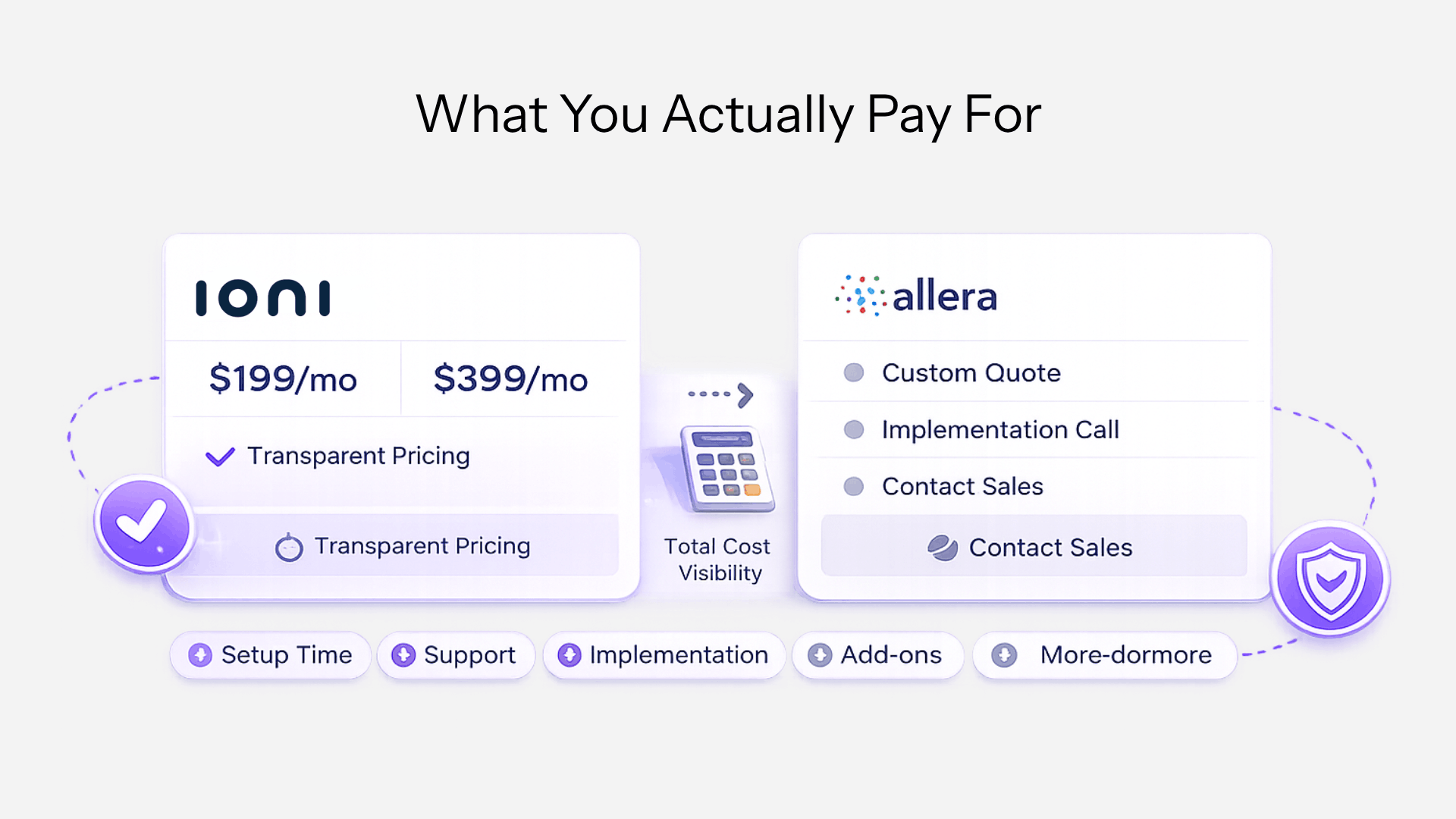
But the buyer should be clear about what is included.
Ask whether the quote includes supplier management, document control, digital forms, implementation, training, extra users, extra sites, support, workflow changes, and future configuration. Ask whether there are extra fees for onboarding, data migration, custom templates, supplier portals, or additional modules. Ask whether pricing changes as the supplier count grows.
The software subscription is only one part of the cost. The higher cost is implementation time, QA workload, consultant dependency, and whether the system actually reduces manual work after go-live.
For teams planning certification work on a compressed timeline, SQF Certification In 90 Days: A Week-By-Week Plan For Small Food Manufacturers can help estimate the operational workload beyond software.
Food Safety Compliance Depth: FSMA, SQF, BRCGS, And Audit Readiness
Food safety software should support how the plant actually manages compliance, not just store documents.
FSMA requires written food safety plans, hazard analysis, preventive controls, monitoring, corrective actions, verification, and records, while SQF and BRCGS add broader requirements around audits, supplier approval, traceability, document control, training, and operational evidence.
Allera helps digitize forms and centralize records, which is valuable for teams moving away from paper-based systems. IONI goes further by connecting HACCP, suppliers, COAs, monitoring, CAPA, deviations, audit evidence, and regulatory requirements into one operational system.
For companies navigating multiple frameworks, IONI’s FSMA, BRCGS, And SQF page explains how these requirements connect. For teams that also need to track regulatory changes over time, AI Regulatory Intelligence shows how IONI helps monitor changing requirements and connect them back to internal documents.
When Allera Is The Better Fit
Allera is a strong fit for manufacturers that want a configurable FSQA system focused on digital forms, document control, supplier management, and audit-ready workflows.
It works especially well for teams moving away from paper records, binders, spreadsheets, and email-based follow-ups. A structured form-based setup can quickly improve visibility, accountability, and daily operational control.
Allera also makes sense when the team wants to configure every checklist, workflow, approval path, and form manually rather than building from existing documents. If current SOPs, HACCP plans, or supplier specs are weak or outdated, a form-first rebuild may be the more controlled approach.
When IONI Has A Clear Edge
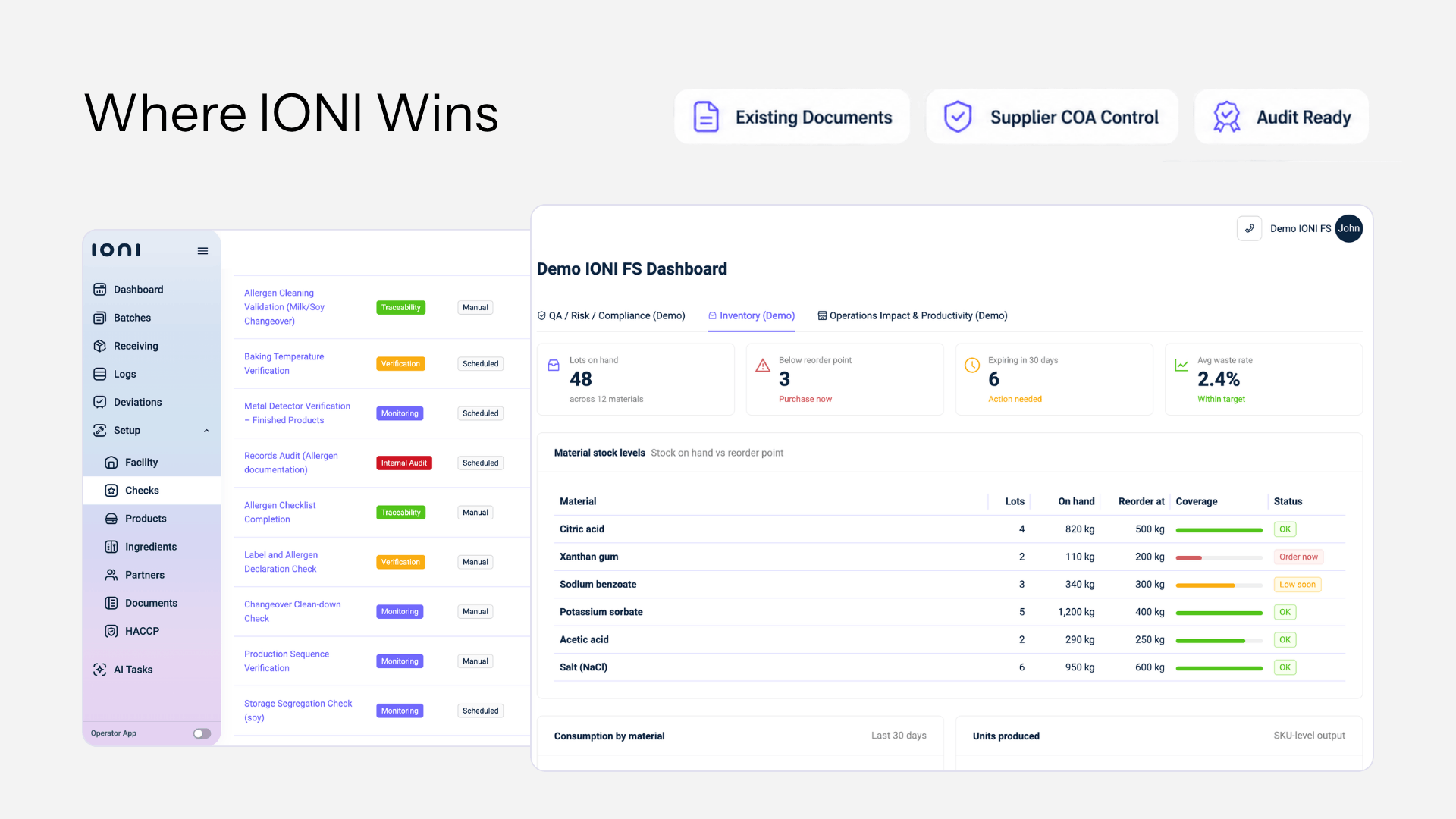
IONI is strongest when the manufacturer already has SOPs, HACCP plans, specs, supplier records, COAs, and monitoring procedures but needs to move quickly.
Instead of rebuilding everything manually, teams upload existing documents, and IONI turns them into connected HACCP, supplier, monitoring, CAPA, and audit-readiness workflows built around the real operation.
See How IONI Works:
IONI matters most when the plant already has documents but needs to become audit-ready quickly.
It is a stronger fit for manufacturers with 30-90 day certification deadlines, teams that need automatic COA-to-spec validation before production, companies looking for predictable SMB pricing, and operations that want HACCP, suppliers, CAPA, monitoring, and audit workflows connected in one system instead of managed separately.
This also matters for teams that have failed or nearly failed audits because records were incomplete, outdated, or disconnected. The article Why Small Food Manufacturers Fail Food Safety Audits And How To Fix It Before The Auditor Arrives explains the most common failure patterns.
IONI is not the right fit for every plant. If a manufacturer has no documents at all, no defined processes, and no internal owner for food safety, software alone will not solve the problem. But when the foundation exists, and the team needs speed, structure, and automation, IONI has a clear advantage.
The Bottom Line: Which One Fits Your Plant?
Here is the practical decision.
Choose Allera if your priority is replacing paper forms with a configurable FSQA system for records, supplier documents, approvals, and workflows.
Choose IONI if you already have SOPs, HACCP files, specs, COAs, and supplier records and need to turn them into an audit-ready system quickly. IONI is the stronger fit for SQF, BRCGS, FSMA, or customer audit preparation when speed and connected workflows matter.
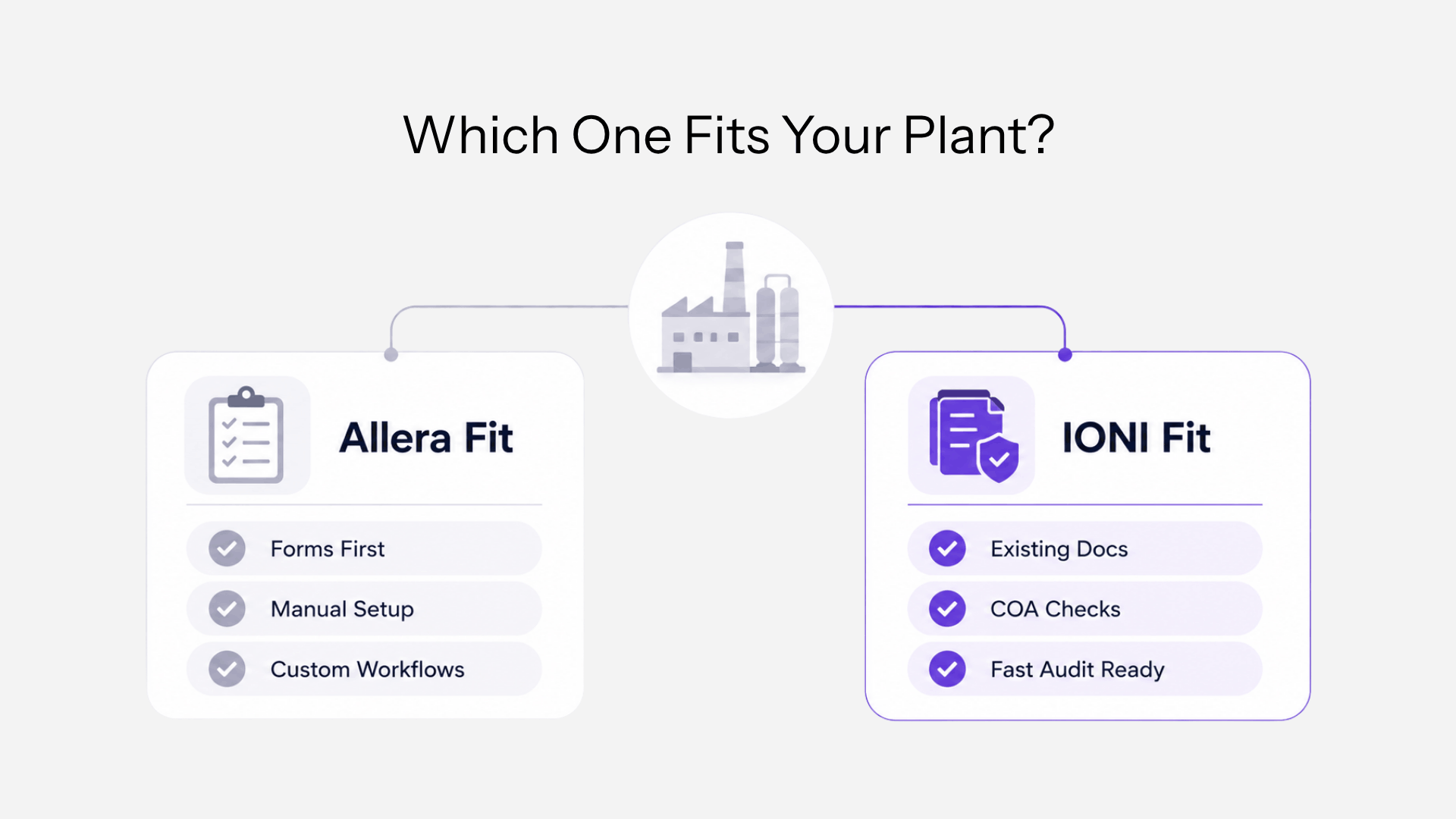
Allera is a strong choice for digitizing and controlling FSQA workflows.
IONI is the stronger choice when you want to convert existing food safety documents into an operational compliance system and validate supplier COAs before production.
Decision Matrix: Which Platform Should You Choose?
The best software choice depends on how the plant actually operates, not on who has the longest feature list.
For most manufacturers, the decision comes down to setup style, audit timeline, supplier risk, document quality, and how much manual configuration the QA team can realistically manage.
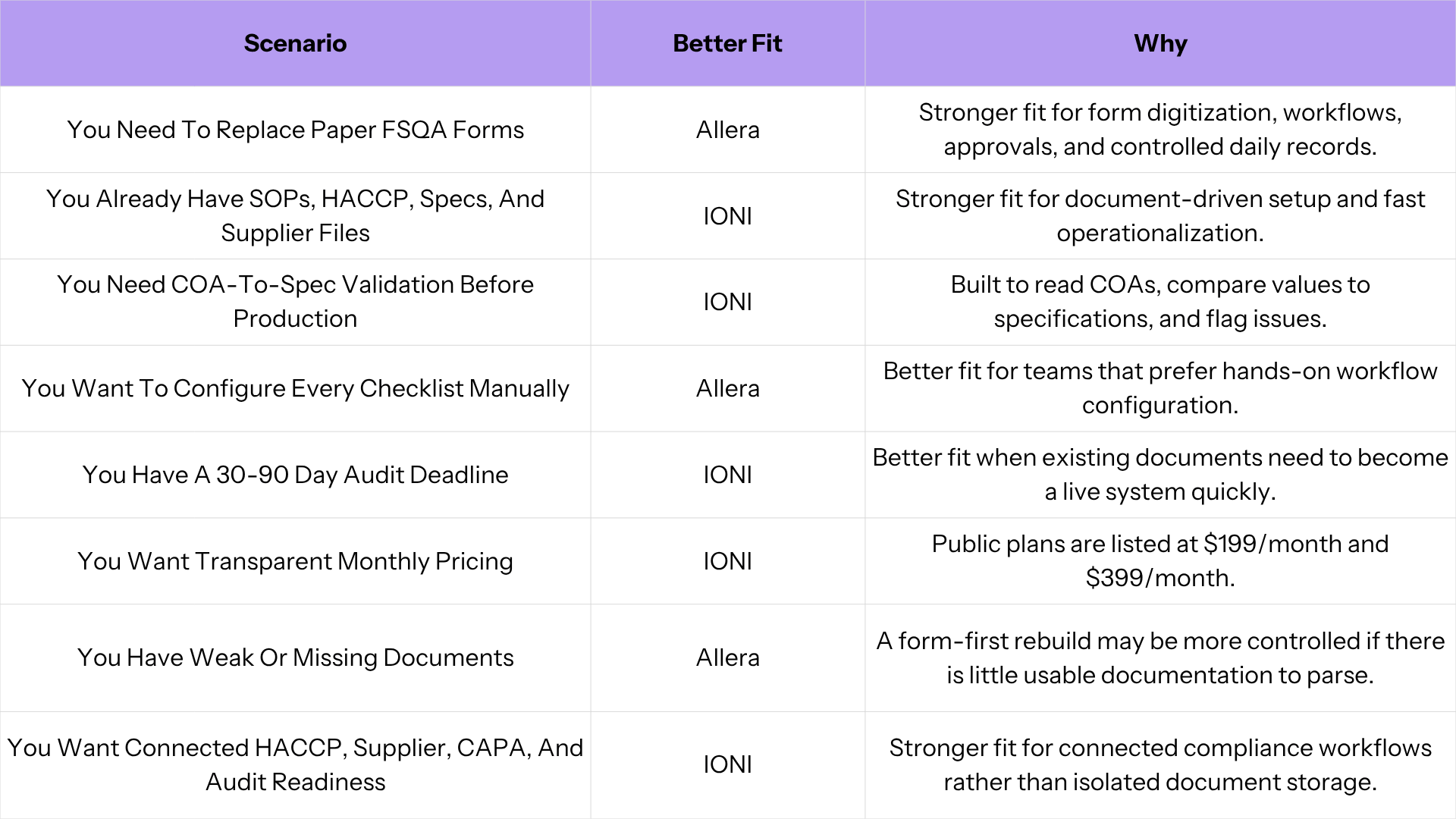
Allera is stronger for structured digitisation: replacing paper forms, standardising records, and configuring workflows manually. IONI is stronger for fast, document-driven setup and connected automation across HACCP, supplier quality, COA validation, CAPA, and audit readiness.
A plant with weak documentation and highly customised workflows may prefer Allera. A plant with existing SOPs, HACCP plans, supplier files, and an upcoming audit will usually get more value from IONI.
The practical question is simple: which platform removes the most manual work before your next audit or customer deadline?
Final Recommendation
IONI and Allera are both strong options for food manufacturers, but they solve different problems.
Allera is built for teams that want to digitise and control FSQA paperwork, forms, and supplier records. IONI is built for manufacturers that already have SOPs, HACCP plans, specs, COAs, and supplier files and need to turn them into a working compliance system quickly.
That is why IONI is the stronger Allera Technologies alternative for manufacturers preparing for SQF, BRCGS, FSMA, or customer audits under tight timelines.
Allera digitises workflows. IONI builds workflows from the documents you already use.
FAQ
Is Allera Or IONI Better For SQF Certification?
IONI is usually the better fit if you already have SOPs, HACCP documentation, supplier files, product specifications, and a certification deadline. The platform can use existing documents to build the food safety system faster. Allera may be better if your main need is configurable digital forms, document control, and a structured FSQA digitisation project.
How Long Does Allera Take To Set Up vs IONI?
Allera publicly positions implementation around 30 days or less. IONI is designed around uploading existing documents and going live in days, depending on document quality, facility complexity, and the number of workflows required.
Does Allera Do Automatic COA Validation?
Allera publicly emphasises supplier document collection, expiration tracking, supplier uploads, document control, and supplier dashboards. IONI specifically focuses on COA-to-spec validation, meaning the system reads COA values, compares them against internal ingredient specifications, and flags out-of-spec results before production or release.
What Does Allera Cost Compared To IONI?
IONI publishes pricing at $199/month for the Standard Plan and $399/month for the Premium Plan. Allera does not appear to publish standard monthly pricing on the public pages reviewed. Buyers should request an itemised quote from Allera and confirm whether implementation, supplier management, document control, users, sites, support, and training are included.
Can I Switch From Allera To IONI?
Yes. If your current system can export SOPs, HACCP plans, supplier files, specifications, monitoring records, corrective actions, or COAs, those documents can become the starting point for rebuilding workflows inside IONI.
Does IONI Work If I Do Not Have Existing Food Safety Documents?
Yes, but IONI works fastest when existing documents are available. If documents are missing, IONI can help identify gaps and generate missing HACCP-related content, SOPs, flowcharts, monitoring tasks, and procedures based on the production context.
Is IONI Only For SQF?
No. IONI supports broader food safety and compliance workflows, including HACCP, FSMA, SQF, BRCGS, CFIA-related documentation, supplier management, COA checks, CAPA, monitoring records, and audit readiness.
Is Allera A Bad Choice?
No. Allera can be a good choice for manufacturers that want a configurable FSQA platform for digital forms, supplier document collection, approvals, and document control. The better question is whether your plant needs form digitization first or document-driven automation first.
Which Platform Is Better For Supplier Quality Management?
IONI is stronger when supplier quality depends on validating COAs against internal specifications. Allera is stronger when the main need is supplier document collection, tracking, and follow-up. For teams evaluating this area more broadly, see Best Supplier Quality Management Software For FSQA Teams In Food Manufacturing 2026.