.png)
Last updated: October 2026
TCS food stands for Time/Temperature Control for Safety food: a food that requires time and temperature control to limit pathogen growth or toxin formation. Under the FDA Food Code, this includes raw or heat-treated animal foods (such as poultry, meat, fish, eggs and dairy), heat-treated plant foods (such as baked potatoes, cooked rice and cooked beans), and cut melons, cut tomatoes, cut leafy greens and raw seed sprouts such as alfalfa. Time-temperature abuse happens when a TCS food sits between 41°F and 135°F (5°C–57°C) for too long.
A bag of dry crackers and a container of cooked chicken can sit on the same prep table, but they do not carry the same food safety risk. The crackers may lose texture. The chicken can support pathogen growth within hours if temperature control fails, often without any smell, color change, or visible warning.
That is the practical meaning of TCS foods.
TCS stands for Time/Temperature Control for Safety. The term is used in the FDA Food Code for foods that need time and temperature control to limit pathogen growth or toxin formation. In plain terms, these are foods where temperature abuse can become a safety problem, not just a quality issue.
For food handlers, TCS status affects receiving, cold holding, hot holding, cooling, reheating, and service. For food manufacturers, it affects hazard analysis, HACCP controls, monitoring records, validation, supplier approval, product assessment, and audit evidence.
This guide explains what makes a food TCS, which foods usually fall into this category, which foods are typically non-TCS, what temperature rules apply, and how TCS classification affects HACCP planning in food manufacturing.
What Makes a Food TCS
The FDA Food Code defines a TCS food as one that requires time/temperature control for safety to limit pathogenic microorganism growth or toxin formation. In practice, the classification usually depends on three product characteristics: water activity, pH, and nutrient content.
Water activity, often written as aw, measures how much water is available for microbial growth. It is not the same as total moisture. A product can contain moisture but still bind enough water through salt, sugar, drying, or formulation to make microbial growth difficult. Pure water has a water activity of 1.0. Many pathogenic bacteria need water activity above 0.85 to grow, which is why foods at or below that level may qualify as non-TCS when the rest of the formulation supports that conclusion.
pH is the second major factor. Most dangerous foodborne pathogens grow best in low-acid or near-neutral foods. The key threshold used in FDA food safety frameworks is pH 4.6. Foods at or below pH 4.6 generally restrict the growth of many serious pathogens, which is why properly acidified foods can often be shelf-stable. FDA guidance for acidified and low-acid canned foods uses this threshold as a critical point in product classification.
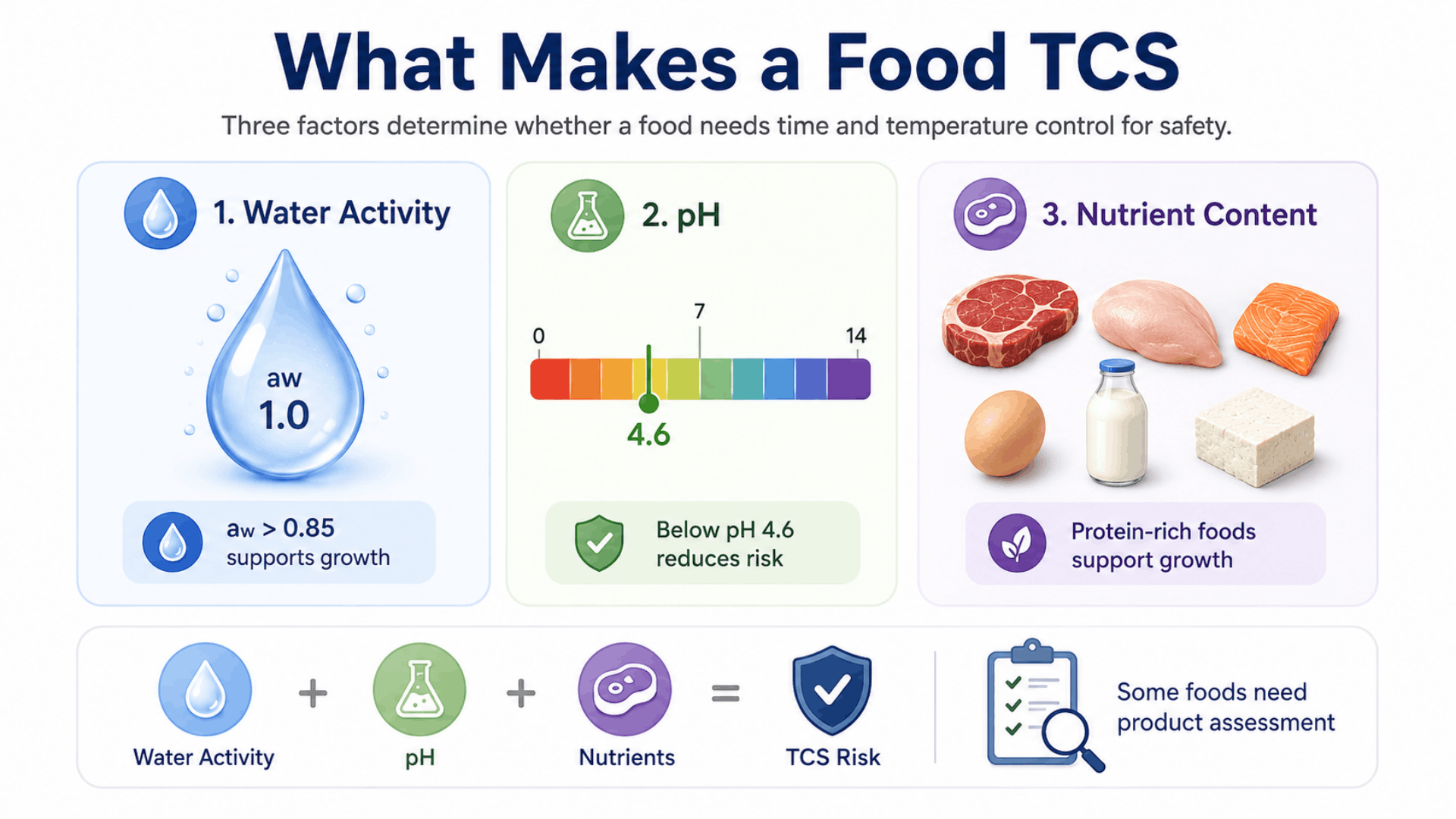
The third factor is nutrient content. Pathogens need nutrients to multiply. Meat, poultry, seafood, eggs, dairy, tofu, cooked legumes, and other protein-rich foods provide a much more favorable growth environment than dry crackers, uncooked rice, or hard candy. This is why animal-derived foods and many cooked plant foods are treated as TCS unless the product has a validated formulation or process that changes the risk.
These factors work together. A product with lower pH may tolerate higher water activity. A product with lower water activity may remain stable even when pH is higher. The FDA's TCS Job Aid uses pH and water activity tables to help determine whether a food is TCS, non-TCS, or requires product assessment.
That last category matters. If a product falls into a product assessment required zone, the business should not casually treat it as non-TCS. It needs scientific support, such as formulation data, pH and water activity testing, a process authority review, predictive modeling, or a challenge study.
The term TCS replaced the older term Potentially Hazardous Food, or PHF, in the FDA Food Code in 2013. Some older training materials and state regulations still use PHF, but both terms point to the same core issue: some foods need active control because they can support pathogen growth or toxin formation.
TCS Foods: Full List by Category
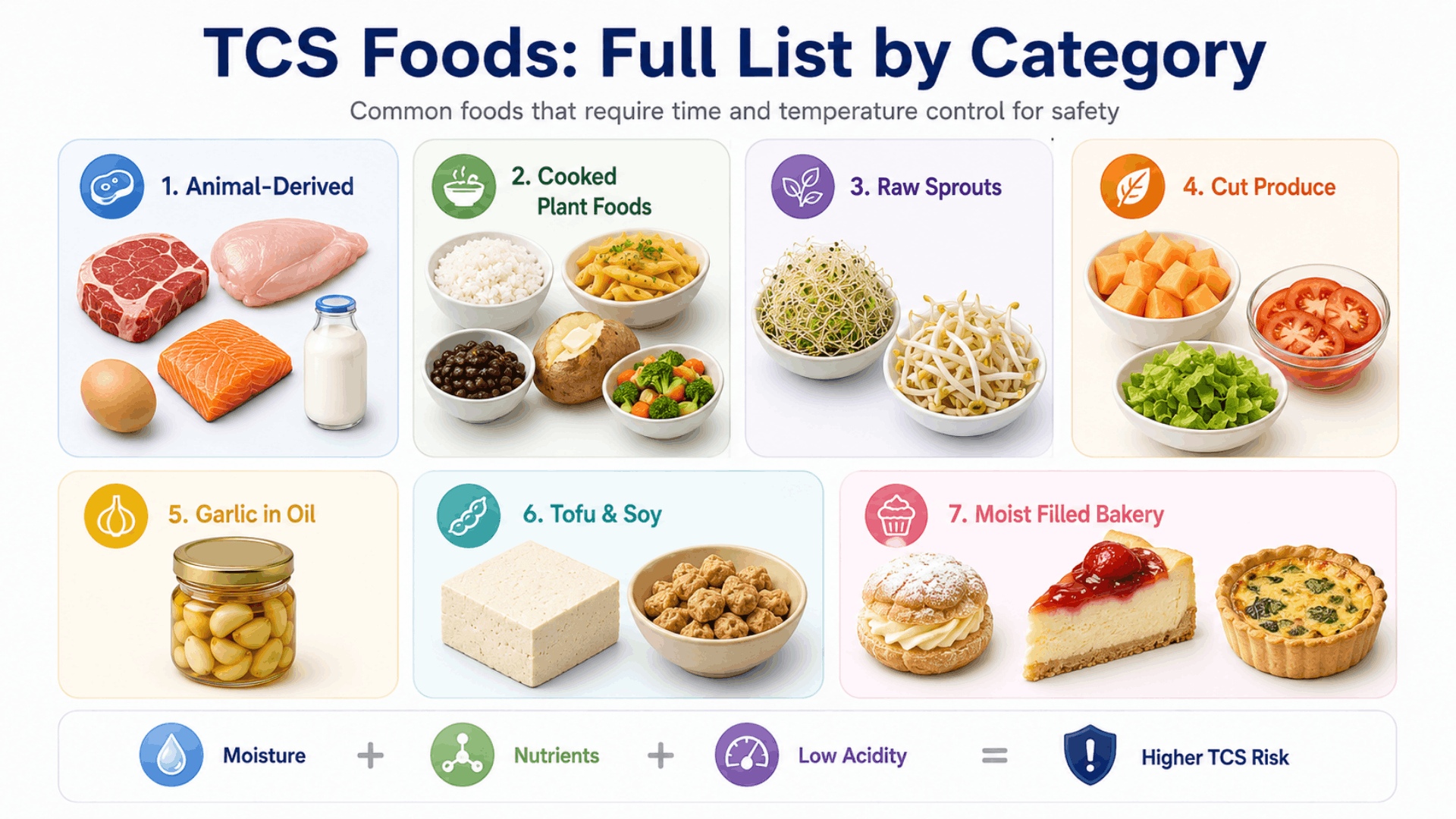
Most TCS foods are not hard to recognize once you understand the pattern. They tend to be moist, nutrient-rich, and low-acid enough to support microbial growth. The details still matter, especially when a food is cooked, cut, filled, mixed, opened, cooled, packaged, or reformulated.
Animal-Derived Foods
Animal-derived foods make up the largest and most obvious TCS category. Raw meat, poultry, seafood, shell eggs, milk, cream, soft cheeses, custards, cooked meat products, deli meats, sausages, pâtés, and cooked seafood all require time and temperature control because they naturally combine moisture, protein, and a pH range that supports pathogen growth.
The risk does not disappear just because the product has been cooked. Cooked chicken, cooked beef, cooked seafood, deli meat, and similar products can still become unsafe if they are cooled too slowly, stored above refrigeration temperature, held too long, or contaminated after cooking.
Hard aged cheeses are different. Products such as parmesan, romano, and some aged cheddar varieties often have lower water activity, which may place them outside TCS status. Still, classification can change when cheese is shredded, mixed into a moist product, exposed after opening, or used in a ready-to-eat formulation with different pH and water activity.
Seafood also needs extra attention because not all hazards are explained by TCS classification alone. FDA's Fish and Fishery Products Hazards and Controls Guidance covers additional concerns such as histamine, parasites, environmental contaminants, and process-specific controls.
Heat-Treated Plant Foods
Many teams recognize meat and dairy as TCS, but miss cooked plant foods. That is where HACCP gaps often appear.
Raw rice, dry pasta, raw potatoes, and uncooked beans are usually shelf-stable because they are dry or structurally protected. Once they are cooked, the food changes. Heat breaks down cell structures, starches gelatinize, and moisture becomes more available. Cooked rice, cooked pasta, cooked beans, cooked potatoes, cooked vegetables, and cooked grains can all support pathogen growth if they are cooled or held incorrectly.
This category is especially important for manufacturers of ready meals, sauces, fillings, dips, prepared salads, frozen meals, plant-based products, and meal kits. A product may look plant-based and low-risk on the surface, but the actual process may create TCS conditions after hydration, cooking, mixing, or cooling.
Raw Seed Sprouts
Raw seed sprouts are treated as TCS because the sprouting process creates the exact conditions many pathogens prefer: warmth, moisture, and time. Seeds can carry contamination before sprouting begins, and the germination environment can allow pathogens to multiply quickly.
This applies to alfalfa sprouts, bean sprouts, broccoli sprouts, clover sprouts, and other raw sprout varieties. The risk is not based only on the finished pH or water activity. It comes from the seed, the process, and the growth conditions.
Cut or Processed Produce
Whole fresh produce is usually not TCS. The skin, rind, or intact plant structure helps limit access to the nutrient-rich interior. Once the product is cut, the risk can change.
Cut melons, cut leafy greens, and cut tomatoes are the most common produce categories treated as TCS under the Food Code. A whole melon may sit intact without the same level of control. Cut that melon into cubes, and the exposed flesh can support microbial growth if temperature control fails.
The same logic applies to leafy greens and tomatoes. Cutting, shredding, chopping, and mixing increase surface area and create more opportunity for contamination to spread. This is why produce handling, wash controls, sanitation, cold holding, and shelf-life management matter so much in fresh-cut operations.
Not every cut fruit or vegetable automatically becomes TCS. The classification depends on the specific food, pH, water activity, handling method, packaging, and storage conditions. But cut melons, cut leafy greens, and cut tomatoes should always be treated with particular care.
Garlic-in-Oil Mixtures
Garlic-in-oil is one of the clearest examples of why formulation matters. Garlic can carry Clostridium botulinum spores from soil. Oil creates a low-oxygen environment. Without acidification or another validated control, that combination can allow botulinum toxin formation.
That does not mean every garlic-in-oil product is unsafe. It means the product needs the right controls. Acidification, refrigeration, formulation limits, shelf-life control, validated recipes, and process authority review may all be relevant depending on how the product is made and sold.
For manufacturers, this is also a reminder that small formulation changes can affect safety. A new acid level, preservative change, supplier change, oil ratio, particulate size, or packaging format can change the product's risk profile. Teams managing sauces, dressings, infused oils, dips, and refrigerated specialty foods need ingredient and formulation data that is easy to trace. IONI Ingredients Intelligence helps connect ingredient specifications, supplier documents, allergens, COAs, and product risk attributes in one place.
Tofu and Soy Protein Products
Tofu and many soy protein products are TCS because they contain enough moisture and protein to support microbial growth. Regular soft tofu, firm tofu, and many processed soy products require refrigeration unless a validated shelf-stable process or formulation supports another classification.
Fermented, dried, acidified, or commercially processed soy products may fall into a different category. The final classification depends on pH, water activity, process, packaging, storage conditions, and shelf-life evidence.
Cooked or Baked Goods with Moist Fillings
Dry baked goods are usually not TCS. The situation changes when the product contains a moist filling, dairy component, egg-based custard, meat filling, cream topping, or other ingredient that supports microbial growth.
A plain doughnut is not the same food safety risk as a cream-filled doughnut. A dry cake is not the same risk as cheesecake. A baked crust is not the same risk as a custard pie or quiche. The product's finished structure matters more than the general category name.
This is a common issue in bakeries, commissaries, frozen dessert operations, and prepared food facilities. If the filling or topping creates TCS conditions, the finished product needs controls that match the actual risk.
Non-TCS Foods: What Doesn't Require Temperature Control
Non-TCS foods are foods whose pH, water activity, formulation, or processing conditions prevent pathogen growth without refrigeration or hot holding.
Dry foods are the easiest examples. Crackers, pretzels, breadsticks, dry cereal, granola, uncooked dry pasta, uncooked rice, dry spices, herbs, honey, and many hard aged cheeses are usually non-TCS because they do not provide enough available water for pathogens to grow.
High-acid foods are another major group. Vinegar, properly acidified condiments, commercial mayonnaise, pickled vegetables, many hot sauces, and properly acidified canned vegetables can be non-TCS when the finished product is controlled and verified.
Commercially sterile sealed products are different again. An unopened retorted can or hermetically sealed shelf-stable product is not controlled the same way as the food after opening. The process and the intact package are part of the safety system.
That last point causes many mistakes. A sealed can of tuna may be shelf-stable. Open it, mix it with other ingredients, and the product becomes TCS. Dry rice may be shelf-stable. Cook it, cool it slowly, and it becomes a food safety concern. Dry powder may be low-risk in storage, but the hydrated mix may need time and temperature control.
This is why a good HACCP plan follows the food through the process. It does not classify risk only at the raw material stage. It asks what happens after cooking, cutting, cooling, rehydrating, mixing, filling, packaging, and storage.
For manufacturers, TCS classification should not live in a spreadsheet separate from the HACCP plan. It should connect directly to hazards, controls, monitoring tasks, corrective actions, supplier evidence, and audit records.
Temperature Rules for TCS Foods
TCS foods need temperature control because the hazard is often invisible. A product can look, smell, and taste normal while pathogens are growing.
Cold TCS foods are generally held at 41°F (5°C) or below. Hot TCS foods are generally held at 135°F (57°C) or above. The range between those two points is known as the temperature danger zone. It is where many pathogens can grow quickly when other conditions support growth.
For basic food handler training, the practical rule is simple: do not leave TCS foods in the danger zone for more than 2 hours. If the surrounding temperature is above 90°F (32°C), the common limit is 1 hour.
There are more specific rules for time as a public health control under the Food Code. In some cases, food may be held without temperature control for up to 4 hours, or up to 6 hours in limited cold-holding situations. But this is not an informal workaround. It requires written procedures, correct starting temperatures, marking, discard rules, and compliance with the applicable local requirements.
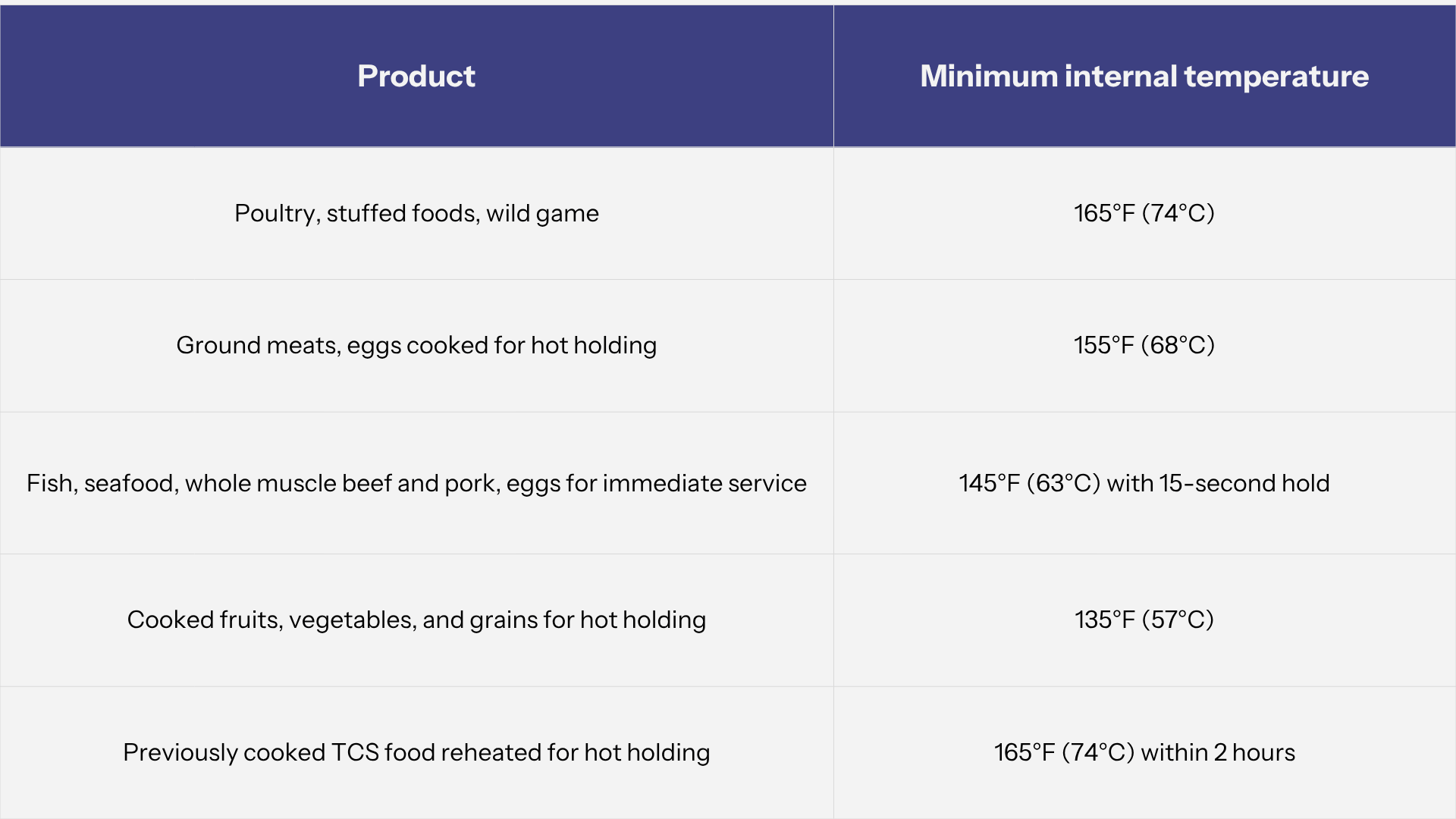
Minimum cooking temperatures vary because different foods carry different pathogen risks. Food service teams often use FDA Food Code requirements, while consumer-facing guidance from USDA FSIS and FoodSafety.gov provides practical temperature references.
Cooling is just as important as cooking. Cooked TCS food should cool from 135°F to 70°F (57°C to 21°C) within 2 hours, then from 70°F to 41°F (21°C to 5°C) within the next 4 hours. Total cooling time should not exceed 6 hours.
In a restaurant, this usually means shallow pans, smaller portions, ice baths, blast chilling, and cooling logs. In a manufacturing plant, it means validated cooling parameters, batch size limits, packaging assumptions, equipment capacity, monitoring records, deviation handling, and re-validation when the process changes.
For Food Manufacturers: How TCS Status Affects Your HACCP Plan
TCS is a Food Code term, and the Food Code is mainly a model code for retail food and food service. Food manufacturers are usually governed by FSMA, especially 21 CFR Part 117, plus product-specific regulations, customer requirements, and certification schemes.
Still, TCS status is highly relevant in manufacturing. It helps the HACCP or preventive controls team decide where time and temperature control is needed, which hazards are significant, what records must exist, and when a product change requires reassessment.
In manufacturing, the better question is not only "Is this food on a TCS list?" The better question is "Can this product, ingredient, or intermediate support pathogen growth or toxin formation at this step of the process?"
That distinction matters. A dry ingredient may not be TCS at receiving. The same ingredient may become TCS after hydration. A vegetable may not require the same control when whole, but may require control after cooking or cutting. A sauce may be safe under one pH target, then move into a different risk category after reformulation.
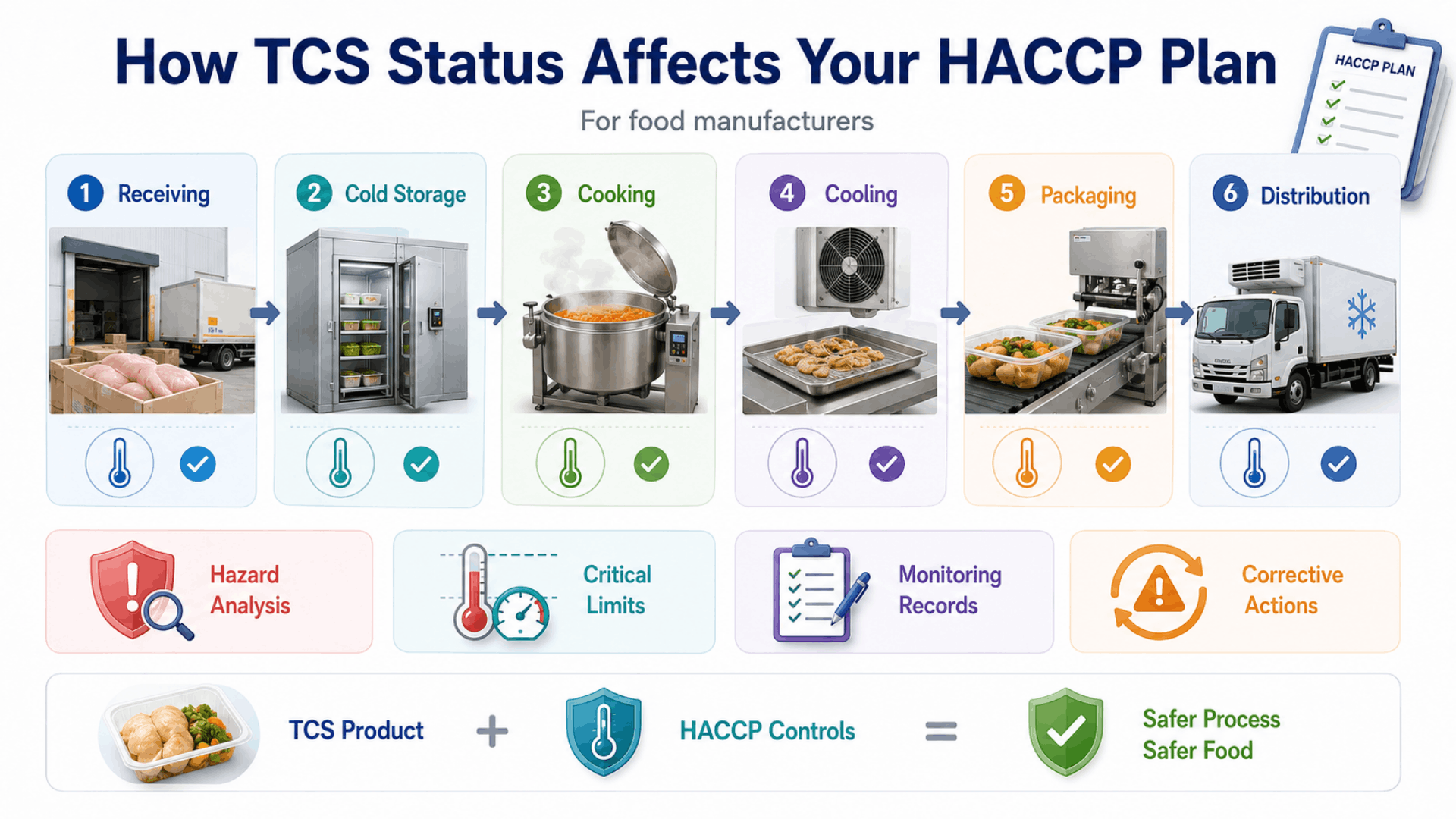
At the hazard analysis stage, TCS status affects how the team evaluates biological hazards. Receiving, cold storage, cooking, cooling, holding, rework, packaging, and distribution may all require review. The plan should reflect the real product, not a generic product category.
At CCPs or preventive controls, TCS foods often need measurable limits. This may include receiving temperatures, cold storage limits, cooking or pasteurization parameters, cooling time, hot holding conditions, refrigerated distribution limits, shelf-life controls, and rework time limits. Each control should have a monitoring method, frequency, responsibility, corrective action, verification step, and record location. To decide whether a step really is a CCP, use the four-question CCP decision tree.
This is where many audit findings begin. The company may have the right temperature limit in the HACCP plan, but the monitoring record is incomplete. Or the cooling CCP was validated for one container size, but production later moved to a larger pack. Or a product was reformulated, but pH and water activity were not reassessed.
For manufacturers managing allergen risk at the same time, TCS review should not sit in a separate file. Reformulation can affect pH, water activity, preservatives, allergens, label claims, and supplier requirements at the same time. Our guide to allergen management for food manufacturers explains how to build a control plan that auditors can actually follow.
Under FSMA, the same logic becomes part of risk-based preventive controls. If a TCS ingredient arrives from a supplier that controls a significant hazard, supply-chain verification may be needed. If a process step controls pathogen survival or growth, validation may be needed. If refrigeration is necessary for safety, monitoring and corrective action records are not optional.
GFSI schemes add another layer of discipline. SQF, BRCGS, and FSSC 22000 auditors expect the food safety plan to match the product and process. A site making refrigerated ready-to-eat foods, cooked fillings, prepared meals, dips, or sauces should be able to show how TCS status was considered in hazard analysis, PRPs, CCPs or OPRPs, monitoring, verification, and training.
For FSSC 22000 sites, this connects directly to PRPs, operational PRPs, validation, verification, and management system discipline. Our guide to FSSC 22000 certification for food manufacturers explains how the scheme is structured and what manufacturers should prepare before audit.
For SQF sites, the technical control is only part of the picture. Auditors also look at whether people understand the controls they are responsible for. That is why food safety culture under SQF Edition 10 matters when TCS control depends on daily behavior, not just written procedures.
For Food Manufacturers: Product Assessment
Not every product fits cleanly into TCS or non-TCS status. Some products fall into a range where pH and water activity alone do not settle the question. These products need a documented assessment before the business can defend storage conditions, shelf life, monitoring requirements, and HACCP controls.
A product assessment is a scientific evaluation of whether the food supports pathogen growth or toxin formation under its actual formulation, process, packaging, and storage conditions.
This assessment may include finished product pH, equilibrium pH, water activity, salt level, preservatives, organic acids, antimicrobials, competitive microflora, heat treatment, cooling profile, packaging atmosphere, oxygen availability, storage temperature, shelf life, intended use, and consumer handling assumptions.
For some products, predictive modeling or a challenge study may be needed. For others, a process authority review and strong formulation data may be enough. The right level of evidence depends on the product, the hazard, the claim being made, and the regulatory or customer expectation.
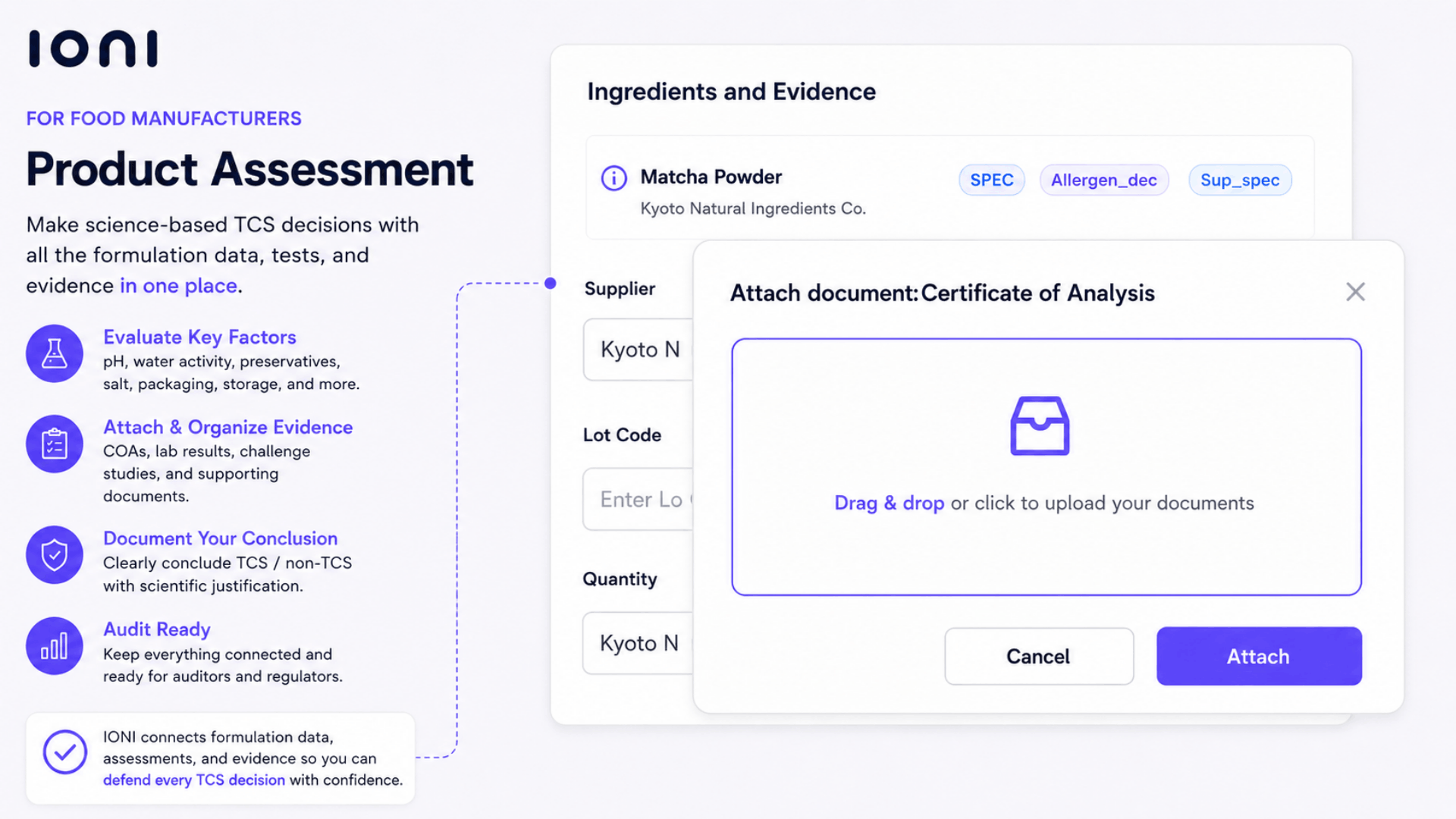
Product assessment becomes especially important when a product has intermediate water activity, a fermented product has variable final pH, a sauce or dressing is reformulated, a chilled product is being considered for shelf-stable distribution, or a product uses several hurdles at once, such as pH plus water activity plus preservatives.
It is also important when packaging changes. A product packed in air may not carry the same risk as the same product in vacuum or modified atmosphere packaging. A larger container may cool more slowly than the pack size used in validation. A new supplier may change salt, moisture, acid, or preservative levels even when the ingredient name stays the same.
A non-TCS decision can be valuable. It may simplify storage, distribution, monitoring, and HACCP documentation. But it must be supported. A single pH result from one trial batch is not enough for a broad classification decision. The conclusion should be documented, reviewed, and maintained as part of the food safety management system.
This is where ingredient data becomes critical. pH, water activity, COAs, allergens, supplier specifications, preservatives, and formulation details should not be spread across disconnected folders. Use IONI Ingredients Intelligence to connect ingredient data, supplier evidence, allergens, COAs, and product risk attributes before they become HACCP or audit gaps.
Product assessment also needs to stay aligned with regulatory and buyer expectations. Rules, guidance, customer requirements, and audit interpretations change over time. QA and regulatory teams need a way to connect those changes to real products, ingredients, markets, and controls.
TCS status can change when regulations, market requirements, formulas, ingredients, or packaging assumptions change.
FAQ
What does TCS stand for in food safety?
TCS stands for Time/Temperature Control for Safety. It is an FDA designation for foods that need time and temperature control to limit pathogen growth or toxin formation. The term replaced Potentially Hazardous Food, or PHF, in the Food Code, although PHF still appears in some older training materials and regulations.
What are examples of TCS foods?
Examples of TCS foods include meat, poultry, seafood, eggs, milk, soft cheeses, cooked rice, cooked pasta, cooked beans, cooked vegetables, cut melons, cut leafy greens, cut tomatoes, raw seed sprouts, tofu, garlic-in-oil mixtures, and baked goods with moist fillings.
These foods usually have enough available moisture, nutrients, and suitable pH to support pathogen growth if they are not kept under proper time and temperature control.
What are non-TCS foods?
Non-TCS foods are foods that do not support pathogen growth under normal conditions because of low water activity, low pH, commercial processing, or a combination of controls. Dry crackers, uncooked rice, dry pasta, honey, hard aged cheese, properly acidified condiments, pickles, hot sauces, and unopened commercially canned shelf-stable foods are common examples.
The classification can change after opening, cooking, cutting, rehydrating, or mixing.
What is the temperature danger zone for TCS foods?
The temperature danger zone is 41°F to 135°F (5°C to 57°C). This is the range where many pathogens can grow quickly if the food supports their growth.
As a practical rule, TCS foods should not stay in this range for more than 2 hours. If the surrounding temperature is above 90°F (32°C), the common limit is 1 hour. Specific time-as-control procedures may allow different handling, but only with written procedures and compliance with applicable rules.
How does TCS status affect a HACCP plan?
TCS status helps the HACCP team identify where biological hazards may become significant. Once a food, ingredient, or intermediate product is TCS, the team needs to evaluate receiving, storage, cooking, cooling, holding, packaging, rework, distribution, and shelf life.
TCS foods often require defined limits, monitoring records, corrective actions, verification, validation, and employee training.
What is a product assessment for TCS determination?
A product assessment is a scientific review used when TCS status cannot be determined from a simple food category or from pH and water activity alone. It evaluates whether the product supports pathogen growth or toxin formation under actual formulation, process, packaging, and storage conditions.
The assessment may include pH, water activity, preservatives, salt, antimicrobials, packaging atmosphere, storage temperature, shelf life, predictive modeling, or challenge study data.
Does TCS apply to food manufacturers as well as restaurants?
Yes, but the application is different.
In food service, TCS classification mainly drives holding, cooling, reheating, date marking, and service procedures. In food manufacturing, TCS status informs hazard analysis, preventive controls, HACCP design, validation, supplier verification, storage requirements, and audit evidence.
The Food Code is mainly a model code for retail and food service. Manufacturers are usually governed by FSMA, USDA rules where applicable, customer requirements, and certification schemes. Still, TCS logic is directly useful because it helps identify where time and temperature control is necessary for safety.
What cooking temperatures apply to TCS foods?
Minimum internal cooking temperatures depend on the food. Common reference points are 165°F (74°C) for poultry and stuffed products, 155°F (68°C) for ground meats and eggs cooked for hot holding, 145°F (63°C) with a 15-second hold for fish, seafood, whole muscle beef and pork, and 135°F (57°C) for cooked fruits, vegetables, and grains held hot.
Food service teams should follow applicable state or local food code requirements. Food manufacturers should use validated process controls based on product type, pathogen risk, regulatory category, and scientific support.
TCS Classification Is Where Food Safety Starts
TCS classification is not just a food handler training term. It is one of the first questions behind safe product design, process control, and HACCP planning.
Can this food support pathogen growth if temperature control fails? Does cooking, cutting, mixing, filling, cooling, or packaging change the risk? Does the product need refrigeration, a validated kill step, cooling records, supplier verification, or shelf-life support? Would an auditor understand the classification decision from the evidence on file?
For food handlers, the answer shapes storage, cooling, hot holding, reheating, and service. For food manufacturers, it shapes hazard analysis, preventive controls, GFSI audit readiness, and regulatory compliance.
The strongest food safety systems do not treat TCS status as a label added at the end. They treat it as part of the product's risk profile from formulation through distribution.
For food manufacturers, see how IONI connects TCS product parameters, HACCP controls, supplier evidence, regulatory monitoring, and audit records in one system. Use your real documents, identify gaps faster, and prepare stronger audit evidence without rebuilding your food safety program from scratch.
A note on Food Code applicability: The FDA Food Code is a model code developed for food offered at retail and in food service establishments. Actual TCS requirements depend on adoption and implementation by state, local, tribal, or territorial authorities. Food manufacturers are primarily governed by FSMA, 21 CFR Part 117, applicable USDA regulations, customer requirements, and certification schemes. Always verify which rules apply to your facility, product category, market, and jurisdiction.