.png)
If a retailer, co-packer customer, or global brand asked for FSSC 22000 and you are not sure how it differs from SQF or BRCGS, that confusion is normal. All three are GFSI-recognized schemes. All three are accepted by many major buyers as evidence of a mature food safety system. But FSSC 22000 is built differently, audited differently, and structured around layers that many food manufacturers do not expect when they start preparing.
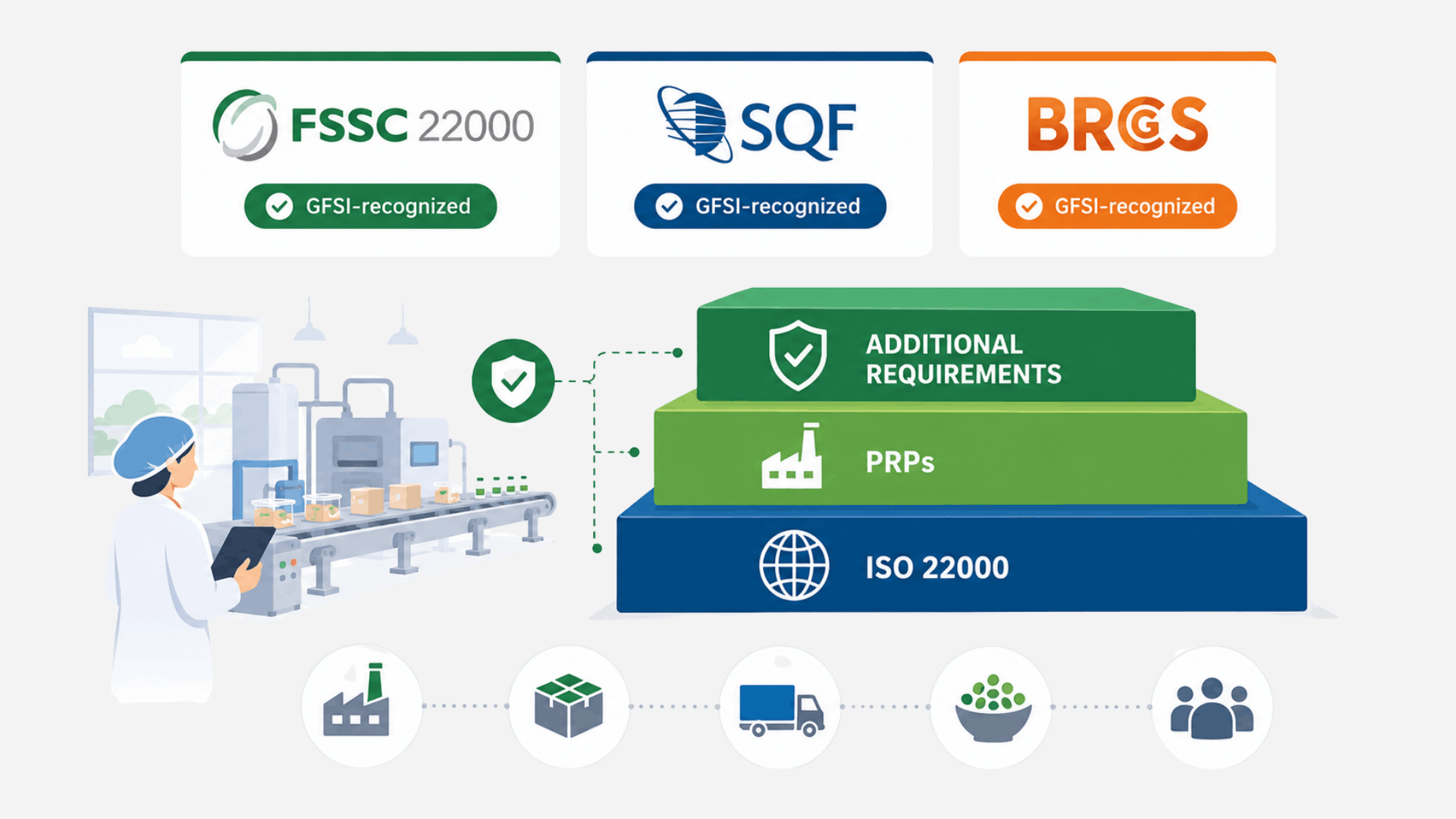
FSSC 22000, or Food Safety System Certification, is a GFSI-recognized certification scheme built on ISO 22000. It is used by food manufacturers, packaging producers, storage and distribution operators, feed producers, and other food chain organizations. It is especially common in companies that already operate ISO-based management systems, and it is often requested by global brands and private-label programs alongside SQF and BRCGS.
This guide explains what FSSC 22000 actually requires, how its layered structure works, how it compares with SQF and BRCGS, what changed in Version 6, what Version 7 means, and what food manufacturers should build first.
What FSSC 22000 Is and Why It's Structured Differently
Most food safety certifications, including SQF and BRCGS, are written as standalone codes. You read the code, implement the code, and prepare evidence against that code.
FSSC 22000 works differently. The FSSC 22000 certification scheme is built from several connected layers that have to operate as one food safety management system.
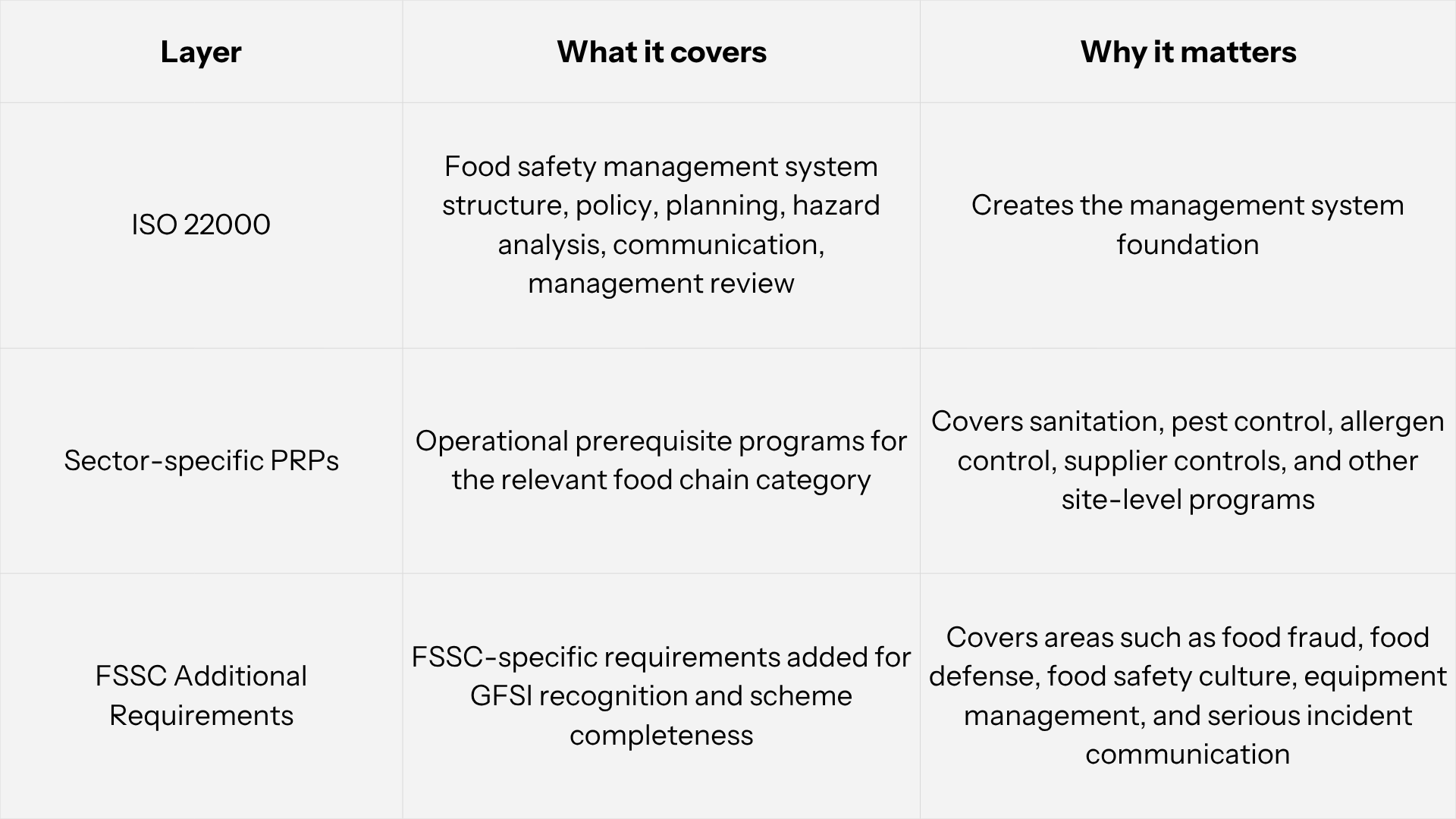
Layer 1 is ISO 22000. This is the base food safety management system standard. It defines how an organization should structure policy, objectives, hazard analysis, operational controls, internal audits, management review, and continual improvement. For a closer look at what ISO 22000 requires on its own, separate from FSSC 22000's added layers, see our guide to what ISO 22000 is.
Layer 2 is the sector-specific Prerequisite Program standard. For food manufacturing, this has traditionally meant ISO/TS 22002-1. The newer ISO 22002-1:2025 now defines requirements for prerequisite programs in food manufacturing, together with the wider ISO 22002 series.
Layer 3 is the FSSC Additional Requirements. These requirements sit on top of ISO 22000 and the PRP standard. They cover areas that ISO 22000 alone does not fully address for GFSI-recognized certification, including food fraud, food defense, allergen management, environmental monitoring, food safety and quality culture, quality control, equipment management, and notification of serious incidents.
The practical consequence is simple: an FSSC 22000 auditor is not checking three separate binders. They are checking whether your ISO 22000 system, PRPs, HACCP controls, monitoring records, supplier files, corrective actions, and FSSC additional requirements work together as one system.
Manufacturers usually run into trouble when these layers are built as separate projects. The HACCP plan sits in one place, sanitation and pest control records sit somewhere else, supplier approval is managed in spreadsheets, and food safety culture is written as a policy that is not connected to training, complaints, deviations, or management review. That is when gaps become visible during an audit.
FSSC 22000 vs SQF vs BRCGS: Which One Do You Actually Need?
FSSC 22000, SQF, and BRCGS are all recognized by the Global Food Safety Initiative. The GFSI list of recognized Certification Programme Owners includes FSSC 22000, and many buyers treat GFSI-recognized schemes as comparable evidence of food safety maturity.
That does not mean they are identical. The right choice depends on buyer requirements, geography, existing systems, and how your facility already manages documentation.
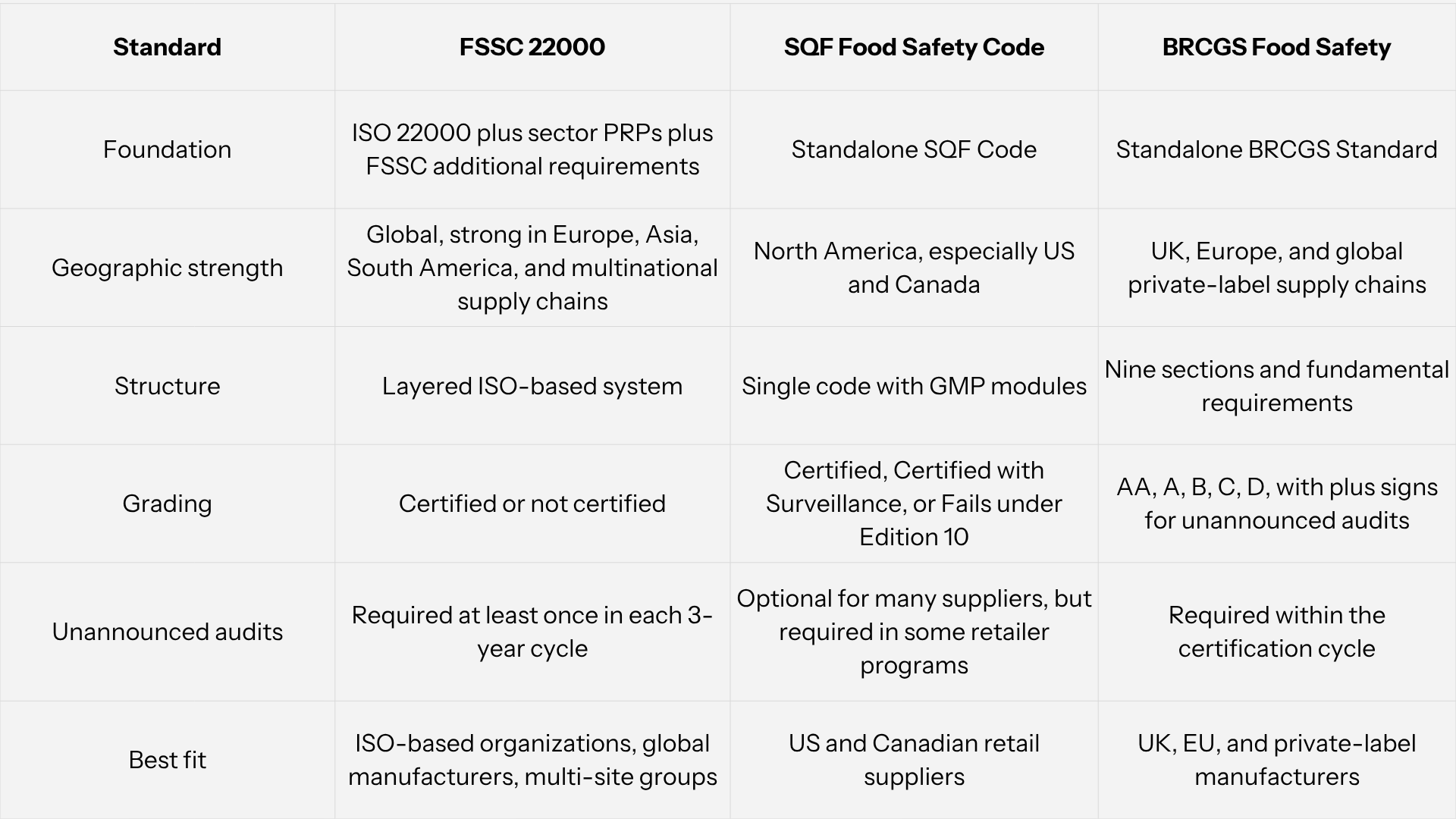
Start with the buyer. If a customer contract specifically requires SQF, then FSSC 22000 may not satisfy that requirement even if both schemes are GFSI-recognized. If a UK or EU retailer asks for BRCGS, the direct path is usually BRCGS. If your organization already runs ISO 9001, ISO 14001, or another ISO-based management system, FSSC 22000 may fit more naturally because the management system structure will already feel familiar.
For manufacturers comparing standards, it helps to separate the technical food safety work from the certification format. The HACCP foundation, supplier approval logic, corrective action process, training records, and monitoring evidence are similar across schemes. The extra work is usually in mapping the same operational evidence to each scheme's required structure.
If your team is comparing certification options, the SQF audit checklist for small food manufacturers and BRCGS certification guide can help you see how those schemes differ in audit expectations.
FSSC 22000 Versions: V6, V7, and What's Changing
FSSC 22000 Version 6 is still the active audit basis during the current transition period. Version 6 became effective for audits on April 1, 2024, and the Version 5.1 upgrade window closed on March 31, 2025.
Version 6 introduced several changes that food manufacturers still need to understand:
Quality control became a mandatory part of the scheme instead of a voluntary add-on.
Food safety and quality culture became a standalone requirement, with a documented plan, objectives, and evidence of implementation.
Labelling and traceability expectations were strengthened.
Organizations must notify their certification body within three working days of serious events affecting the food safety management system or the integrity of certification.
Additional focus was added around equipment management, allergen management, food loss and waste, and serious incident communication.
Version 7 has now been published. The official FSSC 22000 Version 7 Scheme Documents are available from Foundation FSSC. The transition is structured over time rather than as an immediate cutover. Audits against Version 6 are permitted until April 30, 2027. Upgrade audits against Version 7 are conducted from May 1, 2027, until April 30, 2028.
The practical implication for manufacturers preparing now is clear: build against Version 6 if your audit is before the transition deadline, but do not ignore Version 7. If your certification project, recertification cycle, or internal roadmap extends into 2027, add a Version 7 gap review to the plan.
For teams that need ongoing updates across FSSC, SQF, BRCGS, FSMA, CFIA, and EU regulatory changes, regulatory intelligence for food manufacturers should not sit outside the food safety system. It should feed your procedures, risk assessments, supplier requirements, internal audits, and management review. IONI's AI Regulatory Intelligence is built for that continuous monitoring use case.
What FSSC 22000 Requires: The 14 Additional Requirements
Beyond ISO 22000 and the relevant PRP standard, FSSC 22000 Version 6 includes additional requirements that all certified organizations need to address. These are often the most underestimated part of FSSC 22000 certification because many teams assume their HACCP plan and PRPs already cover everything.
Some overlap will exist, especially if you already maintain SQF or BRCGS certification. But overlap is not the same as compliance. FSSC expects documented controls, assigned ownership, evidence of implementation, and review.
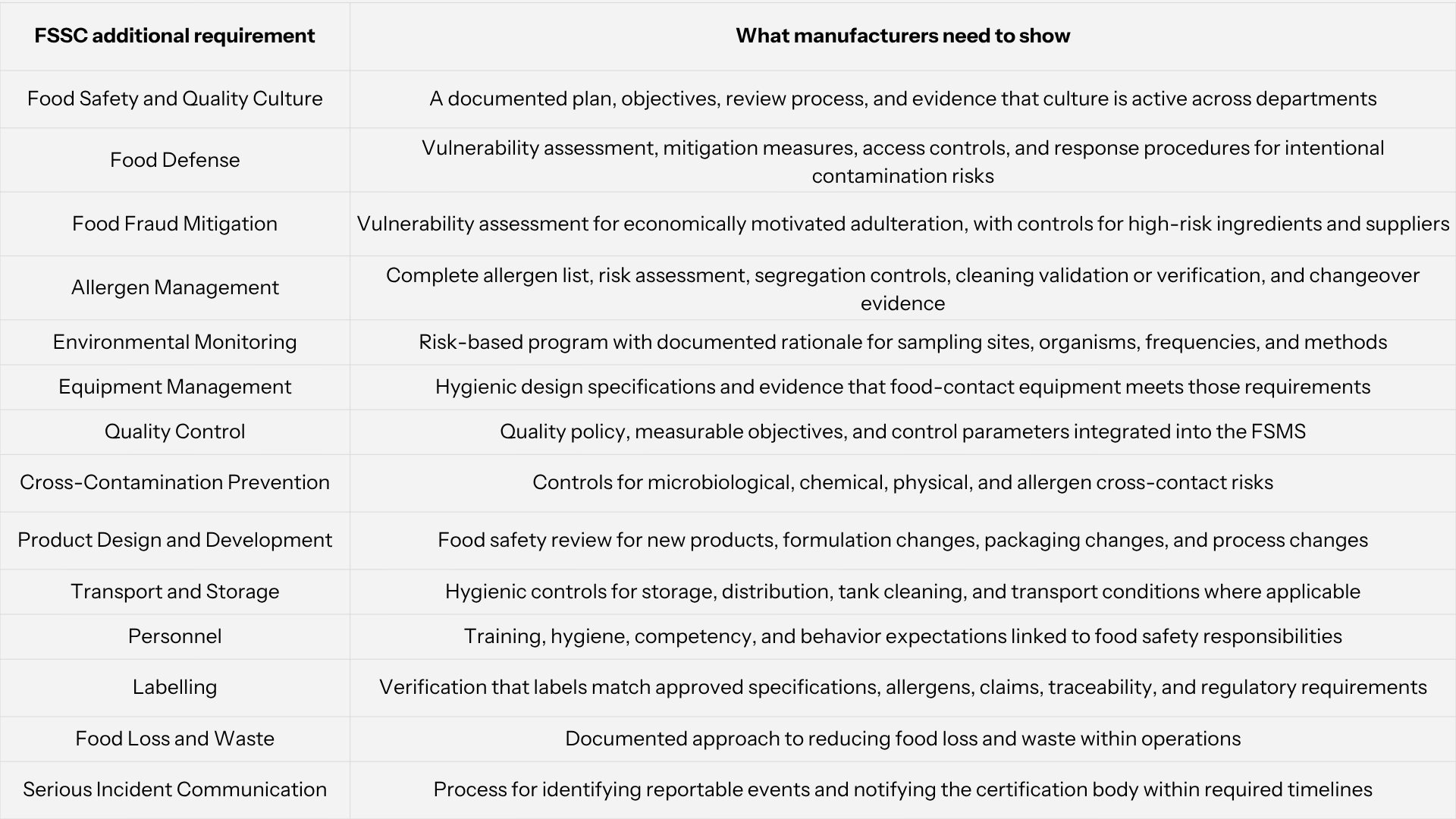
Food safety and quality culture should not be treated as a poster campaign. Auditors will look for evidence that the plan affects training, escalation, reporting, management review, and day-to-day decisions on the floor. The same operational challenge appears in SQF Edition 10, where food safety culture also needs documented assessment and evidence. For more details, see this guide to food safety culture under SQF Edition 10.
Food fraud and food defense also need to be specific. A generic risk matrix is not enough. High-risk ingredients, vulnerable suppliers, unusual pricing, origin risks, and a history of adulteration should influence the controls you choose. This is where supplier documentation, COAs, specifications, and ingredient intelligence become part of the certification system. IONI's Ingredients Intelligence for food companies helps teams connect ingredients, suppliers, risks, allergens, and documentation in one place.
Allergen management needs special attention. Version 6 requires the allergen management plan to account for allergens present at the facility, not just allergens declared on finished product labels. That means shared lines, rework, seasonal ingredients, supplier-introduced allergens, trial runs, and cleaning verification all matter.
Quality control is another common gap. Some facilities still manage quality as a department function that sits outside the food safety management system. Under FSSC 22000 Version 6, quality control needs to be part of the FSMS, with policy, objectives, parameters, monitoring, and review.
How the FSSC 22000 Audit Works
FSSC 22000 certification follows a two-stage audit model consistent with ISO-based certification.
Stage 1 is the document and readiness review. The certification body checks whether your food safety management system is sufficiently developed for the certification audit. They review the management system structure, scope, policies, hazard analysis, PRPs, internal audit process, management review, and FSSC additional requirements. Significant gaps at Stage 1 can delay Stage 2.
Stage 2 is the certification audit. The auditor checks whether the documented system is actually operating. This includes facility walkthroughs, interviews, monitoring record review, corrective action review, supplier file checks, label verification, training records, internal audits, management review, and evidence that procedures match floor practice.
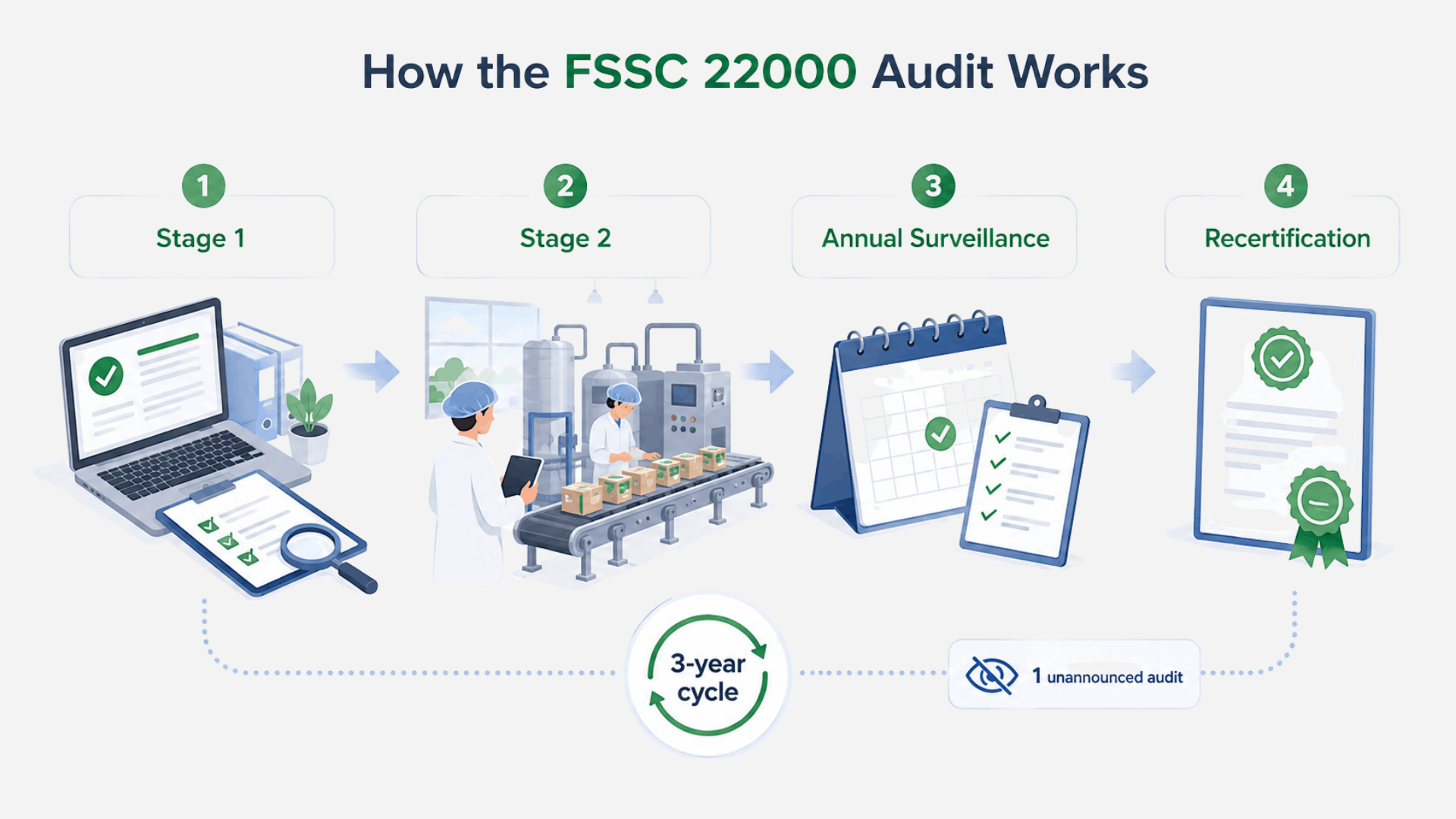
After certification, the organization enters a 3-year certification cycle. Annual surveillance audits are required, and recertification is completed before the certificate expires. At least one audit in each 3-year cycle must be unannounced. That is a base scheme requirement, not only a customer-specific condition.
This matters operationally. A facility preparing for FSSC 22000 cannot build an audit binder once per year and ignore records between audits. Monitoring records, sanitation verification, allergen changeovers, supplier approvals, COA review, complaints, deviations, corrective actions, and management review inputs need to stay current.
If your team wants a broader readiness framework, the Food Safety Compliance Readiness Report explains how to evaluate audit readiness before the certification body arrives.
FSSC 22000 Certification Timeline and Cost
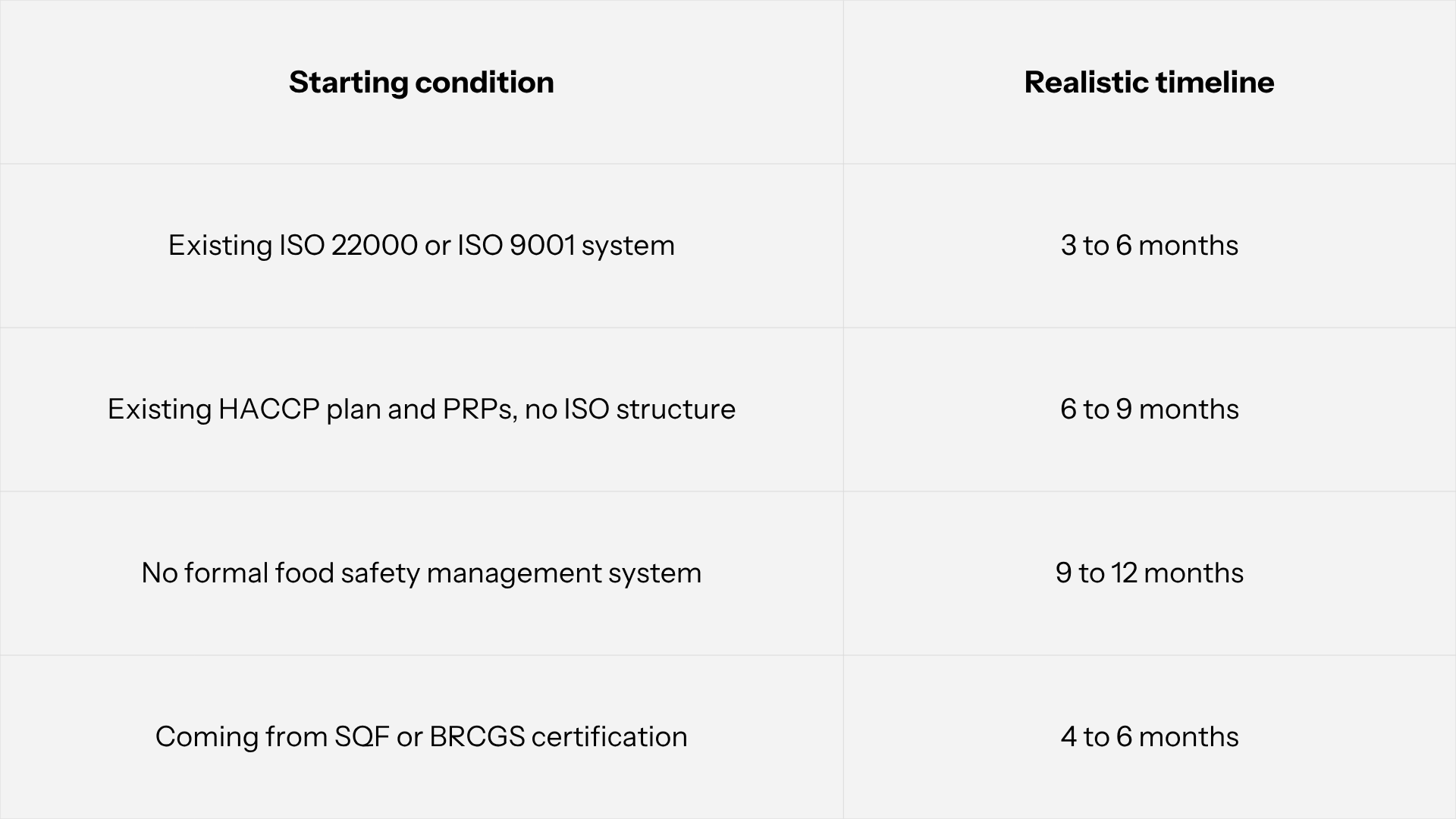
Initial FSSC 22000 certification usually takes 6 to 12 months from project start to certificate issuance. The exact timeline depends on how mature your existing food safety management system is, whether you already use ISO management system practices, and how complete your PRPs and HACCP documentation are.
Audit fees from accredited certification bodies often range from $8,000 to $25,000 for initial certification, depending on facility size, food chain category, audit duration, location, and certification body. Annual surveillance audits are usually lower than the initial certification audit, but still represent a recurring cost.
The direct audit fee is rarely the highest cost. Internal preparation usually takes more time and money. That includes procedure writing, PRP development, hazard analysis updates, food fraud assessments, food defense assessments, allergen program updates, supplier documentation, training, internal audits, corrective actions, software setup, consultant support, and management review.
For small and mid-size manufacturers, the real question is not only "How much does certification cost?" It is "How much operational disruption will preparation create?" A facility that already has controlled documents, organized records, active supplier approval, and consistent monitoring logs will move faster and spend less time rebuilding evidence.
What Auditors Look For and Where Manufacturers Fail
The most common FSSC 22000 audit problems are rarely dramatic. They are usually integration problems.
The first problem is disconnected documentation. The HACCP plan, PRPs, supplier approval files, food fraud assessment, allergen plan, environmental monitoring program, and management review may all exist, but they do not reference each other. A new ingredient is added, but the allergen risk assessment is not updated. A new supplier is approved, but the food fraud assessment still reflects the old supply base. A new piece of equipment is installed, but hygienic design evidence is missing.
The second problem is food safety culture as paperwork. Since Version 6 made food safety and quality culture a standalone requirement, auditors can test whether the plan is real. They may ask operators how they report food safety concerns, supervisors how they handle recurring deviations, and managers how culture metrics are reviewed. If the plan does not connect to actual behavior, it will look weak.
The third problem is incomplete allergen management. Many facilities list finished product allergens but miss allergens brought in through suppliers, rework, shared equipment, trial products, or temporary formulations. FSSC expects a complete facility-level view.
The fourth problem is quality control outside the FSMS. If quality objectives, quality checks, and product release decisions are managed separately from the food safety management system, the system may not satisfy Version 6 expectations.
The fifth problem is missing equipment evidence. Facilities often have maintenance logs and sanitation records, but they may not have documented hygienic design specifications or supplier evidence showing that equipment meets those specifications.
The sixth problem is serious incident communication. A written requirement to notify the certification body is not enough. The facility needs a process that defines who decides whether an event is reportable, who contacts the certification body, what gets documented, and how the decision is reviewed afterward.
The seventh problem is supplier approval that does not match the actual risk. A one-time questionnaire may not be enough for high-risk suppliers or ingredients. Supplier controls should reflect ingredient risk, supplier history, certification status, COA reliability, allergen exposure, country of origin, and past deviations. The same principle appears in SQF supplier programs, which are covered in this guide to SQF supplier approval minimum requirements.
See how IONI helps to avoid fails. No credit card required. 30-minute setup with your real documents.
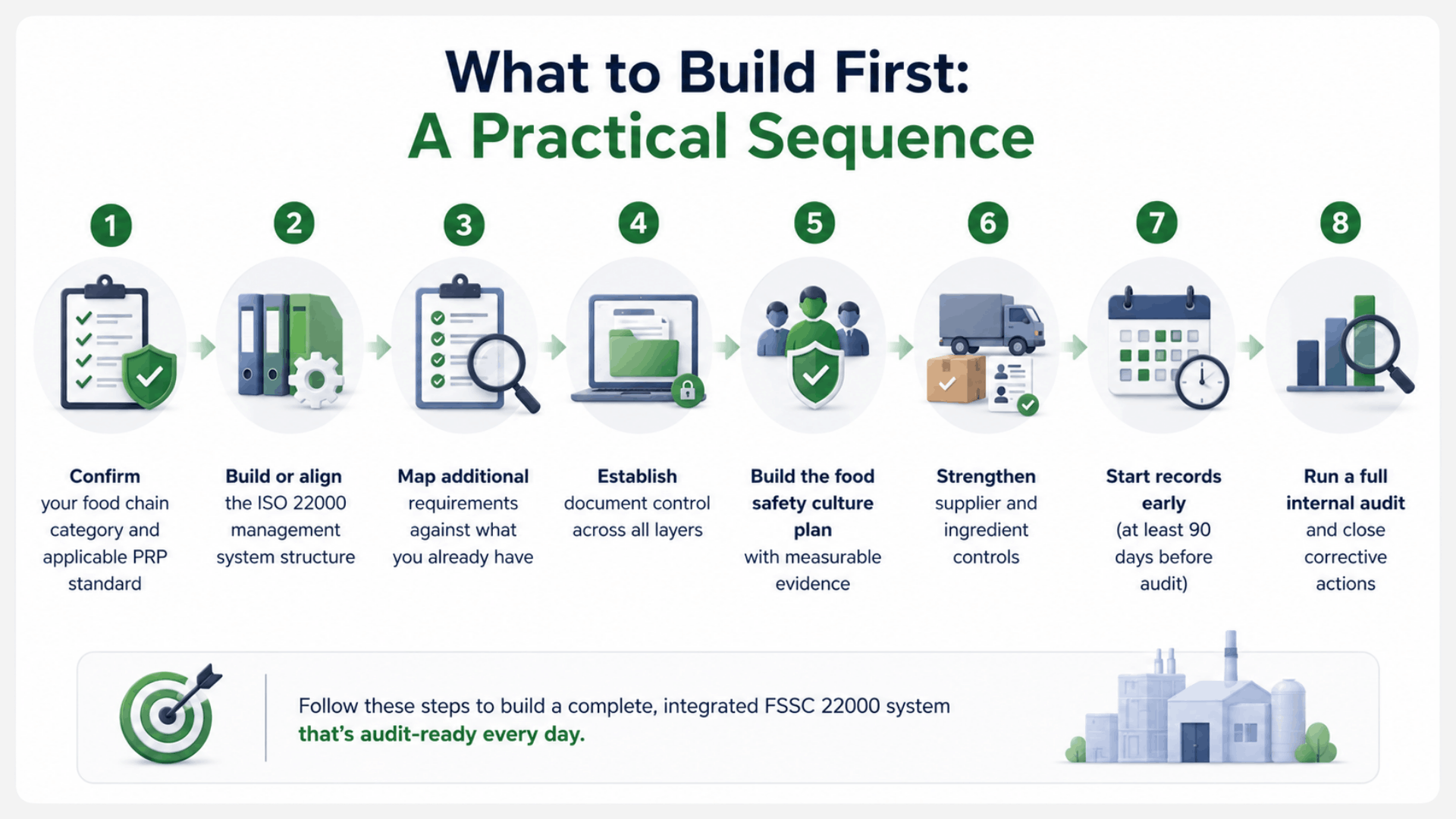
What to Build First: A Practical Sequence
Step 1: Confirm your food chain category and applicable PRP standard.
FSSC 22000 categorizes organizations by food chain category. This determines which PRP requirements apply. Most food manufacturers fall under Category C, but you should confirm the category before building procedures, audit checklists, or internal gap assessments. Using the wrong PRP reference creates avoidable rework.
Step 2: Build or align the ISO 22000 management system structure.
If you already have a HACCP plan but no ISO-based management system, the biggest gap may not be hazard analysis. It may be policy, objectives, risk-based planning, document control, internal audit, management review, communication, and continual improvement.
Step 3: Map the additional requirements against what you already have.
Most manufacturers already have partial coverage. Food defense may exist. Allergen controls may exist. Supplier approval may exist. Corrective actions may exist. The gap analysis should show which requirements are fully covered, partially covered, or missing. Food safety culture, quality control, equipment management, and serious incident communication often need the most work. For a step-by-step method, see our guide to FSSC 22000 gap analysis.
Step 4: Establish document control across all layers.
FSSC 22000 combines ISO 22000, PRPs, and FSSC additional requirements. Document control should show which procedures, records, and responsibilities support each layer. Do not manage them as three unrelated filing systems.
Step 5: Build the food safety culture plan with measurable evidence.
A food safety culture plan should include objectives, responsibilities, communication methods, training, review frequency, and measurable evidence. Examples can include employee reporting, deviation trends, training completion, internal audit findings, complaint trends, management review actions, and corrective action closure.
Step 6: Strengthen supplier and ingredient controls.
Supplier approval, specifications, COAs, allergen declarations, certification status, and ingredient risk assessments should be connected. This is especially important for food fraud, allergen management, traceability, and label verification. If your team uses multiple systems, IONI can support custom integrations with ERP, inventory, document storage, and other operational tools.
Step 7: Start records early.
Begin collecting records at least 90 days before the target Stage 2 audit. Monitoring logs, sanitation checks, training evidence, supplier approvals, internal audit findings, management review records, environmental monitoring results, and corrective actions should show the system working over time.
Step 8: Run a full internal audit.
Run the internal audit 6 to 8 weeks before certification. Audit against ISO 22000, the applicable PRP requirements, and FSSC additional requirements. Every finding should have a root cause, corrective action, a responsible owner, a deadline, verification, and an effectiveness review.
A facility managing FSSC 22000 alongside SQF, BRCGS, FSMA, or customer-specific programs ends up maintaining the same operational evidence in different formats. HACCP records, supplier files, monitoring tasks, corrective actions, allergens, labels, and traceability records need to satisfy more than one audit expectation.
IONI's food safety software connects these records in one system, so the same monitoring task, supplier approval, ingredient file, or corrective action can support whichever certification audit comes next. For manufacturers managing multiple schemes, the FSMA, BRC, and SQF compliance workspace helps reduce duplicate evidence trails.
If you're still choosing a platform, our food safety management system software guide compares seven tools.
FAQ
What is FSSC 22000 certification?
FSSC 22000 certification is a GFSI-recognized food safety certification scheme built on ISO 22000, sector-specific prerequisite programs, and FSSC additional requirements. It is used by food manufacturers and other food chain organizations to demonstrate that their food safety management system is structured, implemented, audited, and maintained according to recognized international requirements.
What is the difference between ISO 22000 and FSSC 22000?
ISO 22000 is the base food safety management system standard. It defines how a food safety management system should be structured. FSSC 22000 adds sector-specific prerequisite programs and FSSC additional requirements on top of ISO 22000. That makes FSSC 22000 a complete GFSI-recognized certification scheme, while ISO 22000 alone is not the same as FSSC 22000 certification.
What is the current version of FSSC 22000?
As of June 2026, FSSC 22000 Version 7 has been published, but Version 6 remains valid during the transition period. Audits against Version 6 are permitted until April 30, 2027. Upgrade audits against Version 7 are conducted from May 1, 2027, until April 30, 2028.
How many additional requirements does FSSC 22000 have?
FSSC 22000 Version 6 includes 14 additional requirements beyond ISO 22000 and the relevant PRP requirements. These include food safety and quality culture, food defense, food fraud mitigation, allergen management, environmental monitoring, equipment management, quality control, product design and development, transport and storage, labelling, food loss and waste, and serious incident communication.
How long does FSSC 22000 certification take?
Most manufacturers should plan for 6 to 12 months. A facility with an existing ISO 22000 or ISO 9001 system may be ready in 3 to 6 months. A facility with HACCP and PRPs but no ISO structure may need 6 to 9 months. A facility starting from a weak or informal system may need 9 to 12 months.
How much does FSSC 22000 certification cost?
Initial certification audits often range from $8,000 to $25,000, depending on facility size, category, audit duration, region, and certification body. Internal preparation costs can be higher than the audit fee because teams may need to update PRPs, conduct gap assessments, strengthen supplier controls, train staff, run internal audits, and close corrective actions before certification.
Can I be certified to both SQF and FSSC 22000?
Yes. Some manufacturers maintain more than one GFSI-recognized certification because different buyers require different schemes. The same HACCP plan, supplier approval process, corrective action system, monitoring records, and traceability evidence can often support more than one certification, but the documentation still needs to be mapped to each scheme's requirements.
Is FSSC 22000 accepted by the same retailers as SQF and BRCGS?
Often, yes. Many retailers and food service buyers accept FSSC 22000, SQF, and BRCGS as GFSI-recognized proof of food safety system maturity. However, some buyers name a specific scheme in their supplier requirements, so manufacturers should confirm the requirement directly before choosing a certification path.
Start With the Three-Layer Structure
The biggest early mistake in FSSC 22000 preparation is not usually a missing form. It is treating ISO 22000, PRPs, and FSSC additional requirements as separate projects.
Map what you already have against all three layers before building anything new. Most manufacturers already have meaningful coverage through HACCP, sanitation, supplier approval, allergen controls, monitoring records, corrective actions, and internal audits. The gap is usually in connecting the evidence, assigning ownership, and keeping records audit-ready throughout the year.
See how IONI builds your FSSC 22000-ready system from your existing documents. No credit card required. 30-minute setup with your real documents.