.png)
Last updated: October 2026
HACCP software is a tool that builds, runs and records a food plant's HACCP plan: hazard analysis, critical control points, monitoring logs, corrective actions and verification records, in one audit-ready system. For most 10–200 person food manufacturers in 2026, the best HACCP software is the one that builds your plan from your own documents, works on the plant floor, and produces SQF, BRCGS or FSMA audit evidence without spreadsheets.
Most food manufacturers already have a HACCP plan. It lives in a Word document, a binder, or someone's email drafts folder. It works until it doesn't. The audit notice arrives, the QA manager leaves, or a retailer asks for documentation that isn't organized anywhere. That's usually when the search for software starts.
This guide compares seven HACCP software platforms on what matters to a 10–200-person food operation: how fast you can go from paper to digital, what standards are actually covered, what it costs, and whether you need a consultant to make it work. We cover IONI, FoodReady, FoodDocs, SafetyChain, Safefood 360, Zip HACCP and SafetyCulture, with a decision framework based on your audit timeline and existing documentation.
TL;DR: Best HACCP Software by Use Case
- IONI: best for building an audit-ready HACCP plan from your existing documents (from $199/mo).
- FoodReady: best if you want consulting bundled in.
- FoodDocs: best for quick self-serve setup.
- SafetyChain: best for larger multi-site plants with an existing quality system.
- Safefood 360: best for broad module coverage (35+ modules).
- Zip HACCP: best for food service daily checklists.
- SafetyCulture: best for multi-location inspections.
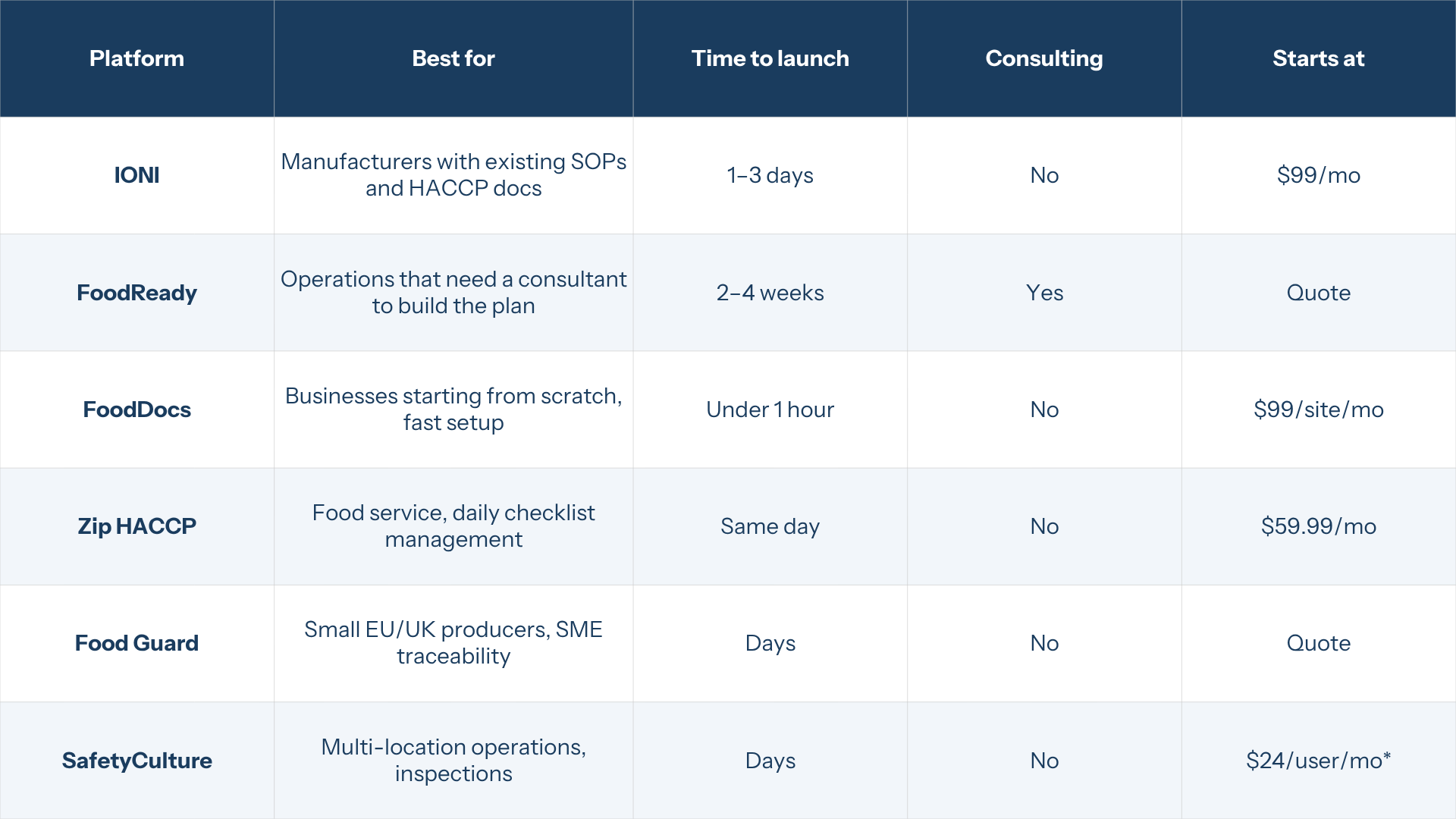
HACCP Software Comparison Table (2026)
| Tool | Best for | Starting price | HACCP plan builder | Standards | Mobile | Typical setup |
|---|---|---|---|---|---|---|
| IONI | Audit-ready plan from your own documents, 10–200-person plants | From $199/mo | AI-built from uploaded documents | SQF Edition 10, BRCGS Issue 9, FSMA, CFIA, FSSC 22000 | Tablet and phone checklists | Typically live within a couple of days of uploading documents |
| FoodReady | Software plus consulting | Quote | Yes, 80+ templates plus consultants | HACCP, FDA, USDA, SQF, BRC, ISO, GFSI | Yes (CCP logs app) | – |
| FoodDocs | Self-serve small sites | $79–$99/site/mo (Lite) | Yes, questionnaire-based | HACCP-based | Yes (monitoring app) | Plan in under 1 hour (vendor claim) |
| SafetyChain | Multi-site mid-market | Quote | – | USDA, FDA, SQF, BRC | iOS, Android, Windows | – |
| Safefood 360 | Module breadth (35+ modules) | Quote | – | Any GFSI-recognized standard | – | – |
| Zip HACCP | Food service checklists | $59.99/location/mo | No (runs daily tasks) | HACCP | Yes | – |
| SafetyCulture | Multi-location inspections | Free (up to 10); Premium $24/seat/mo billed annually | Templates | General | Yes | – |
A dash means the vendor does not state it publicly, or we could not confirm it. Prices are per site or location per month unless noted.
How We Compared These Tools
We scored each tool on six criteria: HACCP plan builder depth, audit readiness (SQF, BRCGS, FSMA), plant-floor usability on mobile devices, supplier and COA handling, setup time, and transparent pricing.
Prices were checked in October 2026 on each vendor's public pricing or product page; where a vendor publishes no price we say so and mark it as a quote. Disclosure: IONI publishes this guide, so we list competitors' strengths as they describe them and mark anything we could not confirm.
What is HACCP Software?
HACCP software replaces paper binders, spreadsheets, and manual checklists with a digital platform where all documents, monitoring logs, and compliance records are stored, updated, and auditable. Instead of spending hours filling out forms before an inspection, teams manage everything from one system.
What HACCP software handles:
- Hazard analysis: identifying biological, chemical, and physical risks in your process
- Critical Control Points (CCPs): setting limits, monitoring procedures, and corrective actions
- SOP and document management: versioned, accessible, exportable
- Audit-ready reporting: records organized the way auditors expect them
- Supplier document tracking: COAs, certifications, expiry dates
Regulations in Canada (CFIA), the United States (FDA/FSMA), and the EU require food businesses to demonstrate a functioning HACCP-based food safety plan. Software makes compliance easier by keeping documentation consistent, up to date, and ready to present at any time.
For regulatory details by country, see:
- CFIA preventive control plan requirements (inspection.canada.ca)
- FDA FSMA Preventive Controls for Human Food (fda.gov)
- Codex Alimentarius HACCP Guidelines (fao.org)
The 7 HACCP Principles Your Software Must Cover
Every HACCP system rests on the seven principles set out by the National Advisory Committee on Microbiological Criteria for Foods (NACMCF) and published by the FDA as HACCP Principles & Application Guidelines (adopted August 14, 1997). Good software supports each one:
- Hazard analysis: map biological, chemical and physical hazards to each process step.
- Critical control points: flag which steps need control, with the reasoning recorded.
- Critical limits: store the minimum and maximum values for every CCP.
- Monitoring: timed digital logs with out-of-limit alerts.
- Corrective actions: guided steps when a limit is missed, linked to the affected product.
- Verification: scheduled reviews and sign-offs that confirm the plan works.
- Record-keeping and documentation: versioned plans and an audit trail of who did what, and when.
For a deeper walkthrough, see meeting all 7 HACCP principles with AI.
How to Choose HACCP Software: 7 tips
Choosing the right HACCP software is crucial for simplifying food safety management, maintaining compliance, and improving efficiency. Below are seven essential factors to consider, along with examples of how each feature helps with everyday HACCP plan tasks.
1. Real-Time Monitoring & Alerts
Even without physical devices, software can track deadlines, task completion, and deviations within the system itself. HACCP software that provides real-time alerts ensures you never miss critical steps in your plan.
Example: The system can notify a manager when a weekly CCP verification task has not been completed, allowing timely follow-up and ensuring all checks are done on schedule.
2. Automated Data Collection & Reporting
Manual data entry in spreadsheets is tedious and error-prone. HACCP compliance software automates the collection of all digital records - checklists, logs, and assessments - and produces reports automatically.
Example: A quality manager can generate a complete HACCP report for all production lines with one click, summarizing all completed tasks, critical deviations, and corrective actions.
3. Audit Trails & Compliance Documentation
A reliable HACCP software keeps detailed digital audit trails, showing who performed each action and when. This makes inspections and audits straightforward and transparent.
Example: During an audit, the system allows staff to quickly display all logged verification steps, corrective actions, and approvals without searching through paper files or emails.
4. Integration with Other Digital Systems
Even purely software-based, your HACCP platform may need to work alongside other management systems, like document storage, employee training, or internal reporting platforms.
Example: The HACCP software can pull employee training completion data from the HR system to confirm that only trained personnel are assigned to specific tasks in the HACCP plan.
5. User-Friendly Interface & Mobile/Browser Access
Software that is intuitive and accessible via browser or mobile ensures staff can easily enter data, complete checklists, and track tasks.
Example: A team member can log a CCP verification directly into the software from a tablet or laptop, with clear prompts guiding them through the correct steps, reducing mistakes and incomplete records.
6. Regulatory Compliance Support
The system should guide users to maintain compliance with FDA, USDA, ISO 22000, and GFSI standards. Built-in workflows, templates, and alerts make adherence easier.
Example: The software can provide step-by-step prompts for documenting hazard analysis and CCP monitoring, ensuring every regulatory requirement is followed and recorded.
7. AI-Powered Efficiency
Modern HACCP food safety software uses AI to analyze your digital records, suggest improvements, and identify gaps in your HACCP plan, saving time and reducing errors.
Example: AI reviews your existing plan and highlights missing steps in critical documentation or SOPs, then recommends actions and generates templates for immediate updates - all within the software.
If you manage to collect all these tips into one system - bingo! You have chosen the jackpot of HACCP software, combining efficiency, compliance, and smart management in a single platform.
Best HACCP Software in 2026
Now that we understand how to choose the right HACCP software, it’s time to explore the market and see which solutions stand out.
In 2026, the best HACCP software will combine user-friendly interfaces, powerful compliance tools, and AI-powered features to simplify food safety management.
From HACCP compliance software that ensures regulatory adherence to HACCP food safety software that streamlines daily tasks, the top platforms help businesses of all sizes manage their HACCP plans efficiently and accurately.
1. IONI - Best Overall HACCP Software
Best for: food manufacturers that already have a HACCP plan in Word, PDF or Excel and want it audit-ready and digital without starting from a blank template.
If your HACCP plan already exists in any form (Word, PDF, Excel, email attachments), IONI is built around that reality. You upload your documents. The AI parses them, identifies your process steps, maps hazards to CCPs, and generates a digital HACCP plan. You don't start from a blank template. You start from your own operation.
According to IONI, teams are typically live within a couple of days of uploading their documents.
Key features:
- Reads your existing SOPs, HACCP plans, and ingredient lists, then builds your compliance system without manual re-entry
- AI-powered hazard analysis: biological, chemical, and physical hazards mapped to your specific process
- Generates complete, audit-ready HACCP documentation as PDFs (Codex-based, FSMA and GFSI-aligned)
- Plant-floor digital checklists for operators, accessible on tablet or mobile
- Supplier COA automation: requests certificates, validates parameters against your specs, flags out-of-spec items before production, sends renewal reminders
- Multi-site support
- Integration via API and CSV
Standards supported: SQF Edition 10, BRCGS Issue 9, FSMA Preventive Controls, CFIA (Safe Food for Canadians Regulations), FSSC 22000 and Codex Alimentarius-based HACCP (IONI food safety software).
Beyond HACCP: IONI is not an ERP and does not replace your accounting system. It is the production and traceability layer that sits on top of the QuickBooks or spreadsheets you already use, tracking batches, lots and production data alongside your food safety compliance records (FSMA, SQF, BRCGS and HACCP).
Here’s how IONI works:
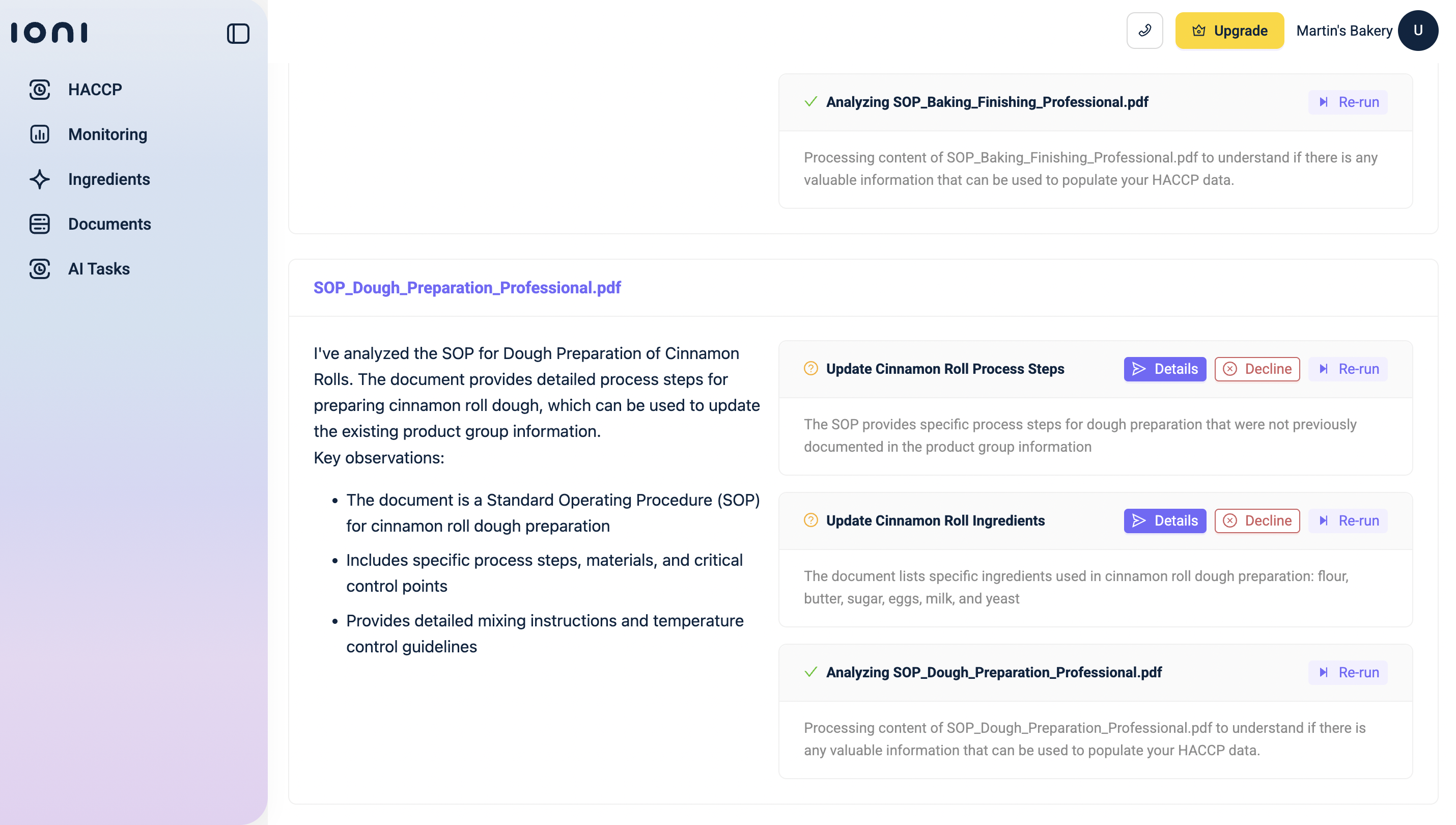
Step 1: Upload your existing documents
You upload your SOPs, process documents, HACCP plan, ingredient lists — any files that describe how your operation runs. IONI parses these automatically and extracts company information, HACCP team members, product groups, and process steps. This becomes the foundation of your digital plan without any manual setup.
.png)
Step 2: AI builds your hazard analysis and plan
IONI analyzes every process step and identifies potential biological, chemical, and physical hazards. The AI suggests Critical Control Points and flags gaps in your current plan. You review the suggestions and apply them with one click. All steps and hazards are validated and marked complete inside the system.
Step 3: Generate your audit-ready HACCP plan
Once all steps, hazards, and CCPs are reviewed, IONI generates your final HACCP plan in compliant PDF format, ready to present to auditors. The system also identifies missing SOPs and offers to generate them automatically. You keep full control to edit, add, or manage content at any time.
.png)
Plus, here`s a video demonstration showing exactly how the platform works - helping users get started in minutes.
Who it's not for: If you have no internal QA knowledge and need a consultant to write your HACCP plan from scratch, FoodReady's consulting bundle will serve you better. IONI is software your team runs independently.
Pricing:
- Standard: from $199/month (pricing starts at $199 per month per ioni.ai/food-safety-software)
- Multi-site and enterprise: custom pricing, contact IONI.
Ready to try it? See how IONI automatically builds your HACCP plan from existing documents. You can also try the AI HACCP plan builder directly.
2. FoodReady: best if you need consulting bundled in
FoodReady AI combines software with food safety consulting. You get a HACCP / PCP plan builder with 80+ templates, plus consultants who help you write the plan, prepare for audits, and get certified. If your team has no one with HACCP experience, that hands-on support has real value.
The tradeoff is time. Onboarding depends on consultant availability, and pricing is not public; it's quoted per engagement (every plan on the FoodReady pricing page says "Get a Quote").
Key features: HACCP / PCP plan builder, 80+ templates, supplier document management, batch and inventory database, lot traceability and recall tools, mobile CCP-logs app, environmental monitoring (Enterprise).
Best for: Small processors with no internal QA manager who want someone to build the HACCP plan for them.
Pricing: Quote-based. A certified HACCP consultant is included in every plan.
Standards supported: HACCP, FDA, USDA, SQF, BRC, ISO and GFSI requirements.
3. FoodDocs: best for quick setup from scratch
FoodDocs asks you a series of questions about your operation and generates a HACCP plan in under an hour, according to the vendor. No document upload needed. You answer; it builds. The output includes CCPs, flowcharts, and SOPs tailored to your inputs.
It's the fastest path from zero to a complete draft. Because it's template-driven, you'll spend time adjusting defaults to match your actual operation. FoodDocs serves both food service and small production businesses (bakeries, butcheries, ready-to-eat producers); larger manufacturers may need to customize templates more significantly.
Key features: HACCP plan builder, pre-set CCPs, auto-generated flowcharts and SOPs, cloud document storage, monitoring app with notifications (Standard plan and up), traceability app (Professional).
Best for: Businesses with no existing HACCP documentation that need a compliant draft quickly.
Pricing (FoodDocs pricing, per site per month):
- Lite: $99 monthly or $79 billed annually
- Standard: $199 monthly or $167 billed annually
- Professional: $299 monthly or $250 billed annually
- Enterprise: custom; 14-day free trial, no credit card required
Standards supported: HACCP-based food safety systems; check the vendor for your specific certification scheme.
4. SafetyChain: best for multi-site plants with an existing quality system
SafetyChain is a food manufacturing quality and compliance platform that says it is trusted in 2,500+ manufacturing facilities. It is aimed at mid-market and enterprise plants rather than a 10-person start-up.
Best for: Larger or multi-site plants that want food safety, quality and compliance programs in one platform.
Pricing: Quote-based. SafetyChain describes a monthly subscription per facility plus a one-time setup fee (SafetyChain pricing).
Standards supported: Compliance tracking for USDA, FDA, SQF and BRC. Apps available on iOS, Android and Windows.
5. Safefood 360 (Ideagen): best for module breadth
Safefood 360, part of Ideagen, was built by food safety experts in 2010 and offers over 35 modules. It says it can support any GFSI-recognized standard, which suits plants managing several certifications at once.
Best for: Plants that want a broad food safety and quality management suite and have the team to configure it.
Pricing: Not published; request a demo.
Standards supported: Any GFSI-recognized standard, per the vendor.
6. Zip HACCP: best for food service daily checklists
Zip HACCP is built for food service: restaurants, catering, commissary kitchens. It handles daily, weekly and monthly food safety checklists, temperature logging (including a Bluetooth probe) and multi-location oversight from a mobile app.
It doesn't build HACCP plans. It executes them. If you're a food manufacturer looking for a system that manages your full compliance program, this isn't the right tool. If you run food service locations and need digital daily checks with clear accountability, it works well.
Best for: Food service operators with daily checklist and temperature-log needs.
Pricing (Zip HACCP pricing):
- $59.99/location/mo (Standard)
- Optional Bluetooth probe: $200 one-time
Standards supported: HACCP.
7. SafetyCulture: best for multi-location inspections
SafetyCulture is a workplace operations platform that food businesses use for inspections, audits, and monitoring. It supports HACCP through customizable templates, real-time alerts from environmental sensors, and mobile training modules.
It's a broad operations tool, not a dedicated food safety platform. Flexible for multi-location hospitality groups but less specialized for a single food manufacturing facility.
Best for: Multi-location inspection and audit workflows.
Pricing (SafetyCulture pricing):
- Free plan: small teams up to 10 users, basic features
- Premium: $24/seat/mo billed annually ($29/seat/mo month-to-month)
- Enterprise: custom
Standards supported: General inspection templates; not specific to a food safety scheme.
Is Digital HACCP Accepted by Auditors?
Yes, with conditions. The FDA's preventive controls rule allows records to be kept as original records, true copies or electronic records, provided they are accurate, legible, created at the time of the activity, and show the date and the signature or initials of the person who did the work (21 CFR 117.305). SQF and BRCGS auditors assess the same thing in practice: whether your records are complete, controlled and retrievable, not whether they are on paper. Confirm your certification body's expectations for electronic signatures before the audit.
What auditors typically check in a digital system: a tamper-evident audit trail showing who entered or changed each record, user-level signatures, controlled document versions, and the ability to retrieve records quickly. Our guide to ALCOA+ data integrity for food safety records explains these tests in detail.
If Your Audit is in the Next 90 Days
Whether you're preparing for SQF, BRCGS, FSMA, CFIA, or a retailer audit like Costco or Loblaws, the pressure is the same: you need documentation that holds up under scrutiny, and you need it fast.
a) Canada (CFIA, SQF, BRCGS)
The Safe Food for Canadians Regulations generally require licence holders to prepare, keep, maintain and implement a documented preventive control plan, with supporting records kept for 2 years (some small businesses are exempt). SQF audits currently run to Edition 9; SQFI expects Edition 10 audits to start on January 2, 2027. Auditors will check your hazard analysis, CCP records, corrective actions, supplier documentation, and internal verification records.
b) United States (FSMA, SQF, BRCGS)
FDA's FSMA Preventive Controls rule requires a written food safety plan covering hazard analysis, preventive controls, monitoring procedures, corrective actions and verification, with the related records. If you're supplying US retailers or distributors, SQF or BRCGS certification is increasingly expected. Both require documented evidence that your controls are working, not just that they exist somewhere in writing.
c) Europe (EU Food Safety, FSSC 22000, BRCGS)
EU food hygiene law, Regulation (EC) No 852/2004, requires HACCP-based procedures for food business operators. FSSC 22000 and BRCGS are the primary certification paths for European manufacturers supplying retail. These audits place heavy weight on supplier documentation, allergen management, and traceability.
Which platform fits a tight timeline?
If you have existing SOPs and a HACCP plan: use IONI. Upload your documents, get a working digital system in days, and spend the rest of the time on verification records and supplier documentation.
If you're starting from zero documentation: use FoodDocs. Answer the setup questions, get a draft plan in under an hour (vendor claim), then customize and add monitoring records.
If you have no internal QA person and no existing documentation: FoodReady's consulting bundle is the realistic option, even if the timeline is tight.
Interested? Watch IONI transform your existing SOPs into a complete HACCP plan.
How to Choose: 5 Questions Before You Buy
1. Do you have existing HACCP documents?
If yes, document import and AI parsing matter more than template libraries. If no, prioritize guided setup like FoodDocs.
2. Do you have an internal QA manager?
If yes, software-only platforms like IONI or FoodDocs give you full control at lower cost. If no, FoodReady's consulting bundle removes the dependency on internal expertise.
3. What's your audit timeline?
Under 90 days: prioritize platforms that launch in days. Over 6 months: focus shifts to long-term usability and team training.
4. What standards do you need to comply with?
Confirm that SQF, BRCGS, FSMA, CFIA, or EU requirements are explicitly supported, not just listed as 'food safety compliance' in the marketing copy.
5. Do you need supplier COA tracking?
If you manage 10 or more active suppliers, automated COA validation is worth prioritizing. Manual COA review is one of the highest-volume QA tasks at a small processor and one of the easiest to automate.
Which Platform Is Right For You
IONI is the best HACCP software for food manufacturers with existing documentation. Fastest path from paper to a working digital compliance system. Covers SQF, BRCGS, FSMA, CFIA and FSSC 22000 in one platform.
FoodReady is the right choice if you need a consultant to build your plan. Onboarding is slower but the support is hands-on.
FoodDocs works best when you're starting from scratch and need a compliant draft fast.
SafetyChain and Safefood 360 suit larger or multi-site plants that need a broader quality suite and accept quote-based pricing.
Zip HACCP is for food service daily checklists, not manufacturer compliance programs.
SafetyCulture works for multi-location operations and inspection management but is not food-manufacturing-specific.
Want to try? Let IONI do the work of building your HACCP plan by pulling directly from your existing SOPs.
Learn more about HACCP and food safety topics in these articles:
- The Future of Food Safety: How AI Is Changing HACCP Compliance – Explore how AI is transforming hazard analysis and plan management.
- 9 Common Mistakes in HACCP Plans and How AI Prevents Them – Understand frequent pitfalls and how software can help avoid them.
- How Small Food Producers Can Save Time with AI-Generated HACCP Plans – Tips for leveraging AI to streamline compliance.
- Manual vs. AI-Generated HACCP Plans: A Detailed Comparison – See the differences between traditional and software-based approaches.
- Basic HACCP Plan Explained: A Step-by-Step Guide for Beginners – A beginner-friendly introduction to HACCP principles.
- HACCP Audit Checklist: Everything Your Business Needs to Be Ready – Practical tools to prepare for inspections using digital software.
- The Smart Way to Meet All 7 HACCP Principles – With AI – Learn how AI can help you implement all seven HACCP principles efficiently.
FAQ
What is HACCP compliance software?
HACCP compliance software is a digital system that holds your HACCP plan and the records that prove you follow it: hazard analysis, CCP monitoring logs, corrective actions, verification and supplier documents. It keeps them versioned, time-stamped and ready to hand to an auditor.
What is the best HACCP software for small food manufacturers?
It depends on what you already have. If you have existing SOPs and a HACCP plan, a tool that builds from your documents (such as IONI, from $199/mo) is fastest; if you need consulting, FoodReady bundles it in; if you are starting from zero, FoodDocs gets you a draft quickly. Judge any tool on plan builder depth, audit readiness for SQF, BRCGS or FSMA, plant-floor usability, supplier and COA handling, setup time and transparent pricing. See the TL;DR above for a quick match.
How much does HACCP software cost?
Published self-serve prices run from about $60 to $300 per site per month: Zip HACCP is $59.99 per location, FoodDocs is $79 to $299 depending on plan and billing, and IONI starts at $199. FoodReady, SafetyChain and Safefood 360 are quote-based. SafetyCulture is priced per seat ($24 per seat per month billed annually on Premium).
Is digital HACCP software accepted in SQF and BRCGS audits?
Yes, with conditions. FDA rules allow electronic records if they are accurate, legible, created at the time of the activity and signed or initialed (21 CFR 117.305), and SQF and BRCGS auditors look for the same qualities: an audit trail, controlled document versions and fast retrieval. Confirm your certification body's expectations for e-signatures. Note that SQF certification adds quality management layers (supplier programs, food defense, food fraud, internal audits) on top of the HACCP plan, so HACCP software alone is a foundation, not the whole program.
What's the difference between HACCP software and food safety management software?
HACCP software focuses on the hazard analysis and critical control point plan. A food safety management system (FSMS) is broader: it also covers prerequisite programs, supplier controls, corrective and preventive actions (CAPA) and training. If you need the wider scope, read our guide to food safety management system software.
Can HACCP software build my HACCP plan for me?
Some can. An AI HACCP plan builder reads your SOPs, process descriptions and ingredient lists, proposes hazards and critical control points, and drafts the plan for your team to review. A qualified person on your team still needs to review and approve it; if no one has food safety training, a consulting bundle such as FoodReady's fills that gap.