.png)
Food safety audits used to be a point in time event. You assembled documents. You rehearsed answers. You tightened up housekeeping. Then you tried to survive the audit week.
That model is quietly dying.
In the second half of 2025 and into 2026, the industry moved from “show me the record” to “prove the system works”. Buyers, certification programs, and regulators are leaning harder on preventive controls, verification, trend analysis, and management accountability. The uncomfortable truth is that many facilities can generate records on demand, but far fewer can demonstrate that their controls are continuously effective.
This is why food safety audit software is changing. Traditional tools were built to store evidence. Modern expectations require systems that evaluate evidence and surface risk before an auditor does.
In this article, I will break down what is changing, why legacy food audit software is hitting a ceiling, how AI transforms food safety audit preparation, and what “audit readiness” really looks like when the system runs every day instead of the week before the audit.
Along the way, I will link to relevant background pieces so you can explore the deeper topics in context, including a practical view of how manufacturers justify software spend through operational outcomes in this ROI analysis, and a risk focused view of recall readiness evidence in this traceability management guide.
Why Food Safety Audit Software Is Changing
The best way to understand why food safety audit software is changing is to look at what auditors and regulators are paying attention to now versus five years ago.
Five years ago, the audit conversation often centered on whether required programs existed and whether forms were completed. Today, more audits center on whether programs are internally consistent, whether verification is meaningful, and whether corrective actions actually prevent recurrence.
This shift is not theoretical. In late 2025 and early 2026, several public safety events reinforced why “documentation only” systems fail. For example, the U.S. Food and Drug Administration published details about its response to a 2025 spike in infant botulism illnesses associated with powdered infant formula, emphasizing investigation, environmental pathways, and response actions rather than paperwork alone.
At the same time, the European Food Safety Authority recommended a stricter acute reference dose for cereulide toxin in infant formula after global recalls, showing how fast scientific expectations can shift and trigger additional market actions.
That pressure flows directly into audits. If science shifts, buyer expectations shift. If buyer expectations shift, audit criteria tighten. If audit criteria tighten, “audit readiness” stops being a binder and becomes a live capability.
This is where food audit software has to evolve.
A modern system must do five things that older tools rarely do well.
First, it must connect procedures to hazards and hazards to controls.
Second, it must connect controls to monitoring data.
Third, it must connect monitoring data to deviations.
Fourth, it must connect deviations to corrective actions.
Fifth, it must connect corrective actions back to verified effectiveness.
That closed loop is the difference between compliance theater and real risk control.
And it is exactly why food safety audit preparation is being redefined. Instead of preparing evidence, teams need systems that continuously assemble and validate evidence.
If you want a practical framing, think of audit readiness as the operational outcome of a well run food safety management system, similar to how ROI is framed as an operational outcome in this manufacturing ROI article.
What changed after Q4 2025
Three forces accelerated change in the second half of 2025 and later.
- Traceability and recordkeeping expectations tightened and compliance deadlines moved from “future problem” to “current reality”. Many industry summaries highlight the U.S. Food and Drug Administration Food Traceability Final Rule compliance date of January 20, 2026 as a forcing function for better structured records and faster retrieval.
- Recalls and safety incidents stayed visible in mainstream reporting. A single event can shift how an auditor samples evidence. For example, a large recall tied to insanitary storage conditions and contamination exposure affected nearly 2,000 products across multiple states in late 2025, illustrating how quickly “facility conditions” can become a high scrutiny audit theme.
- Certification and scheme owners began actively gathering feedback for future revisions, often emphasizing audit consistency, data integrity, and evidence quality. For example, BRCGS opened public consultation for revisions to Global Standard Food Safety Issue 9 in January 2026, signaling continued evolution and tightening of expectations.
Under these conditions, food safety audit software cannot remain a passive repository. It needs intelligence.
The Limits of Traditional Food Audit Software
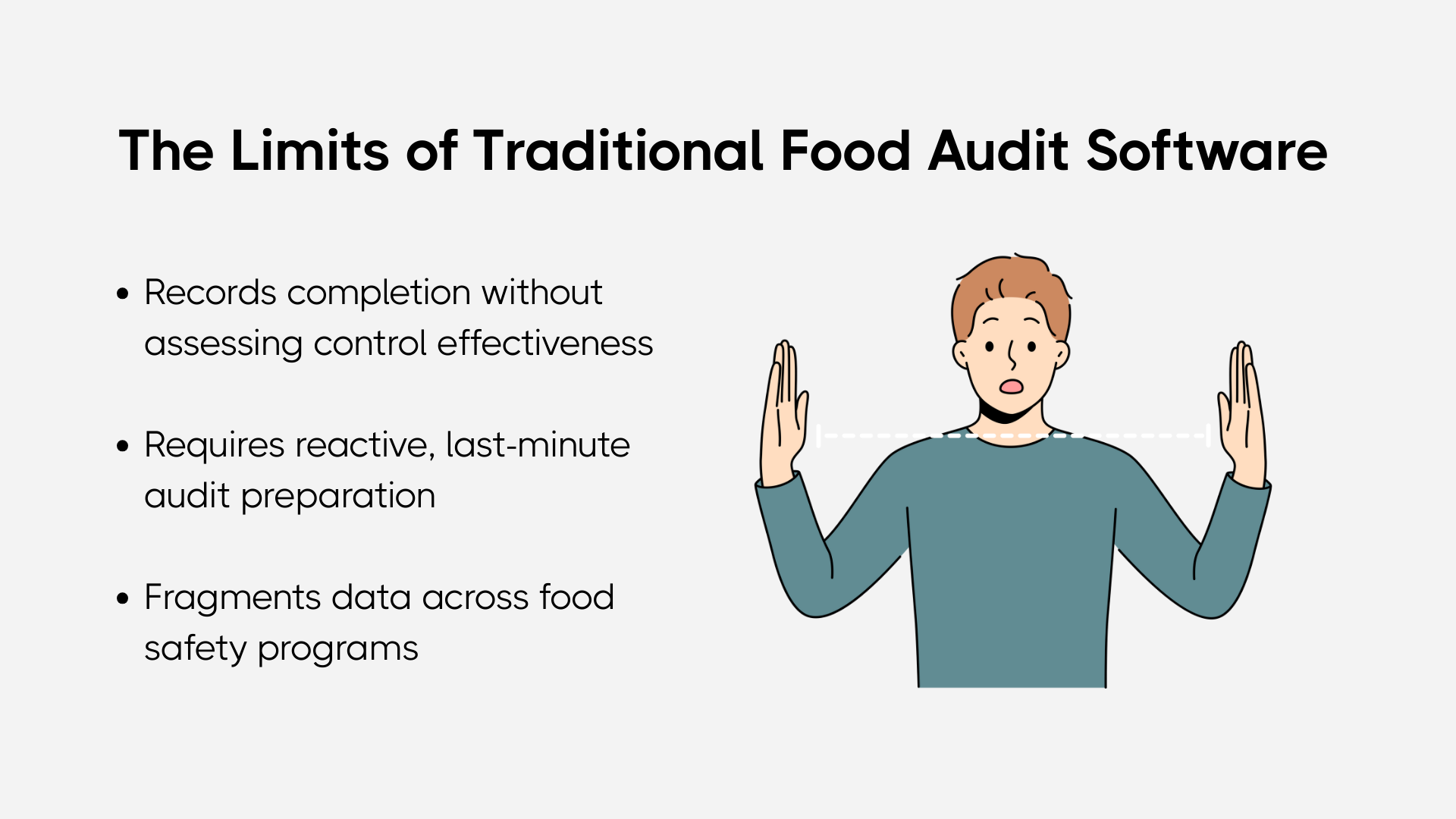
Traditional food audit software generally delivers three benefits.It replaces paper. It centralizes documents. It standardizes forms.
Those benefits are real. They also plateau quickly. The reason is simple. Traditional food audit software is rarely designed to interpret what it stores. It captures completion, not effectiveness. It produces checkmarks, not insight.
Here is what that looks like on the floor.
A sanitation record is completed every shift, but environmental findings trend upward across two lines.
A CCP monitoring log is filled in, but corrective actions repeat for the same root cause. A supplier COA is uploaded, but receiving deviations cluster around one ingredient category. A glass and brittle plastic inspection is recorded, but incidents are occurring near a single packaging station.
In all four examples, a traditional tool stays silent. It has the data. It does not connect the data.
This is where audit risk grows.
The hidden labor problem
Food safety audit preparation with legacy tools creates a predictable cycle.
Week minus six: quality begins “getting ready”.
Week minus four: someone realizes records are missing or inconsistent.
Week minus two: CAPAs get rushed closed.
Week minus one: SOPs are updated to match what people actually do.
Audit week: the plant hopes the auditor samples friendly areas.
This is not just stressful. It is expensive.
It also directly increases the chance of major non-conformances, because rushed changes often create inconsistencies between training, documentation, and implementation.
Fragmentation drives findings
Another limitation is that food audit software often sits separately from HACCP management, CAPA workflows, training records, maintenance, supplier compliance, and traceability.
Auditors do not audit your software categories. They audit your system.
If evidence is fragmented, you spend time stitching it together. The more time you stitch, the more inconsistencies you find. The more inconsistencies you find, the more you patch. The more you patch, the more you drift.
This is why many teams feel they are always “preparing” for audits even when they have food safety audit software installed.
A useful perspective is the distinction between compliance data and risk intelligence. A compliance tool records that a deviation happened and was corrected. A risk intelligence system evaluates whether deviations are increasing, whether corrections are working, and whether the deviation affects higher risk products.
That difference is discussed in a risk management framing in your blog ecosystem, and it aligns with how modern recall readiness systems are described in this recall management guide.
Data integrity and auditor skepticism
Auditors increasingly look for signs that records are being created for the audit, not for control.
If records are backfilled, timestamps look unnatural.
If CAPAs are closed without evidence, effectiveness checks are weak.
If SOPs were updated yesterday, training records become a focus.
If monitoring logs show “perfect” values, validation becomes a focus.
Traditional food audit software does not protect you from these patterns because it does not validate behavior and consistency. AI driven systems can.
How AI Changes Food Safety Audit Preparation
AI changes food safety audit preparation by switching the fundamental unit of work.
In older tools, the unit of work is the form.
In AI systems, the unit of work is the control.
That difference matters because audits are not about forms. They are about controls.
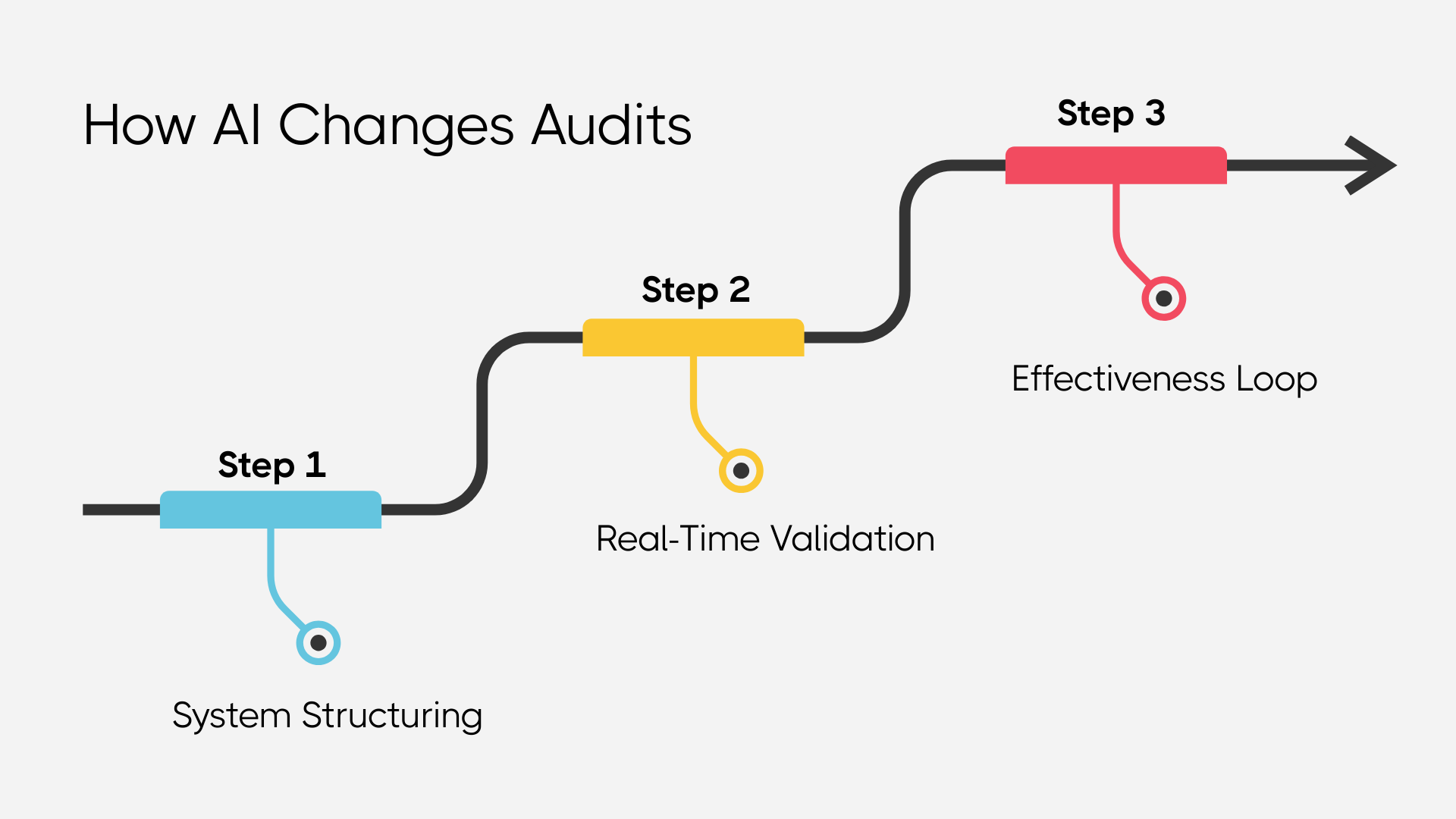
Step one: structure the system, not the filing cabinet
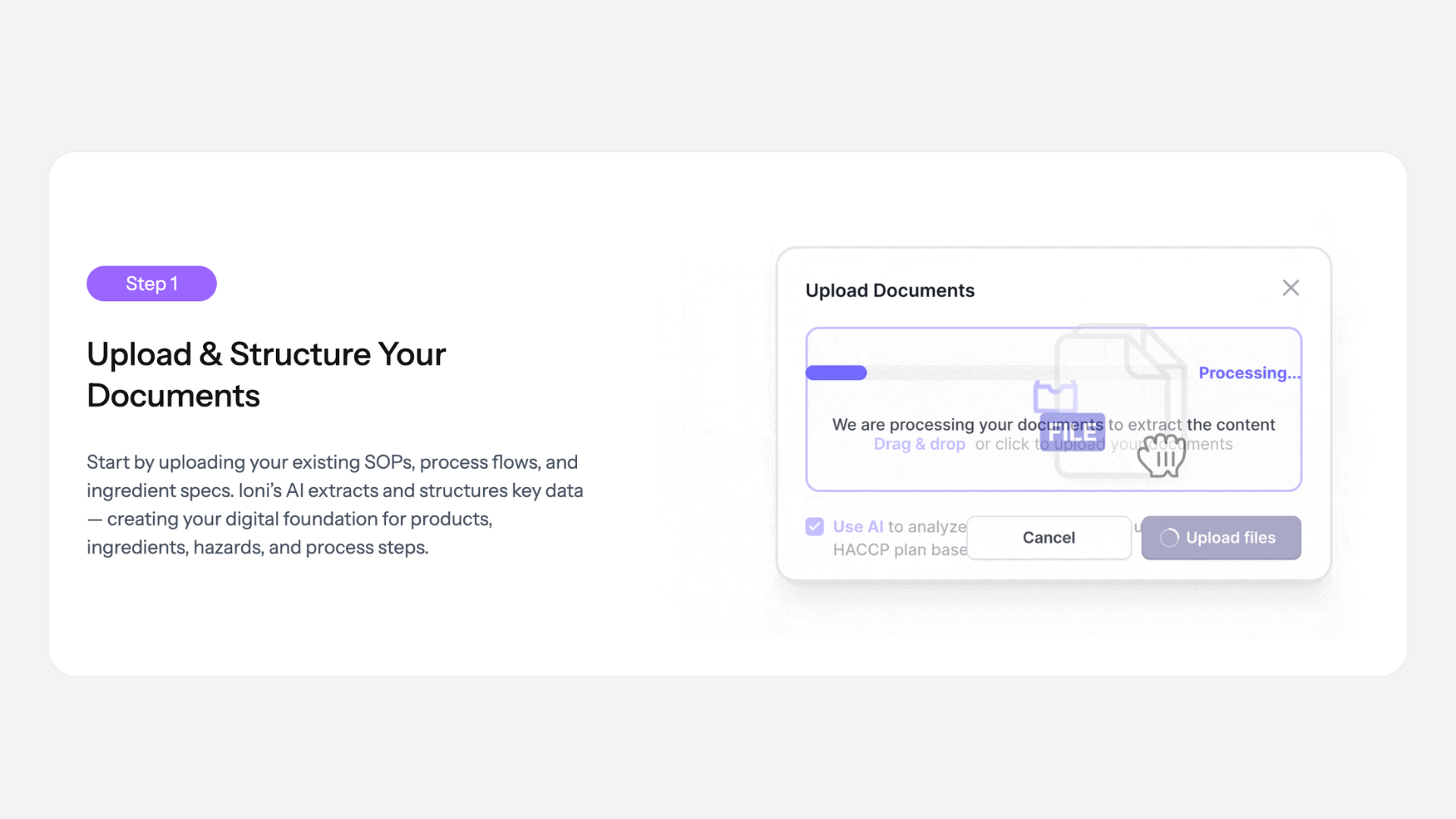
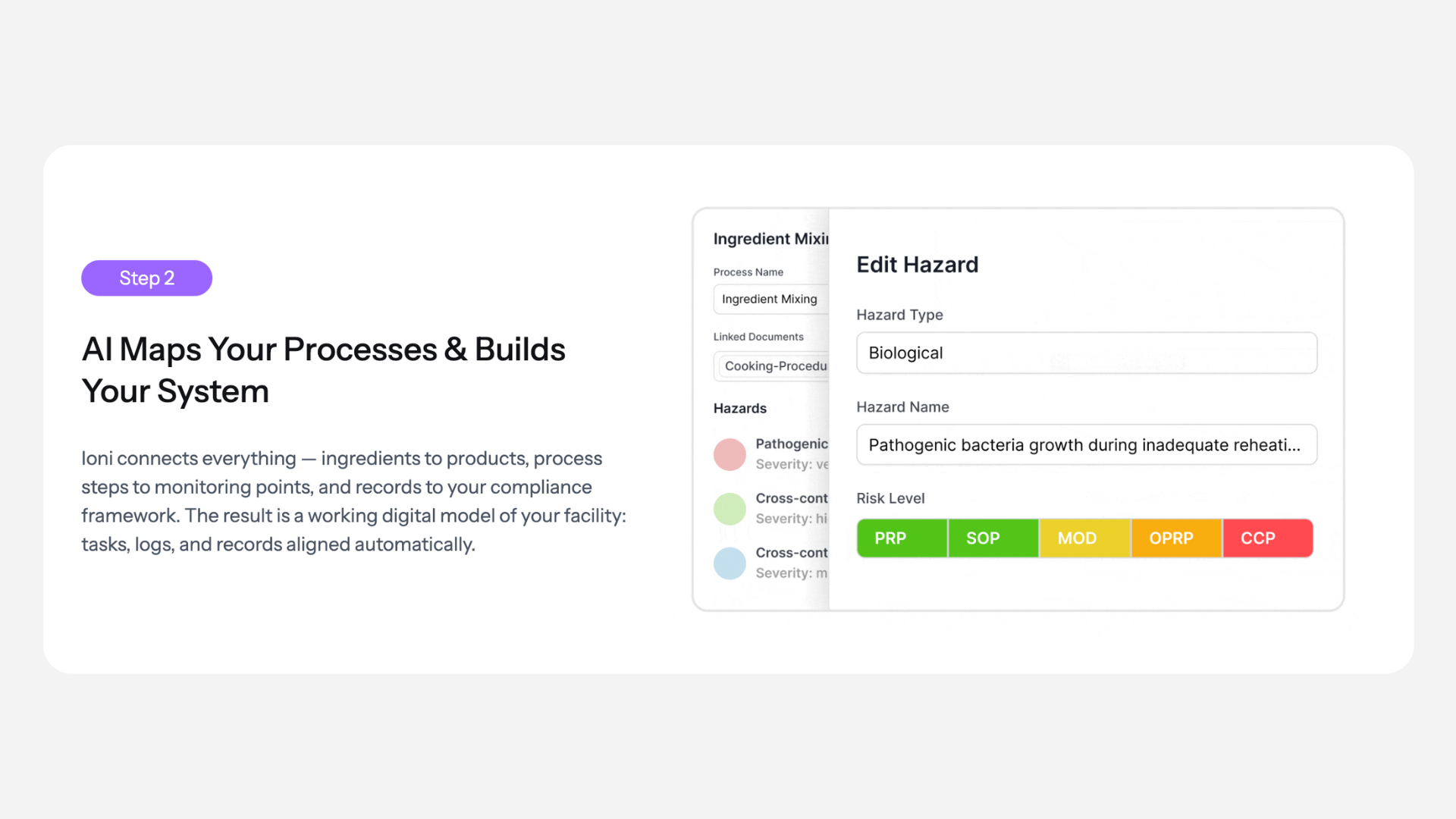
AI driven food safety audit software starts by turning your existing documentation into structured logic.
SOPs become executable procedures.
HACCP plans become connected hazard control maps.
Monitoring programs become task networks tied to specific risks.
Specifications become measurable acceptance criteria.
Once this structure exists, the system can reason about it.
This eliminates a major pain point for manufacturers. Traditional implementations often require weeks of manual configuration. AI reduces that by reading what you already have and building the structure automatically.
Step two: continuously validate evidence
Food safety audit preparation becomes continuous when evidence is validated as it is created.
AI can flag missing monitoring.
AI can flag values that violate limits.
AI can flag repeated deviations.
AI can flag CAPAs closed without required attachments.
AI can flag mismatches between SOP requirements and recorded execution.
This reduces audit surprises because the system surfaces weak points in real time.
It also improves management review because dashboards reflect actual risk signals, not compliance completion rates.
Step three: treat CAPA as a loop, not a checkbox
Many audit findings come down to ineffective corrective action.
A deviation happened.
A correction was made.
A CAPA was opened.
The CAPA was closed.
The same deviation happened again.
Auditors interpret recurrence as evidence that the system does not learn.
AI driven food safety audit software can evaluate recurrence automatically and escalate when the same pattern appears. It can also suggest likely root cause categories based on prior events, which reduces the “generic root cause” problem auditors frequently criticize.
Why this matters now
In late 2025, recall metrics and event visibility remained high. Industry reporting using third party recall data indicated that FDA food recall events increased quarter to quarter in 2025 and that the volume of affected units surged significantly in Q3 2025.
Even when you treat such summaries cautiously, the operational implication is clear. When recall volumes rise, audits tighten, because auditors know more incidents exist in the background.
AI driven food safety audit preparation is not about making the audit faster. It is about lowering the chance that the audit uncovers systemic weakness.
If you want an adjacent read on how automation supports scheme compliance documentation, see this documentation automation piece. The AI layer is what turns documentation automation into readiness.
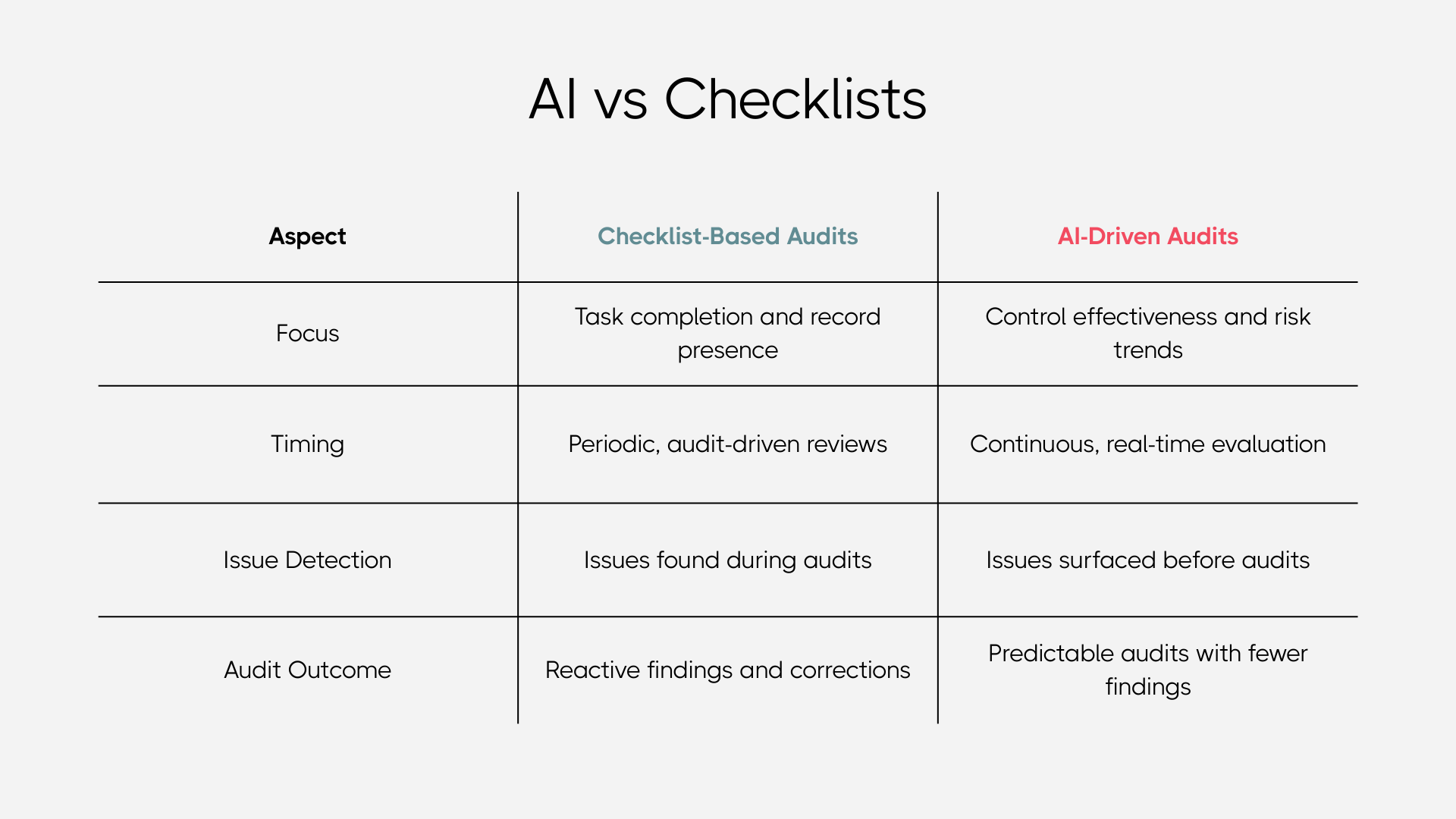
AI vs Checklists: A New Model for Food Safety Audits
Checklists are not the enemy. The checklist mindset is.A checklist asks, “Did you do it?” An AI system asks, “Did it work, and is it still working?” That shift produces a new audit model.
Audit readiness as control health
Imagine two facilities.
Facility A uses food audit software that ensures every checklist is completed.
Facility B uses food safety audit software that evaluates the health of each control.
Both facilities can show forms. Only one can control health.
Control health means you can answer questions like these without a scramble.
Which CCPs have the highest deviation rate this quarter?
Which prerequisite programs are generating the most corrective actions?
Which product lines see higher sanitation rework?
Which suppliers generate the most receiving holds?
Which CAPAs have failed effectiveness checks?
Auditors increasingly ask these questions in different words.
They may ask how you determine where to focus internal audits.
They may ask how management reviews trend data.
They may ask how you evaluate whether corrective actions prevent recurrence.
A checklist driven system provides weak answers. An AI system provides evidence.
AI enables smarter sampling before the auditor does
One of the biggest stressors in food safety audit preparation is auditor sampling.
If you do not know where your weak records are, the auditor finds them.AI reduces reminder based compliance. It flags gaps early, and it helps teams focus internal reviews on high risk areas before the auditor samples them. This is especially valuable in multi site operations where corporate QA cannot manually review everything.
AI strengthens the story of preventive control
Auditors love coherent stories.
What is the hazard?
What is the control?
How do you monitor it?
What happens when it fails?
How do you prove you fixed the cause?
How do you prove it stays fixed?
Traditional food safety audit software can store those pieces. AI can connect them, validate them, and present them as a consistent narrative.
That narrative reduces findings because it reduces ambiguity.
What to Look for in Modern Food Safety Audit Software
If you are evaluating food safety audit software today, you should assume that checklists and document storage are table stakes. The differentiators are about intelligence and evidence quality.
Below are the capabilities that matter most for audit readiness and audit risk reduction.
Fast onboarding from existing SOPs and HACCP documentation
If the tool requires months of manual setup, you will not reach continuous audit readiness. You will reach implementation fatigue.
Modern systems should be able to ingest your current SOPs, HACCP plans, and monitoring forms and structure them quickly.
This is where AI has an immediate impact.
Continuous evidence validation
You want a system that tells you what is missing and what is inconsistent as it happens.
This includes monitoring gaps, missing signatures, incomplete deviation records, CAPA closure without attachments, and training mismatches after SOP updates.
Continuous validation is what makes food safety audit preparation become daily work, not seasonal work.
CAPA effectiveness intelligence
Auditors care about recurrence. A system that only tracks CAPA status is not enough.
Look for recurrence detection, effectiveness checks, root cause consistency, and the ability to link corrective actions to the specific risk they address.
Traceability evidence assembly
Traceability is not just a recall tool. It is an audit evidence tool.
The more expectations tighten around record retrieval and lot level linkage, the more your audit outcome depends on how quickly you can prove product history.
Many industry summaries highlight traceability compliance deadlines as a forcing function for digital systems.
Regulatory change awareness
Audit criteria changes when standards change. If your system does not help you detect change, you stay reactive.
This is why regulatory monitoring is increasingly linked to audit readiness. For a deeper view of how regulatory change monitoring connects to operational compliance, see this regulatory intelligence overview.
Multi site governance and benchmarking
Multi site audit risk is often about inconsistency. You need centralized visibility into which sites are trending toward higher risk and why.
You can take inspiration from how the Global Food Safety Initiative ecosystem discusses audit innovation and benchmarking conversations across the industry.
IONI: Applying AI to Food Safety Audit Software
Applying artificial intelligence to food safety audit software is not about adding automation on top of existing workflows. It is about changing how audit readiness is created and maintained inside food manufacturing operations.
Most audit failures do not originate in the audit itself. They originate months earlier when controls slowly lose alignment with real production, when corrective actions are treated as administrative closures rather than learning mechanisms, and when evidence accumulates without being evaluated. AI changes this dynamic by shifting food safety audit software from a passive record system into an active control validation layer.
The defining characteristic of AI driven food safety audit software is that it operates continuously. It does not wait for an audit cycle to begin evaluating readiness. Instead, it interprets the food safety system as it runs, identifying weaknesses while there is still time to correct them.
This is a fundamental change from traditional food audit software, which assumes that audit preparation is a separate phase. In practice, audit readiness becomes an outcome of daily operations rather than a separate effort layered on top.
From documents to system logic
The first practical shift introduced by AI is how food safety systems are represented digitally. Traditional tools treat SOPs, HACCP plans, and prerequisite programs as static documents. AI driven platforms treat them as structured logic.
When procedures and hazard analyses are interpreted as interconnected elements rather than files, the system can understand how risks are supposed to be controlled. Monitoring tasks, acceptance limits, escalation rules, and corrective actions become part of a single operational model.
This matters for audits because auditors do not evaluate documents in isolation. They evaluate whether controls are clearly defined, consistently applied, and supported by evidence. When documentation is structured into logic, evidence can be validated against intent rather than just checked for existence.
The result is food safety audit software that understands what “normal” looks like and can detect when operations drift away from it.
Continuous validation replaces manual audit preparation
One of the most important changes AI brings to food safety audit preparation is timing. Validation moves from retrospective review to real time evaluation.
Instead of discovering gaps during pre audit record reviews, the system identifies missing, inconsistent, or incomplete evidence as it is generated. Monitoring that is skipped or performed outside defined limits is flagged immediately. Deviations that are not escalated correctly are surfaced early. Documentation inconsistencies between procedures and execution become visible long before an auditor samples them.
This reduces audit risk in a very practical way. Issues are addressed when they are small, isolated, and easy to correct. They do not accumulate into systemic weaknesses that auditors interpret as failures of control.
Over time, this approach fundamentally changes how teams experience audits. Preparation becomes lighter because the system has already been enforcing readiness. Audit stress decreases not because audits are easier, but because fewer surprises remain.
HACCP execution aligned with audit expectations
HACCP plans define how risk should be controlled. Audits evaluate whether that definition is reflected in execution. The gap between the two is where many findings originate.
AI driven food safety audit software reduces this gap by explicitly linking hazard analysis to daily monitoring. Control points are tied directly to tasks, limits, responsible roles, and escalation paths. Deviations are evaluated in the context of the hazard they relate to rather than as generic non conformances.
This alignment simplifies audit conversations. Evidence can be presented in the same logical structure auditors use to evaluate control effectiveness. Instead of navigating between documents, logs, and corrective action records, auditors see a coherent chain from hazard identification through verification.
Food safety audit preparation becomes less about storytelling and more about transparency. The system already reflects how the facility manages risk.
Corrective actions as learning signals, not administrative tasks
Corrective actions are one of the most common sources of audit findings, especially when the same issues recur. In many facilities, CAPAs are treated as compliance artifacts rather than learning mechanisms.
AI changes this by observing patterns across deviations and corrective actions over time. Repetition becomes visible. Ineffective fixes are identified. The system highlights when similar root causes appear across different processes or shifts.
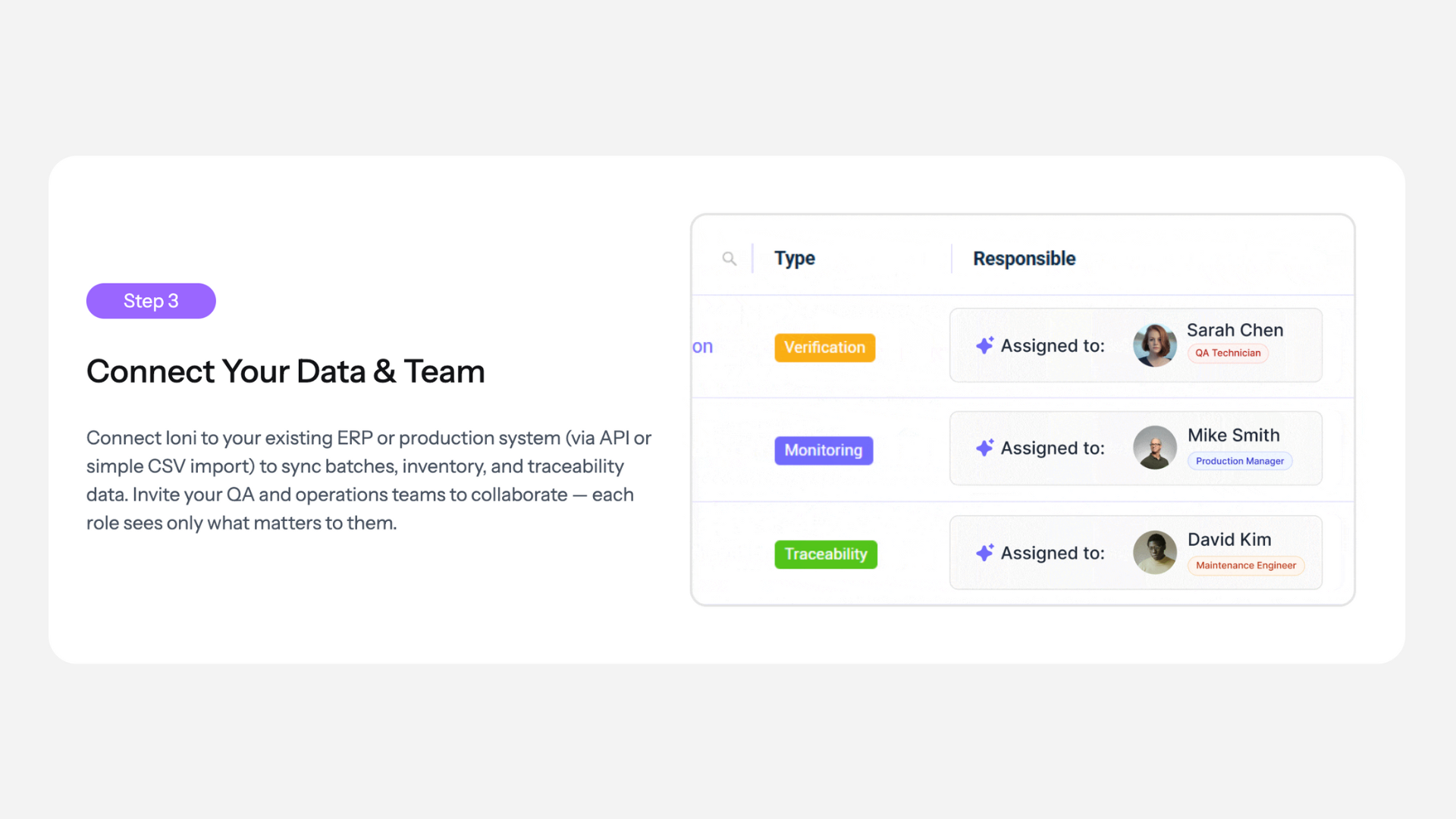
This shifts the role of corrective actions. Instead of simply closing them to satisfy documentation requirements, teams use them to improve control effectiveness. Over time, this reduces the recurrence patterns auditors associate with weak preventive control.
From an audit perspective, this is critical. Repeated issues signal that the system does not learn. AI driven food safety audit software helps demonstrate that learning is happening continuously.
Audit readiness emerges as a system property
When AI is applied correctly, food safety audit software no longer feels like an audit tool. It feels like part of daily operations.
Evidence quality improves because validation happens continuously. Consistency improves because procedures, execution, and documentation are aligned automatically. Visibility improves because emerging risks are surfaced early.
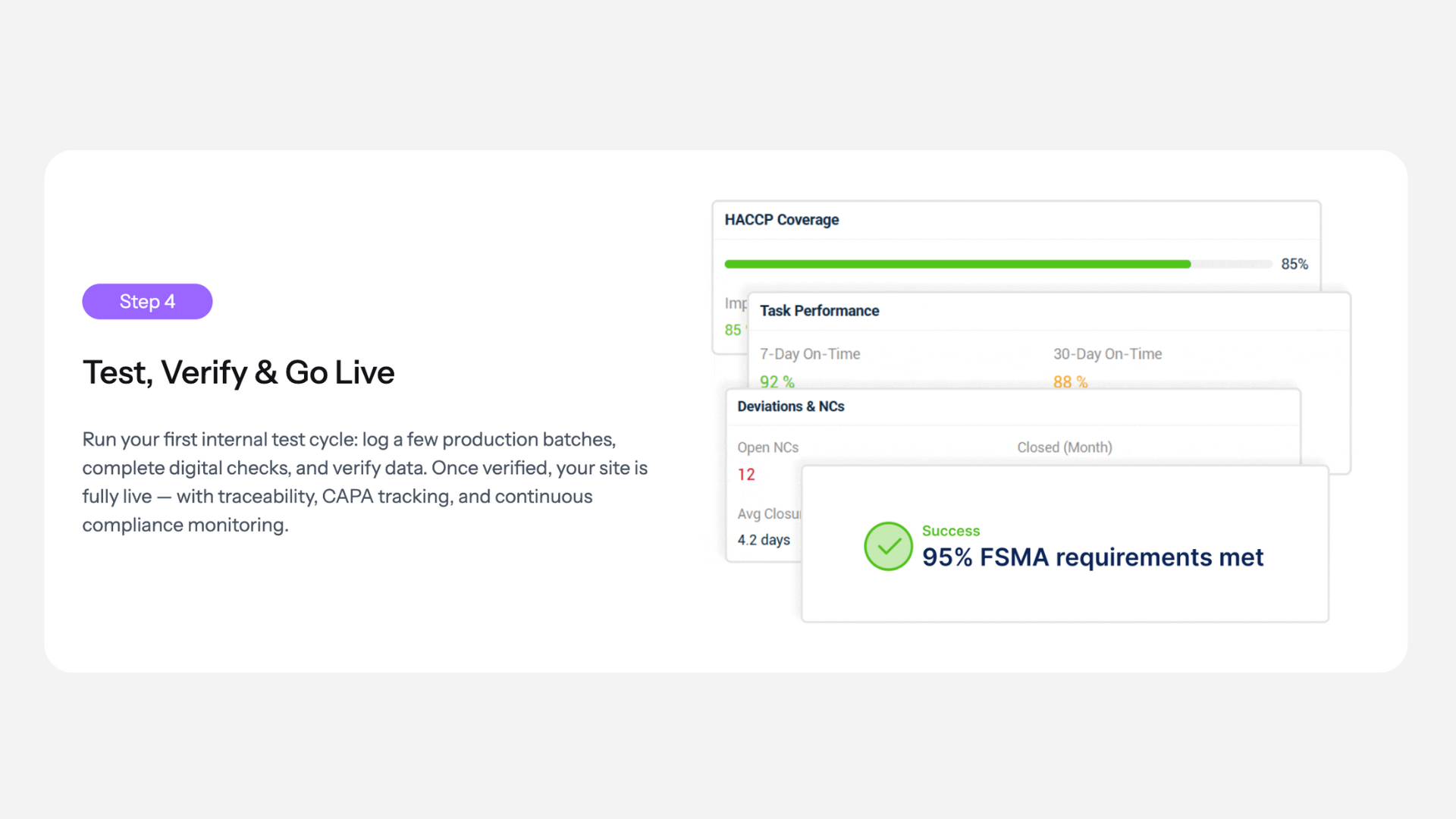
Audit readiness becomes a property of the system rather than the result of preparation effort. External audits shift from discovery exercises to confirmation exercises. Findings decrease not because auditors are less strict, but because the system leaves fewer weaknesses exposed.
This is the practical impact of applying AI to food safety audit software. It does not eliminate audits. It eliminates the conditions that make audits unpredictable.
Ready to try? Feel free to book a demo with us and see how IONI may help you.
How AI Reduces Audit Findings in Food Manufacturing
If you want to explain AI value credibly, focus on findings, because findings are the most visible and costly audit outcome. Below are the most common patterns behind major findings and how AI reduces them.
Pattern 1: recurring deviations without systemic correction
Auditors interpret recurrence as a failure of preventive control.AI reduces recurrence by flagging repetition early, clustering similar deviations, and prompting deeper root cause review.
This is where AI is meaningfully different from food audit software that only stores deviations.
Pattern 2: CAPAs closed without evidence
A CAPA closure date does not prove effectiveness. Auditors often sample attachments, verification results, and validation logic.
AI driven workflows can enforce evidence requirements at closure, preventing “empty CAPA closures” that become instant findings.
Pattern 3: weak trend analysis
Many sites have trend data but do not operationalize it. Auditors increasingly expect management review to include trend analysis and action.
AI surfaces trends automatically and can generate structured management review inputs.
Pattern 4: SOP drift
SOP drift happens when operations change but documentation does not.
AI can detect mismatches between recorded execution and documented expectation, flagging drift before it becomes an audit issue.
Pattern 5: missing training linkage after document updates
Auditors commonly look for training records when SOPs are updated.
AI systems can automatically trigger training requirements when controlled documents change, reducing this class of finding.
Pattern 6: poor traceability retrieval
Traceability gaps create audit escalations and can also create recall escalation.
AI driven traceability evidence assembly reduces retrieval time and improves consistency.
Why this matters in 2026 and later
Food safety events in early 2026 remained visible. Regulatory actions and recall responses reinforced how quickly risk becomes public.
For example, FDA communications about outbreak response and product specific risks highlight the real world consequences of weak controls. Public reporting on formula related toxin threshold changes also highlights how scientific updates can trigger new recall actions, affecting audit scrutiny across categories.
In this environment, audit readiness is not optional. It is the foundation of brand defensibility.
The Role of AI in the Future of Food Audit Software
The future of food audit software is not more digital forms. It is continuous system evaluation. Over the next several years, audit readiness will be shaped by how well food manufacturers can demonstrate that their controls remain effective as conditions change. This shift is not driven by technology enthusiasm, but by audit reality. Auditors are spending less time checking whether records exist and more time assessing whether systems behave predictably under pressure.
As food safety programs grow in complexity, periodic review models are reaching their limits. Weekly or monthly internal reviews cannot keep pace with operational variability, supplier disruption, regulatory updates, and production scale.
Continuous evaluation closes that gap by treating compliance data as a live signal rather than a historical archive. When systems evaluate themselves in near real time, weaknesses surface early, long before they become audit findings.
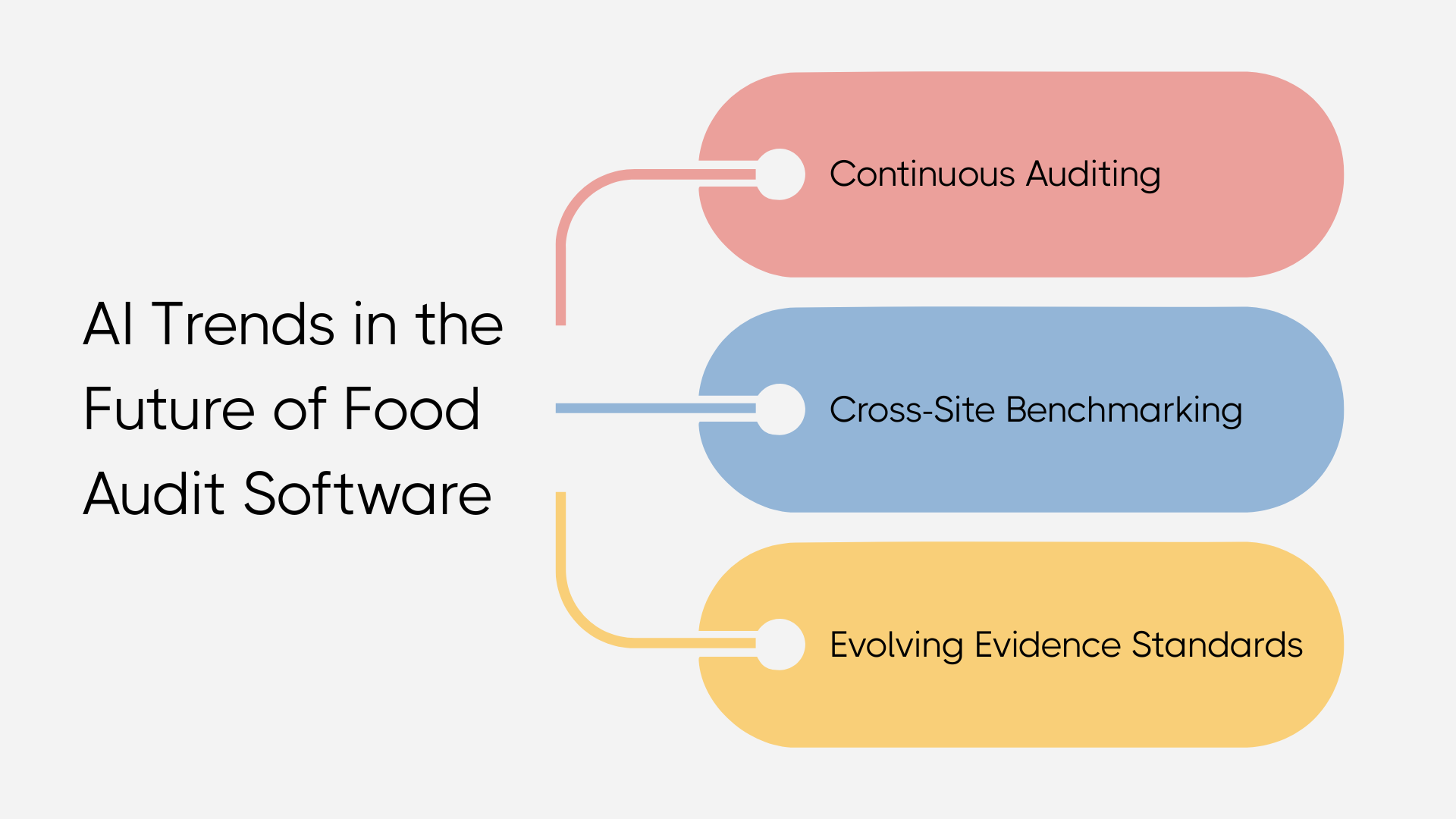
Trend 1: continuous internal auditing
Internal audits will shift from scheduled inspections to continuous assessment driven by control health indicators.
AI will identify which processes need review based on deviation patterns, verification gaps, and data integrity signals.
This reduces internal audit workload while increasing effectiveness.
Trend 2: audit benchmarking across sites
Multi site organizations will benchmark audit readiness across facilities using standardized risk indicators.
This aligns with broader industry interest in benchmarking and audit innovation discussed in GFSI adjacent conversations.
Trend 3: scheme evolution and tighter evidence expectations
Standards evolve. Audit evidence expectations evolve with them.
The fact that BRCGS initiated a public consultation on Issue 9 revisions in early 2026 is one example of ongoing tightening cycles.
AI reduces the operational shock of these evolutions by helping facilities keep procedures aligned and evidence structured as requirements change.
Conclusion
Food safety audits are no longer moments of inspection. They are moments of truth.
An audit now exposes how a food safety system behaves over time, not how well a team prepared for a visit. The difference between passing and failing increasingly depends on whether controls remain aligned with real operations, whether corrective actions actually change outcomes, and whether evidence reflects living processes rather than static documentation.
This is why food audit software is being redefined. Systems built to store records cannot meet expectations shaped by continuous risk, rapid regulatory change, and heightened public visibility of food safety failures. The industry is moving toward platforms that evaluate control health continuously and surface weakness before it becomes visible to an auditor.
AI does not replace food safety expertise. It extends it. It captures institutional knowledge, enforces consistency, and detects patterns that are difficult to see manually. When applied correctly, it shifts audit readiness from a recurring burden into an operational baseline. Audits become confirmations of system maturity rather than tests of endurance.
Manufacturers that adopt this approach will experience a subtle but important change. Audit preparation will consume less time, findings will become more predictable, and conversations with auditors will move away from defending gaps toward demonstrating control. Those that do not will find that digital forms and checklists, no matter how polished, no longer provide protection.
The future of food safety auditing belongs to systems that can explain themselves, prove their effectiveness, and adapt as conditions change. In that future, audit readiness is not achieved. It is sustained.